
Please Choose Your Language
Views: 253 Author: Xinxinke Extrusion Publish Time: 2026-10-24 Origin: Site


Content Menu
● How Direct and Indirect Copper Extrusion Presses Work
>> Direct Extrusion: The Billet Moves Through the Container
>> Indirect Extrusion: The Billet Remains Stationary Relative to the Container
● Direct vs. Indirect Extrusion Press: Comparison at a Glance
● Electrical Copper Quality: What the Press Can—and Cannot—Improve
>> Conductivity Depends on Material Selection
>> Finished Properties Must Match the Application
● Comparing Dimensional Accuracy and Surface Quality
>> Why Indirect Extrusion Can Improve Consistency
>> Why Billet Preparation Becomes More Important
● Profile Geometry, Tooling, and Equipment Limitations
>> Check the Profile Envelope Before Comparing Tonnage
>> Hollow Conductors Require a Separate Tooling Assessment
● Production Efficiency: Measure the Complete Cycle
>> Lower Extrusion Load Is Not the Same as Higher Output
>> Avoid Universal Energy-Saving Claims
● A Practical Cost Model for Copper Profile Production
● Illustrative Selection Scenarios for Electrical Copper Profiles
>> Scenario 1: A Manufacturer with a Broad Product Mix
>> Scenario 2: A Repeated Precision Profile
● Five Steps to Validate a Copper Extrusion Press Proposal
>> 1. Define the Finished Product
>> 2. Agree on Comparable Trial Conditions
>> 3. Record Process and Quality Data Together
>> 4. Measure Repeated Production
>> 5. Establish Acceptance Criteria Before Ordering
>> Is indirect extrusion always better for electrical copper profiles?
>> Does indirect extrusion increase copper conductivity?
>> Can direct extrusion produce precision copper conductors?
>> Which process needs cleaner billets?
>> Can either method produce hollow copper profiles?
Choosing a direct vs. indirect extrusion press for electrical copper profiles comes down to a practical trade-off: production flexibility versus process consistency. Direct extrusion generally offers a more straightforward route for varied profile sizes and product mixes. Indirect extrusion reduces billet-to-container sliding friction, which can support more consistent dimensions and metallurgical structure along the extruded length. Neither method is automatically the better investment.
At Xinxinke Co., Ltd., our perspective starts with the finished conductor rather than the machine specification. Drawing on more than 30 years in copper and aluminum extrusion equipment manufacturing, we focus on matching equipment and customized solutions to the customer's production requirements.
The decisive question is repeatability: which complete production route can repeatedly deliver your required geometry, material properties, and saleable output at an acceptable cost?

In direct extrusion, a ram pushes the heated billet through a stationary die. The metal exits in the same direction as the ram movement.
As the billet travels through the container, sliding friction adds to the required extrusion force. The contact length changes during the stroke, contributing to changes in load and deformation conditions. Direct extrusion nevertheless offers a relatively straightforward arrangement and considerable flexibility for profile manufacturing.
For electrical copper profiles, evaluate this method when the product portfolio includes different conductor sizes, larger sections, or frequent tooling changes. Heavy-metal press manufacturers offer direct systems specifically configured for application requirements, including integrated handling and finishing equipment.
In indirect extrusion, the die and billet move relative to each other while the billet remains stationary relative to the container. Depending on the machine arrangement, the die advances into the billet or the billet and container advance toward the die.
The defining feature is the absence of billet-to-container sliding. In conventional indirect arrangements, the extruded material passes through a hollow supporting stem. This reduces an important source of friction but introduces restrictions related to the support and available profile passage.
"Friction-free extrusion" is therefore misleading. Indirect extrusion removes a particular friction component; it does not eliminate die friction or the work required to deform copper.
The following comparison describes process tendencies, not guaranteed results for every copper profile.
| Selection factor | Direct extrusion press | Indirect extrusion press |
|---|---|---|
| Billet-container relationship | Billet slides within the container | No relative billet-container sliding |
| Extrusion load | Includes additional container-wall friction | Reduced load contribution from container friction |
| Conditions along the stroke | Greater potential variation | More consistent deformation conditions |
| Profile envelope | Generally greater layout flexibility | Restricted by stem and support geometry |
| Billet surface preparation | Important to product quality | Particularly important because surface defects can transfer |
| Dimensional consistency | Depends strongly on tooling and process control | Potential advantage along the extruded length |
| Best selection basis | Product range and complete production economics | Consistency benefits verified against added constraints |
An indirect extrusion press does not automatically produce higher-conductivity copper.
Copper grade, composition, condition, and subsequent processing must be specified independently of the extrusion method. The Copper Development Association lists C10100 oxygen-free electronic copper with a minimum copper content of 99.99% and a minimum annealed electrical conductivity of 101% IACS. IACS means International Annealed Copper Standard, the reference used to express conductivity.
This distinction matters when comparing proposals. A statement such as "better electrical performance" should identify the measurable improvement:
- Conductivity of the finished material.
- Consistency of conductor cross-section.
- Suitability of contact surfaces.
- Compliance with specified mechanical properties.
The press proposal should support the material specification, not replace it.
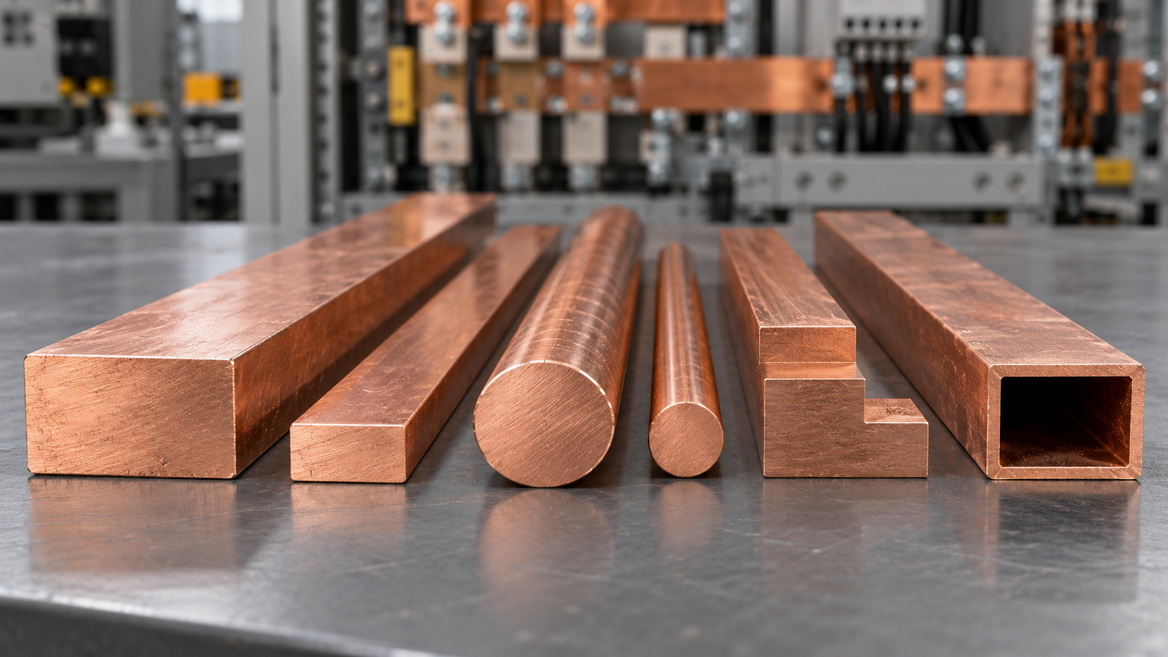
Electrical conductors are not all purchased in the same condition. The C10100 alloy database lists different mechanical properties for hot-extruded, hard, and controlled-grain-size shapes. It also identifies bus bars, bus conductors, and hollow conductors among relevant applications.
Consequently, define the required final condition before choosing equipment. A hot-extruded profile may be an intermediate product rather than a finished conductor.
Our recommended purchasing sequence is to establish the drawing, material specification, final condition, and inspection requirements first. Then assess the extrusion and finishing route needed to achieve them.
Indirect extrusion reduces variation associated with billet-container friction. More consistent deformation conditions can support more uniform dimensions, grain structure, and mechanical properties along the extrusion. These are established process advantages, although published aluminum experience should not be treated as a numerical guarantee for copper.
For an electrical copper profile, the useful question is not simply whether indirect extrusion is "more accurate." Ask:
> Can the proposed line maintain every critical dimension throughout the accepted product length, across repeated billets?
Request measurements from the front, middle, and rear of trial extrusions. An average dimension can conceal unacceptable variation.
Indirect extrusion is more sensitive to billet surface condition because surface defects and contamination can affect the extrusion. Removing the as-cast surface layer and maintaining clean billets are therefore important considerations.
This creates a commercial trade-off. Improved consistency may require additional billet preparation, handling, and inspection.
Do not compare an indirect press using carefully prepared billets with a direct press using a different billet condition and attribute the entire result to machine architecture.
A profile must fit through the available tooling and support arrangement. With indirect extrusion, the hollow stem and die support constrain the usable profile envelope. A sufficiently powerful press may still be unsuitable for a wide or unusually shaped conductor.
For each proposed electrical copper profile, request a feasibility review covering:
1. Overall width and height.
2. Cross-sectional area.
3. Minimum section thickness.
4. Solid or hollow construction.
5. Required extrusion length.
6. Die support and product passage.
This drawing-level review should precede a detailed price comparison.
Hollow copper products introduce additional tooling and alignment requirements. Heavy-metal tube extrusion systems can incorporate piercing devices and guided components to control eccentricity. Such arrangements are application-specific rather than an automatic feature of either extrusion method.
For hollow electrical conductors, ask the supplier to explain how the proposed tooling creates and controls the internal geometry. Do not assume that experience with solid copper bars proves suitability for a hollow profile.
Reducing billet-container friction can reduce the extrusion load and improve thermal consistency. However, that does not establish the production rate of an entire line. Indirect extrusion still has tooling, billet preparation, and profile-envelope constraints.
For procurement purposes, we recommend measuring:
- Accepted kilograms per operating hour.
- Billet preparation time.
- Billet loading and handling time.
- Extrusion and non-extrusion cycle time.
- Tool-change duration.
- Finishing capacity and rejection rate.
A press that extrudes faster can still deliver less accepted product if another stage becomes the bottleneck.
Do not convert lower extrusion force directly into a promised percentage reduction in electricity consumption.
Request metered trial results with a clearly defined measurement boundary. State whether the comparison includes billet heating, hydraulic operation, auxiliary equipment, and finishing.
For a fair evaluation, use comparable copper grades, billet conditions, profile drawings, and acceptance criteria. Otherwise, the reported energy difference may reflect unequal production conditions rather than the extrusion method alone.
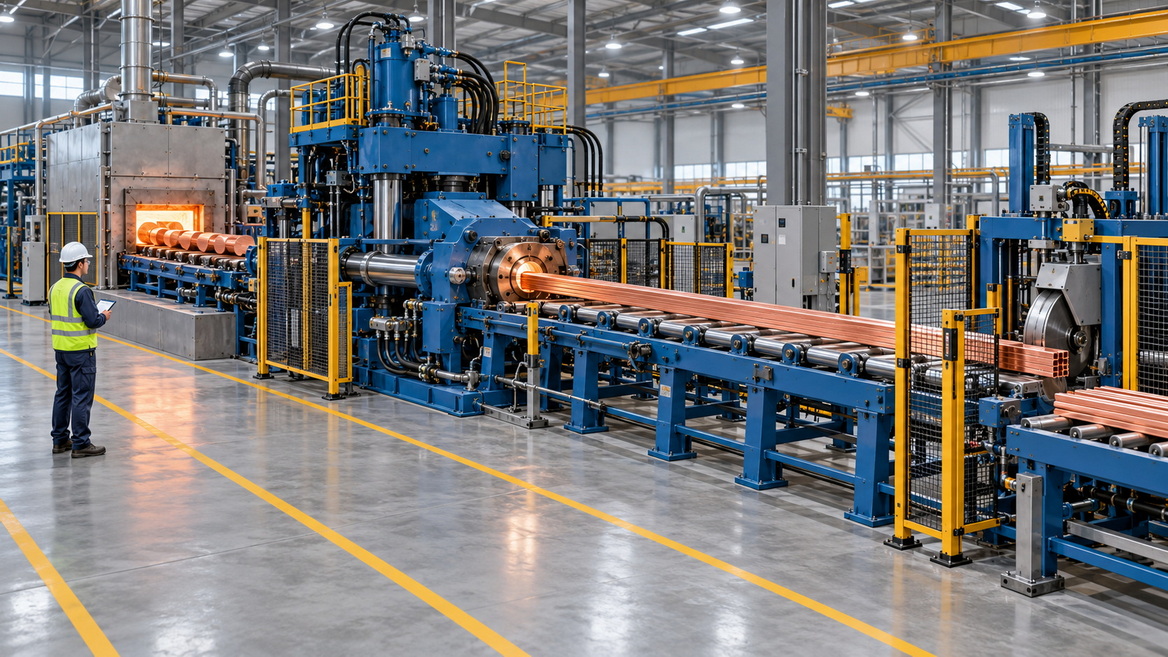
Purchase price is only one part of the investment decision. Our recommended comparison is conversion cost per accepted kilogram, calculated using the same accounting rules for both proposals.
Include:
- Annualized equipment cost.
- Labor and maintenance.
- Tooling and replacement parts.
- Energy.
- Billet preparation.
- Finishing and inspection.
- Net metal losses after scrap recovery credits.
Keep copper purchasing cost separate when comparing conversion performance, or apply the same metal-pricing assumptions to both options.
Also distinguish material yield from first-pass acceptance. Recoverable copper scrap has value, but collecting, processing, and replacing rejected production still consumes resources.
A useful supplier proposal should make these assumptions visible. It should not hide them behind an attractive nominal production rate.
The following are decision examples, not reported Xinxinke customer projects.
Consider a manufacturer producing several solid conductor profiles with frequent changes in size and order quantity.
A direct extrusion press deserves early consideration because direct extrusion generally provides greater manufacturing flexibility and avoids the conventional indirect stem-passage restriction.
The purchasing assessment should prioritize changeover time, tooling access, handling arrangements, and demonstrated production across representative drawings.
Now consider a manufacturer producing a stable profile family in repeated batches, where lengthwise dimensional variation causes downstream difficulty.
Indirect extrusion deserves a detailed trial because its more consistent deformation conditions may address that variation. However, the profile must fit the support arrangement, and billet preparation must be included in the cost comparison.
The investment case becomes convincing only when those process advantages translate into measured acceptance, reduced finishing, or improved usable output.
Provide the drawing, copper grade, final condition, annual volume, and required delivery lengths.
Identify critical dimensions separately from general dimensions. Explain which surfaces serve as electrical contacts or assembly interfaces.
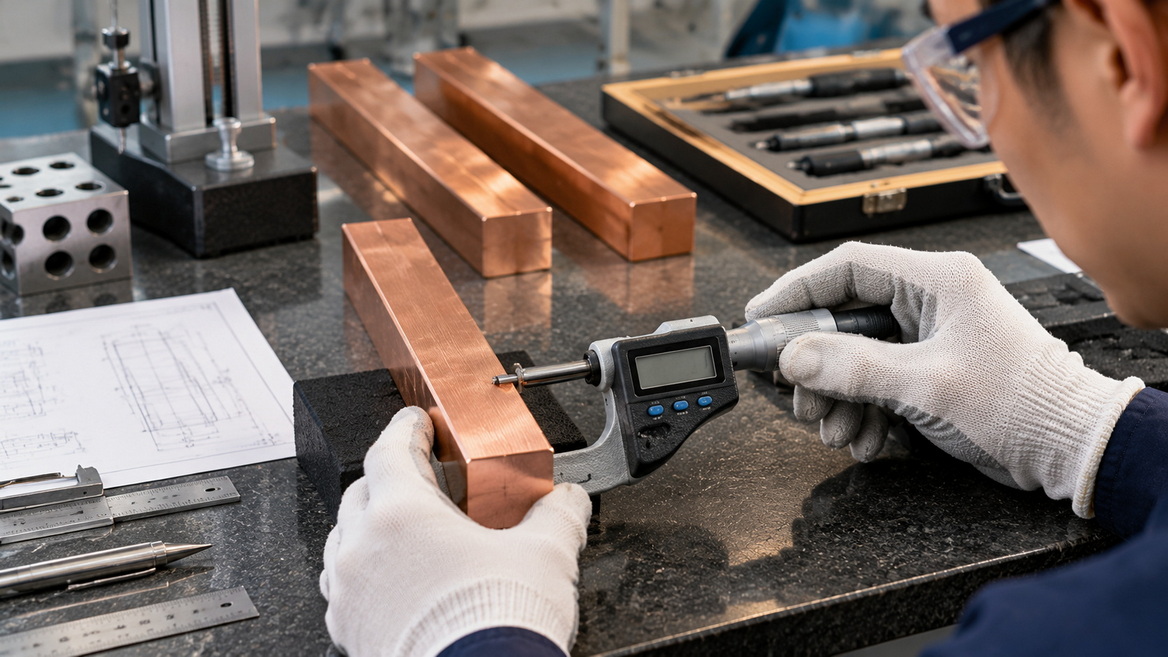
Document billet source, dimensions, surface preparation, and thermal condition. Record any differences between the two proposed routes.
Fair comparison does not require identical settings. It requires transparent settings appropriate to each process.
Request load, speed, and temperature records alongside dimensional inspection.
Where required by the purchase specification, include conductivity and mechanical-property results. Keep every result traceable to its billet and processing history.
Do not approve equipment from one attractive sample.
Agree on a trial sequence that includes repeated billets and relevant product changes. Inspect accepted lengths rather than only conveniently selected sections.
Write the acceptance conditions into the commercial agreement. Specify the product, test conditions, output basis, inspection method, and responsibility for supplied tooling.
This converts a general performance promise into a practical verification plan.
No. It offers potential consistency advantages, but conventional indirect equipment has profile-envelope and billet-preparation constraints. Direct extrusion may better suit a varied product portfolio.
Not inherently. The required conductivity must be tied to the copper grade and material condition. For example, C10100 has a published minimum annealed conductivity of 101% IACS, independent of a claim that one press architecture improves conductivity.
Direct extrusion is not excluded from precision production. Its suitability must be demonstrated against the specified dimensions and final condition. Indirect extrusion's consistency advantage does not establish that direct extrusion will fail a particular drawing.
Both require controlled material preparation. Indirect extrusion deserves particular attention because billet surface defects can transfer to the product; removal of the as-cast surface layer may be necessary.
Hollow-product feasibility depends on the complete tooling and press arrangement. Copper tube extrusion equipment can use dedicated piercing and guidance systems, so buyers should request an application-specific assessment.


