
Please Choose Your Language
Views: 269 Author: Xinxinke Extrusion Publish Time: 2026-10-22 Origin: Site


Content Menu
● Aluminum Extrusion Disadvantages at a Glance
● 1. Custom Tooling Costs Can Weaken Small-Order Economics
>> Evaluate Tooling Against Expected Demand
● 2. Aluminum Extrusion Cannot Produce Every Geometry Directly
● 3. Thin Walls and Deep Features Make Production Harder
>> Why Minimum Weight Is Not Always Minimum Cost
● 4. Dimensional Tolerances Need Early Agreement
>> Specify Functional Dimensions Instead of Tightening Everything
● 5. Surface Imperfections Can Affect Decorative Applications
>> Define Appearance Before Production
● 6. Alloy Selection Creates Performance Trade-Offs
● 7. Secondary Processing Can Reduce the Apparent Cost Advantage
● 8. Press Capability Limits Profile Size and Product Mix
● A Practical Framework for Comparing Finished-Part Costs
● Five Steps to Reduce Aluminum Extrusion Risks
● Discuss Your Extrusion Requirements With Xinxinke
>> Is aluminum extrusion unsuitable for small production runs?
>> Can aluminum extrusion achieve tight tolerances?
>> Why do aluminum extrusions show visible lines?
>> Are hollow aluminum extrusions always a poor choice?
>> Can one alloy suit every extrusion application?
The main disadvantages of aluminum extrusion include custom tooling costs, cross-sectional design restrictions, dimensional variation, surface imperfections, and the need for secondary processing. Alloy selection also creates trade-offs between strength, extrudability, and finish quality. However, these limitations do not make extrusion a poor manufacturing choice. They make early design review and process planning essential.
At Xinxinke Co., Ltd., we approach this subject from an equipment manufacturer's perspective. With more than 30 years of industry experience manufacturing copper and aluminum profile extrusion equipment, our focus is helping customers match machinery and customized solutions to their production requirements.
The useful question is not simply, "What can go wrong?" It is, "Which limitations can we control, and which require a different design or manufacturing process?"

Before selecting equipment or approving a profile drawing, distinguish inherent process limitations from problems that better engineering can reduce.
| Disadvantage | Practical consequence | Planning response |
|---|---|---|
| Custom tooling and setup | Higher initial cost for small orders | Compare total project cost, not material price alone |
| Essentially constant cross-section | Local features need additional operations | Plan drilling, milling, joining, or alternative processes |
| Difficult profile geometry | Slower production or greater tooling demands | Review walls, cavities, symmetry, and narrow features |
| Dimensional variation | Potential assembly and fit problems | Identify critical dimensions before ordering tooling |
| Surface appearance limitations | Additional finishing or rejection risk | Agree on visible surfaces and acceptance criteria |
| Alloy-related compromises | Strength, finish, and productivity may conflict | Select the alloy around the complete application |
| Downstream processing | More handling, equipment, and production stages | Evaluate the finished component rather than the raw profile |
These limitations are interconnected: a complex shape can make tooling more demanding, restrict production speed, and increase the difficulty of meeting dimensional requirements.
A custom aluminum extrusion requires tooling for the intended cross-section. That creates an upfront commitment before the customer receives usable production material.
The commercial burden becomes more noticeable when:
- Order quantities are small.
- Several profile variants require separate dies.
- The design changes after tooling approval.
- Difficult geometry requires additional development.
However, describing aluminum extrusion tooling as universally expensive would be misleading. The Aluminum Extruders Council notes that extrusion tooling generally costs considerably less than stamping dies. Custom extrusions can also eliminate machining or assembly work that a standard profile would require.
From our manufacturing perspective, the better comparison is total finished-part cost. A lower tooling quotation does not necessarily produce the lowest-cost component.
Before approving a custom profile, ask whether the design is stable, whether a standard section could work, and whether integrated features would eliminate downstream operations.
Custom tooling becomes easier to justify when the profile replaces several parts or avoids repeated machining. Conversely, machining an available standard section may deserve consideration for a small, uncertain requirement.
Extrusion pushes heated aluminum through a shaped die opening to produce a continuous profile. Its defining advantage—repeating a cross-section along the length—is also a limitation.
A profile can contain channels, ribs, grooves, or hollow spaces within that cross-section. However, features that vary along its length generally need additional manufacturing operations.
Examples include:
- Local mounting holes.
- Isolated pockets.
- Threaded connections.
- Cutouts near one end.
- Changes in section along the component.
Machining, cutting, bending, welding, and assembly can extend what an extrusion becomes, but those steps add to the manufacturing route. The practical limitation is therefore not "extrusion cannot make complex parts." It is that extrusion alone cannot complete every complex part.
One of the most important aluminum extrusion design limitations is the relationship between profile geometry and manufacturability.
Deep, narrow features, unbalanced walls, and excessive asymmetry can make a section more challenging to extrude. The Aluminum Extruders Council recommends balanced wall thicknesses, smoother transitions, and careful treatment of narrow die features.
A drawing may look economical because it uses less aluminum. Yet aggressive material removal can create a profile that demands slower production or more difficult tooling.
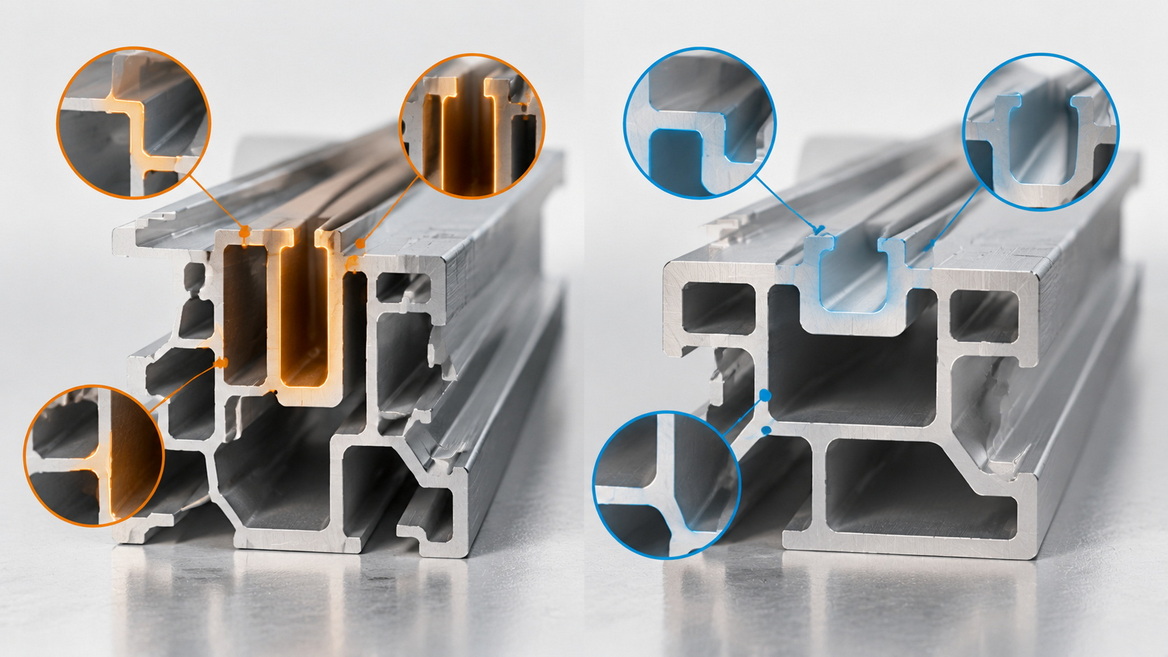
Consider a hypothetical profile redesign with thinner walls and a deeper channel. It might reduce material consumption, but it could also increase die demands and reduce practical extrusion speed.
Industry guidance specifically connects difficult semi-hollow features with slower extrusion or greater die-breakage risk in some circumstances. The correct design balances material use with reliable production, rather than minimizing section weight in isolation.
There is no universal minimum wall thickness suitable for every alloy, profile size, and press. Treat a supplier's minimum capability as application-specific, not as a general design rule.
Aluminum extrusions can achieve precise dimensions. Nevertheless, "extruded" does not mean "automatically suitable for every precision assembly."
A component may need control over:
- Wall thickness.
- Overall width and height.
- Straightness.
- Twist.
- Angular relationships.
- The location of mating features.
The Aluminum Extruders Council distinguishes industry-standard tolerances from precision tolerances and notes that tighter requirements should be discussed directly with the extruder.
Our preferred review question is: "Which dimensions actually determine whether this component works?"
A sliding interface may need close control, while a concealed, non-mating surface may not. Applying equally demanding requirements everywhere can create unnecessary production difficulty.
For complicated components, geometric dimensioning and tolerancing can communicate functional requirements more clearly than a collection of isolated dimensions. Where the required capability exceeds the agreed extrusion tolerance, include a suitable secondary operation in the manufacturing plan.
Extruded aluminum does not automatically emerge with a flawless decorative appearance.
Hydro identifies die condition, profile design, production conditions, and alloy selection as factors influencing surface quality. Its design manual also explains that process-related extrusion lines contribute to the characteristic appearance of extruded profiles.
This matters when customers expect visible architectural, furniture, lighting, or consumer-product surfaces.
A profile can satisfy its dimensional requirements while still failing a customer's visual expectations. That disconnect often begins with an incomplete specification.
A practical surface specification should identify:
1. Which surfaces remain visible after assembly.
2. The intended finish.
3. The agreed inspection conditions.
4. Acceptable reference samples.
5. Handling and packaging expectations.
Alloy selection also matters. Hydro notes that different alloys do not respond equally well to anodizing, so finish requirements belong in the initial material discussion—not only in a later purchasing instruction.
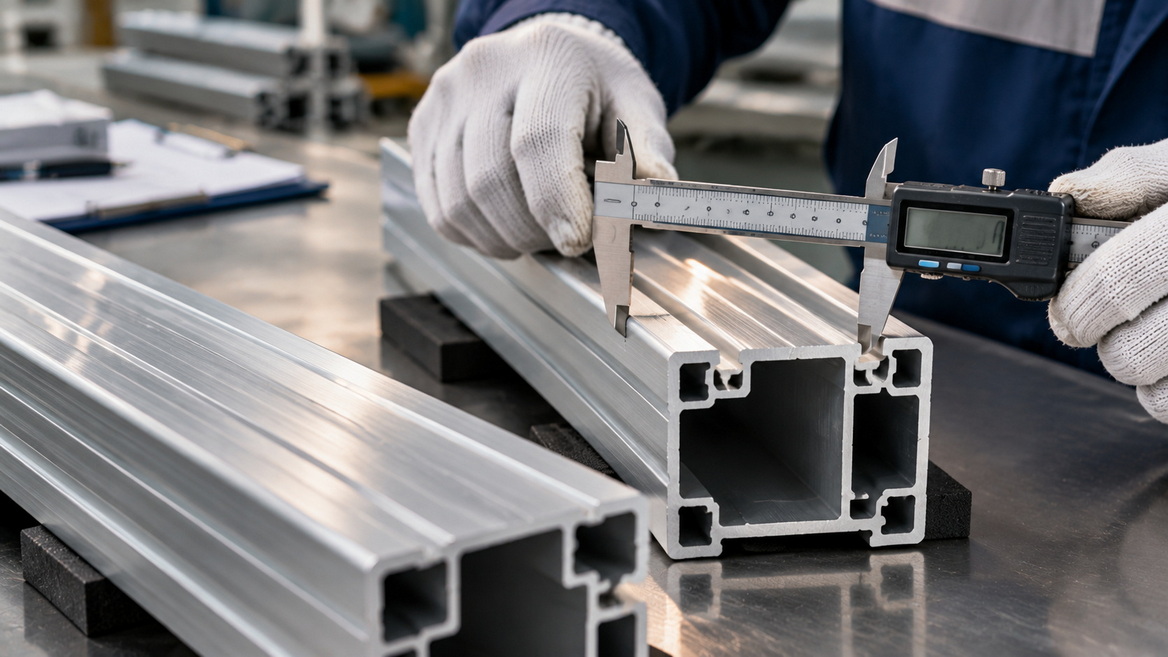
There is no single best aluminum extrusion alloy for every application.
Selection must consider the properties needed in service alongside the requirements of manufacturing and finishing. Hydro's alloy guidance emphasizes that anodizing response, machinability, and weldability can influence the appropriate choice.
For buyers, this creates a common problem: choosing an alloy around one attractive property while overlooking the rest of the production route.
Before specifying the material, ask:
- Will the profile be anodized?
- Will it need extensive machining?
- Will the component be welded?
- Which properties must the finished assembly demonstrate?
- Can the selected alloy and geometry meet those requirements together?
The disadvantage is not that aluminum lacks useful properties. It is that optimizing one requirement does not automatically optimize every other requirement.
A quotation for an unfinished extrusion is not the price of a ready-to-install component.
Depending on the application, the profile may still need cutting, drilling, milling, bending, welding, assembly, or finishing. Hydro describes these operations as normal extensions of extrusion manufacturing.
Each additional stage creates another requirement for scheduling, handling, inspection, or supplier coordination.
However, secondary processing is not inherently excessive or uneconomical. A well-designed extrusion can reduce it considerably. Hydro specifically notes that intelligently designed profiles require little post-processing.
From an equipment-planning perspective, this is why the extrusion press should not be evaluated in isolation. The production concept must account for what happens before the profile reaches the customer.
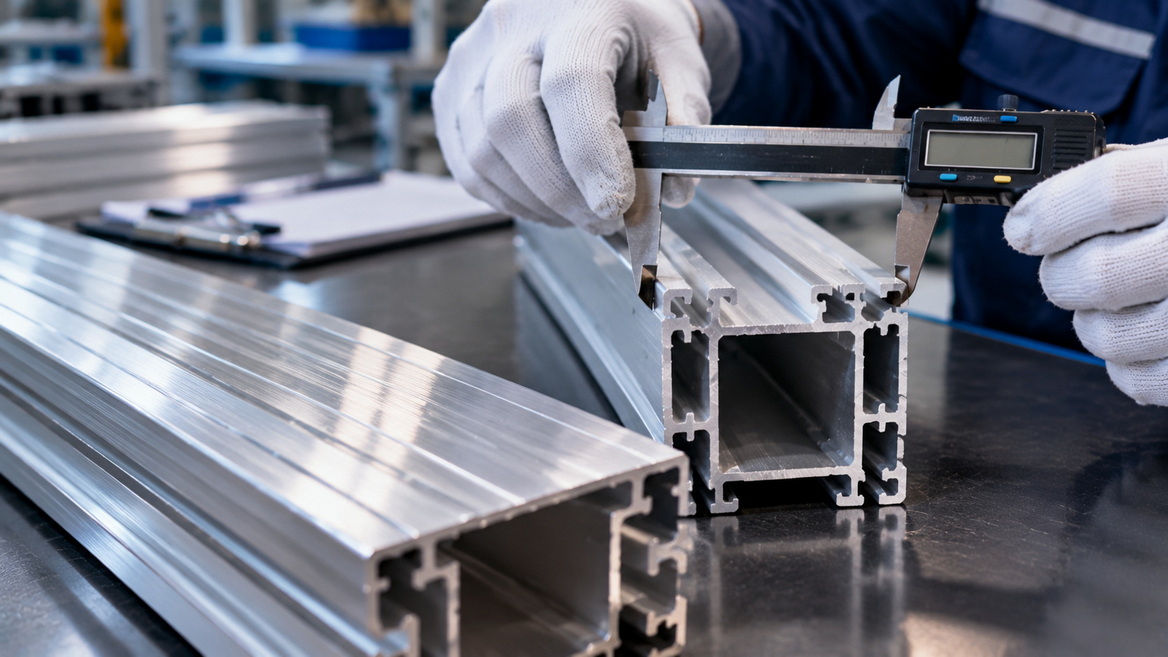
Not every extrusion line can manufacture every profile economically.
The Aluminum Extruders Council identifies profile size, weight per unit length, shape, and available press capacity as linked design considerations. A useful measure is the circumscribing circle diameter: the diameter of the smallest circle enclosing the cross-section.
This creates an important purchasing risk. A manufacturer may select equipment around one headline specification without adequately considering its intended product range.
Our equipment-selection approach is to start with representative profiles and production objectives. Buyers should provide drawings, alloy requirements, target output, dimensional expectations, and downstream requirements before discussing a proposed solution.
A larger machine is not automatically the best investment; the relevant question is whether the proposed production system fits the actual product portfolio.
Include the following categories in the comparison:
| Cost category | Questions to ask |
|---|---|
| Tooling and development | What is included, and what triggers additional charges? |
| Extrusion production | Which alloy, geometry, and quantity assumptions support the quotation? |
| Secondary operations | What remains before the component is usable? |
| Finishing | Which appearance requirements are included? |
| Inspection | How will critical dimensions and appearance be accepted? |
| Packaging and delivery | What protection and handling does the finished part need? |
This approach prevents a low initial quotation from hiding a more expensive finished-component route.
The following checklist translates the design, tolerance, alloy, and finishing considerations above into a practical purchasing sequence.
1. Define the application. Document assembly interfaces, appearance expectations, and functional requirements.
2. Review the cross-section. Identify difficult walls, cavities, transitions, and narrow features.
3. Separate critical requirements. Distinguish essential tolerances from preferences.
4. Map the complete production route. Include fabrication, finishing, inspection, and packaging.
5. Agree on acceptance before scaling. Establish how samples and subsequent production will be evaluated.
No equipment purchase can compensate for an undefined product specification. Conversely, a clear specification gives the machinery supplier and manufacturer a stronger basis for selecting an appropriate solution.
Planning a new production line or reviewing an existing extrusion operation?
Share your profile drawings, target alloys, output requirements, and quality expectations with Xinxinke Co., Ltd. Our team can discuss high-performance extrusion equipment and customized solutions around your intended products.
With more than 30 years of industry experience, we focus the conversation on matching equipment to production needs—not simply comparing machine specifications.
Not necessarily. Custom tooling adds upfront cost, but extrusion tooling is relatively economical compared with several other manufacturing processes. Compare a custom profile with standard-section machining and other realistic alternatives.
Yes. Extrusions can meet industry-standard and precision tolerances. The achievable requirement should be agreed with the extruder for the specific profile, rather than assumed from a general capability statement.
Process-related lines can form as the profile emerges from the die. Surface appearance also depends on tooling condition, profile design, alloy quality, and production conditions.
No. Hollow profiles can provide useful functionality. However, cavities and difficult semi-hollow features can increase manufacturing complexity, so they should be reviewed rather than included without considering production implications.
No single choice optimizes every requirement. Anodizing response, machining, welding, and application needs can point toward different alloy selections.
1. Aluminum Extruders Council. "Aluminum Extrusion Design Guidelines and Manual: Key Design Considerations." Guidance on profile geometry, balanced walls, circumscribing circle diameter, and press-related constraints. [aec]
2. Aluminum Extruders Council. "FAQs." Industry explanations covering custom tooling economics, semi-hollow features, extrusion speed, and manufacturing challenges. [aec]
3. Aluminum Extruders Council. "Aluminum Extrusion Tolerances." Guidance on standard and precision tolerances, dimensional specifications, and geometric dimensioning. [aec]
4. Aluminum Extruders Council. "Aluminum Extrusion Dies: 7 Decisions That Increase Your Die Tooling Costs." Discussion of complexity, tolerances, alloy selection, and tooling cost. [aec]
5. Hydro. "Aluminum Extrusion Process." Explanation of extrusion, aging, finishing, fabrication, and delivery stages. [hydro]
6. Hydro. "Alloys for Extruded Aluminum Profiles." Material-selection guidance covering anodizing, machining, and welding considerations. [hydro]
7. Hydro Aluminium Design Manual. "Chapter 13." Technical discussion of surface quality, extrusion appearance, and relevant production factors. [hydroaluminiumdesign]
8. Hydro. "Machining and Fabrication." Guidance on profile design and downstream manufacturing operations. [hydro]
9. Xinxinke Co., Ltd. Company background supplied for this article. Source for the company's stated experience, equipment specialization, and customized-solution positioning; not independently verified.


