
Please Choose Your Language
Views: 239 Author: Xinxinke Extrusion Publish Time: 2026-09-13 Origin: Site


Content Menu
● What Is a Direct Extrusion Press?
>> How Direct Aluminum Extrusion Works
● What Is an Indirect Extrusion Press?
>> How Indirect Aluminum Extrusion Works
● Direct vs. Indirect Extrusion Press: Key Differences
● Why Thin-Wall Aluminum Profiles Are More Difficult to Extrude
● How Friction Affects Thin-Wall Profile Quality
● Direct Extrusion Press Advantages
>> Strong Production Flexibility
>> Suitable for Larger and Complex Profiles
>> Proven for High-Volume Manufacturing
● Indirect Extrusion Press Advantages
>> Lower Billet-Container Friction
>> More Uniform Extrusion Conditions
>> Potentially Better Surface Appearance
>> Suitable for Precision Applications
● Limitations of Direct and Indirect Extrusion
>> Direct Extrusion Press Limitations
>> Indirect Extrusion Press Limitations
● The Role of Die Design in Thin-Wall Extrusion
>> Important Die Design Factors
>>> Wall Thickness Transitions
>>> Tongue Strength
>>> Hollow Profile Weld Quality
● A Practical Selection Process for Thin-Wall Aluminum Extrusion Presses
>> Step 1: Review the Profile Drawing
>> Step 2: Confirm the Alloy Grade
>> Step 3: Define Quality Requirements
>> Step 4: Evaluate Production Volume
>> Step 5: Review Downstream Equipment
● Direct Extrusion vs. Indirect Extrusion: Application Guide
● Practical Example: Thin-Wall LED Lighting Profile
● Why a Complete Extrusion System Matters
>> What is the main difference between direct and indirect extrusion?
>> Is indirect extrusion better for thin-wall aluminum profiles?
>> Can direct extrusion produce high-precision thin-wall aluminum profiles?
>> Why do thin-wall aluminum profiles twist after extrusion?
>> Which aluminum alloy is commonly used for thin-wall extrusion?
>> Does indirect extrusion require less extrusion force?
>> What information is needed to select an extrusion press?
Thin-wall aluminum profiles demand more than sufficient press tonnage. They require stable metal flow, precise temperature control, accurate die design, and reliable downstream handling. When profile walls become thinner, narrow fins become longer, or hollow chambers become more complex, even small process variations can lead to twist, inconsistent wall thickness, surface defects, or unnecessary scrap.
For aluminum profile manufacturers, the choice between a direct extrusion press and an indirect extrusion press has a direct effect on production consistency, surface quality, energy demand, tooling performance, and finished-profile accuracy.
At Xinxinke Co., Ltd., our team has more than 30 years of experience in copper and aluminum extrusion equipment manufacturing. From press design and hydraulic-system configuration to customized production-line planning, we understand that there is no universal extrusion solution. The most suitable press depends on the aluminum alloy, profile geometry, wall thickness, target tolerance, output requirement, and final application.
A direct extrusion press remains a highly versatile and widely used solution for industrial aluminum production. An indirect extrusion press can offer important benefits for demanding thin-wall aluminum profiles, especially where stable dimensions, reduced friction, and controlled thermal conditions are essential.
> Key takeaway: Direct extrusion is often the practical choice for broad product ranges, large profiles, and high-volume output. Indirect extrusion can be especially valuable for thin-wall aluminum profiles that require better dimensional consistency, lower friction, and more stable metal flow.
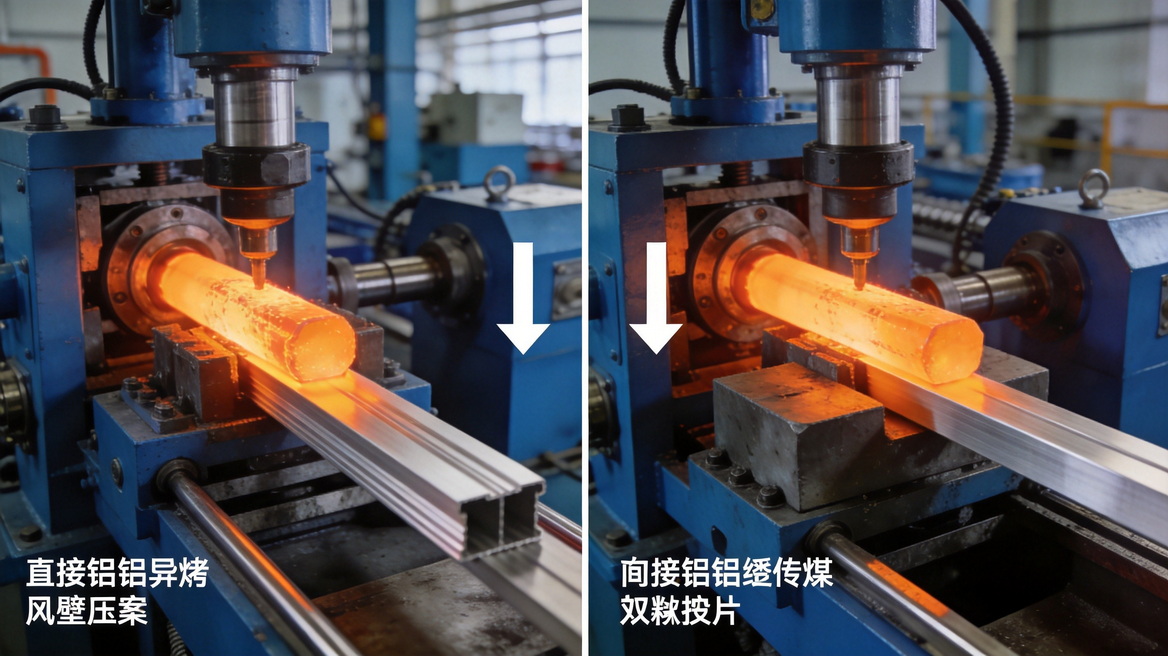
A direct extrusion press, also known as a forward extrusion press, produces aluminum profiles by pushing a heated aluminum billet through a stationary die.
The main ram moves forward and forces the billet toward the die. As the aluminum flows through the die opening, it takes on the required cross-sectional shape. The ram, billet, and extruded profile generally move in the same direction.
This process is widely used because it is flexible, efficient, and suitable for many types of aluminum profiles. It can support the production of architectural profiles, industrial frames, transportation components, solar mounting sections, heat sinks, channels, rails, tubes, bars, and customized aluminum shapes.
The direct extrusion process normally follows these steps:
1. An aluminum billet is heated to a controlled extrusion temperature.
2. The billet is loaded into the press container.
3. A hydraulic ram pushes the billet forward.
4. Aluminum is forced through the stationary extrusion die.
5. The aluminum profile exits the die.
6. The profile is cooled, pulled, stretched, cut, aged, inspected, and packed.
During direct extrusion, the billet moves along the inner wall of the container. This creates friction between the billet and the container liner.
That friction increases the force required to push the aluminum through the die. It also generates additional heat during the extrusion cycle.
For standard or thick-wall profiles, this effect can often be managed with suitable billet temperature, ram speed, die design, and cooling control. For thin-wall aluminum profiles, however, friction-related changes may have a stronger influence on profile quality.
An indirect extrusion press, also called a backward extrusion press, uses a different material-flow arrangement.
Instead of pushing the billet forward through a fixed die, the billet remains stationary relative to the container. The die is mounted on a hollow stem or hollow ram and moves toward the billet.
As pressure increases, the aluminum flows backward through the die and exits through the hollow ram assembly.
Because the billet does not slide along the container wall, the indirect extrusion process substantially reduces billet-to-container friction.
This difference is highly important for thin-wall aluminum profile production.
The indirect extrusion process normally includes the following stages:
1. A heated aluminum billet is positioned inside the container.
2. The billet remains stationary relative to the container wall.
3. A hollow ram carries the die toward the billet.
4. Pressure forces the aluminum to flow through the die.
5. The aluminum profile exits through the hollow ram.
6. The profile moves to cooling, pulling, stretching, cutting, aging, and inspection equipment.
Because billet movement against the container wall is minimized, indirect extrusion can produce a more stable pressure condition during the press cycle.
It can also reduce frictional heat and help maintain more consistent extrusion conditions from the beginning of the billet to the end.
Direct and indirect extrusion presses both shape aluminum through a die. The main difference is the way the billet, die, and ram move during the process.
This change in movement affects friction, pressure, temperature, metal flow, profile quality, press configuration, and production capability.
| Comparison Factor | Direct Extrusion Press | Indirect Extrusion Press | Importance for Thin-Wall Profiles |
|---|---|---|---|
| Billet movement | Billet moves forward inside the container | Billet remains stationary relative to the container | Reduced billet movement helps reduce friction |
| Die position | Die remains stationary | Die moves with the hollow ram | Indirect presses use a more specialized mechanical structure |
| Friction level | Higher billet-container friction | Lower billet-container friction | Lower friction supports more stable flow |
| Extrusion force | Higher force is usually required | Lower force may be required | Stable force can improve dimensional consistency |
| Temperature behavior | Friction can create additional heat | Less frictional heat is generated | Important for thin walls and delicate features |
| Dimensional control | Can change along the billet length | Often more consistent through the cycle | Important for close-tolerance sections |
| Surface quality | May require closer thermal and speed control | Can support smooth, uniform surfaces | Important for visible or anodized profiles |
| Profile size range | Suitable for a wide range of sizes | Limited by hollow stem capacity | Direct extrusion may be better for larger profiles |
| Equipment structure | Conventional and broadly applied | More specialized press design | Equipment selection depends on production goals |
| Billet preparation | Standard billet control required | High billet cleanliness is especially important | Surface contamination can affect profile appearance |
| Typical applications | Large, complex, general industrial profiles | Precision thin-wall, high-quality, stable profiles | The profile requirement should determine the process |
The central difference is friction control.
In direct extrusion, the billet slides through the container. This creates resistance and heat. The amount of friction can change as the billet becomes shorter during the extrusion cycle.
In indirect extrusion, the billet stays relatively fixed inside the container. This reduces the friction source that exists in direct extrusion and can help create more stable pressure and temperature conditions.
Thin-wall aluminum profiles are highly sensitive to metal-flow balance.
A thin-wall section may include narrow flanges, long fins, internal ribs, open channels, hollow cavities, sharp corners, snap-fit details, or uneven wall thickness. Each feature influences the way aluminum flows through the die.
If metal does not reach every area of the die at a controlled and balanced speed, profile defects may occur.
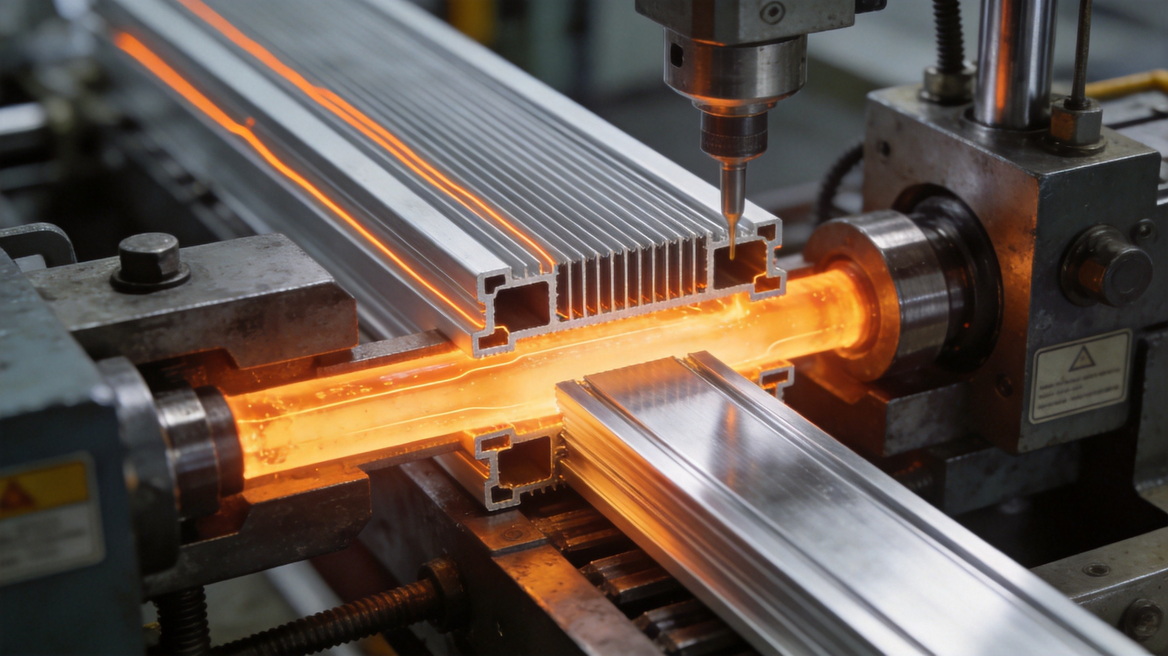
Common thin-wall extrusion problems include:
- Uneven wall thickness
- Twist or spiral deformation
- Bowing and poor straightness
- Wavy flanges
- Thin fin distortion
- Surface tearing
- Die lines
- Uneven cooling
- Dimensional variation
- Low yield during startup
- Profile cracking
- Difficult stretching performance
- Inconsistent anodizing appearance
For this reason, thin-wall aluminum extrusion is not simply about selecting a larger extrusion press.
It requires a complete manufacturing system that includes:
- High-quality aluminum billets
- Stable billet heating
- Suitable extrusion ratio
- Precision die design
- Controlled ram speed
- Accurate press alignment
- Container and liner condition
- Reliable quenching
- Puller synchronization
- Controlled stretching
- Final dimensional inspection
A high-performance extrusion press must support the entire process rather than operate as an isolated machine.
Friction has a strong effect on extrusion force, temperature, and material flow.
In a direct extrusion press, billet-container friction can change throughout the extrusion cycle. At the beginning of the cycle, a larger section of the billet contacts the container wall. As the ram moves forward and the billet becomes shorter, this contact area changes.
This means that extrusion force and heat generation may also change.
For a thin-wall profile, a change in force or temperature can affect:
- Die deflection
- Metal-flow balance
- Exit speed
- Wall thickness
- Profile straightness
- Surface finish
- Cooling behavior
- Mechanical-property consistency
A direct press can still deliver excellent thin-wall extrusion results. However, the process must be controlled carefully.
Manufacturers often use a combination of billet temperature control, ram-speed adjustment, die-bearing optimization, container maintenance, exit-temperature monitoring, and precision pulling systems to maintain stable output.
In indirect extrusion, friction between the billet and container wall is greatly reduced. This can create a more uniform pressure condition and reduce thermal variation during extrusion.
For thin-wall aluminum profiles, this may make it easier to maintain stable flow through narrow sections, thin fins, hollow cavities, and delicate die features.
A direct extrusion press continues to be the preferred solution for many aluminum profile producers because it offers strong flexibility and broad production capability.
Direct extrusion presses can produce a large variety of aluminum profile sizes and shapes.
They are suitable for:
- Architectural aluminum profiles
- Window and door sections
- Curtain wall components
- Industrial frames
- Solar mounting profiles
- Transportation components
- Machine guards
- Structural channels
- Aluminum rails
- Electrical enclosures
- Heat sinks
- Large hollow profiles
- Customized industrial extrusions
The die arrangement of a direct press can be particularly practical for larger profiles because the extruded section does not need to pass through a hollow stem.

A direct extrusion line can support a changing product portfolio.
This is useful for manufacturers that produce multiple profile designs, different alloy grades, and a wide range of cross-sectional dimensions.
For many factories, direct extrusion provides a reliable balance between equipment investment, production speed, die flexibility, and operational familiarity.
Some profiles have a large circumscribed circle, wide face, deep cavity, or complex geometry. These designs may be more suitable for direct extrusion because indirect press configurations can be restricted by hollow-stem dimensions.
When billet heating, die design, ram-speed control, quenching, and downstream handling are well matched, direct extrusion presses can achieve stable high-volume production.
For long-term industrial manufacturing, direct presses remain a proven solution for many product categories.
Indirect extrusion is often selected when quality consistency is more critical than maximum profile-size flexibility.
For thin-wall aluminum profiles, its advantages can be especially meaningful.
The billet remains stationary relative to the container. This significantly reduces the friction created when a billet slides through a container during direct extrusion.
Lower friction can reduce the force required to extrude the aluminum.
It can also help reduce frictional heating and create a more stable flow condition.
Indirect extrusion can provide a more consistent force profile from the start of the billet to the end.
This stability is valuable when producing thin-wall profiles because thin sections are more easily affected by small changes in die pressure, metal flow, and temperature.
More uniform conditions may support:
- Better wall-thickness consistency
- More stable profile dimensions
- Lower twist risk
- Improved straightness
- More repeatable surface quality
- More uniform metallurgical properties
Thin-wall profiles used for consumer products, lighting, electronics, decorative structures, and visible architectural systems may require a high-quality as-extruded surface.
Indirect extrusion can help reduce process variation that may affect surface appearance.
However, billet cleanliness remains essential. Since indirect extrusion reduces the normal friction effect at the billet-container interface, any billet-surface contamination can become more visible in the finished profile.
This makes billet handling, scalping, storage, and loading discipline especially important.
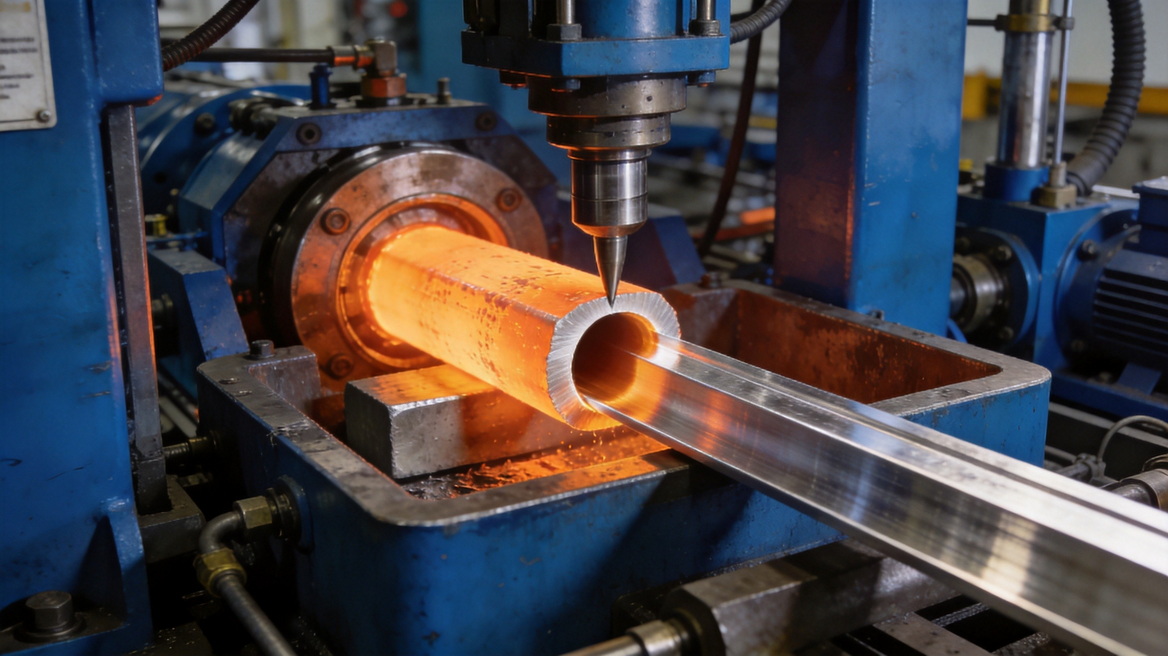
Indirect extrusion can be a strong choice for profiles such as:
- Thin-wall aluminum tubes
- Precision bars
- Electronics housings
- LED lighting profiles
- High-end heat sinks
- Automotive lightweighting components
- Precision mechanical sections
- Thin-wall industrial channels
- Decorative aluminum profiles
- Tight-tolerance hollow profiles
Both methods have practical limitations. A successful equipment decision requires a clear understanding of these factors.
Direct extrusion may require more process control when producing highly demanding thin-wall aluminum profiles.
Potential challenges include:
- Higher extrusion force requirements
- Greater frictional heat
- Changing force conditions during the billet cycle
- More variation in metal flow from front end to back end
- Greater dependence on temperature and speed scheduling
- Higher sensitivity to container and liner condition
- More active control needed for thin-wall tolerance stability
These challenges do not make direct extrusion unsuitable. They simply mean that press design, automation, die engineering, and operational discipline must be well coordinated.
Indirect extrusion has clear technical advantages in specific applications, but it is not suitable for every profile or production plan.
Potential limitations include:
- Hollow stem size restrictions
- More specialized press configuration
- Limits on maximum profile dimensions
- Higher sensitivity to billet cleanliness
- Different tooling and handling requirements
- More complex maintenance considerations
- Less flexibility for certain large profiles
A manufacturer should evaluate whether the expected quality benefit justifies the equipment configuration and operational requirements.
Press selection is important, but die design often determines whether a thin-wall aluminum profile can be produced consistently.
A poorly balanced die can create extrusion defects even when the press is powerful, well maintained, and properly operated.
A properly designed die helps control the velocity of aluminum flow through different areas of the profile.
Different parts of a profile do not naturally flow at the same speed.
Thick areas may resist flow differently from thin areas. Wide sections, deep cavities, long fins, and narrow openings can all create flow imbalance.
Die-bearing lengths are adjusted to control the speed of metal flow through each part of the die.
A balanced die helps reduce:
- Twist
- Bowing
- Uneven walls
- Fin distortion
- Surface defects
- Dimensional variation
Profiles with abrupt transitions from thick walls to thin walls are more difficult to extrude.
A gradual transition usually improves metal flow and reduces local stress concentration.
When possible, profile designers should avoid sudden wall changes and extremely sharp internal corners.
Semi-hollow profiles often require narrow die tongues.
These features can be exposed to high stress during extrusion. If the tongue is too thin or poorly supported, it may bend, crack, or break.
Press capacity and die support must be matched to the profile design.
Hollow aluminum profiles typically require porthole, bridge, or spider dies.
The aluminum streams split and rejoin inside the die. The resulting seam must achieve sufficient integrity for the final product.
Proper weld-chamber design, extrusion ratio, billet quality, temperature control, and process speed are all important.
High extrusion pressure can cause small die deflections.
For thin-wall profiles, even slight movement can affect wall thickness and profile geometry.
The press, die stack, die holder, bolsters, and tooling support system must be designed to minimize unwanted deflection.
The best way to select a direct or indirect extrusion press is to begin with the profile, not the machine.
Start with the complete aluminum profile drawing.
Key details include:
- Minimum wall thickness
- Maximum wall thickness
- Overall profile width and height
- Circumscribed circle
- Hollow, solid, or semi-hollow classification
- Number of cavities
- Long fin dimensions
- Internal ribs
- Slot geometry
- Thin flange areas
- Surface-critical zones
- Assembly features
- Required length
A simple thin-wall open channel may require a very different press configuration from a multi-cavity hollow profile.
The aluminum alloy has a direct effect on extrusion behavior.
Many commercial profiles use 6xxx-series aluminum alloys because they offer a practical balance of strength, corrosion resistance, extrudability, and surface-finishing performance.
However, different alloys require different temperature ranges, speeds, extrusion ratios, and cooling strategies.
The selected press should support the intended alloy range and production volume.
The requirements should be measurable.
Instead of stating that the profile must be "high precision," define the target values for:
- Wall-thickness tolerance
- Width and height tolerance
- Straightness
- Twist
- Flatness
- Surface quality
- Mechanical properties
- Weld integrity
- Anodizing quality
- Powder-coating appearance
- Machining allowance
- Assembly fit
Clear targets make it easier to determine whether direct or indirect extrusion is more suitable.
The required output affects the equipment decision.
Consider:
- Annual production quantity
- Daily operating hours
- Number of profile models
- Billet size
- Number of die changes
- Target cycle time
- Scrap allowance
- Energy consumption
- Labor requirements
- Maintenance planning
- Automation level
A press should support the production plan without creating unnecessary operating cost or idle capacity.
The extrusion press is only one part of the line.
A high-quality thin-wall profile may require:
- Billet heating furnace
- Hot shear
- Die heating oven
- Runout table
- Puller system
- Quenching equipment
- Cooling table
- Stretcher
- Flying saw
- Fixed-length saw
- Aging oven
- Packing system
- Inspection equipment
- Online process monitoring
A mismatch between press output and downstream handling capacity can reduce the quality benefits of a high-performance press.
| Application Requirement | More Suitable Option | Reason |
|---|---|---|
| Large aluminum profile size | Direct extrusion press | Greater flexibility for larger profile dimensions |
| Broad product mix | Direct extrusion press | Suitable for varied industrial and architectural sections |
| High-volume general production | Direct extrusion press | Proven for large-scale production with optimized process control |
| Tight wall-thickness consistency | Indirect extrusion press | Lower friction can support more stable deformation conditions |
| Thin-wall precision profile | Indirect extrusion press | More consistent pressure and temperature behavior |
| Premium visible surface | Indirect extrusion press | Can support stable surface quality with clean billet preparation |
| Large hollow industrial section | Direct extrusion press | Hollow stem limits may restrict indirect extrusion |
| Thin-wall tube or precision bar | Indirect extrusion press | Lower friction and stable flow can be beneficial |
| Complex extrusion production line | Either option | The final decision depends on profile, alloy, tooling, and output |
| High-strength special alloy | Case-by-case evaluation | Alloy behavior and profile geometry must be analyzed together |
Consider a manufacturer producing a 6063 aluminum LED lighting profile.
The design includes a visible outer surface, narrow cooling fins, an internal wire channel, a snap-fit diffuser slot, and a thin wall around the optical chamber.
The key quality requirements are:
- Uniform fin geometry
- Good anodizing appearance
- Tight snap-fit dimensions
- Minimal twist
- Stable wall thickness
- Low surface-defect rate
- Consistent assembly performance
A direct extrusion press can produce this profile effectively when the die is carefully balanced and the production line uses stable billet heating, controlled ram speed, precise quenching, and synchronized pulling.
An indirect extrusion press may provide advantages when the main objective is to maintain very stable dimensions and surface appearance from the beginning to the end of the extrusion length.
The final decision should be based on profile trials, die simulation, process capability analysis, and total manufacturing cost.
A thin-wall aluminum extrusion press should be viewed as part of an integrated production system.
The final profile quality is influenced by the relationship between multiple process stages.
These include:
- Billet quality
- Billet temperature
- Die temperature
- Container condition
- Ram pressure
- Extrusion speed
- Exit temperature
- Quench intensity
- Puller speed
- Cooling conditions
- Stretching parameters
- Cutting accuracy
- Aging process
- Inspection standards
If one stage is unstable, profile quality may decline even when the extrusion press itself performs well.
For example, a thin-wall profile may leave the die with acceptable dimensions but develop twist after uneven cooling. It may appear straight before stretching but show distortion after cutting. It may meet size requirements but fail visual inspection after anodizing.
This is why equipment selection should include an evaluation of the entire production line.
Direct and indirect extrusion presses both have important roles in aluminum profile manufacturing.
A direct extrusion press is often the best option for manufacturers that need broad profile flexibility, larger extrusion capacity, a diverse product portfolio, and reliable high-volume output.
An indirect extrusion press can provide valuable advantages for thin-wall aluminum profiles where lower friction, more stable pressure, consistent dimensions, and controlled surface quality are essential.
The most suitable solution depends on the profile geometry, alloy type, wall thickness, tolerance requirement, surface standard, target output, die design, and downstream handling system.
For thin-wall profiles, successful production begins with a full process evaluation. The right extrusion press should work together with the correct die system, heating equipment, cooling method, pulling system, stretching process, and quality-control plan.
Xinxinke Co., Ltd. provides customized aluminum and copper extrusion equipment solutions based on real production requirements. By combining advanced manufacturing capability, strict quality control, and experienced technical support, we help global manufacturers build extrusion lines that improve productivity, profile quality, and long-term operating reliability.
Share your aluminum profile drawing, alloy grade, wall-thickness range, target output, and required tolerance with Xinxinke Co., Ltd. Our technical team will evaluate the production requirements and recommend a suitable extrusion press and complete line configuration for your application.
In direct extrusion, the billet moves forward through the container and passes through a stationary die. In indirect extrusion, the billet remains stationary relative to the container while the die moves toward the billet on a hollow ram. This difference reduces billet-container friction in the indirect process.
Indirect extrusion can be a strong option for thin-wall aluminum profiles because it reduces friction and can create more stable pressure and temperature conditions. This may help improve dimensional consistency, wall-thickness control, straightness, and surface quality. However, it may not be suitable for every profile size or output requirement.
Yes. Direct extrusion can produce high-precision thin-wall aluminum profiles when the press, die, billet heating system, speed control, cooling system, puller, stretcher, and inspection process are properly matched. The process may require more active control of friction-related temperature and pressure changes.
Twist can result from unbalanced metal flow, uneven wall thickness, asymmetric profile geometry, die deflection, uneven cooling, puller misalignment, inconsistent stretching, or internal stress. A well-balanced die and controlled downstream process are essential for reducing twist.
Many thin-wall aluminum profiles use 6xxx-series alloys, including 6060, 6061, 6063, and 6082. The final choice depends on strength requirements, corrosion resistance, surface treatment, machining needs, welding requirements, and extrusion difficulty.
Indirect extrusion can require less force because the billet does not slide along the container wall in the same way as direct extrusion. Reduced billet-container friction lowers resistance during the process and can create a more stable extrusion force.
Important information includes the profile drawing, aluminum alloy, wall-thickness range, profile size, hollow or solid classification, circumscribed circle, required tolerance, annual production quantity, preferred automation level, available factory space, downstream equipment, and final product application.
1. Misiolek, W. Z., and Kelly, R. M. "Extrusion of Aluminum Alloys." *ASM Handbook, Volume 14A: Metalworking: Bulk Forming*.
2. Hydro. "Do You Know When to Use the Indirect Extrusion Process?"
[https://www.shapesbyhydro.com/en/knowledge/do-you-know-when-to-use-the-indirect-extrusion-process/]
3. Aluminum Extruders Council. "Aluminum Extrusion Design Tips."
[https://aec.org/extrusion-design-tips]
4. Bonnell Aluminum. "Aluminum Extrusion Process."
[https://bonnellaluminum.com/tech-info-resources/aluminum-extrusion-process/]
5. Xinxinke Co., Ltd. "Direct vs. Indirect Extrusion Press for Difficult-to-Extrude Aluminum Alloys."


