
Please Choose Your Language
Views: 241 Author: Industrial Aluminum Profiles Publish Time: 2026-09-10 Origin: Site


Content Menu
● What Makes an Aluminum Alloy Difficult to Extrude?
>> Key Factors That Increase Extrusion Difficulty
● How a Direct Extrusion Press Works
>> Why Friction Matters in Direct Extrusion
>> Advantages of Direct Extrusion Presses
>> Limitations of Direct Extrusion Presses
● How an Indirect Extrusion Press Works
>> Lower Friction in Indirect Extrusion
>> Advantages of Indirect Extrusion Presses
>> Limitations of Indirect Extrusion Presses
● Direct vs. Indirect Extrusion Press Comparison
● When a Direct Extrusion Press Is the Better Choice
>> Direct Press Selection Priorities
● When an Indirect Extrusion Press Is the Better Choice
>> Indirect Press Selection Priorities
● Billet Preparation: A Critical Difference
>> Billet Preparation for Indirect Extrusion
● Temperature Control for Difficult Aluminum Alloys
>> Why Exit Temperature Matters
● Die Design and Press Rigidity
>> Important Die Design Considerations
● Practical Example: Choosing the Right Press
>> Example 1: High-Strength Precision Aluminum Bar
>> Example 2: Large Hollow Transportation Profile
● A Practical Decision Framework
● How Xinxinke Supports Aluminum Extrusion Projects
● Summary
● FAQ
>> What is the difference between direct and indirect aluminum extrusion?
>> Why does indirect extrusion use less force?
>> Is indirect extrusion better for difficult aluminum alloys?
>> Which aluminum alloys are difficult to extrude?
>> Why is billet scalping important for indirect extrusion?
Selecting the right extrusion press for difficult-to-extrude aluminum alloys is a major technical and commercial decision. The choice between a direct extrusion press and an indirect extrusion press influences press force, billet preparation, dimensional stability, extrusion speed, surface quality, scrap control, tooling life, and long-term operating costs.
For manufacturers processing high-strength aluminum profiles, precision bars, aerospace-grade materials, structural sections, or complex industrial components, the extrusion method must match the alloy behavior and final-product requirements. A press that performs well with standard 6xxx aluminum profiles may not deliver the same consistency when processing harder 2xxx, 5xxx, or 7xxx series aluminum alloys.
Xinxinke Co., Ltd. has more than 30 years of experience in copper and aluminum profile extrusion equipment manufacturing. From our engineering perspective, successful extrusion is not determined by press tonnage alone. It depends on the coordinated performance of the press, billet, die, heating system, cooling equipment, handling system, and production-control process.
This article compares direct and indirect extrusion presses for difficult aluminum alloys, explains their working principles, identifies their strengths and limitations, and provides practical guidance for selecting the right solution.
Difficult-to-extrude aluminum alloys require greater force and tighter process control than standard extrusion grades. These alloys generally have higher deformation resistance, more restrictive temperature windows, lower allowable extrusion speeds, and a greater risk of defects during production.
The challenge is not simply pushing aluminum through an extrusion die. The process must maintain a controlled metal flow while preventing overheating, surface tearing, die deflection, cracking, distortion, dimensional inconsistency, and undesirable changes in mechanical properties.
Common difficult-to-extrude aluminum materials include:
- High-strength 2xxx series aluminum alloys
- High-magnesium 5xxx series aluminum alloys
- High-strength 7xxx series aluminum alloys
- Complex 6xxx series aluminum profiles with thin walls or high extrusion ratios
- Aluminum products with demanding structural, machining, aerospace, defense, transportation, or industrial requirements
- Precision bars, rods, tubes, and custom profiles requiring strict dimensional consistency
Difficult alloys often have a higher flow stress. This means the metal resists deformation more strongly when it is forced through the extrusion die. As a result, manufacturers may need higher press tonnage, lower ram speed, more precise billet heating, stronger tooling, and improved control of the exit temperature.
Several variables can make aluminum extrusion more challenging:
- Alloy chemistry: Higher levels of magnesium, copper, zinc, or other alloying elements can increase strength and deformation resistance.
- Billet quality: Poor homogenization, contamination, segregation, or inconsistent grain structure can reduce extrusion stability.
- Extrusion ratio: Higher extrusion ratios require greater deformation and can increase stress on the billet and die.
- Profile complexity: Thin walls, deep channels, wide hollow sections, sharp corners, and difficult tongue ratios can make metal flow harder to control.
- Die design: Inadequate bearing length, weak die support, unbalanced flow paths, or excessive die deflection can create dimensional problems.
- Temperature control: Too-low temperatures increase pressure requirements, while excessive temperatures can create surface defects or weaken the alloy structure.
- Production speed: Faster ram speeds can increase output, but they may also raise exit temperatures and increase the risk of tearing or distortion.
For this reason, difficult-alloy extrusion requires an integrated equipment and process strategy.
A direct extrusion press, also called a forward extrusion press, is the most widely used type of aluminum extrusion equipment.
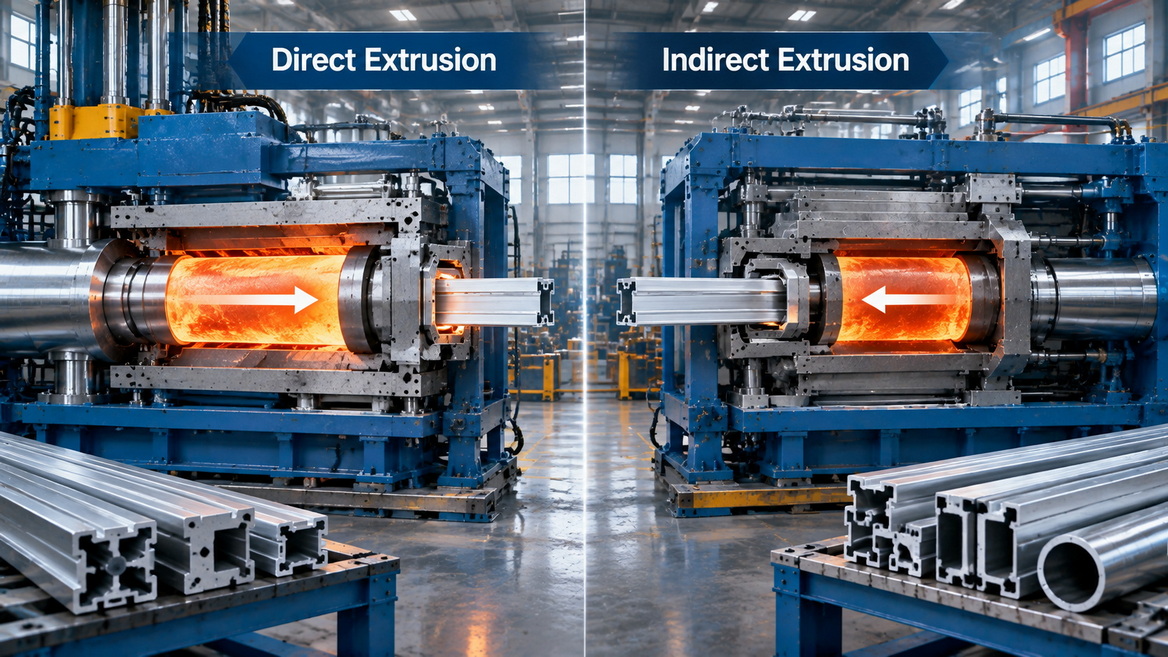
In the direct extrusion process, a heated aluminum billet is loaded into a stationary container. A hydraulic ram pushes the billet forward through a fixed die. The aluminum flows through the die opening in the same direction as the ram movement.
The direct extrusion process usually follows these steps:
1. Aluminum billets are heated to the required extrusion temperature.
2. The heated billet is transferred into the press container.
3. A hydraulic ram applies pressure to the billet.
4. The billet moves forward inside the container.
5. Aluminum flows through the stationary extrusion die.
6. The profile exits the press and travels to cooling, pulling, cutting, stretching, and aging operations.
The major feature of direct extrusion is that the billet slides along the inner wall of the container during the press stroke. This contact creates friction.

Friction between the billet and container wall increases the total load required from the press. It also produces heat and can create changing pressure conditions as the billet becomes shorter.
At the start of the direct extrusion cycle, the billet has a large contact area with the container wall. This usually produces the highest friction and the highest required press force. As extrusion continues, the contact area decreases, so the required force may gradually decline.
This changing force pattern can affect:
- Die deflection
- Metal flow balance
- Profile dimensions
- Surface finish
- Exit temperature
- Grain structure
- Mechanical-property consistency
- Straightness and twist
- Tooling life
For difficult aluminum alloys, this variation makes process control especially important.
Direct extrusion remains a highly effective solution for demanding aluminum production. Modern direct presses can process a wide range of alloys and profile designs when they are properly sized and equipped.
Important advantages include:
- Excellent profile versatility
- Strong compatibility with large aluminum profiles
- Practical production of hollow and semi-hollow profiles
- Broad die-design capability
- Suitability for multi-cavity dies
- Effective use in high-volume industrial production
- Flexible production scheduling for varied product lines
- Compatibility with advanced automation systems
- Wide range of available press sizes and tonnage capacities
- Well suited to custom aluminum profile manufacturing
Direct extrusion presses are commonly used for:
- Building and construction profiles
- Window and door systems
- Curtain wall components
- Transportation structures
- Solar mounting profiles
- Industrial machine frames
- Heat sinks
- Large hollow sections
- Rail and automotive profiles
- General engineering components
- Customized aluminum profiles
The main limitation of a direct extrusion press is the friction created between the billet and container wall.
For difficult-to-extrude aluminum alloys, this may lead to:
- Higher required press force
- Higher energy consumption
- More thermal variation during the extrusion cycle
- Higher risk of die deflection
- Lower extrusion speed in demanding applications
- Increased dependence on billet temperature control
- Greater pressure variation from the front to the rear of the billet
- Potential dimensional changes along long extruded lengths
- More demanding process monitoring requirements
These limitations do not mean direct extrusion is unsuitable for hard alloys. They mean that the press must be engineered with sufficient capacity, rigidity, heating control, and process stability.
An indirect extrusion press, also known as a backward extrusion press, uses a different metal-flow arrangement.
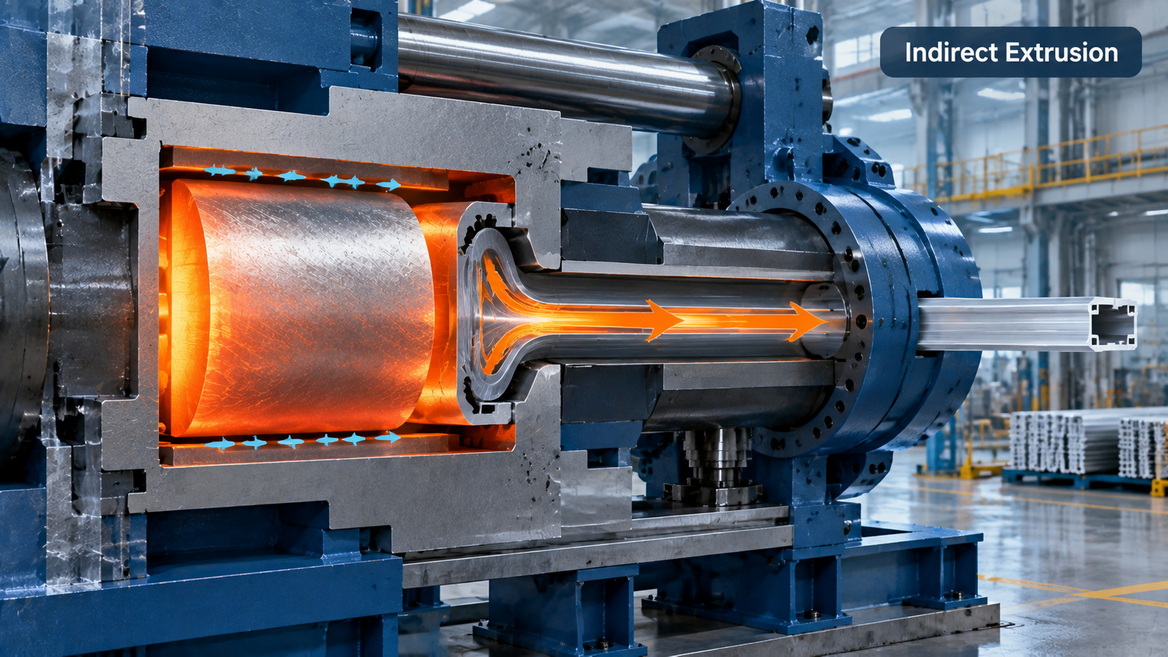
In this process, the aluminum billet remains stationary relative to the container. Instead of pushing the billet toward a fixed die, the die assembly moves toward the billet. The die is mounted on a hollow ram or stem, allowing the extruded aluminum to flow backward through the hollow structure.
The direction of aluminum flow is opposite to the movement of the ram.
The indirect extrusion process generally includes the following steps:
1. A heated aluminum billet is placed inside the container.
2. The billet remains stationary against the container wall.
3. A hollow ram carries the die assembly toward the billet.
4. The die penetrates into the billet under controlled pressure.
5. Aluminum flows backward through the die and hollow stem.
6. The extruded product exits through the rear side of the press arrangement.
The most important difference is that the billet does not slide along the container wall during extrusion.
Because the billet remains stationary relative to the container, indirect extrusion significantly reduces billet-to-container friction.
This changes the extrusion-force profile. The required force is often more stable during the extrusion cycle because the press does not need to overcome the same level of friction created in direct extrusion.
For difficult aluminum alloys, lower friction can create important production benefits.
Indirect extrusion can be highly effective for compact, high-value, and consistency-sensitive aluminum products.
Key advantages include:
- Lower friction during extrusion
- Reduced required press force for comparable conditions
- More stable pressure through the extrusion cycle
- Reduced friction-generated heat
- More uniform temperature conditions
- Potentially better dimensional consistency
- More stable grain structure along the profile length
- Improved consistency in machining performance
- Reduced variation in mechanical properties
- Potentially lower die deflection under certain conditions
- Useful for difficult-to-extrude aluminum alloys
Indirect extrusion can be particularly valuable when manufacturers need a stable, repeatable product over a long extrusion length.
Typical indirect extrusion applications may include:
- Precision aluminum bars
- High-quality machining stock
- Round rods
- Solid profiles
- Compact structural sections
- Certain aerospace and transportation components
- High-strength alloy products
- Aluminum products requiring consistent mechanical behavior
- Specialty industrial components
Indirect extrusion does not replace direct extrusion in every application. It introduces equipment and production limitations that must be considered carefully.
The most important limitation is profile size. Since the profile must pass through the hollow stem or support system, the maximum possible profile size can be restricted.
Other limitations include:
- Restricted maximum profile diameter
- Reduced suitability for very wide or large profiles
- Potential limitations for complex hollow profiles
- More demanding hollow-stem design
- Strict press alignment requirements
- Higher sensitivity to billet surface quality
- Potential need for billet scalping
- Need for careful billet cleaning
- More specialized equipment configuration
- More complex maintenance requirements in some systems
In indirect extrusion, the outer surface of the billet may become part of the final extruded product. This means oxides, dirt, lubricant residue, or surface contamination can enter the profile if billets are not properly prepared.
For this reason, indirect extrusion operations often require stronger billet-quality management.
The following comparison helps manufacturers evaluate which extrusion method may better match difficult aluminum alloy applications.
| Comparison Factor | Direct Extrusion Press | Indirect Extrusion Press |
|---|---|---|
| Process direction | Billet moves toward a stationary die | Die moves toward a stationary billet |
| Aluminum flow direction | Same direction as ram movement | Opposite direction to ram movement |
| Billet-to-container friction | Higher | Lower |
| Required extrusion force | Usually higher | Often lower for comparable conditions |
| Force pattern during extrusion | Typically highest at the beginning and declines during the cycle | Usually more stable through the extrusion cycle |
| Temperature variation | More influenced by frictional heating | Often more uniform |
| Dimensional consistency | Can vary if process conditions change during the stroke | Often more consistent for suitable profiles |
| Billet surface sensitivity | Surface contamination is more likely to remain in the discard portion | Billet surface can become part of the extrudate |
| Billet preparation | Important but generally more forgiving | Critical; cleaning or scalping is often required |
| Profile size capability | Strong capability for large profiles | Limited by hollow stem and die support dimensions |
| Hollow-profile capability | Excellent for many hollow and complex profiles | May be more restricted depending on profile geometry |
| Product flexibility | Suitable for diverse product portfolios | Best suited to selected compact and consistency-sensitive products |
| Typical applications | Large profiles, hollow sections, industrial components, architectural systems | Precision bars, rods, machining stock, selected high-strength sections |
| Equipment requirements | High tonnage, rigid structure, stable heating, strong die support | Precision alignment, robust hollow stem, billet-cleanliness control |
A direct extrusion press is often the preferred solution when a manufacturer requires a high level of flexibility in profile size, geometry, and product variety.
It is particularly suitable for operations producing:
- Large aluminum profiles
- Wide industrial sections
- Hollow profiles with complex internal chambers
- Semi-hollow aluminum profiles
- Multi-cavity extrusion products
- Transportation components
- Architectural and construction profiles
- Solar-energy mounting components
- Machine frames
- Heat sinks
- Customized aluminum extrusions
- Profiles with frequent design changes
For difficult aluminum alloys, direct extrusion can perform very well when the press is correctly specified.
When selecting a direct extrusion press for difficult alloys, manufacturers should evaluate:
- Required press tonnage
- Billet diameter
- Container diameter
- Container-wall condition
- Ram speed range
- Ram speed control accuracy
- Press-frame rigidity
- Die support strength
- Die-slide performance
- Billet heating precision
- Container and die heating system
- Exit-temperature monitoring
- Quenching system
- Puller synchronization
- Runout table configuration
- Automation requirements
- Production data collection
A direct press should not be selected only because it is widely used. It should be designed around the most difficult alloy and profile expected in the production plan.
A manufacturer that purchases a press with too little capacity may face lower output, excessive die wear, unstable dimensions, limited alloy range, and higher operating risk.
An indirect extrusion press is often the stronger option when product consistency is more important than profile-size flexibility.
It can be especially effective for applications that require lower friction, more stable pressure, and reduced variation along the extrusion length.
Indirect extrusion may be the better option for:
- High-strength aluminum bars
- Precision machining stock
- Aluminum rods with strict dimensional requirements
- Compact solid profiles
- Difficult-to-extrude alloy grades
- Products requiring consistent grain structure
- Applications with demanding mechanical-property requirements
- Components requiring stable machinability
- High-value industrial products
- Precision aluminum sections with controlled tolerances
Before choosing indirect extrusion, manufacturers should confirm the following:
- Can the profile pass through the hollow stem?
- Is the profile compact enough for indirect extrusion equipment?
- Is the billet surface clean enough for the finished-product requirement?
- Can the operation support billet scalping or cleaning?
- Does the product require superior consistency over the full extrusion length?
- Will the lower friction meaningfully improve productivity or quality?
- Is the press alignment system precise enough for the planned alloy and die load?
- Does the production volume justify a specialized process configuration?
The indirect process can deliver excellent results, but it should be selected only after reviewing the complete technical and economic picture.
Billet preparation is important in all aluminum extrusion operations. However, it becomes especially critical in indirect extrusion.
In direct extrusion, the outer billet surface tends to remain near the container wall and is often concentrated in the butt discard portion. This can help reduce the chance that surface contamination enters the final extrusion.
In indirect extrusion, the billet surface may flow into the finished product. Any surface defect can become a product-quality issue.
Indirect extrusion billets may require:
- Billet scalping
- Surface brushing
- Oxide removal
- Lubricant control
- Clean handling procedures
- Accurate billet identification
- Lot traceability
- Controlled storage conditions
- Uniform billet heating
- Inspection for cracks or surface defects
Billet scalping removes a thin outer layer from the billet. This helps eliminate surface oxides, contamination, and defects that could otherwise enter the extruded profile.
For high-value products, billet preparation should be treated as part of the production process rather than a separate material-handling task.
Temperature is one of the most important variables in aluminum extrusion.
If the billet temperature is too low, the alloy may resist deformation excessively. This increases press load and can create surface tearing, poor die filling, or flow instability.
If the billet temperature is too high, the extrusion may experience excessive exit temperature, surface defects, grain coarsening, loss of dimensional control, or metallurgical problems.
For difficult-to-extrude alloys, temperature management should include:
- Billet temperature
- Billet temperature uniformity
- Container temperature
- Die temperature
- Ram speed
- Exit temperature
- Cooling rate
- Quench delay
- Ambient production conditions
A modern extrusion line should monitor process temperatures continuously. This allows operators to identify trends before they become quality problems.
Exit temperature is especially important because it directly affects the condition of the aluminum profile as it leaves the die.
An excessive exit temperature may cause:
- Surface tearing
- Pick-up defects
- Reduced surface quality
- Unwanted grain growth
- Dimensional instability
- Difficulties during quenching
- Reduced consistency in final mechanical properties
A low exit temperature may indicate that the press speed is too slow, the billet is too cold, or the process is not operating efficiently.
The goal is not simply to maximize speed. The goal is to maintain a stable and repeatable thermal window.
For difficult-to-extrude aluminum alloys, the die and press must work as a single engineering system.
High-strength alloys can create substantial loads on the die. If the die is not properly designed or adequately supported, it may deflect under pressure. Even a small amount of deflection can change the profile dimensions, wall thickness, flatness, straightness, or metal-flow balance.
Die design for difficult aluminum alloys may require attention to:
- Bearing length
- Bearing balance
- Die material selection
- Die heat treatment
- Port design
- Welding chamber design
- Mandrel support
- Tongue ratio
- Die deflection analysis
- Metal-flow simulation
- Die temperature stability
- Surface finish
- Die-maintenance frequency
For direct extrusion, the changing pressure condition over the stroke may require additional attention to die strength and flow balance.
For indirect extrusion, stable pressure can support consistent flow, but the die support and hollow stem must maintain precise alignment.
Press rigidity affects how accurately the extrusion system holds its geometry under load.
A rigid press helps maintain:
- Die alignment
- Container alignment
- Ram alignment
- Stable metal flow
- Consistent profile dimensions
- Better die life
- Reduced equipment wear
- Improved repeatability
For difficult alloys, a heavy-duty press frame, strong front platen, stable hydraulic system, and precision-guided moving components are essential.
Consider two different aluminum extrusion projects.
A manufacturer produces high-strength aluminum bar for precision machining. The product must maintain stable dimensions, predictable machining behavior, and consistent mechanical performance across long lengths.
In this situation, an indirect extrusion press may offer important benefits. Lower friction can create more stable pressure and temperature conditions, helping improve consistency throughout the extrusion length.
However, the manufacturer must also implement strict billet cleaning, surface inspection, and scalping procedures. Without proper billet preparation, surface contamination could affect the finished bar.
A manufacturer produces a large, complex hollow aluminum profile for a transportation or industrial structure. The profile has internal chambers, wide dimensions, strict straightness requirements, and a changing product mix.
In this situation, a direct extrusion press is often more practical. It can better accommodate large profile dimensions, hollow die systems, and flexible production requirements.
To process difficult alloys successfully, the manufacturer should use adequate press tonnage, optimized die design, controlled billet heating, accurate ram-speed control, and a reliable quenching and handling system.
The correct decision is not based on which method is more advanced. It is based on which method best fits the product.
Before selecting a direct or indirect extrusion press, manufacturers should review the following questions.
- What aluminum alloy will be extruded?
- What mechanical properties are required?
- Is the product solid, hollow, or semi-hollow?
- What is the maximum profile diameter?
- What wall thickness is required?
- Are there strict straightness, twist, or flatness requirements?
- Is surface appearance critical?
- Does the product require machining after extrusion?
- What is the acceptable scrap rate?
- What annual output is required?
- How many different profile designs will be produced?
- How often will dies be changed?
- Is high-volume production or flexible production more important?
- What level of automation is needed?
- What cooling and quenching system is required?
- Can the facility support billet scalping and cleaning?
- What are the maintenance capabilities of the operation?
- What press tonnage is required?
- What container diameter is appropriate?
- Is the press structure sufficiently rigid?
- Can the press maintain stable ram speed?
- Does the heating system provide temperature uniformity?
- Is the die support system strong enough?
- Can the extrusion line collect and analyze production data?
- Is future capacity expansion required?
A careful review of these questions helps reduce the risk of purchasing equipment that does not match the actual production requirements.
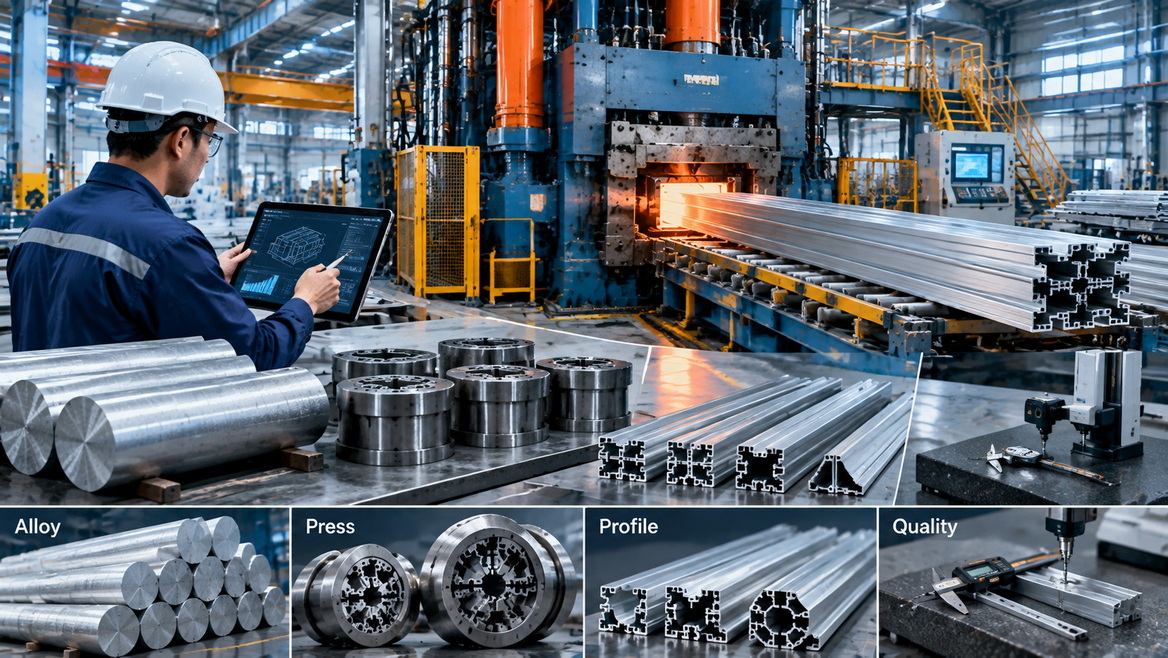
Xinxinke Co., Ltd. is a professional manufacturer of copper and aluminum profile extrusion equipment. With more than 30 years of industry experience, we provide high-performance extrusion presses and customized solutions for manufacturers worldwide.
Difficult aluminum alloy projects require more than a standard machine configuration. They require a complete understanding of material behavior, extrusion force, profile geometry, die requirements, billet heating, cooling, automation, and quality-control objectives.
Our technical team can support customers with customized solutions based on:
- Aluminum alloy type
- Billet diameter and billet length
- Required press tonnage
- Direct or indirect extrusion process requirements
- Profile geometry
- Production output targets
- Heating-system configuration
- Die-handling requirements
- Quenching and cooling needs
- Runout and handling systems
- Automation level
- Plant layout
- Data-monitoring requirements
- Future expansion plans
By matching the equipment configuration to the real production conditions, manufacturers can improve productivity, enhance profile quality, reduce operating risk, and build a more stable extrusion process.
For difficult-to-extrude aluminum alloys, both direct and indirect extrusion presses can deliver strong results when they are correctly matched to the product and process.
A direct extrusion press provides greater flexibility for large profiles, complex hollow sections, diverse die designs, and high-variety production. It remains the preferred solution for many industrial, architectural, transportation, and customized aluminum profile applications.
An indirect extrusion press reduces billet-to-container friction and can provide more stable pressure, more uniform temperature conditions, and improved consistency for selected products. It is particularly valuable for compact profiles, high-strength bars, rods, machining stock, and aluminum products where uniform mechanical behavior is essential.
The most reliable equipment decision considers the complete production system: alloy condition, billet quality, profile geometry, extrusion ratio, press capacity, die design, thermal management, quenching, handling, inspection, and long-term production goals.
Xinxinke Co., Ltd. provides customized aluminum extrusion press solutions designed to help manufacturers process demanding alloys with greater stability, efficiency, and confidence.
In direct extrusion, the hydraulic ram pushes the aluminum billet forward through a stationary die. In indirect extrusion, the billet remains stationary while the die moves toward it, and the aluminum flows in the opposite direction to the ram movement.
Indirect extrusion reduces billet-to-container friction because the billet does not slide along the container wall. Lower friction means the press can use more of its available force to deform the aluminum through the die.
Indirect extrusion can be beneficial for difficult aluminum alloys because it provides lower friction and more stable pressure. However, it is not always the best option. Large, wide, hollow, or highly complex profiles may be more suitable for direct extrusion presses.
Difficult aluminum alloys often include high-strength 2xxx series alloys, high-magnesium 5xxx series alloys, high-strength 7xxx series alloys, and complex 6xxx series profiles with high extrusion ratios, thin walls, or strict quality requirements.
In indirect extrusion, the outer surface of the billet can become part of the finished aluminum profile. Billet scalping removes the outer material layer and helps reduce the risk of oxides, dirt, oil, or other surface contamination entering the final product.
1. Hydro. "Do You Know When to Use the Indirect Extrusion Process?" Discusses friction reduction, force stability, billet preparation, dimensional consistency, and practical indirect extrusion applications.
[https://www.shapesbyhydro.com/en/knowledge/do-you-know-when-to-use-the-indirect-extrusion-process/]
2. Aluminum Extruders Council. "Aluminum Extrusion FAQs." Covers billet surface quality, indirect extrusion considerations, aluminum alloy extrusion characteristics, and common process questions.
3. ASM International / NIST Materials Data Repository. *Extrusion: Second Edition.* Provides technical information on extrusion mechanics, difficult-to-extrude materials, flow stress, extrusion ratio, temperature control, and process behavior.
[https://materialsdata.nist.gov/bitstream/handle/11115/175/Extrusion.pdf?sequence=3&isAllowed=y]
4. Bonnell Aluminum. "Aluminum Extrusion Process." Provides an overview of aluminum extrusion equipment, billet heating, extrusion methods, and downstream production stages.
[https://bonnellaluminum.com/tech-info-resources/aluminum-extrusion-process/]
5. ASM International. "Extrusion Press and Auxiliary Equipment." Reviews extrusion press configurations, auxiliary equipment, direct and indirect press operation, and production considerations for harder aluminum alloys.


