
Please Choose Your Language
Views: 283 Author: Xinxinke Extrusion Publish Time: 2026-10-30 Origin: Site


Content Menu
● What Equipment Is Used in the Extrusion Process?
● Core Extrusion Equipment: From Billet Preparation to the Press
>> Billet Cutting and Loading Equipment
>> Die Ovens and Extrusion Tooling
>> Hydraulic Extrusion Presses
● Direct vs. Indirect Extrusion Equipment
● Downstream Aluminum Extrusion Equipment
>> Quenching and Cooling Systems
>> Stretchers and Finishing Saws
● How Copper Extrusion Equipment Differs from Aluminum Equipment
● How to Identify the Real Production Bottleneck
● Quality Problems: Which Equipment Should You Check?
● A Practical Extrusion Equipment Purchasing Checklist
● Plan Your Extrusion Line with Xinxinke
>> What is the main machine used in metal extrusion?
>> What equipment is needed for an aluminum extrusion line?
>> Can one extrusion press process both copper and aluminum?
>> How do you choose extrusion press capacity?
>> Does every aluminum extrusion need water quenching?
The equipment used in the extrusion process includes billet preparation machinery, heating furnaces, an extrusion press, dies, cooling systems, handling equipment, cutting machines, and inspection tools. For copper and aluminum manufacturers, the right configuration depends on the alloy, profile geometry, required properties, and production volume.
The press supplies the forming force, but it cannot deliver consistent products alone. Heating, tooling, cooling, and downstream handling must work together.
At Xinxinke Co., Ltd., we approach equipment selection from this whole-line perspective. With more than 30 years of industry experience, we manufacture copper and aluminum profile extrusion equipment and develop customized solutions around customers' production requirements.
This guide explains what each machine does, how copper and aluminum lines differ, and what buyers should verify before investing.
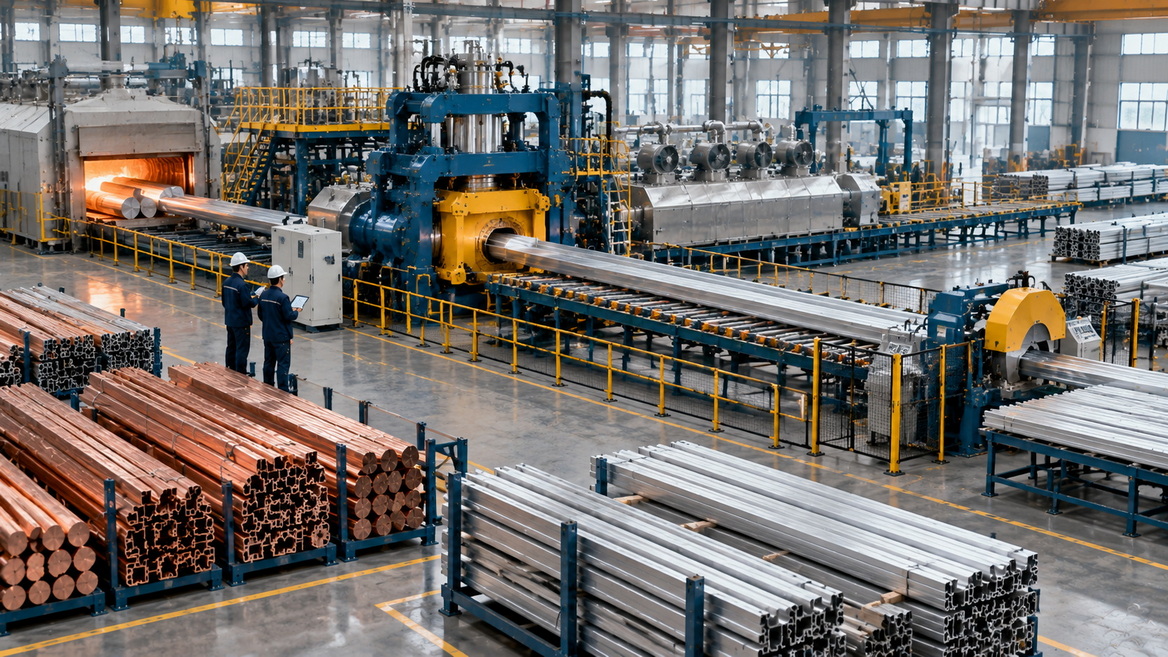
A conventional hot-extrusion line transforms a prepared metal billet into a continuous profile, then cools, straightens, cuts, and inspects it.
However, equipment requirements vary. A line producing aluminum architectural profiles will not necessarily use the same downstream machinery or thermal treatments as a line producing copper rods or tubes.
| Production stage | Typical equipment | Main purpose |
|---|---|---|
| Material preparation | Billet saw, log shear, loading system | Prepare and transfer suitable feedstock |
| Heating | Billet furnace, die oven | Establish controlled forming conditions |
| Extrusion | Hydraulic press, container, ram, die assembly | Force metal through the tooling |
| Cooling | Air, mist, spray, or water-cooling system | Control temperature and required properties |
| Handling | Puller, runout table, transfer equipment | Support and transport emerging profiles |
| Straightening | Stretcher or suitable straightening machine | Correct shape within specified limits |
| Cutting | Finishing saw and length-measuring system | Produce required delivery lengths |
| Thermal treatment | Aging or annealing furnace, when required | Develop specified material properties |
| Verification | Dimensional gauges and testing equipment | Confirm product conformity |
The most important purchasing principle is compatibility: every stage must accommodate the product and the output of the stages around it.
Billet preparation establishes the starting conditions for extrusion.
A saw or shear produces billets of suitable length. Loading equipment then transfers them into the heating and press systems.
Billet dimensions affect material utilization, extrusion length, and cycle time. Buyers should therefore specify the expected billet diameter, length range, alloy families, and handling requirements.
Useful evaluation points include:
- Cutting accuracy and cut-face condition.
- Compatibility with different billet lengths.
- Safe transfer between machines.
- Scrap handling and access for maintenance.
- Changeover requirements when product schedules vary.
Incorrect billet preparation can create avoidable interruptions before the press begins forming material.
In conventional hot extrusion, billet heating reduces deformation resistance and helps establish suitable metal-flow conditions.
Gas-fired and induction systems are possible options. Selection should consider the material, production schedule, temperature-control requirements, and available utilities.
A furnace should not be evaluated solely by its maximum temperature. Temperature distribution, repeatability, loading practice, and heat loss also matter.
There is no universal billet temperature for every copper or aluminum product. Recipes must reflect the alloy, tooling, extrusion conditions, and required properties.
The die defines the profile's cross-section. Its design influences metal flow, dimensional consistency, surface condition, and production stability.
An extrusion tooling package can include:
- The die and supporting tooling.
- Container liners.
- Dummy blocks.
- Mandrels for applicable hollow products.
- Die-handling and preheating equipment.
Hollow products require particular attention. Depending on the material and product specification, production may use bridge or porthole tooling, or a mandrel-based arrangement. These routes are not interchangeable for every application.
Controlled die preheating helps establish repeatable starting conditions. Tool maintenance, cleaning, inspection, and storage are equally important.
The extrusion press forces the billet through the die.
Its main systems include the frame, hydraulic drive, main cylinder, ram, container, tooling support, and controls.
Press capacity must match more than profile width. Important inputs include:
- Alloy and deformation resistance.
- Billet dimensions.
- Profile cross-sectional area.
- Extrusion ratio.
- Product complexity.
- Required production rate.
Extrusion ratio compares the billet cross-sectional area with the total extruded cross-sectional area. It helps describe the degree of deformation, but it does not independently determine press suitability.
A larger press is not automatically a better investment. Oversizing can increase capital and operating demands without solving tooling, heating, or downstream limitations.
In direct extrusion, the ram pushes the billet toward a stationary die. The metal exits in the same general direction as the ram movement.
The billet moves relative to the container, creating friction at their interface.
Direct presses are widely used for varied product ranges. Their suitability still depends on the alloy, geometry, tooling arrangement, and production economics.
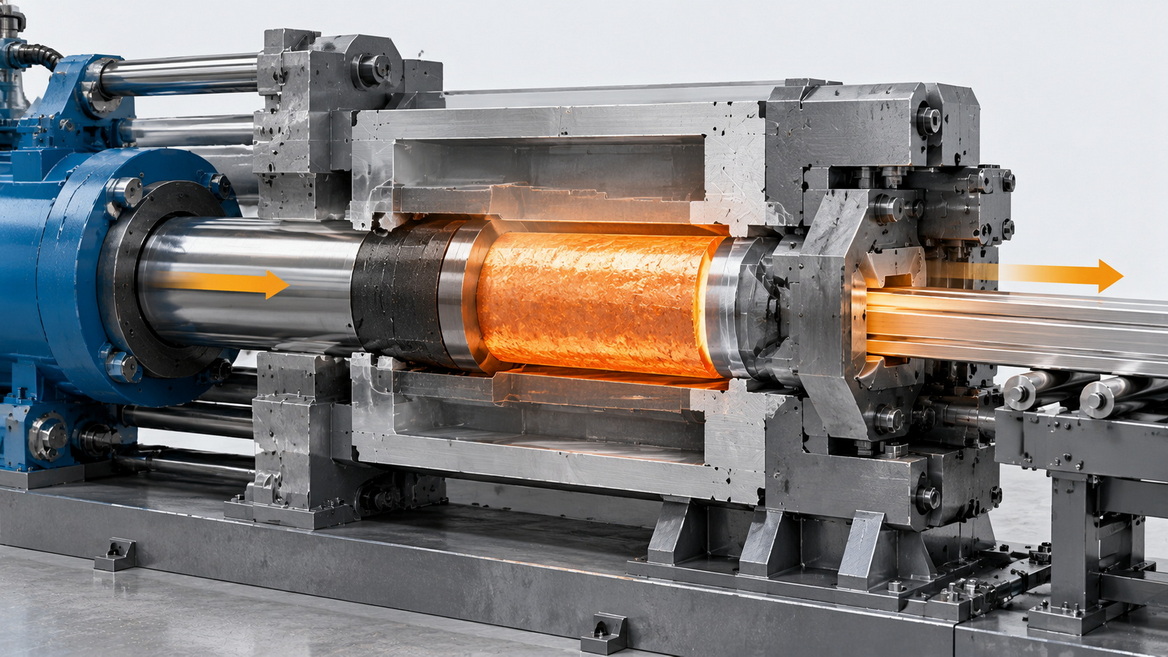
In indirect extrusion, the tooling arrangement allows extrusion without the same billet-to-container sliding associated with direct extrusion.
Reduced interface friction can lower the required extrusion force and improve material-flow conditions.
However, indirect extrusion is not universally preferable. Tool access, product dimensions, handling arrangements, and process flexibility must also be assessed.
The practical question is not which method sounds more advanced. It is which method best supports the specified products at an acceptable total production cost.
Cooling is a process-control stage, not simply a way to make profiles easier to handle.
For heat-treatable aluminum alloys, cooling after extrusion influences the properties achievable through subsequent aging. Available methods include air, mist, water spray, and water immersion.
The system must balance sufficient cooling with distortion control.
Thin and thick sections may respond differently within the same profile. Adjustable cooling zones can help address this variation, but settings must be validated for the actual product.
Buyers should review cooling capacity alongside exit speed, alloy sensitivity, profile geometry, and the required temper.
The puller guides the emerging profile along the runout table. It supports orderly movement but does not replace the press as the source of extrusion force.
Runout and transfer equipment must support hot material without introducing unnecessary marking, bending, or handling delays.
Check the usable table length, profile support arrangement, transfer sequence, and compatibility with the longest planned extrusions.
A fast press can still spend time waiting if the handling system cannot clear the line.
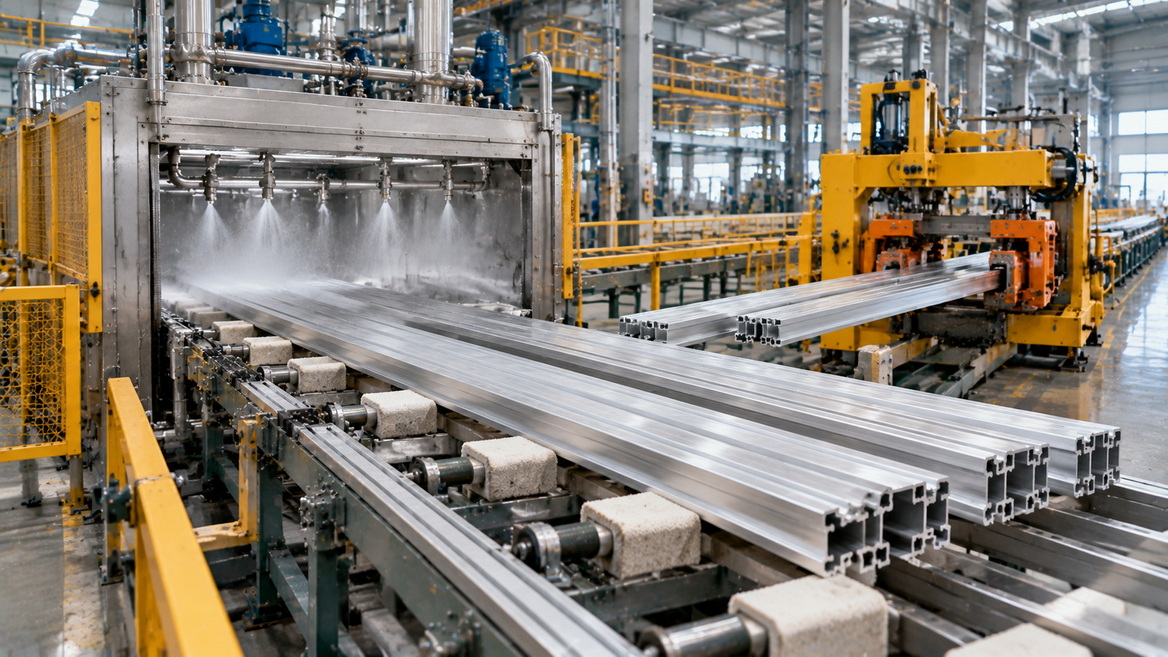
Stretchers apply controlled elongation to help correct bow and twist in suitable extrusions.
They cannot reliably rescue every defect caused by unsuitable tooling, uneven flow, or incorrect cooling.
Selection should consider gripping arrangements, available force, working length, and allowable deformation.
Finishing saws then cut profiles to delivery lengths. Evaluate cut quality, length accuracy, clamping, chip collection, and protection of visible surfaces.
Artificial aging develops the required properties in applicable heat-treatable aluminum alloys through a controlled thermal cycle.
The correct cycle depends on the alloy and target condition. Not every extrusion requires artificial aging, and one recipe should not be applied indiscriminately across products.
Furnace evaluation should include temperature uniformity, usable load capacity, airflow, recording capability, and loading practices.
Copper and aluminum share the basic extrusion principle, but their production requirements should not be treated as identical.
Copper and copper-alloy products may require different forming conditions, lubrication practices, tooling arrangements, and downstream treatments. The differences also vary substantially between alloys.
Important distinctions include:
| Selection factor | What buyers should establish |
|---|---|
| Material | Exact copper or aluminum alloy designation |
| Product route | Solid profile, rod, tube, or other section |
| Forming conditions | Validated temperature, force, and speed requirements |
| Tooling | Die, mandrel, container, and lubrication compatibility |
| Downstream treatment | Cooling, straightening, annealing, or other required stages |
| Final inspection | Applicable dimensional and material-property requirements |
An aluminum aging furnace is not a substitute for a copper annealing specification.
Similarly, a machine's advertised ability to process both metals does not confirm suitability for every alloy or product. Request an application-specific assessment.
A valuable equipment review starts with the entire production cycle rather than the press rating.
Consider a line where billet heating cannot supply material quickly enough. Increasing press speed will not remove the furnace constraint.
Likewise, insufficient cooling capacity may limit extrusion speed, while slow cutting or transfer operations may prevent the line from clearing finished profiles.
Use this practical review:
1. Map each stage from billet loading to finished-product handling.
2. Record processing, waiting, transfer, and changeover times.
3. Identify the stage that repeatedly restricts output.
4. Check whether proposed upgrades move the constraint elsewhere.
5. Validate improvements using acceptable finished output.
Good product per operating hour is more informative than peak ram speed alone.
For internal performance tracking, also distinguish gross output from saleable yield. Scrap, rejected profiles, and rework can make an apparently fast line commercially inefficient.
Defects often have multiple causes. Use symptoms to guide investigation, not to assign blame automatically.
| Observed problem | Equipment or process areas to investigate |
|---|---|
| Dimensional variation | Die condition, temperature stability, press alignment, process settings |
| Bow or twist | Metal flow, cooling balance, handling, stretching practice |
| Surface scratches | Tooling, support surfaces, transfer equipment, chips |
| Inconsistent properties | Alloy verification, exit conditions, quenching, thermal treatment |
| Variable cut length | Measuring system, clamping, saw controls |
| Frequent stoppages | Hydraulics, sensors, loading sequence, maintenance condition |
The strongest troubleshooting approach links inspection results to production records.
Record billet identification, tooling identification, relevant temperatures, speeds, cooling settings, and thermal-treatment cycles. This makes comparisons between acceptable and rejected batches more useful.
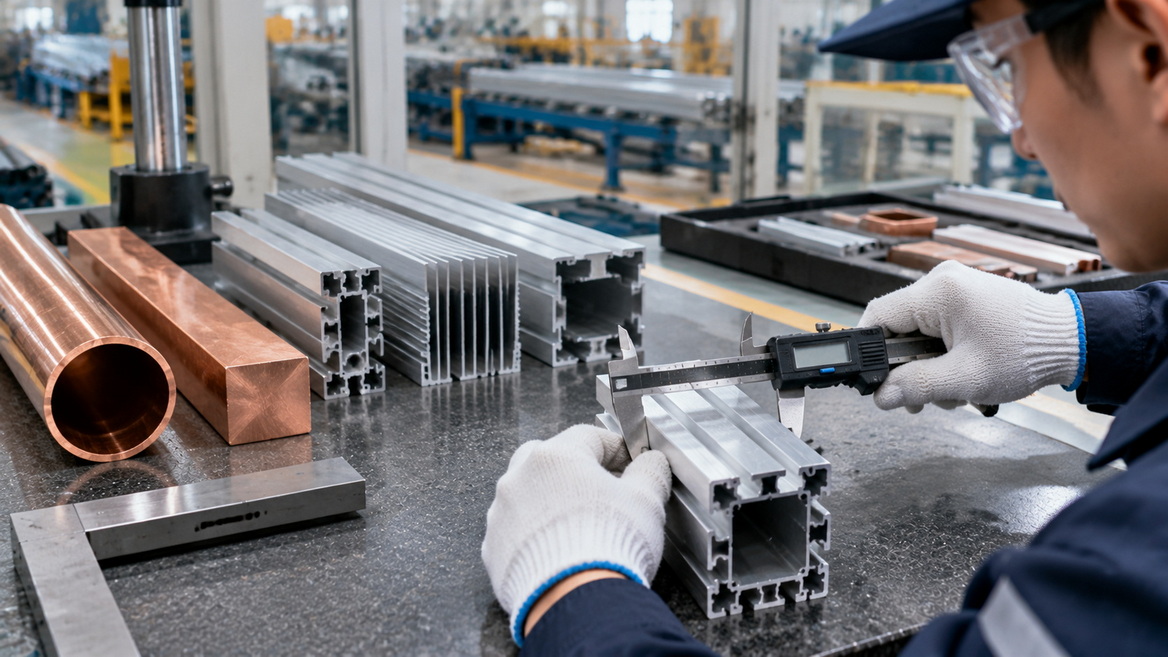
Before requesting a quotation, prepare a clear technical brief:
- Alloy grades and product drawings.
- Required tolerances and surface expectations.
- Billet dimensions and available feedstock.
- Annual demand and expected product mix.
- Target properties and delivery condition.
- Available floor space and utilities.
- Automation, staffing, and maintenance requirements.
Next, agree on measurable acceptance criteria.
Where practical, trials should use representative alloys and profiles rather than only simple demonstration products. Specify how output, dimensional conformity, surface quality, and required properties will be evaluated.
Also define training, documentation, spare parts, installation responsibilities, and service scope before placing the order.
Energy comparisons should use a stated measurement boundary, such as the press alone or the complete line. Comparing energy per kilogram of acceptable product is more useful when product mix and operating conditions are comparable.
Xinxinke Co., Ltd. supplies copper and aluminum extrusion equipment supported by advanced manufacturing capabilities, quality-control practices, and a professional technical team.
Our focus is matching equipment to the customer's production task—not recommending a press in isolation.
Send your alloy specifications, profile drawings, target output, quality requirements, and factory layout to request a customized equipment proposal. These details provide the foundation for discussing press configuration, heating, tooling, downstream handling, and inspection needs.
The extrusion press is the main forming machine. It forces metal through a die, while heating, handling, cooling, and finishing equipment support the complete production process.
Typical equipment includes billet cutting and heating systems, a die oven, an extrusion press, cooling equipment, a puller, runout tables, a stretcher, and finishing saws. Aging equipment is added when required.
Potentially, but suitability requires an engineering assessment. Force capacity, temperature capability, tooling, lubrication, controls, and downstream equipment must match the specified alloys and products.
Start with alloy data, billet dimensions, profile geometry, extrusion ratio, and output requirements. Have the equipment supplier evaluate these together rather than selecting capacity from profile size alone.
No. Cooling requirements depend on the alloy, geometry, processing route, and required properties. Air, mist, spray, or immersion may be appropriate under validated production conditions.
1. Aluminum Extruders Council. "Aluminum Extrusion Manual." Industry guidance covering extrusion-line equipment, quenching, handling, and thermal treatment. [Read the manual]. [tricityextrusion]
2. Aluminum Extruders Council. "Extrusion Equipment." Technical material addressing presses, handling, automation, cooling control, and furnace technology. [View the technical resource]. [aec]
3. SMS group. "Light Metal Extrusion Presses." Manufacturer information on direct and indirect presses, handling equipment, and heat-treatment systems. [View the equipment overview]. [sms-group]
4. SMS group. "Extrusion Presses for Heavy Metals." Manufacturer information on heavy-metal extrusion and direct and indirect press applications. [View the equipment overview]. [sms-group]
5. U.S. Department of Energy. "Process Heating Systems." Guidance on industrial process-heating practices and energy optimization. [View the resource]. [energy]
6. SMS group. "Service Packages for Extrusion Presses." Information on equipment checks, alignment, hydraulic optimization, and maintenance support. [View the service overview]. [sms-group]
7. Xinxinke Co., Ltd. Company description supplied for this article. Source for the company's stated experience, manufacturing capabilities, quality-control focus, and customized services. No company URL or independent verification was provided.


