
Please Choose Your Language
Views: 235 Author: Xinxinke Extrusion Publish Time: 2026-11-18 Origin: Site


Content Menu
● Russia's Extrusion Equipment Market: What Buyers Should Understand
>> Where Industrial Clusters Matter
● Selection Criteria: How These Manufacturers Were Assessed
● Five Extrusion Press Manufacturers to Evaluate for Russian Projects
>>> Company Background and Market Coverage
>>> Core Strengths
>>> OEM and Custom Engineering Scope
>>> Buyer Fit and Verification Priorities
>> 2. Foshan Yejing Machinery Manufacturing Co., Ltd.
>>> Company Background and Market Coverage
>>> Core Strengths
>>> OEM and Custom Engineering Scope
>>> Buyer Fit and Verification Priorities
>> 3. Foshan Sailixin Machinery Manufacturing Co., Ltd.
>>> Company Background and Market Coverage
>>> Core Strengths
>>> OEM and Custom Engineering Scope
>>> Buyer Fit and Verification Priorities
>>> Company Background and Market Coverage
>>> Core Strengths
>>> OEM and Custom Engineering Scope
>>> Buyer Fit and Verification Priorities
>> 5. UBE MACHINERY CORPORATION, Ltd.
>>> Company Background and Market Coverage
>>> Core Strengths
>>> OEM and Custom Engineering Scope
>>> Buyer Fit and Verification Priorities
● Comparison Table: Press Capacity, Manufacturing Scale, MOQ, and Certification
● Technical Buyer's Guide: Specify Production, Not Just Tonnage
>> Start With the Alloy and Profile Portfolio
>> Make Structural Materials Traceable
>> Evaluate Energy Claims on the Same Basis
● Certification and Compliance for Russian Deliveries
>> CE, ISO, and RoHS Are Not Interchangeable
>> Check Transaction Feasibility Before Paying a Deposit
● The Overlooked Procurement Trap: A Fast Press Can Still Produce an Expensive Tonne
● Factory Verification, Trial Production, and Logistics
>> Verify the Factory Before Negotiating Final Payment Terms
>> Use Production Trials Instead of Generic Samples
>> Plan Transport Before Freezing the Machine Design
>> 1. How Can We Verify Whether a Supplier's ISO Certificate Has Expired?
>> 2. Can Two Presses With the Same Tonnage Produce Different Results?
>> 3. Should We Buy a Complete Line or Source Each Machine Separately?
>> 4. Can a Chinese Supplier Automatically Deliver an Extrusion Press to Russia?
>> 5. What Should Happen if the Press Passes Factory Testing but Fails at Our Site?
Selecting an extrusion press supplier for a Russian production project requires more than comparing machine prices and nominal tonnage. Buyers must evaluate engineering capability, material traceability, hydraulic reliability, commissioning support, spare-parts availability, and the legal feasibility of delivering and servicing the equipment.
A reliable assessment starts with five questions:
- Does the supplier manufacture the critical machine components or primarily assemble purchased equipment?
- Can its engineering team demonstrate experience with comparable alloys, profiles, and billet dimensions?
- Are material inspections, machining tolerances, and assembly checks documented?
- Can the supplier substantiate delivery schedules with a realistic production plan?
- Will technical support, replacement components, and control-system access remain available after installation?
This guide compares five established extrusion press manufacturers relevant to supplier evaluation for Russian projects. It distinguishes documented manufacturing capability from claims that still require project-level verification.

Russia has an established aluminum-processing industry, but buyers should distinguish three different businesses: producing primary aluminum, extruding finished profiles, and manufacturing the presses used to make those profiles.
An aluminum-profile producer is not automatically an extrusion press manufacturer. Likewise, a manufacturer of mechanical forging presses should not be described as a supplier of hydraulic aluminum extrusion lines without product-specific evidence.
The Russian Aluminium Association's April 2026 industry update reported that domestic aluminum consumption remained approximately 1.4 million tonnes, broadly maintaining the previous year's level. It also reported consumption growth of 20% compared with 2022. These figures describe the wider aluminum market, not extrusion press sales or extruded-profile output.
For procurement managers, the implication is practical: equipment investment should follow verified downstream demand and the factory's actual product mix—not an assumed nationwide machinery boom.
Russian aluminum processing has regional concentrations rather than one single machinery hub. Tatarstan, represented by profile producer TATPROF, and the Kaluga region, where AGRISOVGAZ operates, illustrate the downstream industrial base that creates demand for extrusion equipment and supporting services. AGRISOVGAZ reported recognition among leading Russian aluminum-profile producers for the first half of 2025. These are examples of profile-manufacturing activity, not evidence of local press manufacturing.
A genuinely local supplier or integrator can potentially simplify factory visits, Russian-language coordination, and maintenance. However, those benefits must be verified against named engineers, workshop capabilities, and contractual responsibilities.
For imported machinery, proximity alone is less important than a workable lifecycle-support arrangement.
The shortlist uses six procurement criteria.
| Criterion | Evidence buyers should request | Why it matters |
|---|---|---|
| Manufacturing identity | Business registration, factory address, equipment list, live factory inspection | Separates manufacturers from intermediaries |
| Engineering capability | Comparable projects, calculations, drawings, process proposals | Establishes whether customization is technically credible |
| Quality control | Material certificates, inspection plans, non-destructive testing records, assembly reports | Reduces hidden structural and machining risks |
| Production suitability | Billet range, extrusion speed, dead-cycle time, thermal-control strategy | Connects machine specifications to saleable output |
| Delivery and support | Manufacturing milestones, commissioning plan, spare-parts commitments | Reduces start-up delays and lifecycle uncertainty |
| Compliance feasibility | Applicable conformity documents, classification review, end-user screening | Determines whether delivery and operation are legally and technically feasible |
No supplier should receive a final award solely because its website displays certification logos or unusually high production figures.
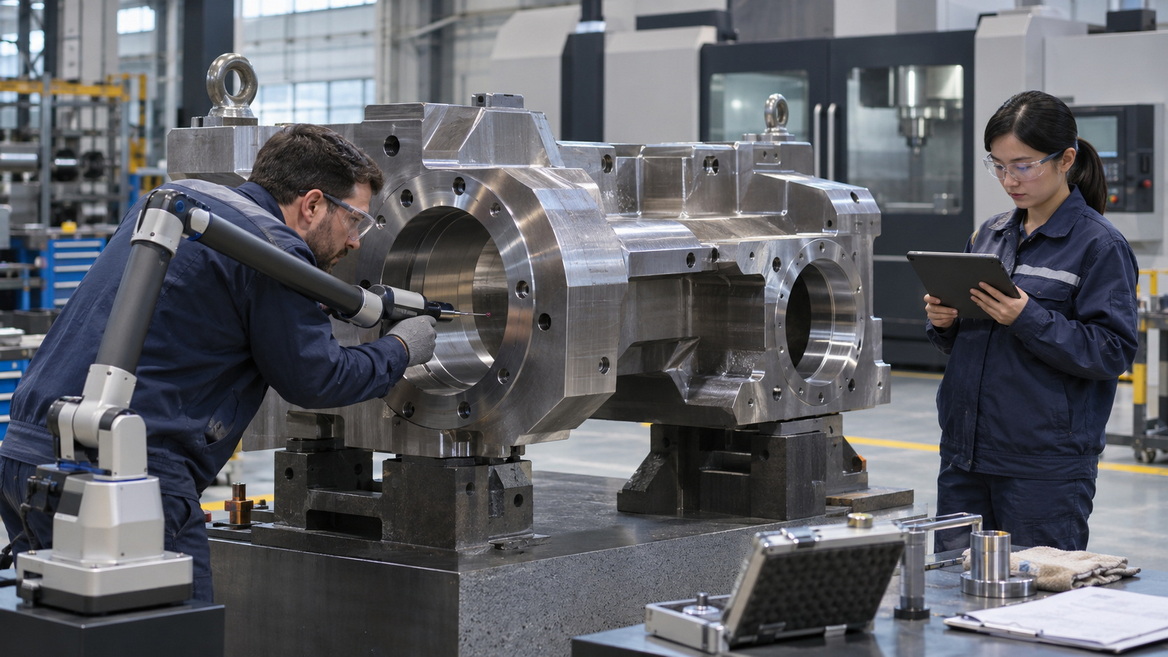
Based in Foshan, Guangdong, China, Xinxinke states that it was founded in 1991 and specializes in copper and aluminum profile extrusion equipment. Its official website reports annual output of approximately 200 machines and exports to Southeast Asia, Europe, and the United States. Those export-market statements do not establish a current Russian installation or service network.
Xinxinke is a relevant candidate for small and medium-sized extrusion businesses seeking an application-specific machine rather than a fixed, standardized package.
Its published technical table covers presses from 600 to 9,000 metric tonnes, including long-stroke and short-stroke configurations. The broader company homepage advertises capability up to 20,000 tonnes. Buyers considering larger machines should therefore distinguish catalogued models from engineered-to-order capability and request comparable operating references.
Its project page lists direct and indirect extrusion installations, including machines identified for aluminum-profile producers and a 2,750-tonne indirect extrusion project. These references provide useful starting points for customer verification.
Xinxinke's published materials describe customization around billet dimensions and production requirements. Relevant discussion areas include:
- Press force and container dimensions.
- Direct versus indirect extrusion.
- Billet handling and heating interfaces.
- Factory layout and auxiliary-equipment integration.
- Control functions and production-data requirements.
For machinery, "OEM/ODM" should mean a documented engineering scope, drawing responsibility, and acceptance criteria—not simply adding a buyer's nameplate.
Xinxinke deserves consideration where purchasing value depends on specification flexibility, direct technical coordination, and support for a smaller producer's customized project.
However, competitive pricing and communication efficiency should be tested rather than assumed. Request a structured quotation, a named project engineer, a technical-response schedule, and a clear division between standard equipment and paid engineering changes.
The reviewed information does not establish current machine-specific certification for a Russian delivery. Obtain the relevant documents before contracting.
Foshan Yejing Machinery Manufacturing Co., Ltd. states that it has manufactured aluminum extrusion equipment since 1990. Its website reports more than 3,000 extrusion presses supplied since then and describes service to domestic and overseas customers.
Yejing's main distinction is its emphasis on integrated aluminum extrusion production.
The company reports approximately 66,667 square meters of factory space, around 300 employees, and maximum annual output of 300 sets. Its stated processing, assembly, and commissioning capability covers 600–9,000 MT presses. Maximum annual output is not the same as available capacity for a new order.
Its intelligent-line offering connects equipment such as the billet furnace, hot-log shear, press, puller, run-out table, and die heater through centralized control. It also describes production-data storage and connection to factory management systems.
Yejing is particularly relevant when a buyer wants coordinated line engineering rather than separate equipment purchases.
Potential customization discussions should cover:
- Press and billet-loading configuration.
- Heating and downstream handling interfaces.
- Centralized control architecture.
- Production-data collection.
- Layout integration with existing equipment.
Yejing suits buyers prioritizing line integration, automation, and a substantial disclosed manufacturing base.
Its website states ISO 9001:2015 and TÜV-related CE conformity credentials. Buyers should obtain the actual certificates, confirm the certified entity and manufacturing address, and review the machine-specific declaration and applicable standards. A website statement alone does not establish current conformity for the ordered line.
Foshan Sailixin Machinery Manufacturing Co., Ltd. states that it was established in 2011 in Shishan, Nanhai District, Foshan.
Its website reports more than 1,400 domestic and overseas sales and a 50,000-square-meter industrial park. These are supplier-reported figures; the reviewed homepage does not provide a country-by-country market breakdown.
Sailixin publishes a self-developed aluminum extrusion press range of 700–7,500 tonnes and identifies nearly 30 research and development technicians.
Its equipment offering extends beyond the press to billet furnaces, die ovens, quenching equipment, cooling tables, pullers, stretchers, aging furnaces, and automatic handling equipment.
Sailixin describes whole-factory planning, design, and technical support for complete production-line equipment.
That makes it relevant for buyers evaluating a new plant or a coordinated expansion, particularly where press selection must match downstream cooling, stretching, and aging capacity.
Sailixin is worth evaluating for integrated aluminum-profile projects within its published tonnage range.
Its website displays ISO 9001 and high-tech-enterprise credentials. Buyers should verify certificate details and distinguish company-management certification from machine safety conformity.
Request evidence showing which line components are manufactured internally, which are subcontracted, and who accepts responsibility for overall line performance.
SMS group GmbH is a Germany-based metallurgical plant and equipment supplier. Its industrial roots date to 1871; the present SMS group GmbH organization emerged from the merger of SMS Siemag AG and SMS Meer GmbH in 2015. Its operations serve international metals producers.
SMS offers extrusion technology for light metals, heavy metals, and steel. Its aluminum extrusion offering combines presses with heating and downstream equipment through its associated technology businesses, including IAS and OMAV.
Its 2026 exhibition material highlighted a 150-MN direct tube and extrusion press supplied for ASAŞ, demonstrating capability at the large-project end of the market. That example is a technical benchmark, not a standard model suitable for every buyer.
SMS is best understood as a project-engineering and lifecycle-technology supplier rather than a private-label machinery factory.
Its scope can include integrated process equipment, automation, heating, extrusion, and handling systems.
SMS is relevant as a technical benchmark for large, complex, or highly automated investments.
For Russian projects, current supply eligibility must be established before treating it as a commercially available option. European restrictions cover categories of industrial goods and technology, and transaction feasibility depends on the equipment, parties, end use, and applicable rules.
UBE MACHINERY CORPORATION, Ltd. is headquartered in Ube, Japan. Its manufacturing origins date to January 1914, while the current corporation was established in September 1999 and began business in April 2000. Its North American organization explicitly serves the United States, Canada, and Mexico.
UBE offers direct and indirect extrusion technology for aluminum and copper-related applications.
Its SS5G catalog lists nominal press sizes from 1,500 to 10,000 MT. The design emphasizes short-stroke operation, servo-driven pumps, ram-speed control, and container and crosshead alignment.
In October 2025, UBE announced that it had reached 600 extrusion presses manufactured. This is cumulative production, not annual manufacturing capacity.
UBE's offering includes application engineering and lifecycle services such as installation, modification, renewal, and relocation.
Its published service material also discusses upgrades intended to improve cycle time, energy use, and temperature control.
UBE is relevant for buyers comparing advanced control, high-strength aluminum processing, and long-term equipment modernization.
Certification requires particular care: a publicly accessible ISO 9001 certificate reviewed for this guide shows an expiry date of May 31, 2026. That does not prove that UBE's certification has lapsed; it means the published document cannot establish current validity in November 2026. Request the renewed certificate directly.
Current authorization to supply or service a Russian project must be confirmed separately.
Press force and manufacturing output measure different things. Neither establishes the tonnes of acceptable profiles a particular factory will produce per shift.
| Manufacturer | Published press capacity | Disclosed manufacturing scale | MOQ / order basis | Certification evidence and limitations |
|---|---|---|---|---|
| Xinxinke | Technical table: 600–9,000 MT; broader homepage claim up to 20,000 T | Approximately 200 units annually, supplier-reported | Not publicly verified; request a one-press or complete-line quotation | Current project-specific documents must be requested. |
| Yejing | 600–9,000 MT | Maximum 300 sets annually, supplier-reported | Not publicly disclosed | Website states ISO 9001:2015 and TÜV-related CE credentials; verify scope and validity. |
| Sailixin | 700–7,500 T | More than 1,400 cumulative domestic and overseas sales reported | Not publicly disclosed | ISO 9001 displayed; verify issuer, scope, and dates. |
| SMS group | Application-specific; 150-MN project example | Comparable annual press-unit output not established here | Project-specific | Request factory, machine, and destination-specific documentation. |
| UBE Machinery | SS5G catalog: 1,500–10,000 MT | 600 cumulative presses announced in October 2025 | Not publicly disclosed | Reviewed ISO document expires May 31, 2026; obtain updated evidence. |
For capital equipment, "MOQ: one set" may sound plausible, but it should not be presented as a verified supplier policy without a quotation.
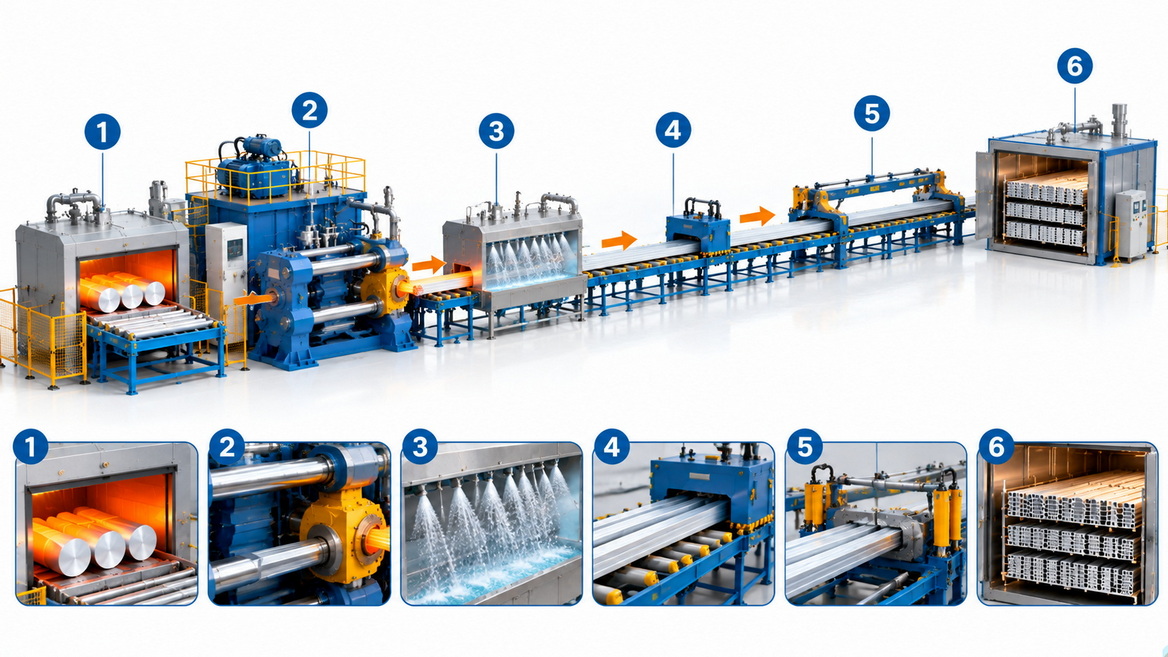
Send the supplier a representative package of profile drawings, alloy designations, tempers, billet dimensions, dimensional tolerances, and intended applications.
Separate architectural profiles from demanding transportation, electrical, or high-strength products. UBE's published range, for example, distinguishes direct extrusion from indirect extrusion suited to hard-alloy applications. This illustrates why process selection must precede price comparison.
The proposed line should explain how the press, billet heater, die heater, quench, puller, stretcher, and aging equipment work together.
For copper projects, do not accept an aluminum-line proposal with only the machine name changed. Require an alloy-specific process review and comparable references.
Include the following in the purchase specification:
- Approved material grades for major load-bearing components.
- Heat-number traceability and material certificates.
- Required heat-treatment records.
- Agreed non-destructive testing methods and acceptance criteria.
- Machining and alignment inspection records.
- Written approval before substituting critical materials or components.
This is a proposed procurement control, not a claim that every shortlisted supplier already follows the same inspection plan.
A common purchasing risk is an apparently equivalent substitution that changes fatigue performance, component life, or spare-parts compatibility. Prevent it through a controlled bill of materials and inspection hold points.
UBE advertises SS5G power reductions against identified earlier configurations, while SMS has published energy-saving claims for its HybrEx technology against conventional presses. Those comparisons use different baselines and should not be combined into a universal savings ranking.
Instead, require each bidder to state:
- The reference machine and operating conditions.
- Whether the figure covers only the press or the complete line.
- The alloy, profile, billet length, and production speed.
- The treatment of idle time and auxiliary loads.
- Energy consumption per tonne of accepted output.
A lower motor rating is not a substitute for a measured production trial.
Treat quality-management certification, machinery safety conformity, and restricted-substance requirements as separate questions.
An ISO 9001 certificate concerns the named organization and its certified activities. It does not by itself certify a particular press's output, safety, or suitability.
For a Russian installation, do not assume that CE documentation is sufficient. The Eurasian Economic Commission lists TR CU 010/2011 for machinery safety, alongside low-voltage and electromagnetic-compatibility regulations that may require assessment depending on the equipment and supply configuration. Determine the applicable conformity route with a qualified specialist.
Likewise, do not use a generic RoHS statement as evidence that an entire heavy industrial line satisfies every destination requirement. Ask the supplier to explain applicability and exclusions for the actual equipment.
Russia-related restrictions can affect equipment, components, software, financing, transport, and technical services. Official European measures include restrictions involving industrial goods and technology, with additional controls affecting designated parties and certain third-country transactions.
Before contracting, obtain a documented review covering:
1. The buyer, end user, and beneficial owners.
2. Equipment and component classifications.
3. Applicable export-control and sanctions requirements.
4. Banking, insurance, and transport acceptance.
5. Installation, remote support, software updates, and future spare parts.
Do not treat an intermediary or alternative shipping route as a substitute for lawful authorization.
A useful insider-style purchasing rule is to reject performance guarantees based only on peak ram speed or an unusually simple demonstration profile.
The commercially important measure is saleable output.
A proposed acceptance test should therefore define the complete production boundary:
- Approved profile drawings and alloy.
- Billet condition and dimensions.
- Warm-up and stabilization requirements.
- Die changes and ordinary production interruptions.
- Accepted dimensional and surface-quality criteria.
- Scrap accounting and weighing method.
- Energy-metering boundary.
- A sustained test period agreed by both parties.
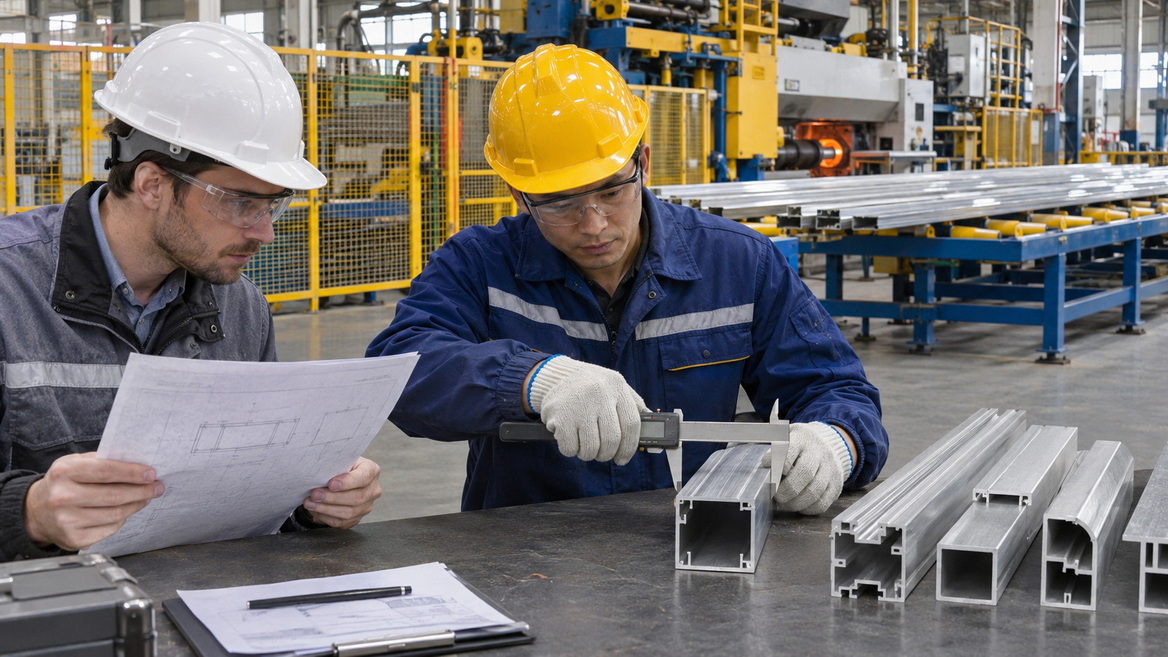
This prevents a disagreement in which the supplier demonstrates the press's mechanical speed while the buyer expects a guaranteed quantity of finished, acceptable profiles.
It also exposes line bottlenecks: a capable press cannot compensate for undersized heating, cooling, stretching, or handling equipment. Integrated supplier offerings from Yejing and SMS demonstrate why evaluating the complete process chain matters.
Request a live walkthrough showing the legal entity's name, machining equipment, assembly area, test facilities, and machines currently under construction.
Then compare the evidence with:
- The contracting entity.
- The bank beneficiary.
- The factory address.
- The certificate holder.
- The entity responsible for warranty service.
Where subcontracting is involved, identify who controls quality and who carries contractual responsibility.
A finished profile sample alone cannot demonstrate that the proposed press produced it.
For a meaningful trial, agree on material identification, die identification, process records, inspection methods, and witnessing arrangements. Separate factory acceptance from site acceptance, because utilities, foundations, alignment, and downstream integration may differ.
Require the supplier and forwarder to review:
- Largest package dimensions and individual lifting weights.
- Disassembly and reassembly responsibilities.
- Center-of-gravity and lifting information.
- Route and unloading restrictions.
- Corrosion protection and storage requirements.
- Insurance coverage and damage-reporting procedures.
- Installation access and foundation readiness.
The cheapest freight quotation may exclude difficult lifting, inland permits, or site handling. List those responsibilities explicitly.
The strongest extrusion press shortlist for a Russian project is not necessarily the longest list or the one with the lowest initial quotation. It is the shortlist whose members can document their engineering capability, match the proposed line to the required products, and support a legally feasible installation throughout its operating life.
Xinxinke offers a relevant starting point for buyers seeking customized copper and aluminum extrusion equipment with direct engineering coordination. Yejing and Sailixin provide additional integrated-line options, while SMS and UBE offer useful technology benchmarks where current supply eligibility permits.
For a project-specific proposal from Xinxinke Co., Ltd., submit your profile drawings, alloy grades, billet dimensions, target saleable output, and factory layout. Ask for a clearly scoped technical offer covering equipment configuration, inspection milestones, acceptance testing, installation, and long-term spare-parts support.
Request the complete certificate and all schedules, not a cropped logo.
Check the legal entity, address, certificate number, scope, issue date, expiry date, and issuing certification body. Confirm current status directly with the issuer when uncertainty remains.
UBE's reviewed public document is a useful example: its stated May 2026 expiry means buyers need renewed evidence, but it does not justify claiming that the company currently lacks certification.
Yes. Tonnage describes nominal force, not complete production capability.
Require comparable information on billet dimensions, extrusion speed under load, temperature control, alignment, handling time, and downstream equipment. Published designs from Yejing and UBE show that short-stroke layouts, servo-driven movements, and control systems are important differentiators beyond nominal force.
The final comparison should use the same profile portfolio and acceptance conditions.
Use a complete-line proposal when interface responsibility is a major concern. Consider separate sourcing when your team can manage integration and there is a clear technical or commercial advantage.
In either case, appoint one party to control the interface matrix: signals, material transfer, emergency stops, production sequencing, and performance boundaries.
Yejing and Sailixin both describe broader line-level offerings, while SMS presents an integrated extrusion ecosystem.
No automatic conclusion follows from the supplier's country.
Review the transaction's parties, equipment, incorporated technology, end use, payment arrangements, and applicable laws. Official European measures also address certain third-country entities and transactions, illustrating why country of assembly alone is not a sufficient compliance test.
Obtain qualified advice before making a binding payment.
The contract should distinguish equipment defects from site-readiness and integration problems.
Specify site-acceptance conditions, utility requirements, installation responsibilities, adjustment periods, retesting procedures, payment retention, and remedies.
Avoid a warranty clause that promises only replacement parts while leaving the buyer responsible for every diagnostic visit, freight charge, and production interruption.
- Xinxinke's official company information, technical tables, and project references provide its founding year, reported production scale, product range, and application examples. Its homepage and technical table describe different upper capacity limits, which buyers should reconcile in a project quotation. [xxkextrusion]
- Yejing's official website provides its corporate name, manufacturing history, stated production capability, integrated-line offering, and certification claims. [yjing-extrusion]
- Sailixin's official website provides its corporate name, establishment year, published tonnage range, industrial-park size, and reported cumulative sales. [slxextrusionpress]
- SMS group's official heritage and technology publications explain its corporate history, extrusion scope, and integrated production-line offering. [sms-group]
- UBE's official company profile, product catalog, manufacturing announcement, service information, and published certificate support its company history, technical range, cumulative production, and certification-document caveat. [ubemachinery.co]
- The Russian Aluminium Association's April 2026 update supplies the cited industry-consumption figures. These are broader aluminum-market indicators, not extrusion press market statistics. [aluminas]
- The Eurasian Economic Commission provides official machinery-safety regulations and the list of technical regulations in force. [eec.eaeunion]
- The Council of the European Union provides official information on Russia-related restrictions. Transaction-specific review remains necessary. [consilium.europa]


