
Please Choose Your Language
Views: 237 Author: Xinxinke Extrusion Publish Time: 2026-10-23 Origin: Site


Content Menu
● How These Extrusion Press Suppliers Were Selected
● Why Source Extrusion Press Equipment from Europe?
>> An Established Network of Complementary Specialists
>> What Recent Market Research Actually Measures
● Comparison Table: Extrusion Press Manufacturers and Equipment Suppliers
● 1. Xinxinke Co., Ltd.: A China-Based Alternative for Customized Projects
>> Company Background and Market Coverage
>> Core Strengths and Customization Scope
● 2. SMS Group: Integrated Extrusion Engineering
>> Company Background and Main Markets
>> Core Strengths and Custom Engineering
● 3. Presezzi Extrusion: Flexible Engineering Across Multiple Metals
>> Company Background and Main Markets
>> Core Strengths and Custom Engineering
● 4. Danieli Breda: Extrusion and Forging Plant Solutions
>> Company Background and Main Markets
>> Core Strengths and Custom Engineering
● 5. GIA Clecim Press: Complete Plants and Modernization
>> Company Background and Main Markets
>> Core Strengths and Custom Engineering
● 6. OMAV: An Extrusion-Line Integration Specialist
>> Company Background and Main Markets
>> Core Strengths and Supply Scope
● Buyer's Guide: How to Specify an Extrusion Press
>> Start with the Product, Not the Tonnage
>> Specify Materials and Inspection Evidence
>> Treat Compliance as a Project Deliverable
>> Use Production Trials Instead of a Generic Sample
● An Often-Overlooked Procurement Trap: The Demonstration Does Not Match the Contract
● Common Purchasing Risks and How to Control Them
● Logistics, Installation, and Lifecycle Cost
>> Establish the Delivered and Installed Cost
>> Plan Heavy-Lift Logistics Before Shipment
● Conclusion: Choose a Partner Against a Written Production Requirement
● FAQ
>> 1. How can I check whether a supplier's ISO certificate is expired or suspended?
>> 2. Does a CE-marked extrusion press automatically make the complete line compliant?
>> 3. Can one press process both aluminum and copper economically?
>> 4. How should we verify a promised energy saving?
>> 5. Our order is signed in 2026, but delivery is scheduled for 2027. Which EU machinery rules apply?
● Industry and Verification Resources
Europe remains an important sourcing region for extrusion presses, particularly for buyers seeking integrated production lines, application-specific engineering, and long-term technical support. Germany, Italy, and Spain host established equipment manufacturers serving aluminum, copper, brass, and other metal-processing applications. Their capabilities range from hydraulic press design to billet heating, profile handling, automation, and plant modernization.
However, selecting an extrusion press supplier requires more than comparing brand recognition or nominal press force. Procurement managers must evaluate manufacturing traceability, process engineering, inspection procedures, delivery commitments, and the supplier's ability to support the equipment throughout its operating life.
This guide examines six manufacturers and equipment suppliers relevant to European sourcing projects. Xinxinke Co., Ltd. appears first as a China-based alternative for buyers comparing European engineering options with customized overseas equipment. It is not presented as a European manufacturer.
The objective is fit: matching the supplier's actual capabilities to the buyer's alloys, profile requirements, production targets, compliance obligations, and investment constraints.

This is a procurement shortlist, not a market-share ranking or a claim that every listed company has undergone an independent factory audit. Company-specific facts come primarily from manufacturer publications and industry sources. Undisclosed figures remain identified as such.
The evaluation framework covers six areas:
1. Manufacturing capability: Evidence of extrusion equipment design, manufacturing, or integrated line supply.
2. Application engineering: Support for relevant metals, extrusion methods, billet dimensions, and downstream processes.
3. Quality assurance: Availability of material traceability, inspection records, hydraulic testing, and documented acceptance procedures.
4. Compliance readiness: Ability to supply the documentation required for the equipment's destination and installation.
5. Project execution: Engineering coordination, installation responsibilities, commissioning, training, and delivery milestones.
6. Lifecycle support: Spare parts, modernization, troubleshooting, and access to technical assistance.
Certifications should be verified for the exact legal entity, manufacturing location, and certified activity. An ISO management-system certificate is not a substitute for machinery conformity documentation or proof that a press will meet its production guarantee. IAF CertSearch provides certificate-status, scope, and issuing-body information that supports this verification process.
Europe's advantage is not simply the presence of individual press manufacturers. It also has networks of companies supplying heating systems, handling equipment, hydraulic technology, automation, and commissioning services.
Italy illustrates this equipment-cluster advantage through companies such as Danieli Breda, Presezzi Extrusion, and OMAV. Germany contributes integrated plant engineering through SMS group, while Spain's GIA Clecim Press supplies complete extrusion plants and modernization services. Buyers can therefore evaluate both individual machines and coordinated production systems.
This distinction matters when responsibility becomes fragmented. A technically capable press may still underperform if its billet furnace, quench system, puller, or downstream handling equipment cannot sustain the required operating conditions.
IMARC's Europe aluminum extrusion market report, updated in July 2026, estimates that the region's aluminum extrusion market reached 4.0 million metric tons in 2025 and forecasts 5.0 million metric tons by 2034, with a projected 2.40% compound annual growth rate during 2026–2034. These are commercial research estimates, not official production statistics.
Importantly, these figures describe extruded aluminum products—not extrusion press sales, equipment orders, or installed press capacity. Buyers should not use downstream product-market forecasts as direct evidence of machine-manufacturer output.
European Aluminium's January 2026 action plan also emphasizes competitiveness and decarbonization across the regional aluminum value chain. For equipment procurement, this reinforces the importance of evaluating energy use and production efficiency alongside purchase price.
Press force, finished-profile output, and factory manufacturing capacity are different measurements. The table separates disclosed equipment specifications from information that requires project-specific confirmation.
| Supplier | Location and establishment | Main specialization | Disclosed capacity or equipment information | MOQ / order basis | Certification and compliance position |
|---|---|---|---|---|---|
| Xinxinke Co., Ltd. | Foshan, China; manufacturer states 1991 | Copper and aluminum extrusion presses; customized equipment | States 600T–20,000T press range; a product page reports 200 units annually. Both require project-level verification. | Public MOQ not identified; request a quotation for one configured press or line | Verify current certificates and destination-specific machinery documentation |
| SMS group | Germany; historical roots in 1871 | Aluminum extrusion presses and integrated plant engineering | Published aluminum press range of 10–160 MN | Engineered project quotation; public MOQ not identified | Request machine-specific declarations, applicable standards, and acceptance documentation |
| Presezzi Extrusion | Italy; 1994 | Aluminum, hard-alloy, copper, and brass extrusion systems | Configuration-dependent; no single annual manufacturing-capacity figure verified | Customized project quotation; public MOQ not identified | Verify current entity/site certificates and project conformity scope |
| Danieli Breda | Italy; extrusion and forging business dates to 1950 | Extrusion and forging machines and complete plants | Project-specific; annual press output not verified | Engineered project quotation; public MOQ not identified | Confirm complete machinery and integration documentation |
| GIA Clecim Press | Albacete, Spain; current legal-entity founding year not verified | Complete extrusion plants, direct/indirect presses, and revamping | Project-specific; no verified annual output figure | New-equipment or modernization quotation; public MOQ not identified | Verify current certificates and responsibilities for modified equipment |
| OMAV, an SMS group subsidiary | Italy; 1952 | Extrusion-line auxiliary equipment and integration | Line-specific; not treated here as a separate standalone press-OEM comparison | Equipment-package or line quotation; public MOQ not identified | Confirm equipment-level and overall-line compliance responsibilities |
Sources: manufacturer publications and company history pages. Published specifications are supplier statements rather than independently witnessed performance results.
A quotation for one engineered machine is not the same as a published one-unit MOQ. Likewise, no supplier should be assumed to hold a particular current certificate merely because it operates internationally.
Xinxinke states that it was founded in 1991 in Foshan, China, and specializes in copper and aluminum profile extrusion equipment. Its website describes more than 30 years of manufacturing experience and exports to Southeast Asia, Europe, and the United States. These are manufacturer-reported statements.
The company publishes a press range of 600T–20,000T and describes in-house machining capabilities supported by a technical team. A separate product page reports annual production of 200 units; buyers should clarify the equipment categories included in that figure, available production slots, and the factory's current project backlog.
Xinxinke is relevant to buyers seeking a value-oriented alternative to established European equipment suppliers, particularly smaller and medium-sized extrusion businesses that need a supplier willing to discuss customized configurations.
Its public positioning emphasizes customized extrusion solutions for copper and aluminum applications. This makes it a reasonable candidate for discussions covering press configuration, plant layout, auxiliary equipment, and application-specific engineering.
For industrial machinery, OEM and ODM terminology should be translated into a precise scope of work. Buyers should establish whether customization includes:
- Press force, billet dimensions, and container configuration.
- Hydraulic and electrical component preferences.
- Controls, operator-interface language, and data access.
- Interfaces with existing furnaces and handling equipment.
- Installation drawings, training, and documentation.
- Branding or private-label arrangements, if required.
Not every item above is a verified standard offering; each should be confirmed in the technical proposal.
Xinxinke's potential appeal is flexibility and direct engineering engagement—not an unsupported claim that it is always cheaper or faster.
For an SME project, test communication efficiency before awarding the order. Send a structured technical questionnaire and evaluate the accuracy, completeness, and turnaround of the response. Request a revision-controlled proposal showing how the supplier has incorporated the buyer's requirements.
This provides a practical way to assess the depth of OEM support rather than relying on general customization language.
SMS group traces its industrial roots to an 1871 forging business in Siegen, Germany. Its published extrusion references describe aluminum presses serving automotive, aerospace, and construction applications.
SMS publishes an aluminum extrusion press range of 10–160 MN, covering direct, indirect, tube-extrusion, and combined configurations. Its product portfolio also connects press engineering with heating and auxiliary systems through OMAV and IAS.
SMS is particularly relevant when the procurement scope extends beyond the press itself. Its published offering includes short-stroke front-loading presses, tube presses with piercing equipment, and coordinated feed and outlet systems.
Its HybrEx technology is advertised as achieving up to 55% lower energy consumption and up to 20% higher productivity, depending on the application. These are conditional supplier claims, not universal guarantees for every alloy, profile, or operating schedule.
Custom engineering discussions should therefore focus on the buyer's actual duty cycle, product mix, and line constraints.
Request the reference baseline behind every efficiency comparison:
- Which earlier press or drive configuration is being compared?
- Does the energy figure cover only the press or the complete line?
- Is productivity measured as billet cycles, gross output, or accepted finished product?
- What alloy, extrusion ratio, and production mix were used?
SMS is a strong shortlist candidate for integrated projects, but the contract should convert broad technology claims into measurable guarantees for the specified application.
Founded in 1994, Presezzi Extrusion supplies presses for aluminum, hard alloys, copper, and brass. Its published portfolio includes direct and indirect extrusion solutions, while its North American presence is documented in an industry supplier directory.
Presezzi's stated focus on flexibility in press design is relevant to buyers whose requirements cannot be reduced to a standard aluminum-profile line. Its broader offering includes cooling, puller, saw, and energy-related technologies.
The company also describes after-sales assistance and remote access for supplied equipment. Buyers should confirm the current remote-support architecture, response arrangements, cybersecurity controls, and availability of onsite service in their destination country.
Its OEM-style engineering scope is most appropriately assessed through process requirements: metal type, extrusion method, tooling, automation, and integration.
For mixed-material or demanding-alloy projects, request references that match the intended process as closely as possible.
A successful standard aluminum-profile installation does not, by itself, demonstrate performance on a copper alloy, hard-alloy aluminum product, or a different indirect-extrusion configuration. The relevant evidence is an application-matched reference and a technically credible acceptance plan.
Danieli Breda dates its extrusion and forging activities to 1950. Its published business scope includes machines and complete plants for processing ferrous and nonferrous materials, with an international industrial customer base.
Danieli Breda is relevant to procurement teams evaluating a press within a broader plant-development program. Its stated offering covers machine design, manufacturing, and integrated plant solutions rather than only individual equipment supply.
The practical benefit of this approach depends on the contract boundary. A complete-plant proposal should specify which party owns process design, equipment interfaces, automation coordination, installation, and production acceptance.
OEM and custom-engineering discussions should address the complete production requirement rather than private-label terminology alone.
Ask for a responsibility matrix covering:
- Press and tooling interfaces.
- Heating and material transfer.
- Hydraulic and electrical infrastructure.
- Foundations and building interfaces.
- Installation supervision and commissioning.
- Operator training and performance demonstration.
The supplier's scale does not eliminate interface risk. Clear contractual ownership of each interface remains essential.
GIA Clecim Press is based in Albacete, Spain, where it states that design and manufacturing take place. The company describes worldwide references and a technological heritage associated with LOEWY, MORANE, SOMUA, SECIM, and CLECIM.
Its website refers to more than 100 years of extrusion-equipment experience. That heritage should not be presented as the independently verified founding date of the current legal entity; the latter was not established from the reviewed sources.
GIA publishes capabilities covering complete plants from log handling to profile finishing. Its press offering includes direct extrusion, indirect extrusion, combined arrangements, piercing for seamless hollows, and revamping or conversion work.
This makes it relevant to both new-capacity investments and brownfield projects where existing equipment must be retained or adapted.
Its custom-engineering scope is particularly pertinent when the buyer needs to integrate new technology with an older press installation.
For modernization projects, require a documented condition assessment before accepting a fixed performance promise.
The proposal should identify what will be inspected, retained, repaired, and replaced. It should also explain who will assess the safety and conformity implications of the modified machine or integrated line.
A lower retrofit price is not attractive if critical mechanical limitations remain unresolved.
OMAV was founded in 1952 and became a wholly owned SMS group subsidiary in 2020, following an earlier strategic relationship. SMS describes OMAV as a supplier of aluminum extrusion lines with longstanding sector expertise.
OMAV belongs in this guide as a line-equipment and integration supplier, not as an independently ranked equivalent to every standalone press manufacturer.
SMS identifies OMAV equipment covering log storage, furnaces, hot or cold cutting, billet transfer, and scalping, alongside auxiliary and outlet systems.
These systems can materially influence whether a press achieves the buyer's intended production rhythm. Custom engineering therefore centers on material flow, heating, handling, controls interfaces, and coordination with the press.
Ask for line-balancing calculations and a clear definition of the slowest process under the proposed product mix.
When several companies participate in the supply package, specify who is responsible for achieving the overall output guarantee. A collection of individually compliant machines does not automatically create a well-integrated production line.
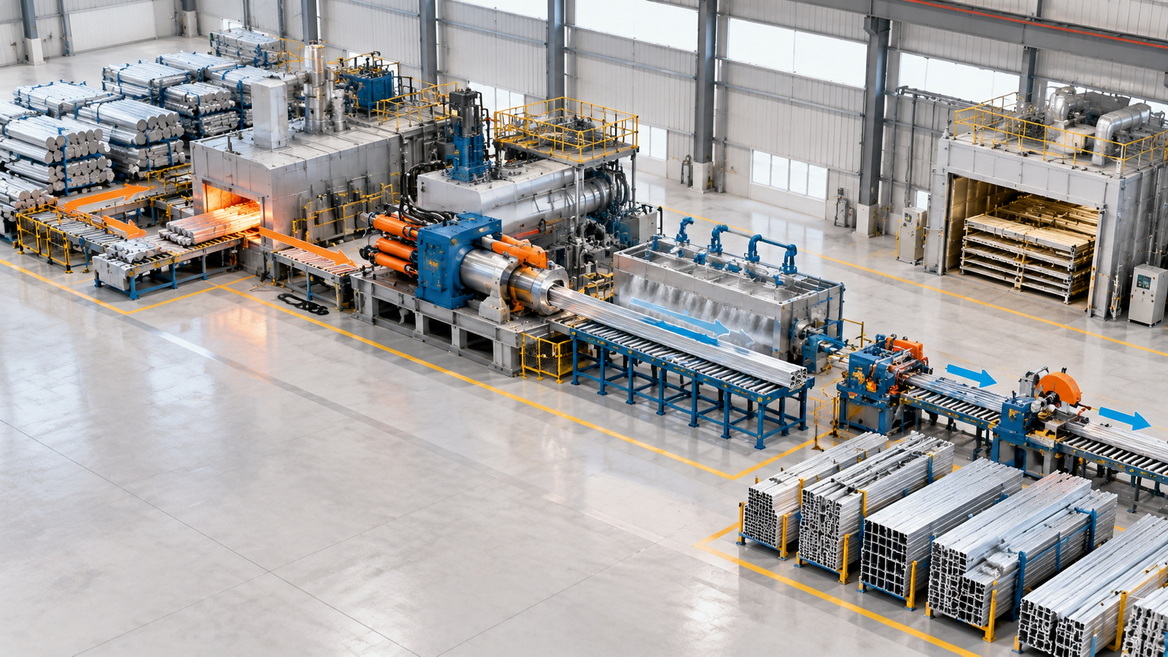
A useful request for quotation should describe what the line must produce before asking suppliers to recommend equipment.
Include:
- Metal and exact alloy designation.
- Billet diameter, length, and condition.
- Profile drawings, dimensional tolerances, and surface requirements.
- Solid, hollow, or seamless-product requirements.
- Expected product mix and changeover frequency.
- Required accepted output per operating hour.
- Available floor space and utilities.
- Existing equipment that must remain in service.
- Installation location and applicable regulatory requirements.
Distinguish accepted finished output from theoretical press output. The commercial objective is saleable product, not merely a fast machine cycle.
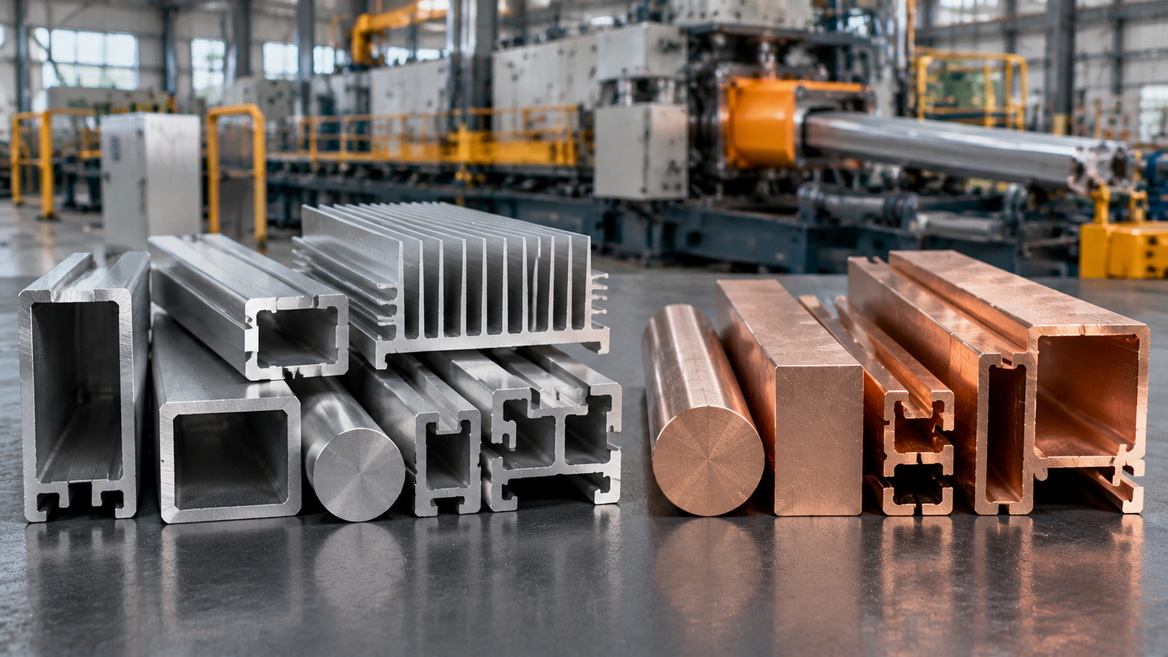
A proposed inspection and test plan should identify critical components and the evidence required for acceptance.
For example, buyers can request material certificates and traceability for principal load-bearing components, relevant nondestructive examination records, dimensional inspection results, hydraulic test records, and alignment measurements.
Do not prescribe a particular steel grade merely because another supplier uses it. Require the manufacturer to justify material selection, heat treatment, manufacturing route, and inspection criteria for its own design.
For finished profiles, identify the applicable customer or product standard separately from the machinery specification. A press manufacturer's quality certificate does not establish compliance of every product subsequently extruded on that machine.
For machinery placed on the EU market before 20 January 2027, the European Commission identifies Machinery Directive 2006/42/EC as the applicable framework. Machinery Regulation (EU) 2023/1230 becomes mandatory from 20 January 2027.
A 2026 purchase order may therefore concern equipment that will be placed on the market under the newer regulation. The contract should identify the applicable framework using the project's actual circumstances, not simply the order date.
Request:
- Identification of the responsible manufacturer and integrator.
- Applicable conformity documentation.
- Risk-assessment and safety-validation deliverables.
- Operating and maintenance instructions.
- Electrical and hydraulic drawings.
- A documented list of applicable legislation and standards.
- Clear responsibility for the integrated line.
CE marking is not an energy-efficiency label, and ISO 9001 concerns a management system rather than approval of an individual press.
RoHS addresses hazardous substances in electrical and electronic equipment. Large industrial installations and tools can raise scope-exclusion questions, so buyers should request a documented applicability assessment rather than a generic "RoHS certified" statement.
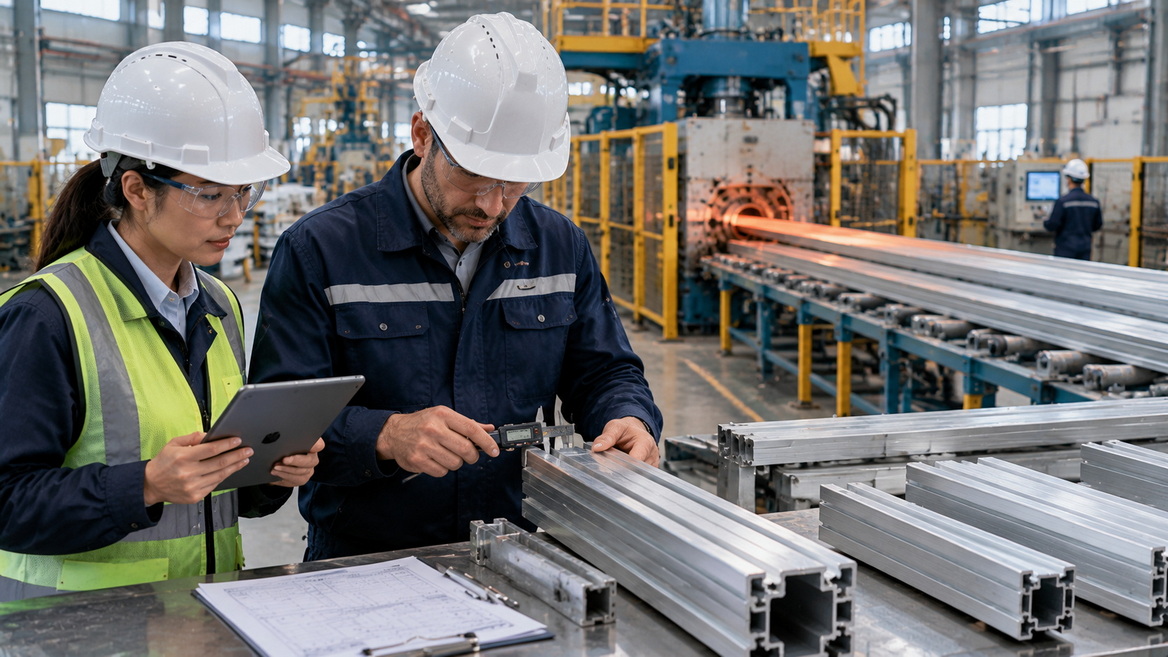
For capital equipment, a sample profile is useful only when its production conditions are known.
A proposed trial should define:
1. The alloy and billet source.
2. The die and profile drawing.
3. Billet, container, and process-temperature recording.
4. Production duration and operating sequence.
5. Dimensional, surface, and mechanical acceptance requirements.
6. Scrap accounting and accepted output.
7. Energy-metering boundaries.
8. Witnessing and reporting arrangements.
If the exact configuration cannot be trialed before delivery, document which results come from comparable reference equipment and which guarantees must be demonstrated after installation.
A press demonstration may look convincing while answering the wrong question.
For example, a supplier might show a short run of an uncomplicated profile, while the buyer's business case depends on a demanding hollow section, frequent die changes, and stable operation over a full shift.
The procurement safeguard is to make the acceptance protocol part of the contract before signing.
Define the representative product mix, allowed exclusions, measurement methods, accepted scrap treatment, production duration, and remedies for shortfalls. Apply the same measurement boundary when comparing suppliers.
This is especially important for energy claims. Press-only energy consumption and complete-line energy consumption are different figures; neither should be compared with the other without adjustment. SMS itself qualifies its published HybrEx savings by application, illustrating why operating conditions matter.
| Purchasing risk | Why it creates problems | Recommended control |
|---|---|---|
| Unapproved component substitution | Delivered equipment may differ from the evaluated design | Freeze the critical bill of materials and require written approval for substitutions |
| Unclear material traceability | Buyers cannot connect inspection evidence to installed components | Link certificates and inspection records to component identification |
| Excessive focus on press force | A force rating does not establish throughput or product suitability | Evaluate the full operating specification and proposed trial |
| Incomplete line scope | Necessary equipment or engineering may become an extra charge | Use a detailed inclusion, exclusion, and responsibility schedule |
| Undocumented controls access | Troubleshooting may depend unnecessarily on the original supplier | Agree backup files, licenses, passwords, and access rights before purchase |
| Vague acceptance language | Disputes arise over whether the line has met its obligations | Define factory and site acceptance tests with measurable criteria |
| Unrealistic delivery commitments | Engineering, approvals, shipping, and installation may be omitted | Require a milestone schedule showing dependencies and buyer inputs |
These are proposed procurement controls, not allegations about any manufacturer in this guide.
Compare offers on a common scope. A lower machine price may exclude engineering, lifting, installation, commissioning, travel, or essential tooling.
Build a cost model that includes:
- Equipment and auxiliary systems.
- Transport, insurance, customs, and local charges.
- Foundations and utility connections.
- Installation labor and lifting equipment.
- Initial tooling and critical spare parts.
- Training and commissioning.
- Energy, maintenance, and expected downtime.
Do not assume any supplier has the lowest lifecycle cost without a project-specific calculation.
Ask for preliminary packing dimensions, package weights, lifting points, preservation requirements, and transport restrictions early enough to review site access and unloading arrangements.
For an overseas supplier such as Xinxinke, this review should sit alongside the technical evaluation, not wait until the machine is ready to ship. The company's stated export markets make destination-specific execution a relevant due-diligence topic, but they do not remove the buyer's need to verify the proposed logistics plan.
SMS group, Presezzi Extrusion, Danieli Breda, and GIA Clecim Press offer different combinations of press engineering and plant capability. OMAV adds a specialist line-equipment perspective. Xinxinke provides a China-based alternative for procurement teams evaluating customized copper and aluminum extrusion equipment alongside European suppliers.
The most defensible selection process compares application-matched references, contractual scope, current compliance evidence, acceptance procedures, and lifecycle support—not company descriptions alone.
To start a technical discussion with Xinxinke, prepare your alloy list, profile drawings, billet dimensions, target accepted output, installation country, and planned commissioning date. Request a configuration proposal, a clearly itemized scope, and an agreed verification plan before making the purchasing decision.
Search IAF CertSearch using the certificate number or exact company name. Check the legal entity, certified site, standard, scope, status, and issuing certification body. The platform provides information on active, suspended, withdrawn, and expired certificates.
If the result is missing or inconsistent, contact the issuing body directly. Do not treat an old PDF or an unexplained database mismatch as sufficient proof of either validity or fraud.
Do not assume that it does. Establish whether the contract covers an individual machine, partly completed machinery, or an integrated assembly, and identify the party responsible for the relevant conformity assessment.
This issue becomes especially important when the press, furnace, handling equipment, and controls come from different suppliers. Use the applicable machinery framework and a competent compliance assessment to establish the responsibilities.
Some manufacturers explicitly offer extrusion technology for both materials, including Xinxinke, Presezzi, and Danieli Breda's broader nonferrous equipment portfolio. That does not establish that one proposed configuration is commercially suitable for every alloy or production mix.
Request separate operating proposals and performance commitments for each intended material. Include tooling, heating, changeovers, maintenance, and accepted-output assumptions in the comparison.
Require a written baseline and measurement protocol. Identify the equipment included, meter location, alloy, profile mix, trial duration, and denominator—preferably expressed against clearly defined accepted production.
Do not interpret an "up to" claim as a guaranteed result. For example, SMS qualifies its published HybrEx energy and productivity improvements by application.
The purchase-order date alone is not decisive. The European Commission states that the current Machinery Directive applies to machinery placed on the EU market before 20 January 2027, while the new Machinery Regulation applies mandatorily from that date.
Resolve the applicable framework before design approval, identify the responsible party, and specify the required conformity documentation in the contract.
- European Aluminium, "An Action Plan for European Aluminium," January 2026: association context on competitiveness and decarbonization. [european-aluminium]
- European Commission, "Machinery": official guidance on the transition between the Machinery Directive and Machinery Regulation. [single-market-economy.ec.europa]
- European Commission, "RoHS Directive": official information on hazardous-substance restrictions for electrical and electronic equipment. [environment.ec.europa]
- IAF CertSearch: verification of accredited management-system certificates, including status and scope. [iafcertsearch]
- IMARC, "Europe Aluminum Extrusion Market," updated July 2026: commercial estimates for downstream extruded-aluminum demand, not press-equipment sales. [imarcgroup]


