
Please Choose Your Language
Views: 245 Author: Xinxinke Extrusion Publish Time: 2026-11-16 Origin: Site


Content Menu
● Australia's Extrusion Industry: Why the Market Matters
● How These Extrusion Press Suppliers Were Selected
● Six Extrusion Press Manufacturers to Evaluate for Australian Projects
>> 2. Foshan Yejing Machinery Manufacturing Co., Ltd.
>> 3. Foshan Sailixin Machinery Manufacturing Co., Ltd.
>> 4. Presezzi Extrusion S.p.A.
>> 6. Danieli Breda — Danieli & C. Officine Meccaniche S.p.A.
● Comparison Table: Capacity, Order Scope, and Certification
● Technical Buyer's Guide: Specify the Process Before the Press
>> Match the Alloy Portfolio to the Machine
>> Evaluate More Than Nominal Tonnage
>> Specify Traceability for Critical Components
● Australian Compliance: What Buyers Must Verify
● The Overlooked Procurement Trap: Acceptance-Test Boundaries
● Factory Verification, Trials, and Logistics
>> Verify the Factory Behind the Quotation
>> Use Representative Production Trials
>> Make Delivery and Installation Responsibilities Explicit
● Conclusion: Select the Supplier Around the Production Outcome
>> 1. How can we verify whether a supplier's ISO certificate has expired or been suspended?
>> 2. Does CE marking allow an extrusion press to enter production immediately in Australia?
>> 3. How should two presses with the same nominal force be compared?
>> 4. How can we prevent component substitutions after signing the order?
>> 5. What should we require if the manufacturer has no verified Australian service team?
● Industry Sources and Further Reading
Selecting an extrusion press supplier for an Australian production facility requires more than comparing machine tonnage and purchase prices. Buyers need to assess engineering capability, factory quality controls, safety documentation, commissioning support, and the supplier's ability to maintain production after installation.
Australia has an established aluminium extrusion industry, but an important distinction often disappears in supplier directories: a company that manufactures aluminium profiles does not necessarily manufacture extrusion presses. Machinery buyers should separate equipment builders from profile producers, distributors, and maintenance contractors.
This guide therefore covers six international extrusion press manufacturers worth evaluating for Australian projects—not six factories claimed to manufacture presses within Australia. Local representation, Australian installations, service coverage, and import arrangements must be verified individually.
The companies appear in a practical sourcing order rather than an independently audited performance ranking. Xinxinke is included first as the publisher's company; supplier-reported capabilities are identified throughout, and inclusion does not establish Australian regulatory approval.

Australia combines upstream aluminium production with downstream extrusion operations. The Australian Aluminium Council reports that its members produced 85,894 tonnes of extruded aluminium in 2025. This is a member-production figure, not an extrusion machinery market valuation or a count of equipment manufactured domestically.
For machinery procurement, Australia's strength lies in its operating expertise, established extrusion plants, and demand for reliable automation.
The Brisbane region provides a useful example. The 2025 Australasian Aluminium Extrusion Conference included visits to Capral's Bremer Park operation and G.James's Eagle Farm plant. Industry coverage describes automated extrusion, die handling, billet handling, and process-management systems at these facilities. Capral also operates across several Australian states, illustrating the geographically distributed nature of the market.
These conditions make three sourcing questions particularly important:
- Can the proposed line operate efficiently with the buyer's available workforce?
- Can faults be diagnosed and resolved without prolonged international travel?
- Can the equipment supplier provide documentation suitable for Australian installation and operation?
Australian procurement should therefore combine international machinery comparisons with local engineering, electrical, safety, and service planning.
The shortlist prioritises manufacturers with publicly identifiable extrusion machinery capabilities. It does not rely on profile-production capacity, general metal fabrication, or unrelated plastic extrusion equipment.
The following evaluation framework is recommended for the final purchasing decision. It is a procurement framework, not a claim that every listed company has passed an on-site audit.
| Evaluation area | Suggested weighting | Evidence to request |
|---|---|---|
| Application engineering and development capability | 25% | Comparable alloy applications, calculations, drawings, design-change procedures |
| Manufacturing and quality control | 20% | Machining capability, inspection plans, material traceability, assembly records |
| Safety and compliance documentation | 20% | Risk assessment, electrical drawings, safety-function documentation, relevant declarations |
| Commissioning and lifecycle support | 15% | Named service personnel, response commitments, spare-parts plan |
| Delivery reliability | 10% | Production schedule, inspection milestones, comparable delivery references |
| Commercial transparency | 10% | Detailed scope, exclusions, warranty terms, acceptance criteria |
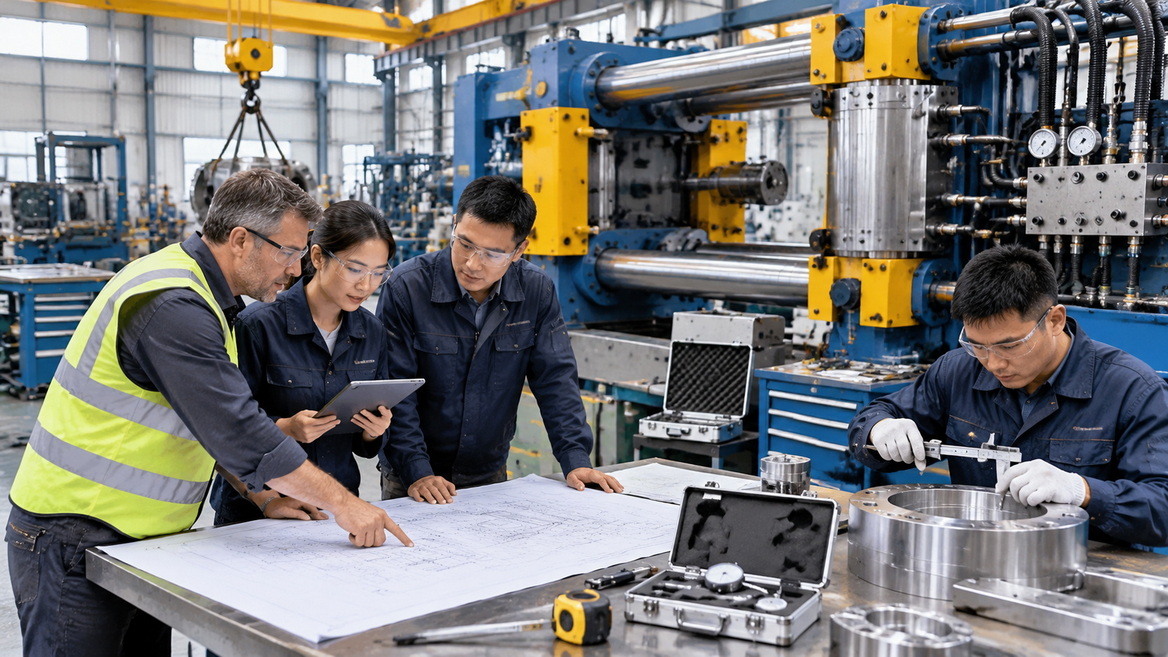
A supplier should not receive a high score simply because its website displays certificates. Buyers need current documents linked to the correct legal entity, manufacturing location, and equipment scope.
Likewise, a short quoted lead time has limited value unless it includes engineering approval, bought-out components, factory testing, shipping preparation, and commissioning responsibilities.
| Company detail | Procurement overview |
|---|---|
| Established | 1991 |
| Manufacturing location | Foshan, Guangdong, China |
| Principal equipment | Copper and aluminium extrusion presses |
| Reported markets | China, Southeast Asia, Europe, and the United States |
| Customisation focus | Application-specific presses and production-line configurations |
Xinxinke specialises in copper and aluminium profile extrusion equipment. Its company information reports approximately 200 units of annual production and sales, together with manufacturing capability extending from 600T to 20,000T. These are supplier-published figures and should be confirmed against the proposed machine and current factory workload.
The company's potential relevance to small and medium-sized extrusion businesses is its combination of dedicated press manufacturing and configurable equipment. Rather than purchasing a line around a standard catalogue specification alone, buyers can discuss billet dimensions, extrusion force, machine arrangement, and supporting equipment requirements.
Xinxinke describes substantial in-house machining resources, including large CNC equipment and heavy lifting capability. Its technical information also provides model-level specifications, although the published technical table covers a narrower range than the broader company capability statement. Buyers considering unusually large presses should request references for comparable completed machines.
For an Australian project, the most useful way to assess Xinxinke's proposed value is through a controlled quotation exercise:
- Submit the same profile drawings and production assumptions used for competing bids.
- Request a documented engineering response rather than a generic equipment list.
- Agree on a named technical contact and drawing-review schedule.
- Compare the completeness of the offer, not simply the initial price.
This approach tests the flexibility and communication efficiency that matter to smaller manufacturers. It also establishes the depth of OEM-style support before an order is placed.
Here, OEM support should mean documented customer-specific equipment engineering—not an assumed private-label manufacturing arrangement. Xinxinke's published information supports customised equipment discussions, but branding rights, design ownership, software access, and exclusivity require separate contractual agreement. Its website also reports ISO certification and CE-certified equipment; buyers should obtain the underlying documents rather than treating those statements as project approval.
| Company detail | Procurement overview |
|---|---|
| Established | 1990 |
| Manufacturing location | Foshan, Guangdong, China |
| Principal equipment | Aluminium extrusion presses and integrated extrusion lines |
| Reported markets | Domestic and international customers |
| Customisation focus | Press configuration, line automation, and production-data integration |
Foshan Yejing Machinery Manufacturing Co., Ltd., operating through yjing-extrusion.com, publishes capabilities covering the processing, assembly, and commissioning of 600–9,000MT extrusion presses.
The company reports approximately 300 employees, more than 100 sets of processing and assembly equipment, and maximum annual output reaching 300 sets. It also states that it has manufactured more than 3,000 aluminium extrusion machines since 1990. These figures describe the supplier's reported manufacturing scale, not guaranteed availability for a particular delivery date.
Yejing's principal differentiator is integrated line control. Its published production-line description brings billet heating, hot-log shearing, the extrusion press, pullers, run-out equipment, and die heating into a central control arrangement. It also describes production-data storage and possible connection to an enterprise management system.
For Australian buyers, this makes Yejing relevant when the project objective extends beyond replacing an individual press.
Important quotation questions include:
- Which machines are included in the central control scope?
- Who is responsible for communication between third-party equipment?
- Can production records be exported in a usable format?
- What happens if the central industrial computer fails?
Yejing states that it operates under ISO 9001:2015 requirements and has obtained CE certification through TÜV. Buyers should request current certificates, the exact equipment covered, and machine-specific conformity documentation. Private-label or formal ODM arrangements are not established by the reviewed information and should not be assumed.
| Company detail | Procurement overview |
|---|---|
| Established | 2011 |
| Manufacturing location | Shishan, Foshan, Guangdong, China |
| Principal equipment | Aluminium extrusion presses and auxiliary production equipment |
| Reported markets | Domestic and overseas customers |
| Customisation focus | Press selection, factory planning, and complete-line support |
Foshan Sailixin Machinery Manufacturing Co., Ltd., operating through slxextrusionpress.com, publishes a self-developed aluminium extrusion press range of 700T–7,500T.
Its website reports nearly 30 research and development technicians, a 50,000-square-metre industrial park, and cumulative domestic and overseas sales exceeding 1,400 sets. These remain company-reported figures rather than independent production audits.
Sailixin offers a broad range of supporting equipment, including billet furnaces, die ovens, quenching equipment, cooling tables, pullers, stretchers, ageing furnaces, and automatic handling equipment. It also describes factory planning and production-line technical support.
This scope makes it worth evaluating when a buyer wants one supplier to coordinate several process stages.
However, complete-line procurement introduces interface risks. Buyers should require an equipment-responsibility schedule stating who supplies, installs, tests, and warrants every major subsystem.
Sailixin displays an ISO 9001 certificate on its website. The reviewed information does not establish a blanket certification status for every machine configuration, nor does it verify Australian service infrastructure. Both points should be resolved during qualification. Its published offering supports customised system discussions; formal OEM branding and ODM intellectual-property terms require direct confirmation.
| Company detail | Procurement overview |
|---|---|
| Established | 1994 |
| Manufacturing base | Italy |
| Principal equipment | Extrusion presses and integrated extrusion plant equipment |
| Reported markets | International extrusion and casthouse customers |
| Customisation focus | Tailor-made presses, automation, and turnkey plant engineering |
Presezzi Extrusion S.p.A. states that it was established in 1994 and designs extrusion presses for aluminium, hard alloys, copper, and brass. Its group offering includes complete tailor-made extrusion plants as well as individual machines.
Presezzi is particularly relevant for buyers seeking a highly engineered line rather than a narrowly specified standalone press.
Its engineering information describes customer-specific design, multiple automation levels, factory preassembly, and dry testing before shipment. Those practices provide useful subjects for contractual inspection milestones. A dry test, however, should not be confused with proving profile quality under hot production conditions.
There is also a specific Australian industry connection: Presezzi was identified among the equipment and software suppliers sponsoring the 2025 Australasian Aluminium Extrusion Conference. Conference participation demonstrates industry engagement, but it does not by itself establish an Australian service office or guaranteed local response time.
Its published customisation model is project engineering. Buyers requiring private-label equipment or ownership of newly developed designs should negotiate those rights explicitly.
| Company detail | Procurement overview |
|---|---|
| Establishment information | A single founding year for the present extrusion business was not verified in the reviewed material |
| Manufacturing base | Germany and international group operations |
| Principal equipment | Light-metal, heavy-metal, and other extrusion systems |
| Reported markets | International extrusion producers |
| Customisation focus | Direct, indirect, hybrid-drive, and tube extrusion applications |
SMS group offers light-metal extrusion systems together with heating and auxiliary equipment through its associated capabilities, including OMAV and IAS.
Its published range includes direct extrusion presses, indirect extrusion presses, combined process options, and tube extrusion systems. The company identifies indirect extrusion as particularly relevant to hard aluminium alloys such as AA2xxx and AA7xxx because reduced billet-container friction changes force requirements and material flow.
SMS is worth evaluating where the business case depends on a demanding alloy portfolio, specialised tube production, or a broader plant-engineering package.
The company publishes application-dependent energy and productivity claims for its HybrEx technology. Buyers should not apply those percentages directly to their own operation without an agreed baseline, production mix, and measurement boundary.
SMS and OMAV also appeared in the technical programme for the 2025 Australasian Aluminium Extrusion Conference, including presentations on heating and next-generation presses. This provides evidence of regional technical engagement, not automatic confirmation of project-specific service arrangements.
The reviewed product pages support engineered equipment selection, not an assumption of private-label OEM or ODM services.
| Company detail | Procurement overview |
|---|---|
| Extrusion business heritage | Since 1950 |
| Manufacturing base | Italy |
| Principal equipment | Non-ferrous extrusion presses and integrated plants |
| Reported markets | International metal-processing customers |
| Customisation focus | Direct, indirect, piercing, and application-specific plant configurations |
Danieli Breda identifies its extrusion and forging business heritage as beginning in 1950. Its non-ferrous extrusion portfolio includes front-loading direct presses, indirect presses, short-stroke back-loading presses, and configurations with internal piercing.
Its relevance is strongest where process complexity justifies extensive engineering.
Danieli's published technical information discusses hard-alloy processing, including 7xxx-series applications, and isothermal extrusion control intended to maintain a more consistent profile exit temperature. It also describes integration with production-management systems.
Buyers should ask Danieli to explain which of these features are necessary for the intended product mix and which are optional.
A sophisticated press does not automatically provide a better return for a factory producing relatively straightforward architectural profiles. The commercial comparison should connect technical features to saleable output, scrap reduction, maintenance requirements, and staffing.
Danieli's published material supports tailored industrial plant solutions. Australian reference installations, service coverage, certificate scope, and any OEM branding arrangements should be confirmed directly rather than inferred from group size.
Press force, annual machine-building output, and finished-profile production capacity are different measurements. They should never appear in a quotation comparison as though they were interchangeable.
The table below separates these categories. "RFQ confirmation" means that a binding minimum order or certificate package was not established from the reviewed public information.
| Manufacturer | Published press capability | Reported annual machine output | MOQ or minimum project scope | Certification evidence and limitations |
|---|---|---|---|---|
| Xinxinke | Company capability statement: 600T–20,000T; technical table is narrower | Approximately 200 units | RFQ confirmation; specify one press or one line as the required bid scope | Website reports ISO certification and CE-certified equipment; verify documents and model scope |
| Yejing | 600–9,000MT | Maximum annual output reported as 300 sets | RFQ confirmation | ISO 9001:2015 and TÜV CE claims; confirm validity and equipment coverage |
| Sailixin | 700T–7,500T | Not verified in reviewed material; cumulative sales are not annual capacity | RFQ confirmation | ISO 9001 certificate displayed; obtain current certificate and machinery documentation |
| Presezzi | Application-specific; obtain model proposal | Not verified in reviewed material | RFQ confirmation | Request current management certificates and project-specific conformity package |
| SMS group | Application-specific direct, indirect, hybrid, and tube systems | Not verified in reviewed material | RFQ confirmation | Verify the supplying legal entity, factory, and project documentation |
| Danieli Breda | Application-specific direct, indirect, and piercing configurations | Not verified in reviewed material | RFQ confirmation | Obtain project-specific certificates, declarations, and test documentation |
The published numerical ranges and certification statements above come from the respective supplier materials; none substitutes for an independently witnessed factory assessment.
A press quotation should start with production requirements:
- Alloy grades and intended tempers.
- Profile drawings and dimensional tolerances.
- Solid, hollow, or seamless product requirements.
- Billet diameter and length.
- Maximum profile envelope.
- Required saleable length.
- Annual saleable output and shift pattern.
The Australasian industry is strongly associated with 6000-series extrusion, while local plants also process structural alloys such as 6082. Equipment selection should follow the intended alloy and product mix, not a generic assumption that every aluminium profile requires the same process.
For hard-alloy or copper applications, require comparable operating references. A supplier's ability to manufacture an aluminium press is not sufficient evidence for every other material.
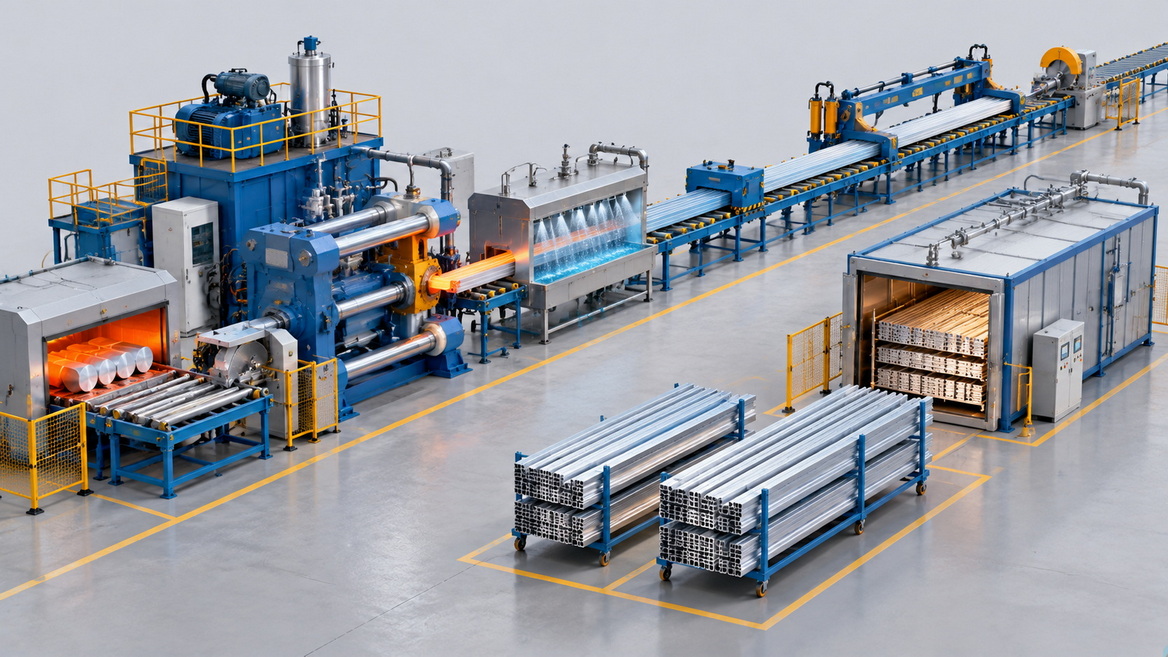
Nominal extrusion force is only one constraint.
Ask suppliers to state the proposed billet size, available force through the operating stroke, extrusion speed range, dead-cycle assumptions, and thermal-control strategy.
Then evaluate the entire production route:
- Billet heating and handling.
- Die heating and transfer.
- Press operation.
- Quenching.
- Pulling and run-out.
- Stretching and sawing.
- Ageing and packing.
A bottleneck outside the press can prevent an expensive press upgrade from delivering the expected output.
Material substitution is a procurement risk best controlled through documentation and inspection, not general promises.
The purchase specification should identify the required evidence for critical components, including:
- Frame and tie-rod materials.
- Main-cylinder materials and inspection records.
- Heat-treatment documentation where applicable.
- Container and liner specifications.
- Hydraulic pump and valve identities.
- PLC, drive, sensor, and safety-component part numbers.
Do not prescribe one material grade for every manufacturer's design. Instead, require an approved material schedule, traceability, and documented approval before substitutions.
Safe Work Australia states that designers, manufacturers, importers, and suppliers have duties to eliminate or minimise plant risks so far as reasonably practicable and to pass on information needed for safe use. Importing a machine does not transfer all responsibility to the overseas builder.
Accordingly, neither a CE statement nor a management-system certificate should be treated as a complete Australian installation approval.
The technical review should consider:
- Machinery risk assessment.
- Guarding and interlocked access.
- Emergency stops and safety functions.
- Hydraulic and electrical isolation.
- Stored-energy hazards.
- Hot billets, tooling, and profiles.
- Safe maintenance access.
- Installation, operating, and maintenance instructions in English.
Safe Work Australia guidance identifies the AS 4024 series and ISO 12100 among relevant machinery-safety references. Applicability, current editions, and any registration requirements should be checked with a competent Australian specialist and the relevant state or territory authority.
RoHS documentation should be handled separately from machinery safety. Buyers should ask what specific components, destination requirements, or contractual obligations a supplier's RoHS statement actually addresses rather than accepting it as a general environmental or press-safety certificate.
A particularly useful precaution is to define exactly what a production guarantee measures.
A claim of "five tonnes per hour," for example, is incomplete unless the contract states:
- Which alloy and profile are being produced.
- Whether output means billet input or accepted finished product.
- Whether butt scrap, saw losses, and rejected lengths are deducted.
- Whether die changes and normal interruptions are included.
- Which auxiliary machines operate during the test.
- How long the test runs and how results are recorded.
The same principle applies to energy claims. SMS explicitly qualifies its published HybrEx improvements as application-dependent; that illustrates why buyers need a project-specific baseline rather than a headline percentage.
For procurement purposes, saleable output is a more useful acceptance measure than peak ram speed alone.
Build the acceptance protocol before placing the order. Otherwise, supplier and buyer can both report accurate figures while measuring different outcomes.
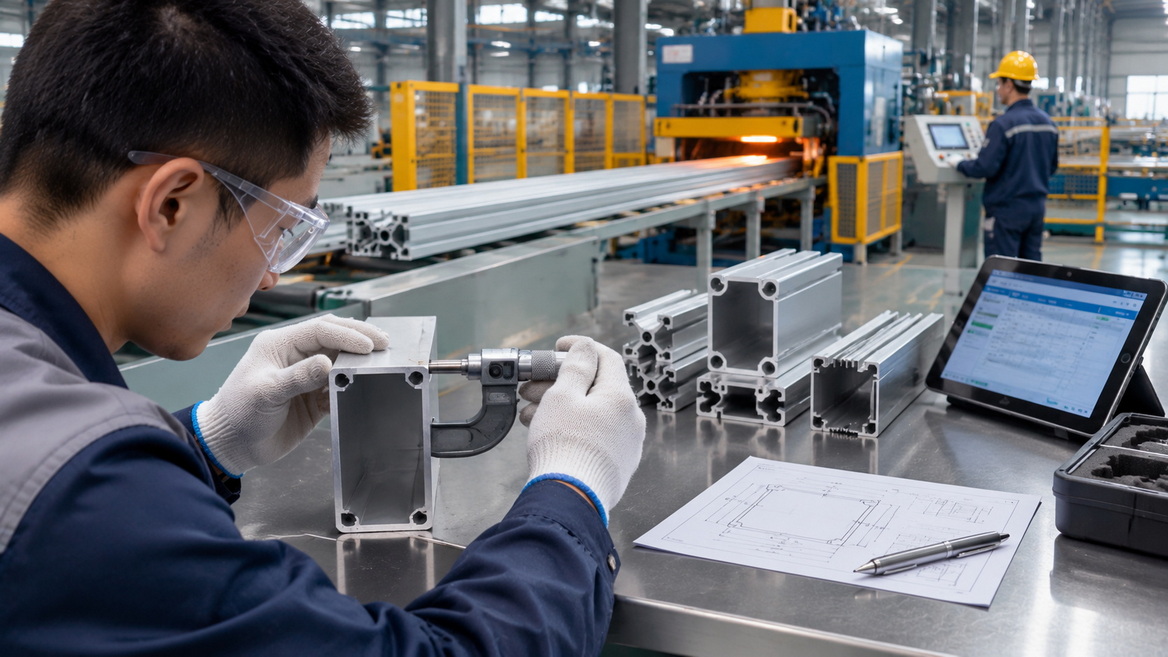
Request a live factory walkthrough, followed by an independent inspection where the investment warrants it.
The inspection should distinguish work performed internally from subcontracted activities and connect the offered design to comparable completed machines.
Safe Work Australia specifically identifies inspection, testing, and third-party verification of manufacturing processes as possible measures for importers assessing plant safety.
For capital equipment, the equivalent of a "sample order" is usually a carefully defined trial.
Where feasible, use the buyer's representative alloy, die, and profile requirements. Agree in advance on dimensional inspection, surface acceptance, production records, and responsibility for trial materials.
Separate factory preassembly and dry testing from hot-production validation. Presezzi, for example, explicitly describes factory preassembly and dry testing; those checks have value but answer different questions from a full process trial.
The logistics plan should cover:
1. Shipment dimensions and weights for every major item.
2. Packing, preservation, lifting points, and unloading instructions.
3. Foundation drawings and site readiness.
4. Crane access and installation sequence.
5. Electrical, cooling-water, compressed-air, and other utility interfaces.
6. Commissioning personnel and travel responsibilities.
7. Spare-parts delivery and remote-support access.
Ask an Australian freight forwarder, customs broker, and installation contractor to review the shipment and site plan before finalising the delivery commitment.
The machinery schedule should distinguish "ready for shipment," "arrived at site," "mechanically installed," and "accepted for production."
A defensible Australian extrusion press shortlist should distinguish machine builders from profile producers and published capabilities from verified project commitments.
Xinxinke, Yejing, and Sailixin offer different Chinese manufacturing and customisation propositions. Presezzi, SMS group, and Danieli Breda provide additional options for integrated plants and specialised process requirements. Their suitability depends on the buyer's alloy portfolio, production targets, budget, and support expectations—not listing position.
For a Xinxinke proposal, submit profile drawings, alloy grades, billet dimensions, required saleable output, and factory-layout constraints. Request a matched technical scope, inspection plan, and acceptance protocol so the offer can be compared directly with alternative extrusion press suppliers.
The purchasing objective is not simply to acquire sufficient force. It is to commission a maintainable production system with clearly defined quality, capacity, safety, and lifecycle responsibilities.
Request the complete certificate, not a cropped website image.
Check the legal entity, factory address, certificate number, scope, issue date, and expiry date. Then confirm current status directly with the issuing certification body or its verification service.
Also check whether the certified scope covers the relevant manufacturing activity. Certification of a related trading company is not equivalent to certification of the press factory.
Treat this as one part of qualification. Current certification does not replace inspection of the proposed machine or its safety documentation.
No—buyers should not treat CE marking as automatic permission to operate.
Australian importers and users retain plant-safety responsibilities. Safe Work Australia requires appropriate information flow, risk control, and relevant inspection or testing; certain plant designs or items may also require registration. The applicability of those requirements must be checked for the actual installation.
Include Australian compliance review in the project programme before shipment.
Issue an identical production brief to both suppliers.
Require each proposal to identify the billet, alloy, die assumptions, usable speed range, cycle sequence, auxiliary equipment, and acceptance-test conditions.
Then compare guaranteed results against the same production mix. Direct and indirect presses, for example, involve different material-flow and friction conditions, making force alone an inadequate process comparison.
Attach an approved component list and material schedule to the contract.
State which items require written approval before substitution. Include inspection hold points, nameplate photographs, traceability records, and document review before shipment.
For control systems, also specify software backups, access rights, recovery procedures, and responsibility for replacing discontinued components.
A substitution is not necessarily unacceptable, but it should be evaluated before installation—not discovered during a breakdown.
Require a written support model.
It should identify remote-response arrangements, personnel who can travel, local contractor responsibilities, critical spare parts, and access to drawings and troubleshooting information.
Remote support can be useful—Presezzi, for example, publishes remote after-sales capability—but it does not eliminate the need to plan physical repairs, safe isolation, and specialist attendance.
Do not accept "global service" as a substitute for named responsibilities and realistic response commitments.
- Australian Aluminium Council, "Producers and Distributors": 2025 member extrusion production and Australian industry directory. [aluminium.org]
- Australian Government Department of Industry, publication of the Australian Aluminium Council's June 2025 briefing, "The Threat of Dumping in Australia's Aluminium Extrusions Industry." This concerns extruded products, not an extrusion machinery market forecast. [industry.gov]
- Light Metal Age, "Australasian Extrusion Conference Returns": Australian plant locations, automation developments, and 2025 conference context. [lightmetalage]
- Safe Work Australia, "Guide for Importing and Supplying Safe Plant": importer obligations, inspection, testing, and information requirements. [safeworkaustralia.gov]
- Safe Work Australia, "Managing the Risks of Plant in the Workplace": machinery-risk guidance and technical-standard references. [safeworkaustralia.gov]
- Xinxinke company information and technical specifications. The supplied English About page could not be retrieved during review; the company homepage, technical information, and Spanish-language About page provided supporting details. [xxkextrusion]
- Yejing and Sailixin official company and product information. [yjing-extrusion]
- Presezzi official company, engineering, and service information. [presezziextrusion]
- SMS group official light-metal extrusion press information. [sms-group]
- Danieli official extrusion technology and business-unit information. [danieli]


