
Please Choose Your Language
Views: 248 Author: Xinxinke Extrusion Publish Time: 2026-10-12 Origin: Site


Content Menu
● Introduction: Why Source an Extrusion Press Machine from China?
● Selection Criteria: How This Manufacturer Shortlist Was Developed
>> 1. Manufacturing Identity and Factory Capability
>> 2. Engineering and Research Capability
>> 3. Quality Control and Traceability
>> 4. Delivery Stability and Service Readiness
>> 5. Certification and Destination-Market Compliance
● The List: Ten Extrusion Press Machine Manufacturers in China
>> 2. Taiyuan Heavy Industry / TZ Extrusion Press Business
>> 3. Foshan Yejing Machinery Manufacturing Co., Ltd.
>> 4. Foshan Sailixin Machinery Manufacturing Co., Ltd.
>> 6. Wuxi Weite Machinery Co., Ltd.
>> 7. Wuxi Yuanchang Machinery Co., Ltd.
>> 8. Foshan Nanhai Yuen-Sun Hydraulic Equipment Co., Ltd.
>> 9. Foshan Qisheng Machinery Technology Co., Ltd.
>> 10. Wuxi Xinwang Machinery Co., Ltd.
● Manufacturer Comparison: Capacity, MOQ, and Certification Evidence
● Technical Buyer's Guide: What to Specify Before Requesting Prices
>> Define the Material and Product Mix
>> Specify Materials and Inspection Requirements for the Machine
>> Compare Productive Output, Not Advertised Speed
>> Treat Thermal Equipment as Part of the Production System
>> Evaluate CE and RoHS Correctly
● Common Procurement Pitfalls and How to Avoid Them
>> Pitfall 1: Undocumented Material Substitution
>> Pitfall 2: Hydraulic and Electrical Component Changes
>> Pitfall 3: Incomplete Production-Line Scope
>> Pitfall 4: Confusing Press Force Units
>> Pitfall 5: Treating Advertised Factory Output as Guaranteed Delivery Capacity
● An Often-Overlooked Acceptance Trap: The Demonstration Billet
● Factory Verification, Trial Production, and Logistics
>> Sample and Trial-Production Procedure
● Conclusion: Select a Partner Around Verified Production Requirements
● FAQ
>> 2. Can two extrusion presses with the same rated force produce different accepted output?
China offers a broad supplier base for companies investing in aluminum and copper extrusion equipment. Buyers can source conventional hydraulic presses, short-stroke systems, indirect extrusion presses, and integrated production lines from manufacturers serving different investment levels and technical requirements.
The challenge is not finding an extrusion press machine supplier. It is identifying a manufacturing partner that can deliver repeatable production performance, documented machine quality, reliable installation support, and compliance appropriate to the destination market.
This guide presents ten manufacturers for procurement consideration, with Xinxinke Co., Ltd. listed first as the commissioning company. The order is not an independently audited market-share ranking. Supplier specifications are attributed to published sources, and missing information is identified rather than estimated.
The most important purchasing principle is verification: compare documented capabilities and production results, not brochure claims alone.
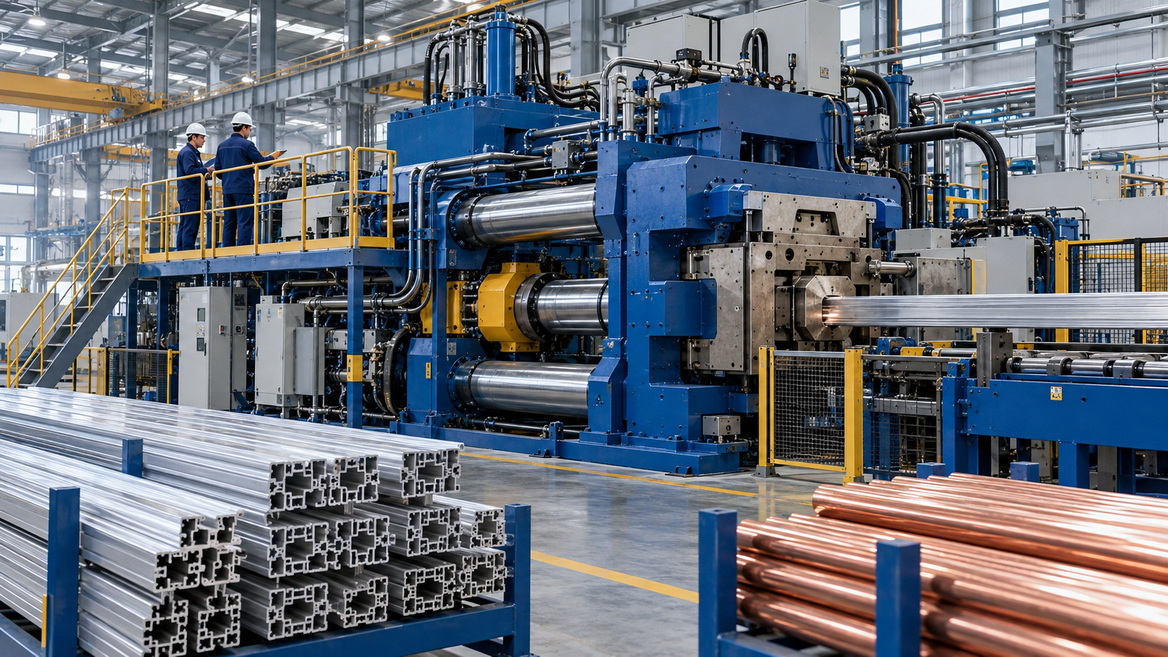
China's aluminum industry provides substantial demand for extrusion equipment, tooling, thermal systems, and downstream automation. The International Aluminium Institute's August 2026 statistics reported estimated Chinese primary aluminum production of 3.874 million metric tonnes against a global total of 6.172 million metric tonnes—approximately 62.8% of worldwide production that month. This measures primary metal output, not extrusion press sales or equipment market share, but it demonstrates the scale of the industrial ecosystem supporting aluminum processing.
For machinery sourcing, two regional concentrations are particularly relevant:
- Foshan, Guangdong, hosts extrusion equipment manufacturers including Xinxinke, Yejing, Sailixin, HLT, Qisheng, and the mainland Yuen-Sun operation.
- Wuxi, Jiangsu, hosts nonferrous extrusion equipment suppliers including Weite and Yuanchang.
For a procurement manager, these concentrations offer a practical opportunity: several factory visits can be organized within one region, allowing direct comparison of machining capabilities, assembly methods, component selection, and service resources.
However, proximity does not prove equal quality. Buyers should evaluate each legal entity, manufacturing site, and proposed machine separately.
The companies below were selected for published evidence of metal extrusion press activity, identifiable manufacturing locations, and relevance to industrial procurement.
This is a sourcing shortlist, not a claim that all ten suppliers have passed the same factory audit. Particular caution applies where information comes from marketplace listings or another manufacturer's editorial content.
An initial supplier review should establish:
- The registered Chinese company name and business license.
- The relationship between the exporting entity and manufacturing factory.
- Which structures and components are manufactured internally.
- Which machining, heat-treatment, testing, and assembly activities are subcontracted.
- Whether the inspected factory is the facility that will manufacture the purchased machine.
Treat a showroom visit as an introduction, not proof of production capability.
A suitable supplier should explain how the proposed press matches the buyer's alloy, billet dimensions, profile geometry, extrusion ratio, and required production rate.
Useful evidence includes application calculations, hydraulic schematics, control descriptions, comparable installations, and a clear explanation of the limits of the proposed configuration.
The Aluminum Extruders Council highlights the relationship between extrusion speed, billet temperature, die temperature, container temperature, surface integrity, and dimensional tolerances. Consequently, press force alone is an incomplete basis for machine selection.
Request an inspection plan covering the proposed machine's critical structures, hydraulic equipment, controls, and alignment.
For important components, ask the supplier to identify:
- Specified material grades.
- Heat-treatment requirements.
- Material certificates and traceability methods.
- Dimensional inspection requirements.
- Applicable nondestructive examination.
- Acceptance criteria and inspection responsibility.
A purchase specification should define these requirements before manufacturing begins.
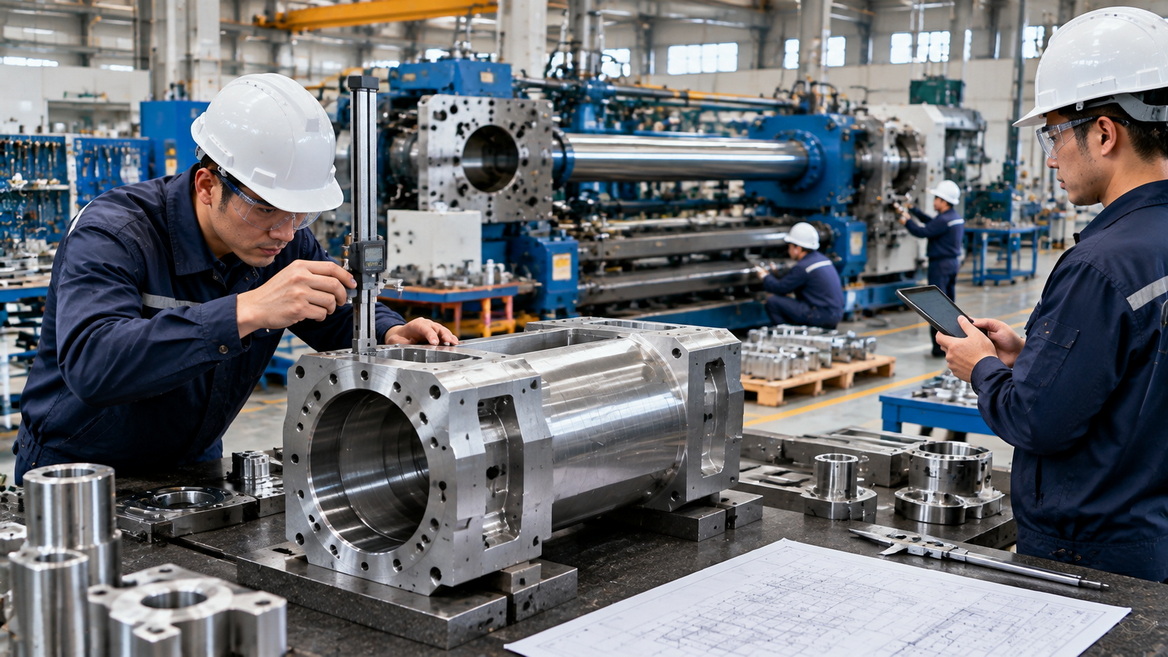
Evaluate the proposed manufacturing schedule alongside actual workshop loading. Require milestone dates for design approval, major component completion, assembly, factory acceptance testing, and shipment readiness.
Service capability should be assessed separately from equipment capability. Ask who will commission the line, what language they use, what remote access they require, and how critical spare parts will be supplied.
ISO management-system certification and machine conformity documentation answer different questions.
An ISO certificate concerns a defined management-system scope and organization. A machine's conformity documentation concerns the specific equipment and applicable requirements.
For European projects, the European Commission states that machinery placed on the market before January 20, 2027 must comply with Machinery Directive 2006/42/EC. Machinery Regulation (EU) 2023/1230 applies mandatorily from January 20, 2027. A press ordered in 2026 therefore needs a compliance plan based on its actual market-placement circumstances, not simply the purchase-order date.
Location: Foshan, Guangdong
Establishment information: The company website states 1991; an exhibition listing states 2006
Published markets: Southeast Asia, Europe, and the United States
Xinxinke manufactures copper and aluminum profile extrusion equipment. Its website describes direct and indirect extrusion presses, associated thermal equipment, and customized solutions. Published specifications include a 5,500-metric-ton short-stroke press for a 380 × 1,550 mm billet and a 2,750-ton indirect extrusion press.
The company states an overall manufacturing range of 600T–20,000T and annual output of approximately 200 units. These are supplier-reported figures, not independently audited production results.
For small and medium-sized profile producers, Xinxinke can be considered as a candidate for application-specific procurement rather than a standardized catalog purchase. Its stated combination of press manufacturing, auxiliary equipment, and bespoke solutions provides a basis for discussing billet handling, hydraulic controls, thermal equipment, and line interfaces with one supplier.
OEM/ODM discussion scope: Customized press specifications, direct-versus-indirect configuration, copper or aluminum applications, and supporting line equipment. Buyers should agree the precise engineering deliverables, component schedule, control ownership, and customization boundaries in writing.
Procurement assessment: Xinxinke's cost-performance, communication efficiency, and flexibility should be tested through a structured quotation exercise. Compare response quality, technical completeness, and the ability to revise a configuration without leaving responsibility gaps.
Important verification point: The website's 1991 founding claim differs from the 2006 date in its exhibition profile. Request documentation explaining whether these dates refer to a predecessor business, brand history, or the current legal entity.
Location: Taiyuan, Shanxi
Historical roots: 1950
Published markets: Chinese and international aluminum-processing customers
Taiyuan Heavy Industry's history traces back to the Taiyuan Heavy Machinery Plant established in 1950. Its extrusion equipment portfolio includes heavy presses with published forces from 5MN to 235MN.
A published product listing describes single-action, double-action, indirect, short-stroke, and front-loading aluminum extrusion presses, together with associated equipment and customer-specific manufacturing.
Core advantage: Relevance to heavy-duty extrusion projects where very large press force, specialized configurations, and substantial engineering integration are central requirements.
OEM/ODM discussion scope: Project-engineered extrusion systems, machine configurations, and related equipment rather than conventional private-label manufacturing.
Procurement assessment: Define foundation loads, handling requirements, installation responsibilities, and production guarantees early. A large press requires a coordinated plant-engineering project, not merely a machinery purchase.
Location: Foshan, Guangdong
Established: 1990
Published markets: Domestic and overseas customers
Yejing specializes in aluminum extrusion presses and complete production solutions. Its website states a maximum annual output of 300 sets and more than 100 processing machines. These figures should be checked against current factory loading and the specific equipment included in the capacity statement.
Published press examples include 1,100T, 2,300T, and 2,750T models associated with different billet diameters.
Core advantage: A long-established aluminum extrusion focus combined with published machining and assembly capacity.
OEM/ODM discussion scope: Application-matched press selection and complete-line configuration. Buyers should confirm which auxiliary equipment is manufactured internally and which is supplied through partners.
Procurement assessment: Ask for production references using comparable alloy families, billet sizes, and profile complexity. General export experience does not automatically demonstrate suitability for a demanding new application.
Location: Shishan, Nanhai, Foshan
Established: 2011
Published markets: Domestic and overseas installations; country-level distribution requires confirmation
Sailixin states that it develops and manufactures aluminum extrusion presses and provides complete-line solutions. Its current product page advertises self-developed presses from 700T to 7,500T, while other published company material describes a narrower 1,100T–6,500T range. Buyers should therefore confirm the current model catalog rather than assuming every published range is interchangeable.
Core advantage: Short-stroke aluminum extrusion equipment with associated billet heating, handling, and cooling-line options.
OEM/ODM discussion scope: Customized press and auxiliary-equipment configurations for profile production.
Procurement assessment: Clarify the exact model, rated force unit, billet dimensions, and included automation. Request current evidence for any high-tech enterprise, patent, or management-system claims.
Location: Sanshui, Foshan, Guangdong
Founded: 1957
Entered metal profile extrusion equipment: 2017
Published markets: Chinese aluminum producers and global project customers
HLT's corporate history should be distinguished from its extrusion-specific experience. The company states that it was founded in 1957 and entered the metal profile extrusion equipment sector in 2017 with its YPL2000 aluminum extrusion press.
Its published annual production capability of 700 press sets and broad 600T–36,000T specification coverage relate to its wider forming-equipment business, including ceramic and other presses. They should not be presented as aluminum extrusion press capacity alone.
Core advantage: A broader industrial pressing-equipment platform and an established extrusion equipment division.
OEM/ODM discussion scope: Engineered metal-profile extrusion solutions, automation, and equipment integration, subject to model-specific confirmation.
Procurement assessment: Request extrusion-specific reference installations, available assembly capacity, and performance data. Corporate scale is useful context but cannot replace evidence for the proposed extrusion machine.
Location: Wuxi, Jiangsu
Established: 1989
Published markets: Domestic and foreign-trade customers; regional distribution is not clearly established
Weite's website describes an integrated business covering design, development, production, sales, and foreign trade. It reports approximately 30,000 square meters of premises, more than 15,000 square meters of factory space, and over 160 employees.
Core advantage: An identifiable extrusion press manufacturing operation with published engineering and factory-scale information.
OEM/ODM discussion scope: Customer-specific horizontal extrusion press engineering, subject to confirmation of the proposed alloy and force range.
Procurement assessment: Obtain a current product schedule, installation references, and manufacturing plan. Employee count and site size should support—not substitute for—machine-specific inspection.
Location: Wuxi, Jiangsu
Established: 1995, according to supplier profiles
Published markets: Southeast Asia, the Middle East, Eastern Europe, and South America, according to its company profile
Yuanchang's official site describes a manufacturer of nonferrous metal extrusion equipment for profiles, tubes, and bars. Its stated activities cover mechanical structures, hydraulic systems, electrical controls, assembly, commissioning, and after-sales support.
Supplier listings describe a historical range of 300T–3,000T and applications involving aluminum, copper, and magnesium. These listings should be treated as historical supplier information until a current technical offer confirms availability.
Core advantage: A nonferrous extrusion focus spanning the press and its principal engineering systems.
OEM/ODM discussion scope: Customized metal-profile equipment and project integration around mechanical, hydraulic, and control requirements.
Procurement assessment: Ask for references matching the actual metal to be processed. A successful aluminum installation is not sufficient evidence for every copper or magnesium application. Its published export regions are company-profile claims requiring reference checks.
Location: Foshan, Guangdong
Mainland company established: 2008
Taiwan parent established: 1980, according to its supplier profile
Published markets: Country-level export distribution requires confirmation
This entry concerns the mainland Foshan company, not the Taiwan parent as a separate Chinese factory.
Its supplier profile lists aluminum extrusion presses, automatic pullers, and aluminum billet saws. It describes whole-line supply through cooperation with other equipment suppliers and a press range of 580UST–4,000UST.
Core advantage: Extrusion press and handling-equipment supply supported by an established parent-company relationship.
OEM/ODM discussion scope: Press, puller, saw, and partner-supplied line configurations.
Procurement assessment: Specify which entity signs the contract, manufactures the press, provides the warranty, and dispatches commissioning personnel. Also preserve the published UST designation: US short tons must not be silently converted into metric tons.
Location: Sanshui, Foshan, Guangdong
Established: 1996, according to its supplier profile
Published markets: Regional sales distribution is not sufficiently documented
Qisheng's supplier profile identifies aluminum extrusion machines, extrusion presses, related parts, and extrusion press lines. It describes activities involving product design, research and development, mechanical processing, production, and sales.
Core advantage: A supplier profile spanning presses, line equipment, and related components.
OEM/ODM discussion scope: Application-specific aluminum extrusion equipment and associated parts, with detailed capability confirmation required.
Procurement assessment: Request evidence of current workshop operations, completed machine references, and the engineering team responsible for the proposed project. Published company history alone does not establish current delivery capability.
Location: Wuxi, Jiangsu
Establishment year: Not verified in the reviewed sources
Published markets: Not verified
Xinwang appears in extrusion-industry supplier articles as a provider of customized extrusion presses for aluminum, copper, and magnesium. However, the reviewed evidence is secondary editorial material rather than a sufficiently detailed primary manufacturer profile.
Core advantage reported by those sources: Customized nonferrous extrusion equipment.
OEM/ODM discussion scope: Potential application-specific press engineering, pending direct confirmation.
Procurement assessment: This is a preliminary discovery candidate, not an equally verified alternative to manufacturers with detailed primary-source information. Before issuing a purchase recommendation, confirm the legal entity, factory address, establishment date, product range, recent installations, and current certifications.
"Capacity" must be defined carefully. Press force is not annual factory output, and neither figure establishes finished-profile production per hour.
Published minimum order quantities were not consistently available. Accordingly, the table identifies a practical quotation basis rather than inventing supplier-confirmed MOQs.
| Manufacturer | Published press or manufacturing capacity | MOQ / quotation basis | Certification position in reviewed evidence |
|---|---|---|---|
| Xinxinke | 600T–20,000T; approximately 200 units/year, company-reported | Request a quotation for one press or one configured line; minimum order unverified | Current certificates require direct verification |
| Taiyuan / TZ | 5MN–235MN heavy extrusion presses | Project-engineered system; minimum order unverified | Request model-specific conformity documentation |
| Yejing | Maximum 300 sets/year, company-reported | Press or complete-line inquiry; minimum order unverified | Current certificates require direct verification |
| Sailixin | Current product page: 700T–7,500T | Customized press or line inquiry; minimum order unverified | High-tech enterprise claim is not machine conformity evidence |
| HLT | 700 presses/year across its wider forming-equipment business | Engineered extrusion project; minimum order unverified | Corporate status does not replace machine documentation |
| Weite | Published site scale; annual extrusion unit output unverified | Custom press inquiry; minimum order unverified | Current certificates require direct verification |
| Yuanchang | Historical supplier listing: 300T–3,000T | Nonferrous press project; minimum order unverified | Current certificates require direct verification |
| Mainland Yuen-Sun | Supplier listing: 580UST–4,000UST | Press or integrated line inquiry; minimum order unverified | Current certificates require direct verification |
| Qisheng | Current numerical capacity not verified | Press, line, or parts inquiry; minimum order unverified | Current certificates require direct verification |
| Xinwang | Current numerical capacity not verified | Preliminary supplier inquiry | Primary documentation required before qualification |
Capacity statements above derive from the manufacturers' websites and supplier profiles; they are not a common, independently audited dataset.
An extrusion press machine should be selected around the production program, not a preferred tonnage.
Provide each supplier with:
- Alloy designation and billet condition.
- Billet diameter and length.
- Profile drawings and maximum dimensions.
- Solid, hollow, tube, or bar requirements.
- Dimensional and surface acceptance criteria.
- Required mechanical properties and downstream treatment.
- Expected production mix and changeover frequency.
The Aluminum Extruders Council explains that chemistry, extrusion speed, tooling, billet and container temperature, die design, quenching, and aging jointly affect the finished product. This is why a nominally powerful press can still be unsuitable for a particular profile portfolio.
Do not prescribe a universal steel grade for every press structure. Require the manufacturer to justify its selected materials against component function, fatigue loading, thermal exposure, and manufacturing method.
For the frame, tie rods, cylinder, container, and tooling interfaces, the purchase specification should state the required documentation and inspection criteria.
A useful contract provision is that material substitutions, heat-treatment changes, and component-brand changes require written approval before implementation.
Request guaranteed performance for representative profiles, including:
- Accepted output per hour.
- Billet-to-billet cycle time.
- Extrusion speed and its measurement location.
- Die-change time.
- Reject rate under defined conditions.
- Energy use per accepted tonne.
- Required staffing and utilities.
AEC productivity work considers alloy, press size, ram speed, scrap, and die changes, illustrating why a single speed figure cannot represent complete plant performance.
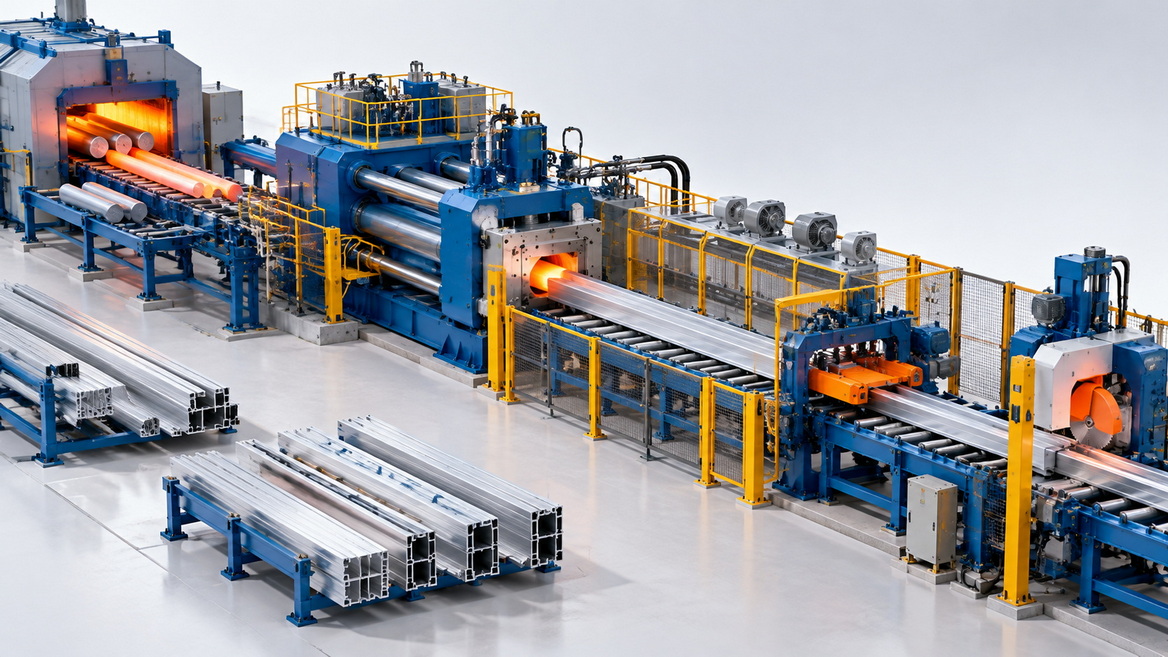
Specify billet heating, die heating, container temperature control, exit-temperature measurement, and quenching requirements together.
AEC technical material notes that temperature-measurement variations can cause errors exceeding 20°C–30°C and affect extrusion performance. A carefully engineered press can therefore be undermined by inadequate temperature measurement or thermal control.
For EU-bound machinery, request the applicable declaration of conformity, instructions, risk-assessment information, and evidence supporting the technical documentation. A generic "CE certificate" should not be accepted as the entire compliance package. The Machinery Directive requires the manufacturer to address essential requirements, prepare technical documentation, provide instructions, carry out the applicable conformity assessment, issue the declaration, and affix the marking.
RoHS is not a universal environmental certificate for every extrusion press. European Commission guidance identifies exclusions for qualifying large-scale stationary industrial tools and fixed installations, including examples of metal-forming presses. Whether a particular press or associated equipment qualifies requires a specific scope assessment.
A quotation may describe a component as "high-strength steel" without identifying the grade, treatment, or traceability.
Avoidance: Require an approved material schedule and inspection plan. Identify which critical parts need certificates, traceable markings, and witnessed testing.
A quoted component brand can become unavailable or be replaced during production.
Avoidance: Attach a controlled bill of materials to the contract. Define an approval process for substitutions and require revised drawings and spare-parts information.
A competitive press price may omit billet heating, die ovens, cooling equipment, pullers, sawing, or control integration.
Avoidance: Compare quotations using an identical scope matrix with clear supply boundaries, interfaces, and installation responsibilities.
Supplier literature may use metric tons, US short tons, or meganewtons. Xinxinke's specifications distinguish MT and UST, while Yuen-Sun's profile uses UST and TZ publishes MN.
Avoidance: Require rated force in kN or MN alongside any ton designation. Specify the operating conditions under which that force is available.
A manufacturer's annual output claim does not reveal its current backlog or the resources allocated to a particular project.
Avoidance: Request a project schedule, current production loading, and evidence that critical machining and assembly slots have been allocated.
A technically convincing demonstration can still fail to prove that a press will meet the buyer's production requirements.
The underlying problem is the test recipe. Easy-to-extrude material, favorable billet dimensions, uncomplicated tooling, and optimized temperatures can produce an impressive demonstration that does not represent normal production.
This is a procurement risk derived from established process relationships—not a claim that a particular listed manufacturer uses misleading demonstrations. Published extrusion guidance explains that billet temperature, pressure, alloy, profile shape, extrusion ratio, and speed are interrelated.
Make the factory acceptance test representative of the intended operation:
1. Agree the billet alloy, dimensions, condition, and source.
2. Approve the test dies and representative profiles.
3. Record billet, die, container, and profile exit temperatures.
4. Record complete cycles, including non-extruding time.
5. Measure accepted product, not merely total extruded weight.
6. Run enough consecutive cycles to evaluate thermal stability.
7. Agree surface, dimensional, and mechanical acceptance methods.
8. Preserve raw test records and identify all test conditions.
Also define whether a quoted speed means ram speed or profile exit speed. These describe different parts of the process and should not be compared without the relevant geometry and extrusion ratio.
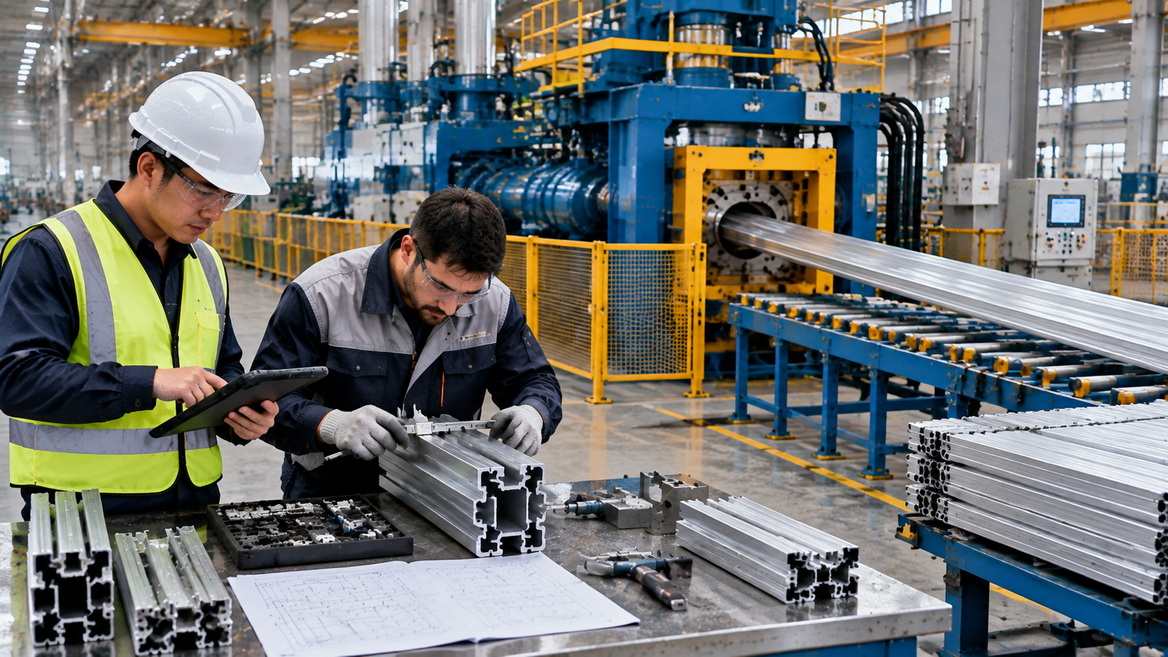
Conduct a live or in-person review of the actual manufacturing site. Ask to see critical-component machining, assembly, inspection equipment, machine identification, and comparable projects in progress.
Where certification is claimed, search the company name or certificate number in IAF CertSearch and review status, scope, site, issuing body, and accreditation information. The database supports checks for active, suspended, withdrawn, and expired certificates.
For extrusion equipment, "sample approval" should mean an agreed production trial rather than an isolated attractive profile.
Use buyer-approved drawings and record the relationship between the press, tooling, material, thermal conditions, and downstream treatment. Evaluate repeatability across a production sequence, not just the first acceptable piece.
Define factory acceptance testing before shipment and site acceptance testing after installation as separate contractual milestones.
Before shipment, require:
- Package dimensions and weights.
- Lifting points and handling instructions.
- Packing and corrosion-protection requirements.
- A transport feasibility review.
- Foundation and utility drawings.
- Installation responsibilities and commissioning schedule.
- Insurance, customs, and unloading responsibilities.
Do not finalize a shipping arrangement until the buyer, supplier, and freight specialist agree which party controls each stage.
The manufacturers in this guide serve different procurement situations. Taiyuan/TZ warrants consideration for very large engineered systems; several Foshan suppliers offer aluminum extrusion presses and line equipment; Wuxi suppliers provide additional options for nonferrous extrusion projects. These are starting points for qualification, not substitutes for factory audits and application testing.
Xinxinke provides a relevant first inquiry for buyers seeking copper and aluminum extrusion presses, direct or indirect configurations, and customized supporting equipment. Its published specifications and manufacturing claims create a useful basis for technical discussions, while its historical dates, current capacity, and project-specific documentation should still be verified.
To request a meaningful proposal from Xinxinke, submit your alloy grades, billet dimensions, representative profile drawings, target accepted output, factory utilities, and installation country. Ask for an itemized configuration, a documented acceptance-test plan, and clearly defined commissioning and spare-parts support.
Search the exact legal company name or certificate number in IAF CertSearch. Review active status, expiry information, covered sites, scope, certification body, and accreditation details. A certificate covering an unrelated site or activity should not be treated as proof that the proposed manufacturing operation is covered. If the record is missing or unclear, seek confirmation directly from the issuing certification body.
Yes. Alloy, billet dimensions, tooling, temperature control, ram speed, scrap, and changeover behavior influence productivity. Require both suppliers to demonstrate performance using the same representative production requirements and report accepted output under recorded conditions. AEC productivity research explicitly considers several of these variables rather than press force alone.
The contract should identify who takes responsibility for the integrated machinery configuration and its interfaces. Separately supplied compliant machines do not eliminate the need to assess the assembled system. For an EU project, obtain a project-specific determination of the applicable machinery obligations and identify the party issuing the relevant conformity documentation. The manufacturer's obligations include technical documentation, conformity assessment, instructions, and the declaration.
Use a controlled test protocol agreed before purchase. Record material identity, billet dimensions, temperatures, tooling, pressure, cycle times, exit conditions, and downstream settings. Compare results against the contractual baseline while changing one relevant variable at a time. This approach reflects the documented interaction between extrusion pressure, speed, temperature, alloy, and shape.
No. The European Commission ties the transition to machinery placed on the EU market, not simply the order date. Machinery placed on the market before January 20, 2027 must comply with the current directive; Machinery Regulation (EU) 2023/1230 applies mandatorily from that date. Establish the applicable timeline and obligations before signing a long-lead equipment contract.


