
Please Choose Your Language
Views: 248 Author: Xinxinke Extrusion Publish Time: 2026-10-29 Origin: Site


Content Menu
● China's Position in the Extrusion Equipment Supply Chain
● Selection Criteria: How to Evaluate a Qualified Supplier
● Top 10 Extrusion Handling Table Manufacturers in China
>> 3. Foshan Nanhai Wangeshi Machinery Equipment Co., Ltd.
>> 4. Enping Huanan Heavy Industrial Technology Co., Ltd.
>> 5. Foshan Yejing Machinery Manufacturing Co., Ltd.
>> 6. Foshan Dynamax Industry Co., Ltd.
>> 7. Zhaoqing Keda Machinery Manufacturing Co., Ltd.
>> 8. Jiangyin Royal Machinery Equipment Co., Ltd.
>> 9. Foshan Jianeng Jingjin Technology Co., Ltd.
>> 10. Foshan Sailixin Machinery Manufacturing Co., Ltd.
● Manufacturer Comparison: Capacity, MOQ, and Certification
● Technical Buying Guide: Specify the System, Not Just the Table
>> Define the Profile and Production Envelope
>> Make Material and Component Specifications Traceable
>> Treat Compliance as a Project Requirement
● The Overlooked Procurement Trap: Accepting an Empty Demonstration
● Factory Verification, Samples, and Logistics
>> Use Samples to Test Contact Quality
>> Plan Shipping Around Installation
● FAQ
>> 1. How can I check whether a supplier's ISO certificate is expired or belongs to another company?
>> 2. Can a supplier guarantee output using only press tonnage?
>> 3. What if the supplier cannot perform a hot-profile trial before shipment?
>> 4. Who is responsible when equipment from several suppliers operates as one line?
>> 5. How should OEM or ODM development be protected against future service problems?
Choosing an extrusion handling table manufacturer requires more than comparing table length, motor power, and purchase price. For a professional procurement team, the real question is whether the supplier can deliver a downstream handling system that protects profile surfaces, matches the extrusion press, supports the required production rhythm, and remains serviceable after installation.
China offers a substantial supplier base for this equipment, particularly around Foshan in Guangdong and the machinery-producing areas of Jiangsu. Available solutions range from individual runout conveyors and cooling beds to integrated systems incorporating quenching, pullers, stretchers, saw tables, and automatic stacking equipment. Manufacturer product information demonstrates considerable variation in configuration and integration scope.
This guide evaluates ten sourcing candidates, starting with Xinxinke Co., Ltd. It is a procurement shortlist—not an audited ranking by market share, manufacturing output, or independently tested performance.
Transparency: Xinxinke's first position reflects this article's commissioning context. Its stated 30-plus years of experience comes from company-provided information. Where founding dates, export destinations, production capacity, or certification status could not be independently established, those details are identified as unverified rather than estimated.
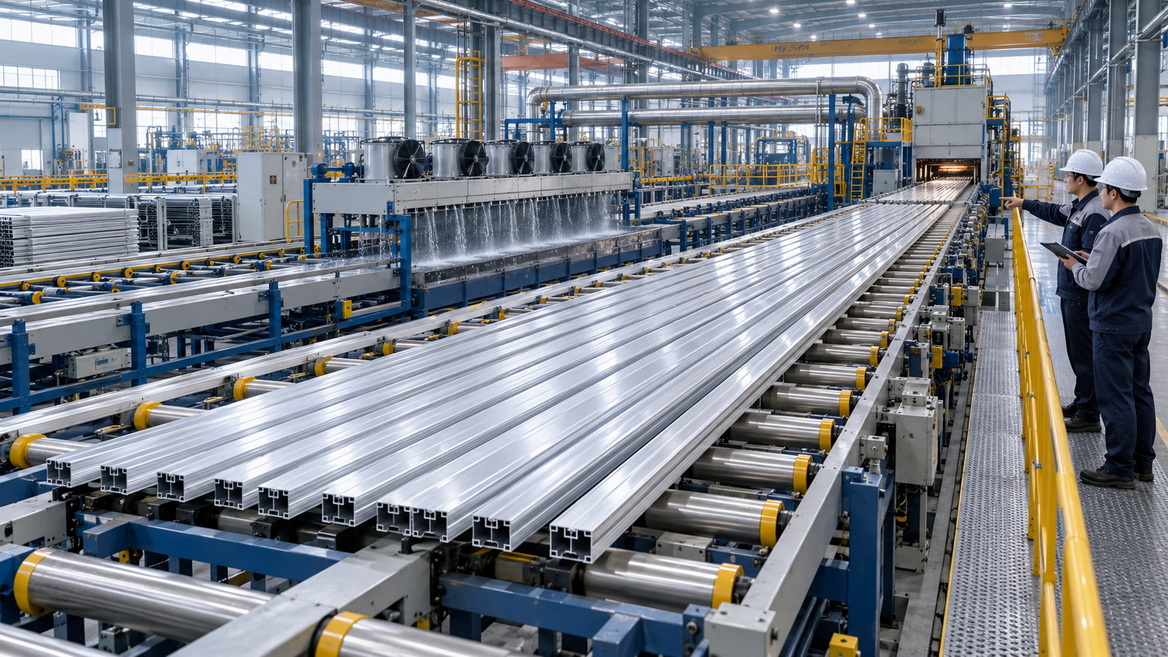
China's aluminum industry provides a large operating environment for extrusion equipment development. The International Aluminium Institute's September 2026 statistics report estimated Chinese primary aluminum production of 3.750 million metric tonnes against a global total of 6.014 million tonnes—approximately 62% of that month's reported total. These figures describe primary metal production, not extrusion output or handling-table sales, but they help explain the scale of the surrounding industrial ecosystem.
Recent industry evidence also points toward greater emphasis on higher-value production. China's 2025–2026 non-ferrous metals development plan calls for approximately 1.5% annual growth in the output of ten major non-ferrous metals while encouraging more high-end products and improved resource utilization. This is relevant to equipment buyers because higher-value profiles demand more consistent processing, handling, and quality documentation.
Foshan is particularly useful for supplier comparison because multiple extrusion machinery businesses operate within the same regional cluster. Xinxinke, MSGC, Wangeshi, Yejing, Dynamax, Sailixin, and Jianeng Jingjin all have publicly described connections to the Foshan extrusion equipment supply chain. Jiangsu offers additional sourcing options, including Jiangyin Royal and the wider Keda equipment network.
The practical advantage is supplier access—not automatic quality assurance. Buyers must still investigate engineering ownership, subcontracting, inspection records, and project-specific performance.
The companies below were shortlisted for publicly described involvement in extrusion handling equipment, cooling tables, or complete extrusion-line integration. Their inclusion does not mean every company manufactures every module in-house.
A useful procurement scorecard should address six areas.
| Evaluation area | Evidence to request | Procurement significance |
|---|---|---|
| Factory identity and certification | Business license, manufacturing address, current certificates, issuing-body verification | Confirms the contracting entity and the actual production site |
| Engineering and development | Layout drawings, load calculations, control sequences, previous customized projects | Shows whether the supplier can adapt the system rather than merely resize it |
| Quality control | Material records, weld inspections, alignment checks, electrical tests, inspection plans | Makes hidden quality differences easier to identify |
| Production capability | Current workshop loading, assembly space, outsourcing list, project schedule | Provides a more useful delivery assessment than a general annual-capacity claim |
| Process integration | Press, quench, puller, stretcher, saw, and stacker interface documents | Reduces mechanical and control-system conflicts |
| Export and service support | Manuals, commissioning plan, spare-parts list, remote-support terms, customer references | Defines support after shipment |
These are recommended purchasing requirements, not claims that all ten suppliers currently satisfy them. Manufacturer descriptions show why this review matters: one supplier may offer a complete multi-stage handling arrangement, while another emphasizes a cooling-bed module or broader line procurement.
- Established: Exact legal founding year not independently verified; company-provided information states more than 30 years of industry experience.
- Location: Foshan contact information is publicly listed.
- Market positioning: Copper and aluminum extrusion equipment and customized solutions.
- Main markets: Global customers according to the supplied company brief; country-level sales distribution requires confirmation.
- Customization scope: Handling tables and associated extrusion-line auxiliary equipment.
Xinxinke is a relevant first-round candidate for small and medium-sized processors, regional equipment brands, and buyers seeking coordinated customization rather than a fixed catalog configuration. Its public product categories include handling tables, quenching systems, straighteners, heating equipment, and automatic stacking equipment. Its solutions page describes bespoke equipment for aluminum extrusion and copper processing.
For a cost-conscious buyer, the potential value lies in matching equipment scope to actual production requirements: table dimensions, transfer arrangement, automation level, existing machinery interfaces, and service access.
Xinxinke's intended positioning emphasizes flexibility, efficient communication, research-led development, and deeper support for customized projects. These should be tested through a technical clarification meeting and a sample drawing-review cycle rather than treated as independently proven advantages.
Recommended verification priorities include:
- A project-specific general arrangement drawing.
- Identification of in-house versus externally sourced modules.
- A documented design-change and approval process.
- A detailed quality inspection plan.
- Written confirmation of private-label, OEM, or joint-development responsibilities.
Xinxinke is therefore best approached as a potentially flexible engineering partner—not automatically the lowest-priced supplier or a verified capacity leader.
- Established: Not verified in the reviewed product information.
- Location: Sanshui District, Foshan, Guangdong.
- Main markets: Geographic sales breakdown not established.
- Customization scope: Multi-stage handling tables, stretchers, finish-saw arrangements, and optional automatic stacking.
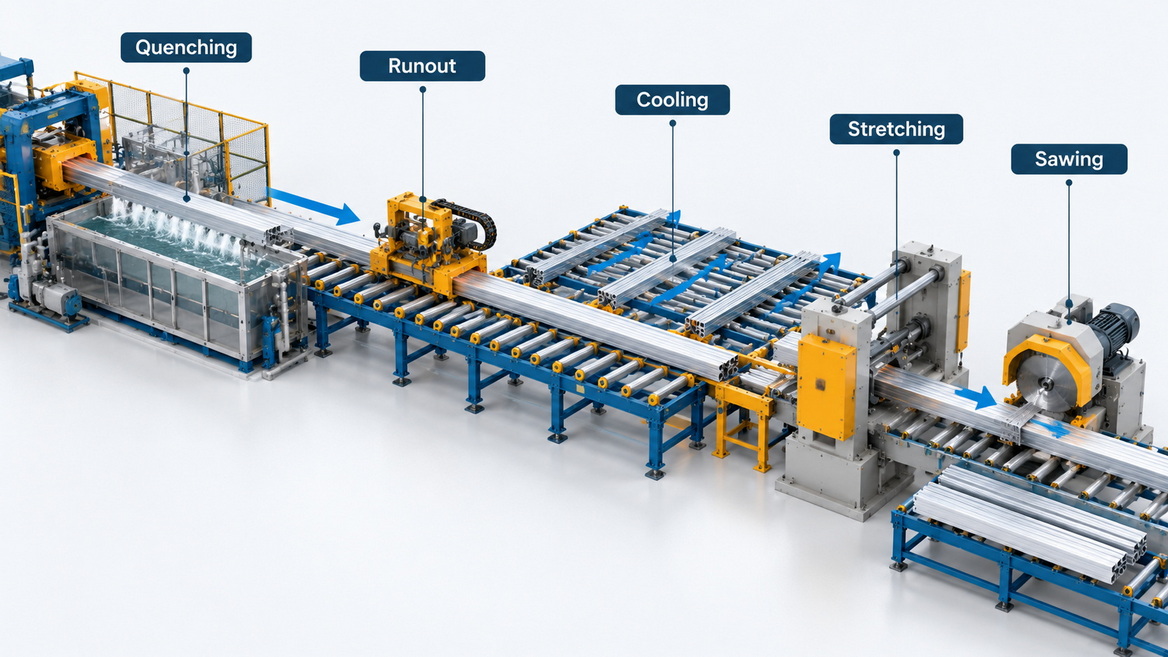
MSGC provides one of the more detailed public descriptions of an aluminum extrusion handling table. Its stated configuration includes initial handling, quenching, runout, cooling, stretching, finished sawing, and checking sections. Table length and width are customized to the associated extrusion press.
The company also describes four- or five-stage felt-belt arrangements and manual, single-operator, or unmanned stretcher options. This makes MSGC relevant to buyers comparing different labor requirements and levels of downstream automation.
Its main evaluation point is the completeness of the proposed package. Ask which modules, controls, guarding, and commissioning activities are included in the quotation.
- Established: Not verified in the reviewed material.
- Location: Foshan, Guangdong.
- Main markets: Not independently established.
- Customization scope: Aluminum handling tables and cooling beds adapted to production requirements.
Wangeshi lists automatic handling tables and cooling tables within a broader extrusion equipment portfolio that includes presses, furnaces, quenching systems, and pullers. Its handling-table descriptions refer to natural and forced-air cooling and customization for different production demands.
This makes the company relevant to buyers who want a supplier familiar with several stages of an extrusion line.
The key procurement question is how general customization claims translate into measurable specifications. Request allowable profile dimensions, load limits, support spacing, transfer speeds, cooling assumptions, and control interfaces.
- Established: 1993, according to its supplier-published information.
- Location: Enping, Jiangmen, Guangdong.
- Main markets: Country-level distribution requires confirmation.
- Customization scope: Extrusion equipment, runout tables, and customized cooling-table handling systems.
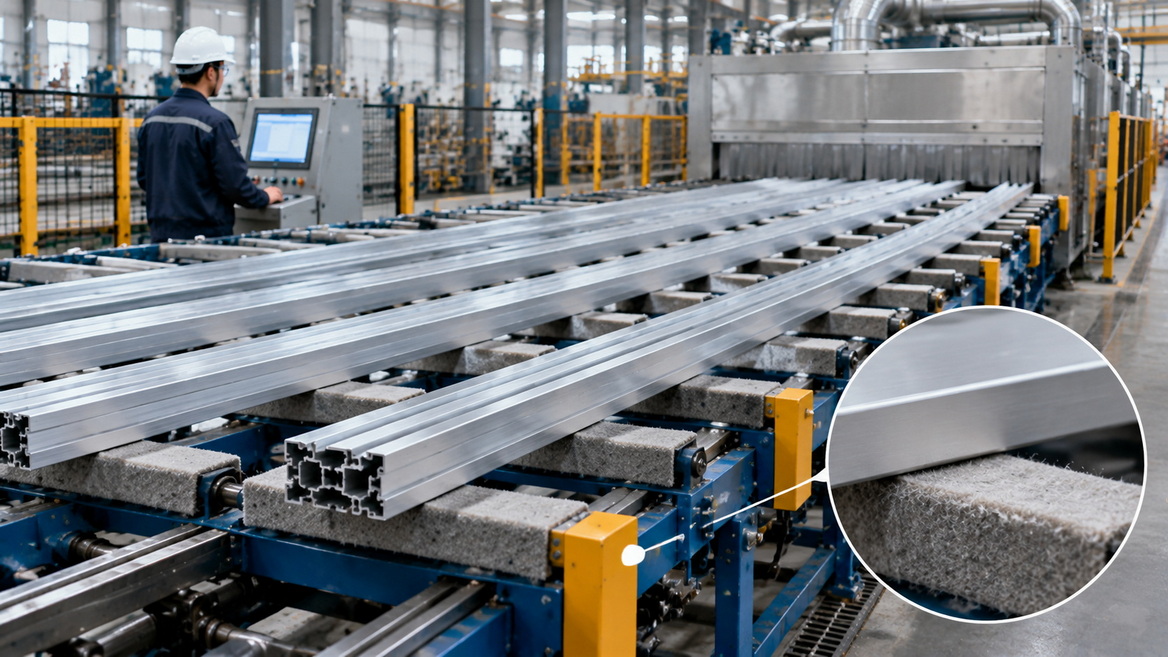
Huanan's published handling-system description includes hydraulic lifting, chain-driven high-temperature rollers, temperature-resistant felt belts, and controlled spacing between profiles. The supplier also describes equipment for copper and aluminum extrusion applications.
Its stated mechanical configuration makes it a useful candidate for buyers focusing on robust runout handling and profile-transfer arrangements.
Before approval, inspect frame fabrication, roller alignment, lifting synchronization, hydraulic protection, and access for replacement of wear components. For copper-related projects, request application-specific references rather than assuming an aluminum handling arrangement is directly transferable.
- Established: 1990.
- Location: Foshan, Guangdong.
- Main markets: Domestic and international customers; destination-specific service coverage should be checked.
- Customization scope: Extrusion presses, complete production solutions, and handling-table-related equipment.
Yejing's company website states that it has manufactured more than 3,000 aluminum profile extruders since 1990. This is a company-reported cumulative extrusion-machine figure, not annual handling-table capacity.
Its relevance lies in broader line integration. Buyers purchasing a new press and downstream equipment together may benefit from discussing mechanical and control interfaces with the same supplier.
For a handling-table-only purchase, request comparable retrofit references. Designing equipment around an existing third-party press can involve different responsibilities from supplying a new integrated line.
- Established: Public secondary descriptions report 2008; verify against the business license.
- Location: Foshan, Guangdong.
- Main markets: International marketing is evident; actual installed-base distribution requires confirmation.
- Customization scope: Cooling tables, handling systems, and wider extrusion-line equipment.
Dynamax lists aluminum extrusion cooling tables and handling systems through its supplier catalog. At least one published offering specifies a minimum order of one piece, although the exact commercial scope must be confirmed in a formal quotation.
The company is relevant to buyers comparing downstream handling equipment alongside furnaces and broader production-line procurement.
The principal due-diligence issue is responsibility allocation. Establish who designs and manufactures each module, who owns the control program, and which company will resolve faults involving multiple machines.
- Established: The supplier profile states that the Keda business was founded in 2002.
- Location: Zhaoqing, Guangdong.
- Main markets: Not independently established.
- Customization scope: Aluminum extrusion auxiliary equipment; exact handling-table scope requires a current proposal.
Keda's supplier profile describes an extrusion auxiliary-equipment business with production or sales operations connected to Guangdong, Jiangsu, and Shandong. A separate industry listing identifies a cooling-table offering from Wujiang Keda Machine Factory.
This makes the business relevant to auxiliary-equipment sourcing, but it also creates an important verification requirement: buyers should not assume that every Keda-branded listing belongs to the same legal entity or factory.
Confirm the relationship between the quoting company, manufacturing site, invoice issuer, and warranty provider before paying a deposit.
- Established: Legal founding year not verified; marketplace membership since 2018 is not a founding date.
- Location: Jiangyin, Wuxi, Jiangsu.
- Main markets: Its supplier profile lists North America, South America, Europe, Southeast Asia, Africa, Oceania, the Middle East, and East Asia.
- Customization scope: OEM/ODM services are listed, alongside extrusion dies, machinery, handling tables, pullers, and furnaces.
Royal's public catalog includes a dedicated category for aluminum extrusion handling and cooling tables, with listed minimum orders of one piece. Its broader profile describes complete copper and aluminum extrusion equipment and related spare parts.
The company may suit buyers combining machinery procurement with tooling and auxiliary equipment.
However, a broad product portfolio makes factory-role verification especially important. Ask which equipment is manufactured internally and which is sourced from partner factories. Do not apply generic marketplace lead-time statements to a customized handling system without a project schedule.
- Established: Not verified in the reviewed product information.
- Location: Sanshui District, Foshan, Guangdong.
- Main markets: Country-level sales distribution not established.
- Customization scope: Cooling conveyors, hydraulic lifting, different stretcher arrangements, and multiple transfer configurations.
Jianeng Jingjin publishes comparatively detailed cooling-table specifications. Its product page describes production-line lengths of 26–57 meters, compatibility with presses from 700 to 9,500 tons and larger specialized lines, and stretching capacities from 15 to 600 tons. These are supplier-published configuration ranges, not independently verified performance guarantees.
The company also describes felt-belt, chain-and-belt, and hydraulic walking-beam arrangements.
This detail makes it useful for technically specific comparisons. Buyers should nevertheless obtain a model-specific data sheet: the published maximums should not be assumed to coexist in one standard system.
- Established: 2011, according to company-published information.
- Location: Shishan, Nanhai District, Foshan.
- Main markets: Domestic and overseas customers are reported; handling-table-specific destinations require verification.
- Customization scope: Complete extrusion-line planning, including runout and cooling-table integration.
Sailixin describes a business centered on extrusion presses and complete production solutions. Its published material includes cooling-table layout, puller, saw, stretcher, furnace, and electrical-control integration within customized projects.
It is most relevant when the handling table forms part of a broader line investment.
The main assessment point is engineering and supply ownership. Ask whether the handling system is designed and built internally or supplied through a specialist partner, and ensure that the contract assigns a single accountable party for line-level acceptance.
Two different capacity questions must be separated:
1. Supplier manufacturing capacity: how many systems the factory can deliver within a period.
2. Equipment process capacity: the profiles, loads, speeds, and production conditions the proposed system can handle.
Verified annual handling-table manufacturing output was not available for these ten suppliers. Inventing such figures would create a misleading comparison. The table therefore shows published equipment scope where available and the information still required.
"RFQ confirmation" means the item must be established through a project-specific quotation.
| Supplier | Published capacity or equipment scope | MOQ status | Certification status and purchasing action |
|---|---|---|---|
| Xinxinke | Customized handling and auxiliary equipment; numerical capacity requires RFQ | RFQ confirmation | Obtain current site-specific certificates and machine documentation |
| MSGC | Customized dimensions; four- or five-stage handling arrangements | RFQ confirmation | Verify certificates and complete-system conformity documents |
| Wangeshi | Customized automatic handling and cooling tables | RFQ confirmation | Request current quality-system and electrical-safety evidence |
| Huanan | Hydraulic lifting runout and cooling-table systems | RFQ confirmation | Verify exact model documentation and inspection records |
| Yejing | Complete-line integration; handling-table capacity requires RFQ | RFQ confirmation | Check certificates against the contracting entity and delivered scope |
| Dynamax | Cooling-table and handling-system listings | One piece in a reviewed listing | Confirm current certificate scope and project-specific documentation |
| Zhaoqing Keda | Extrusion auxiliary-equipment scope | RFQ confirmation | Verify legal entity, factory address, and certificate ownership |
| Jiangyin Royal | Handling and cooling-table product category | One piece in reviewed listings | Verify actual manufacturer and system-level documentation |
| Jianeng Jingjin | Published 26–57 m lines; 15–600 t stretching range | RFQ confirmation | Require configuration-specific safety and acceptance records |
| Sailixin | Cooling-table integration within complete-line projects | RFQ confirmation | Verify current certificates and responsibility for outsourced modules |
Published scope and commercial details are drawn from the suppliers' product information and listings. No certification should be treated as currently validated solely because a marketing page displays a logo.
A useful request for quotation should include:
- Alloy and temper requirements.
- Maximum and minimum profile dimensions.
- Weight per meter and maximum supported load.
- Extruded length and finished cut length.
- Surface-quality expectations.
- Expected extrusion speed and production rhythm.
- Cooling or quenching requirements.
- Existing press, puller, stretcher, and saw interfaces.
- Available floor space and maintenance access.
Supplier product ranges demonstrate that handling tables are configurable systems rather than interchangeable conveyors. Their dimensions, transfer arrangements, cooling methods, and stretcher configurations vary substantially.
Do not accept a guaranteed tonnes-per-hour figure without the associated profile mix, operating conditions, and acceptance method.
A practical way to reduce material substitution risk is to include a controlled bill of materials in the technical agreement.
Specify the required frame materials, beam sections, roller construction, bearings, drive components, hydraulic equipment, and control hardware. Require written approval before substitutions.
For profile-contact materials, ask for:
- Exact felt composition and manufacturer.
- Continuous and short-duration temperature limits.
- Thickness and dimensional tolerances.
- Attachment method and replacement procedure.
- Batch identification and supporting technical data.
MSGC explicitly describes different felt requirements at different handling stages. This supports a zone-by-zone specification rather than a single generic requirement for "high-temperature felt."
For machinery placed on the EU market before 20 January 2027, the Machinery Directive 2006/42/EC remains the applicable machinery framework. Regulation (EU) 2023/1230 becomes mandatory from 20 January 2027. A purchase signed in 2026 may therefore require planning around the later framework, depending on when the equipment is placed on the market.
Request a configuration-specific conformity plan covering guarding, interlocks, emergency stops, electrical documentation, operating instructions, and responsibility for the integrated assembly.
CE marking is not an environmental certification and should not be treated as a substitute for technical review. RoHS applicability should also be assessed for the actual equipment and contractual scope rather than demanded as a generic certificate for every mechanical assembly.
A useful insider check is to distinguish an unloaded demonstration from a representative production test.
A supplier may show smooth movement with no profiles on the table. That demonstrates basic motion, but it does not establish hot-load alignment, surface protection, transfer stability, or synchronization with the rest of the line.
For procurement purposes, divide acceptance into three stages:
1. Factory mechanical and electrical checks.
2. Representative loaded trials where the factory has suitable upstream equipment.
3. Site acceptance with the buyer's actual profiles and complete production line.
The reason is visible in the equipment architecture: handling tables can combine lifting systems, temperature-sensitive contact materials, multiple conveyors, stretchers, and saw interfaces. Testing only one motion leaves much of that combined behavior unexamined.
Include a restart test after a controlled stop. Check whether profiles shift, contact one another, or develop marks during stopping and restarting—not only during steady running.
Before ordering, match the business license, quotation, bank beneficiary, manufacturing address, and warranty entity.
During an audit, request a live walkthrough of fabrication, assembly, electrical work, inspection, and export packing. Ask to see current work in progress and traceable records, not only completed-machine photographs.
This is especially important where public information suggests multiple group locations or a broad sourcing portfolio.
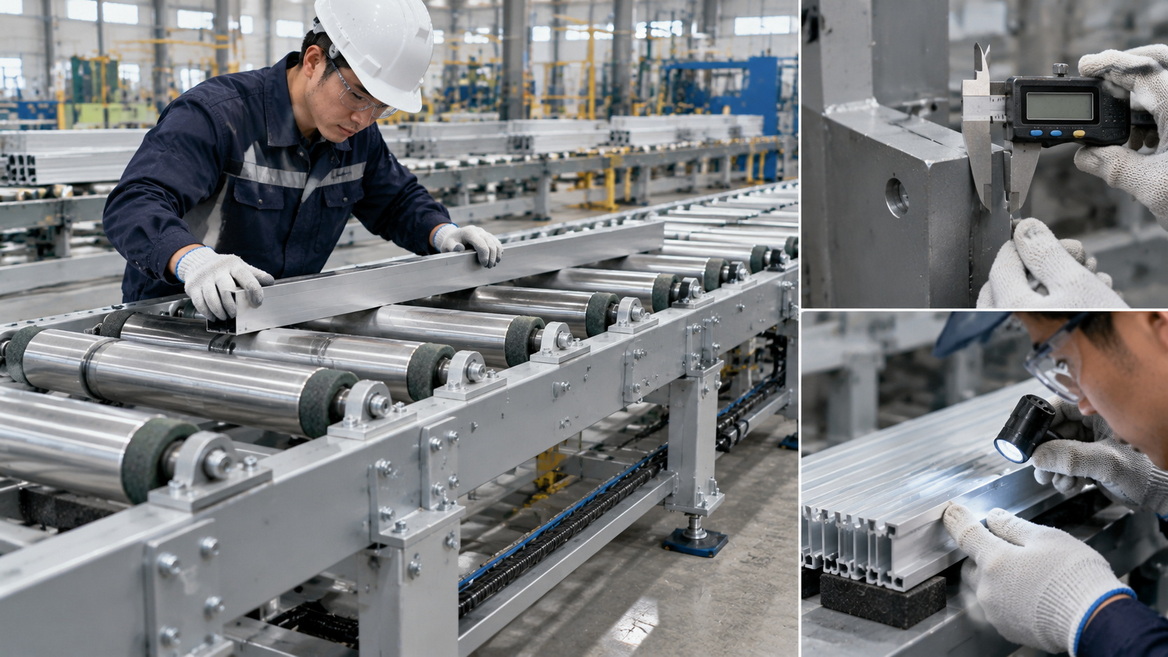
A full custom handling table is not normally a conventional sample purchase. A more useful sample stage can include felt, roller coverings, representative contact assemblies, and document samples.
Then agree on trials using representative profiles. Define acceptable surface condition, transfer behavior, dimensional checks, and evidence collection before testing begins.
The logistics annex should define:
- Package dimensions and weights.
- Lifting and center-of-gravity information.
- Shipment split and assembly sequence.
- Corrosion and moisture protection.
- Match-marking and connection identification.
- Foundation and utility requirements.
- Installation supervision and commissioning responsibilities.
This matters particularly for long modular systems: Jianeng Jingjin, for example, publishes line lengths up to 57 meters, making shipment segmentation and site reassembly material project considerations.
The right extrusion handling table supplier is the company that can turn your product mix, surface requirements, production targets, and factory constraints into a documented, testable system.
Xinxinke is a relevant starting point for buyers seeking flexible customization and coordinated extrusion-equipment discussions. MSGC and Jianeng Jingjin offer detailed publicly described handling configurations. Yejing and Sailixin are relevant to broader line integration, while the remaining candidates provide additional options for comparing auxiliary-equipment scope, commercial structure, and regional supply capabilities.
Send shortlisted suppliers the same technical package. Require a signed scope matrix, traceable component specifications, a realistic schedule, and agreed acceptance criteria. For a customized Xinxinke proposal, provide representative profile drawings, alloy information, the existing line layout, and target production conditions so the discussion begins with engineering requirements rather than a generic machine price.
Compare the certificate's legal entity, manufacturing address, scope, certificate number, issue date, and expiry date with the quotation and business license.
Then verify the record through the issuing certification body or an appropriate accredited-certification database. If the factory address differs, request an explanation and supporting documentation.
A valid management-system certificate does not by itself demonstrate that a specific handling table meets your performance requirements.
A procurement team should not accept that basis alone. Press tonnage does not define the entire handling requirement.
Ask the supplier to state the profile mix, weight per meter, extrusion speed, transfer sequence, cooling assumptions, stretcher cycle, and saw cycle behind its proposed output. The wide configuration ranges published by handling-system suppliers illustrate why a single press-size label is insufficient.
Use staged acceptance.
Complete agreed mechanical, electrical, alignment, and safety checks at the factory. Record which process outcomes remain unproven. Then define site acceptance using representative hot profiles after installation.
The contract should identify unresolved test conditions, responsibility for corrective work, and the payment milestone associated with final acceptance.
Assign responsibility explicitly before ordering.
The contract should name the party responsible for mechanical interfaces, control handshakes, safety integration, commissioning, and final line acceptance. For EU projects, the applicable machinery framework covers machinery and partly completed machinery, so documentation and integration responsibilities must reflect what is actually supplied.
Avoid contracts in which each supplier guarantees only its individual machine while nobody accepts responsibility for the assembled line.
Define ownership and access rights for drawings, software, parameter files, customized parts, and replacement components.
The agreement should address:
- Editable control-program backups and access conditions.
- Version-controlled drawings and parts lists.
- Standard versus proprietary components.
- Design-change approval.
- Spare-parts availability and pricing arrangements.
- Responsibility for servicing private-label equipment.
Royal publicly lists OEM/ODM services, while other candidates describe customized equipment or line integration. These labels do not establish identical development rights; the actual obligations must be written into the contract.
- International Aluminium Institute — Primary Aluminium Production, including September 2026 regional figures. [international-aluminium]
- State Council of the People's Republic of China — "China unveils plan to support growth of non-ferrous metals industry," September 28, 2025. [english.www.gov]
- European Commission — Machinery legislation and the transition to Regulation (EU) 2023/1230. [single-market-economy.ec.europa]
- EUR-Lex — Machinery safety requirements and application dates. [eur-lex.europa]
- Xinxinke — Handling Table, Product Category, Solutions, and published contact information. The supplied contact-page URL could not be retrieved; no additional claims were inferred from it. [xxkextrusion]
- MSGC Group — Aluminum Extrusion Handling Table product specifications. [msgroupchina]
- Wangeshi — Handling Table product category. [wgs-extrusionline]
- Enping Huanan — Customized handling-system supplier listing. [huananmachine.en.made-in-china]
- Yejing — Company information and aluminum-profile handling-table listing. [yjing-extrusion]
- Dynamax — Cooling Tables supplier catalog. [dynamax10.en.made-in-china]
- Zhaoqing Keda — Company profile; related Wujiang Keda cooling-table listing requires entity verification. [zhaoqingkeda.en.made-in-china]
- Jiangyin Royal — Company profile and extrusion handling-table category. [rextrusion.en.made-in-china]
- Jianeng Jingjin — Cooling Table technical specifications. [aluminum-solution]
- Sailixin — Company-published manufacturing background and line-integration description; supplier claims require independent verification. [slxextrusionpress]


