
Please Choose Your Language
Views: 231 Author: Xinxinke Extrusion Publish Time: 2026-10-15 Origin: Site


Content Menu
● How These Suppliers Were Selected
● Why Buyers Consider Chinese Copper Extrusion Equipment Suppliers
>> Three Different Industrial Ecosystems
>> Copper Demand Provides Context, Not a Machine Purchase Specification
● First Decide Which Copper Extrusion Technology You Need
>> Conventional Hydraulic Copper Extrusion Presses
>> Continuous Copper Extrusion Machines
● Comparison Table: Capacity, MOQ, and Certification Evidence
>>> Positioning: Flexible Copper and Aluminum Extrusion Equipment Projects
>> 2. Taiyuan Heavy Industry Co., Ltd. — TYHI
>>> Positioning: Large, Engineered Copper Extrusion Projects
>> 3. Wuxi Weite Machinery Co., Ltd.
>>> Positioning: Broad Conventional Extrusion Press Configurations
>> 4. Wuxi Yuanchang Machinery Co., Ltd.
>>> Positioning: Explicit Copper Bar and Tube Press Listings
>> 5. Wuxi Techway Technology Co., Ltd.
>>> Positioning: Non-Ferrous Extrusion Production-Line Equipment
>> 6. Jiangsu Giant Ally Imp. & Exp. Co., Ltd.
>>> Positioning: Integrated Equipment Sourcing and Export Coordination
>> 7. Dalian Konform Technology Co., Ltd.
>>> Positioning: Continuous Copper Extrusion Technology
>> 8. Aibang Machinery Technology Co., Ltd.
>>> Positioning: Continuous Rotary Copper Extrusion Lines
>> 9. Wuxi Xinwang Machinery Co., Ltd.
>>> Positioning: A Conditional Conventional-Press Candidate
>> 10. Wuxi Bono International Co., Ltd.
>>> Positioning: Copper Extrusion Equipment Export Supply
● Buyer's Guide: How to Qualify a Copper Extrusion Press Supplier
>> Define the Product Before Selecting Press Tonnage
>> Turn Material Quality into a Documented Inspection Plan
>> Use Product Trials Instead of Generic Samples
>> Check Compliance for the Actual Destination and Delivery Date
>> Plan Heavy-Machine Logistics Before Signing
● The Overlooked Procurement Trap: Fast Movement Is Not Productive Extrusion
● Conclusion: Select the Process, Then Qualify the Partner
● FAQ
>> 1. How Can I Verify Whether a Manufacturer's ISO Certificate Has Expired?
>> 2. Can an Aluminum Extrusion Press Be Used for Copper Simply by Changing the Die?
>> 3. How Should I Compare a Hydraulic Copper Press with a Continuous Extrusion Machine?
>> 4. Is a CE Certificate Enough for Importing an Extrusion Press into the EU?
>> 5. What Should Happen if a Machine Passes Factory Testing but Fails After Installation?
China offers a substantial supplier base for copper extrusion equipment, from customized hydraulic presses to large copper-alloy production lines and continuous extrusion systems. For international procurement managers, the opportunity is not simply to obtain a competitive machine price. It is to find a supplier that can match the required alloy, product geometry, production schedule, compliance obligations, and long-term maintenance strategy.
The scale of China's copper industry helps explain this equipment ecosystem. The U.S. Geological Survey's 2025 copper report estimated China's refined copper production at 12 million metric tons in 2024, compared with a rounded global total of 27 million metric tons. These figures describe copper production, not extrusion press sales, but they demonstrate the size of the industrial market supporting copper-processing equipment.
This guide begins with Xinxinke Co., Ltd. and examines nine additional companies relevant to copper extrusion procurement. It distinguishes conventional hydraulic press manufacturers from continuous extrusion specialists and equipment exporters, because those categories are not interchangeable.
The central purchasing principle is verification: evaluate the exact machine, manufacturing entity, process capability, and contractual guarantees—not just the supplier's catalog.
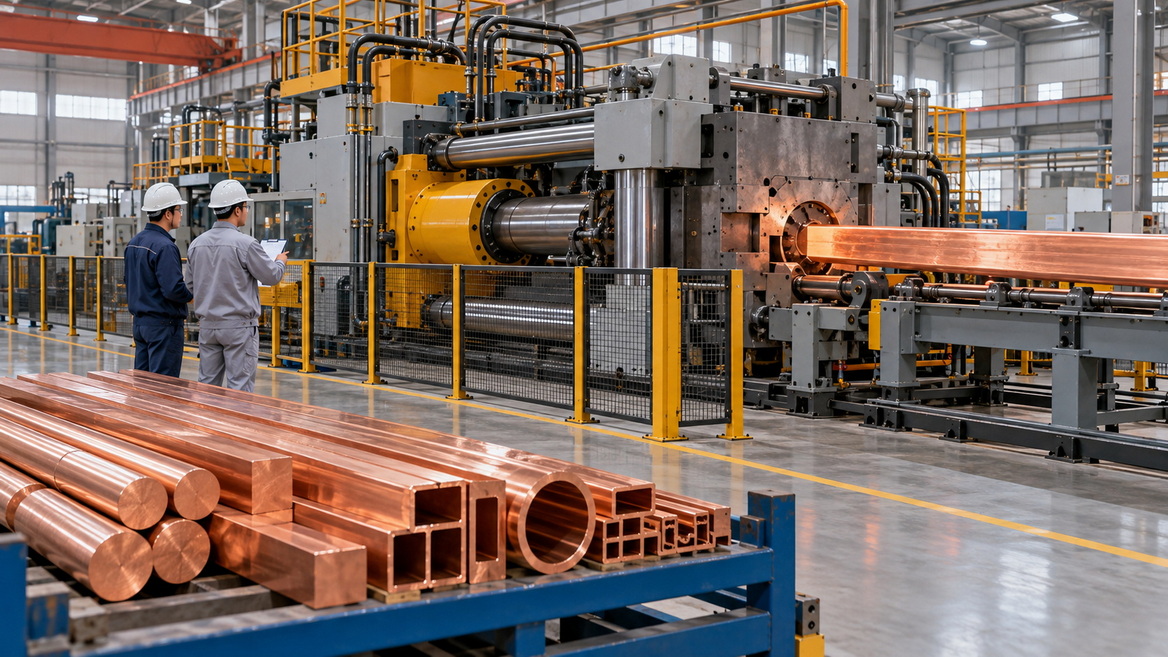
A useful supplier shortlist must explain its limitations as clearly as its advantages.
The companies below were selected using publicly available product information, company profiles, exhibition listings, and evidence of involvement in copper or non-ferrous metal extrusion equipment. This is a procurement shortlist, not an independently audited ranking by revenue, quality, or market share.
Xinxinke appears first because it is the commissioning company for this article. Its inclusion should not be interpreted as independent proof of superiority.
The screening criteria are:
1. Copper-processing relevance: published copper extrusion machinery or a clearly identified copper-related equipment offering.
2. Engineering capability: evidence of press design, production-line integration, tooling support, or process-specific development.
3. Manufacturing transparency: identifiable factory location, legal entity, and separation between manufacturing and export activities.
4. Quality-control readiness: willingness to provide inspection plans, component traceability, test records, and acceptance procedures.
5. Delivery accountability: a project schedule covering design approval, component procurement, assembly, testing, shipment, and commissioning.
6. Customization capability: support for product-specific tooling, controls, utilities, handling equipment, and plant layout.
7. Compliance documentation: machine-specific conformity evidence rather than generic certificates.
Where establishment dates, annual production capacity, markets, or certifications could not be confirmed, they are identified as unverified rather than estimated.
The supplier locations in this guide illustrate three useful procurement ecosystems:
- Foshan, Guangdong: Xinxinke operates within an established extrusion-equipment environment serving aluminum and copper applications. Its exhibition profile identifies Foshan as its headquarters.
- Wuxi and surrounding Jiangsu locations: several shortlisted companies publish conventional copper extrusion presses, non-ferrous extrusion equipment, tooling, and integrated production-line offerings.
- Taiyuan and Dalian: Taiyuan is represented by heavy extrusion machinery, while Dalian has a documented continuous extrusion technology supplier.
These locations provide different starting points for supplier research. They do not, by themselves, prove that a particular factory can produce the required copper component.
The International Copper Study Group publishes copper market statistics and industry reports, including its 2025 statistical yearbook. An October 2025 forecast reported by Reuters projected global refined copper usage of 28.7 million tons in 2026 and identified China as accounting for approximately 58% of global usage. These were forecast figures, not final 2026 results.
For equipment buyers, the practical implication is to evaluate how a proposed line will serve their own product demand. A favorable copper market outlook does not justify buying excess press capacity without confirmed orders, tooling plans, and downstream processing capability.
Conventional presses are relevant to billet-based production of profiles, bars, and tubes. Public offerings from Taiyuan Heavy Industry, Wuxi Weite, and Wuxi Yuanchang include copper extrusion equipment and single- or double-action configurations.
A quotation should identify:
- Press configuration and rated force.
- Billet diameter and usable length.
- Solid or hollow product requirements.
- Container, stem, die, and mandrel arrangements.
- Extrusion speed under the specified load.
- Heating, handling, cooling, and downstream equipment.
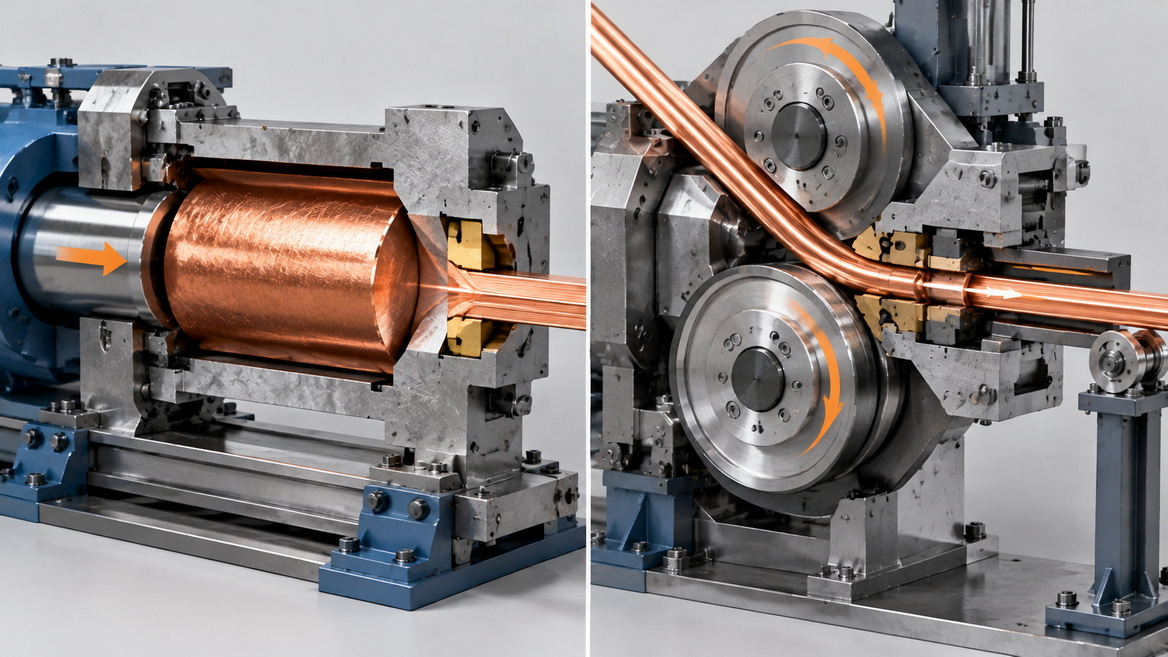
Continuous extrusion is a separate equipment category. Dalian Konform and Aibang publish continuous copper extrusion offerings, with applications including copper wire, busbar, strip, and conductors.
A continuous machine should therefore not be compared directly with a hydraulic press using nominal tonnage. The appropriate comparison is whether each process can deliver the required finished product, quality, throughput, and operating cost.
"Capacity" can mean press force, machine output, or annual factory production. The table separates these concepts where public information allows.
A one-machine inquiry is not automatically a confirmed minimum order quantity. Where MOQ is unavailable, request written confirmation.
| Company | Equipment focus and published capacity information | MOQ or purchasing approach | Certification evidence and limitations |
|---|---|---|---|
| Xinxinke Co., Ltd. | Copper and aluminum extrusion equipment; copper-specific force and output require a project quotation | Custom project; MOQ not publicly verified | Request current factory certificates and machine-specific conformity documents |
| Taiyuan Heavy Industry / TYHI | Published extrusion range of 5–235 MN across multiple materials; a 40 MN double-action copper press is listed | Engineered project; MOQ not published | Confirm certificates and compliance package for the contracting entity and machine tzpress |
| Wuxi Weite Machinery | Published 500–10,000 T extrusion range, including copper applications; output is product-dependent | Custom project; MOQ not confirmed | Obtain current certificates and model-specific documentation weitepress |
| Wuxi Yuanchang Machinery | Copper press listings include 1,000-, 1,800-, 2,500-, and 3,600-ton models; one listing claims 180 sets/year of factory capacity | One piece shown in product listings | ISO 9001 and CE are advertised; current scope and machine applicability require validation wxyuanchang.made-in-china+1 |
| Wuxi Techway Technology | Published non-ferrous equipment range of 100–3,600 tons, including copper applications | MOQ not publicly verified | Current certification evidence requires direct confirmation wxtw01.made-in-china |
| Jiangsu Giant Ally | Published copper press offerings include GA-1350T and GA-1650T | One set shown in listings | Verify both exporter documentation and actual manufacturing entity jsjiangli.made-in-china+1 |
| Dalian Konform Technology | Continuous extrusion; published 300H example reports up to 800 kg/hour for copper flat wire under stated conditions | Standard or customized line; MOQ not confirmed | Company states ISO 9001 certification and CE compliance; verify current documents konformgroup+1 |
| Aibang Machinery Technology | Continuous rotary extrusion lines for copper; project output requires confirmation | MOQ not publicly verified | Request current certificates and conformity documentation continuousextrusion |
| Wuxi Xinwang Machinery | Secondary industry listing describes aluminum, copper, and magnesium extrusion solutions; rated capacity requires confirmation | Custom project; MOQ not verified | Manufacturer identity, current certificates, and copper references require additional checks slxextrusionpress |
| Wuxi Bono International | Export listings include copper presses from 500–5,500 T and double-action models | One set shown in listings | Confirm original factory, certificate holder, and warranty responsibility wuxibono.goldsupplier |
Published tonnage ranges are supplier descriptions, not confirmation that every listed model is suitable for every copper alloy. Likewise, an advertised factory output figure should not be treated as an audited delivery guarantee.
Xinxinke is a relevant starting point for buyers seeking customized copper and aluminum extrusion equipment rather than a fixed, catalog-only purchasing process. Its ALUMINIUM CHINA exhibitor profile states that the company was established in 2006, is headquartered in Foshan, and works in aluminum and copper extrusion equipment.
The company information supplied for this article describes more than 30 years of industry experience. Buyers should distinguish that experience claim from the legal establishment year: accumulated team or industry experience is not necessarily the age of the current company.
- Establishment: 2006, according to the exhibition profile.
- Main market orientation: international buyers are a stated target; a verified country-by-country sales breakdown was not available.
- Core proposition: customized extrusion equipment for copper and aluminum processing.
- OEM/custom engineering scope to discuss: press configuration, controls, utilities, tooling interfaces, handling systems, and production-line layout.
- Buyer fit: small and medium-sized extrusion plants and growing manufacturers that need project flexibility. The company's published positioning identifies these customer groups and emphasizes customization support.
For this buyer segment, communication efficiency should be tested rather than merely claimed. Ask Xinxinke to assign a technical contact, provide a documented response schedule, and issue a requirements-to-design checklist.
Its value proposition is strongest when flexibility produces measurable project benefits: fewer layout compromises, clearly documented customization, and faster resolution of engineering questions. Claims of favorable cost-performance should be assessed through an itemized quotation and lifecycle-cost comparison.
TYHI publishes copper-alloy extrusion equipment encompassing single-action and double-action presses. Its extrusion website states that extrusion press development began in 1962 and lists equipment spanning 5 MN to 235 MN across several materials, including a 40 MN horizontal double-action copper extrusion press.
- Establishment: the cited evidence confirms extrusion development since 1962, not the legal incorporation date.
- Main market orientation: large industrial extrusion projects; a geographic revenue breakdown was not verified.
- Core advantage: published experience with heavy extrusion systems and copper-alloy configurations.
- Custom engineering scope: press architecture and complete copper extrusion equipment packages.
- Buyer fit: projects where heavy engineering capability and line integration are central requirements.
Request references matching the intended copper alloy and press configuration. A large installed base across several metals is useful background, but it does not replace evidence for the exact copper application.
Wuxi Weite states that it was founded in 1989. Its published product range covers 500–10,000 T direct and indirect presses, including single- and double-action arrangements for copper and other metals.
- Establishment: 1989.
- Main market orientation: domestic and international extrusion projects; destination-specific sales shares are not published in the cited material.
- Core advantage: breadth of press configurations.
- Custom engineering scope: direct or indirect extrusion, loading arrangements, press configuration, and profile or tube applications.
- Buyer fit: purchasers comparing multiple conventional process routes.
The important question is not how many configurations the catalog lists. It is which configuration the supplier recommends for the buyer's alloy, section geometry, yield target, and tooling requirements—and why.
Wuxi Yuanchang's public profile gives an establishment date of March 30, 1996. Its listings include copper extrusion presses for bars and tubes, with single- and double-action options. A published 1,800-ton copper press listing advertises ISO 9001 and CE credentials.
- Establishment: 1996.
- Main market orientation: global non-ferrous processing customers, according to its published company description.
- Core advantage: identifiable copper-specific models and technical selection tables.
- Custom engineering scope: press selection, bar and tube applications, and non-ferrous extrusion equipment packages.
- Buyer fit: buyers seeking a documented starting point for a conventional copper press inquiry.
Request a copper-specific operating envelope. A model table should be supplemented with loaded speed, thermal conditions, actual billet dimensions, trial results, and agreed finished-product acceptance criteria.
Wuxi Techway states that it was founded in 2006 and manufactures non-ferrous extrusion production-line equipment. Its public profile describes more than 30 specifications across a 100–3,600-ton range for aluminum, copper, and magnesium processing.
- Establishment: 2006.
- Main markets: a verified geographic breakdown was not available.
- Core advantage: a published multi-material equipment portfolio.
- Custom engineering scope: production-line equipment selection and integration, subject to confirmation.
- Buyer fit: plants evaluating a broader equipment package rather than only a stand-alone press.
Before shortlisting, request copper-specific customer references and clarify which equipment is manufactured internally. Line integration capability and ownership of component manufacturing are separate questions.
Jiangsu Giant Ally's public profile lists an establishment date of August 10, 2009, and identifies the business as both a manufacturer/factory and trading company. Its offering includes aluminum and copper extrusion presses, dies, tooling, furnaces, and related equipment.
- Establishment: 2009.
- Main market orientation: export-oriented equipment supply; verified regional sales shares are unavailable.
- Core advantage: breadth of equipment sourcing and package coordination.
- Custom engineering scope: press and tooling packages, heating equipment, and related line components.
- Buyer fit: purchasers seeking coordinated procurement across several equipment categories.
Clarify whether Giant Ally manufactures the proposed press, commissions it from another factory, or acts as the export contractor. The answer determines who should sign the technical guarantees and provide warranty support.
Dalian Konform states that its origins date to 1993, with research and development history extending to 1984. Its official website describes continuous extrusion, cladding, and sheathing equipment and reports installations across 53 countries as of 2023.
- Establishment: company origins in 1993; confirm the incorporation date of the actual contracting entity.
- Main markets: international customers across multiple continents.
- Core advantage: specialized continuous extrusion technology.
- Custom engineering scope: copper wire, busbar, strip, and process-specific line development.
- Buyer fit: manufacturers whose products and feedstock suit continuous extrusion.
A published American customer project provides useful evidence of application-specific development. Konform reported modifying pretreatment, temperature control, tooling, take-up, and rolling arrangements for thin copper strip. The reported output for that customized strip trial was 300 kg/hour—different from the machine's stated maximum copper flat-wire output of 800 kg/hour.
That distinction illustrates why product-specific test data matters more than headline throughput.
Aibang identifies itself as a Chinese manufacturer of continuous rotary extrusion lines for copper and aluminum. Its published applications include copper conductors for high-speed railway use.
- Establishment: not verified in the reviewed material.
- Main markets: not sufficiently documented to name.
- Core advantage: a clearly identified continuous copper extrusion offering.
- Custom engineering scope to verify: feed preparation, tooling, conductor geometry, controls, and downstream handling.
- Buyer fit: conductor and related continuous-extrusion applications.
Aibang belongs in a process-specific inquiry list, but buyers should obtain stronger corporate, factory, certification, and installation evidence before treating it as a fully qualified supplier.
A secondary industry listing describes Wuxi Xinwang as providing customized extrusion solutions for aluminum, copper, and magnesium. That supports further investigation, but it is weaker evidence than a verified copper press specification or witnessed installation.
- Establishment: not verified.
- Main markets: not verified.
- Core proposition: customized non-ferrous extrusion equipment, according to the secondary listing.
- OEM/custom engineering scope: requires direct confirmation.
- Buyer fit: preliminary inquiries where the buyer can conduct additional factory and technical checks.
Before requesting commercial offers, obtain the business license, official product catalog, factory address, and copper-specific reference projects. This entry should remain conditional until those documents are reviewed.
Wuxi Bono's public listings include copper tube presses, brass extrusion plants, and single- and double-action copper extrusion machines. Several listings specify a minimum order of one set.
- Establishment: not verified in the reviewed material.
- Main market orientation: international equipment supply.
- Core advantage: a broad published copper equipment offering.
- Custom project scope to verify: press sourcing, auxiliary equipment, export logistics, and commissioning coordination.
- Buyer fit: purchasers willing to evaluate an export supplier alongside the original manufacturer.
Bono should not automatically be classified as the factory producing every listed machine. Require disclosure of the original manufacturer and define responsibility for design changes, acceptance testing, spare parts, and warranty service.
Start with a product and process specification, not a desired machine size.
Provide prospective suppliers with:
- Copper or copper-alloy designation and applicable material standard.
- Feedstock chemistry and dimensional tolerances.
- Finished section drawings.
- Required dimensional, surface, and mechanical properties.
- Conductivity requirements where applicable.
- Expected product mix and batch size.
- Target saleable output per shift.
- Available electrical power, cooling water, floor space, and lifting capacity.
Require the supplier to explain how these requirements determine the machine configuration.
To reduce the risk of substituted or inadequately specified components, request:
1. A bill of materials identifying critical load-bearing and wear components.
2. Material grades and traceable material certificates.
3. Heat-treatment records where applicable.
4. Agreed inspection and nondestructive-testing requirements.
5. Hydraulic component brands, models, and substitution rules.
6. Electrical component and control-system specifications.
7. Inspection hold points before critical components become inaccessible.
The contract should prohibit unapproved substitutions. "Equivalent quality" is too vague unless the equivalence criteria are documented.
For an extrusion press, the relevant "sample" is usually a controlled production trial using representative feedstock and tooling.
The factory acceptance test should define:
- Trial alloy and feedstock source.
- Product drawing and tooling revision.
- Warm-up conditions.
- Run duration.
- Recorded pressure, speed, temperature, and power.
- Dimensional measurements and test methods.
- Accepted output and rejected material.
- Responsibilities if the trial fails.
Where copper-product quality is critical, use an independent laboratory for the agreed material tests.
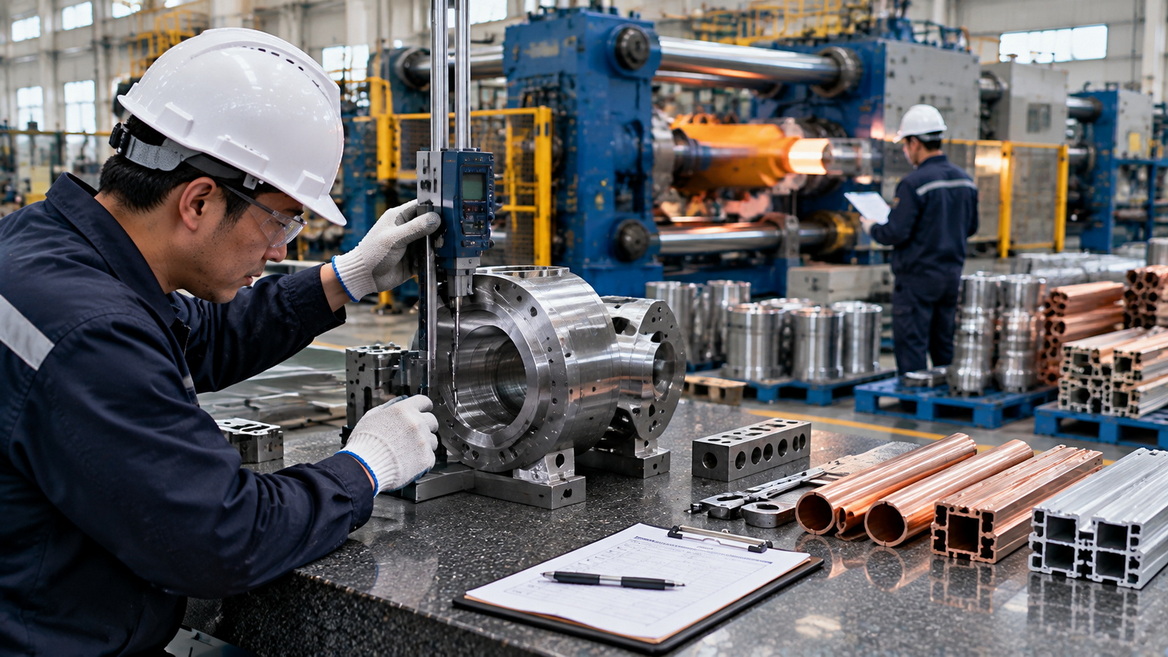
CE marking is the manufacturer's declaration that a product meets applicable EU requirements; it is not a substitute for reviewing the technical documentation and Declaration of Conformity. The European Commission advises manufacturers to identify relevant requirements, assess conformity, compile evidence, and issue the declaration.
For projects approaching 2027, the timing matters. Regulation (EU) 2023/1230 applies from January 20, 2027. Buyers should agree which rules apply to the machine when it is placed on the market or put into service.
Do not treat RoHS paperwork as proof of mechanical safety or extrusion capability. Request a destination-specific compliance assessment that explains which environmental and product requirements apply to the supplied machine and its components.
Require a shipping and installation package covering:
- Individual module dimensions and weights.
- Lifting points and handling instructions.
- Transport locks and corrosion protection.
- Container, flat-rack, or breakbulk assumptions.
- Export packing and insurance responsibilities.
- Foundation drawings and utility requirements.
- Unloading and installation boundaries.
- Commissioning personnel, travel costs, and training.
- Spare-parts delivery arrangements.
Ask a customs broker to confirm classification and import requirements for the exact equipment package. Do not assume that one description or tariff code covers the press, furnace, control equipment, and all auxiliary systems.
A useful internal procurement check is to separate advertised movement speed from loaded production performance.
A supplier may demonstrate a fast approach stroke or an easy section, while the buyer's demanding product requires different load, tooling, temperature, or downstream conditions. A maximum speed figure is therefore not an adequate production guarantee.
The published Konform example makes the broader point clear: the same machine family carried a stated maximum copper flat-wire output of 800 kg/hour, while a customized thin-strip trial reported 300 kg/hour. Both figures can be valid, but they answer different questions.
To prevent misleading comparisons:
- Specify the exact test product and alloy.
- Record speed and output during the agreed operating conditions.
- Measure accepted product rather than gross processed material.
- Include normal handling interruptions and reject losses.
- Require a sufficiently long run to evaluate stable operation.
- Attach the test protocol to the purchase contract.
The purchasing question is not "How fast can this machine move?" It is "How much conforming product can this line reliably deliver under our agreed conditions?"
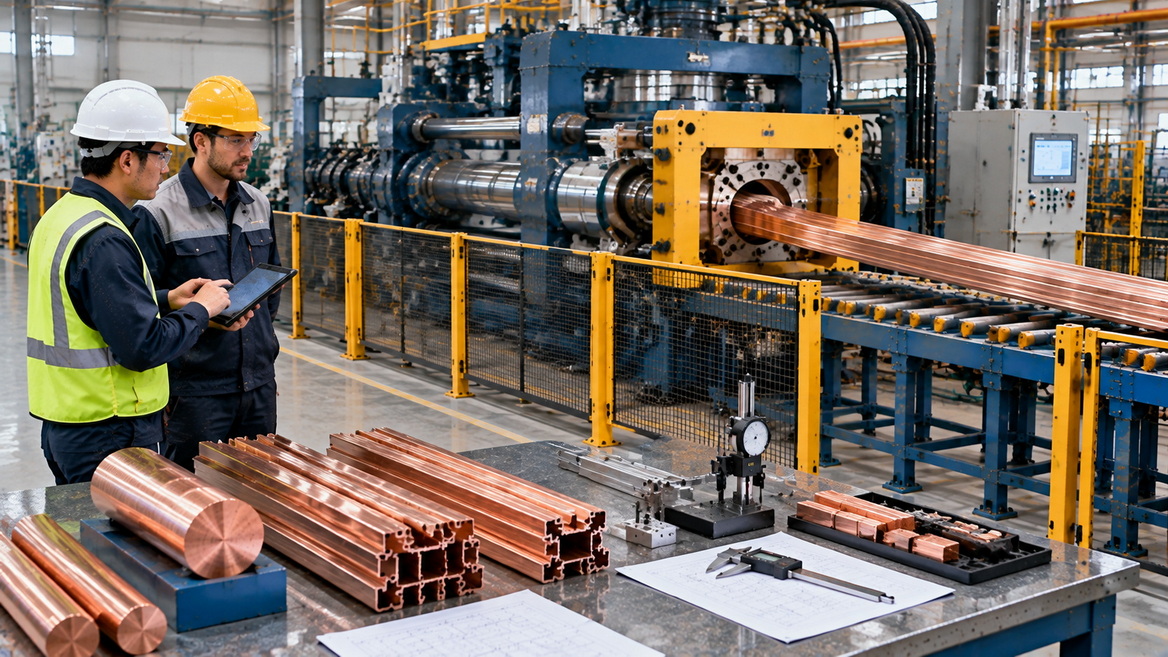
Chinese suppliers offer several routes to copper extrusion capacity: conventional hydraulic presses, heavy engineered systems, continuous extrusion lines, and coordinated export packages. The right route depends on the product—not on the supplier's position in a list.
Xinxinke Co., Ltd. provides a relevant starting point for buyers seeking flexible copper and aluminum extrusion equipment projects. Its proposed advantages in customization, communication, and support should be converted into a written engineering scope, documented response process, and product-specific acceptance commitment.
For a meaningful quotation, submit your alloy specification, section drawings, feedstock dimensions, target output, plant utilities, and destination requirements. Ask Xinxinke and competing suppliers to respond against the same technical checklist. That creates a defensible comparison of equipment performance, customization depth, compliance responsibilities, and total project cost.
Search the company name or certificate number in IAF CertSearch and review the certificate status, scope, issuing body, and accreditation details. The database supports checking whether a certificate is active and identifying the certified activities and locations.
Also compare the certified entity with the supplier named in your contract. A certificate for a related company or a trading office does not automatically cover the factory manufacturing your press. If the record is missing or unclear, obtain confirmation directly from the issuing certification body before drawing a conclusion.
Do not approve that substitution solely because a catalog mentions both metals.
Several suppliers publish equipment for multiple non-ferrous materials, but this does not establish that every model is interchangeable across all applications.
Require a written copper-specific assessment covering press loading, operating conditions, tooling, container arrangements, handling equipment, and a representative production trial.
Compare process suitability and finished-product economics, not machine tonnage.
Conventional suppliers publish billet-based copper press configurations, while continuous specialists publish applications such as copper wire, busbar, and strip.
Ask each supplier to quote the same finished product, quality requirements, accepted output, utility consumption, and downstream scope. Include feedstock preparation and any additional processing in the comparison.
No. Review the machine-specific Declaration of Conformity, applicable legislation, technical evidence, instructions, and conformity responsibilities. EU guidance explicitly identifies these as elements of the conformity process.
For delivery around the regulatory transition, establish whether the current machinery framework or Regulation (EU) 2023/1230 applies. The new regulation applies from January 20, 2027.
Define this situation before purchase through separate factory and site acceptance protocols.
The contract should identify:
- Which guarantees are tested at the factory and which at the buyer's site.
- Required site utilities, foundations, feedstock, and tooling.
- How a failure is investigated.
- Who pays for corrective work and repeat testing.
- The deadline for corrective action.
- The payment amount retained until final acceptance.
- The available remedies if contractual performance remains unmet.
This prevents disagreements about whether the cause is the machine, installation, utilities, feedstock, or operating conditions.


