
Please Choose Your Language
Views: 234 Author: Xinxinke Extrusion Publish Time: 2026-10-21 Origin: Site


Content Menu
● Introduction: Why Source a Billet Heating Furnace from China?
● How We Selected These Billet Heating Furnace Manufacturers
● Understand the Furnace Category Before Comparing Suppliers
>> Aluminum Billet and Log Heating Furnaces
>> Induction Billet Heating Systems
>> Billet Heating Is Not Homogenizing or Melting
● The Top 10 Billet Heating Furnace Manufacturers in China
>> 2. Foshan Jingye Machinery Manufacturing Co., Ltd.
>> 3. Foshan Dynamax Industry Co., Ltd.
>> 4. Foshan Nanhai Huitai Technology Machinery Co., Ltd.
>> 5. Foshan Xianneng Furnace Industry Technology Co., Ltd.
>> 6. Foshan Winko Machinery Equipment Co., Ltd.
>> 7. Hebei Yuantuo Electromechanical Equipment Manufacturing Co., Ltd.
>> 8. Luoyang Judian Metal Hot Processing Equipment Co., Ltd.
>> 9. Forever Furnace Manufacturing Co., Ltd.
>> 10. HLQ Induction Equipment Co., Ltd.
● Manufacturer Comparison: Capacity, MOQ, and Certification
● Buyer's Guide: How to Qualify a Billet Heating Furnace Supplier
>> 1. Issue a Complete Process Specification
>> 2. Audit the Factory and Its Quality-Control Process
>> 3. Replace a Simple Sample Check with a Production Trial
>> 4. Check Compliance Without Relying on Logos
>> 5. Plan Delivery, Installation, and Service Before Ordering
● An Overlooked Procurement Trap: A Good Temperature Reading Can Hide a Bad Billet
● Conclusion: Select a Supplier Around Proven Process Performance
● FAQ
>> 1. How Can I Verify Whether a Supplier's ISO Certificate Has Expired?
>> 2. Can One Furnace Heat Aluminum, Copper, and Steel Billets Effectively?
>> 3. How Should I Compare Two Suppliers Quoting Different Throughput Figures?
>> 4. Does a CE Certificate Mean the Furnace Can Be Imported Without Further Checks?
China offers a substantial supplier base for billet heating furnaces, from aluminum extrusion line specialists to manufacturers of induction heating systems for copper, brass, and steel. However, these suppliers serve different applications. A furnace designed for aluminum extrusion is not automatically suitable for steel forging or copper processing.
The scale of China's aluminum industry helps explain the depth of its equipment supply chain. In a February 2026 industry analysis, CRU reported that the International Aluminium Institute estimated China's 2025 primary aluminum production at 44.2 million metric tons. This is an indicator of the country's industrial base—not a measure of billet furnace sales or supplier quality.
Foshan, particularly the Nanhai, Dali, and Shishan areas, has a visible concentration of extrusion equipment and aluminum-processing furnace businesses. Suppliers such as Xinxinke, Jingye, Dynamax, Huitai, and Xianneng illustrate this local manufacturing ecosystem. Its practical attraction is the availability of related presses, furnaces, handling equipment, and technical services within the same region.
For procurement managers, the most important selection principle is verification: compare what a supplier can demonstrate under your production conditions, rather than what its brochure promises.
This guide presents ten manufacturers worth investigating. It is an application-based shortlist, not an independently audited market-share ranking. Xinxinke appears first as the featured supplier; its placement does not imply independently established superiority.

The shortlist draws on publicly available manufacturer information, product portfolios, and supporting industry sources reviewed for this article. No factory visits, customer interviews, or independent performance tests were conducted.
The evaluation framework focuses on six purchasing requirements:
| Selection criterion | Evidence a procurement team should request |
|---|---|
| Application compatibility | References involving comparable alloys, billet dimensions, and forming processes |
| Engineering and development | Thermal calculations, layout drawings, control descriptions, and relevant project documentation |
| Manufacturing and quality control | Inspection plans, material traceability, assembly records, and calibration procedures |
| Production performance | Guaranteed throughput, temperature distribution, and energy consumption under defined conditions |
| Compliance | Current management-system certificates and model-specific conformity documentation where applicable |
| Delivery and service | Manufacturing milestones, commissioning arrangements, spare-parts support, and response commitments |
An established company can still offer a furnace outside its strongest area. Likewise, a large factory does not necessarily provide better support for a small, customized project.
Founding dates below are identified as supplier-reported where appropriate. Missing dates, unverified certificates, and undisclosed production capacities remain explicitly marked rather than estimated.
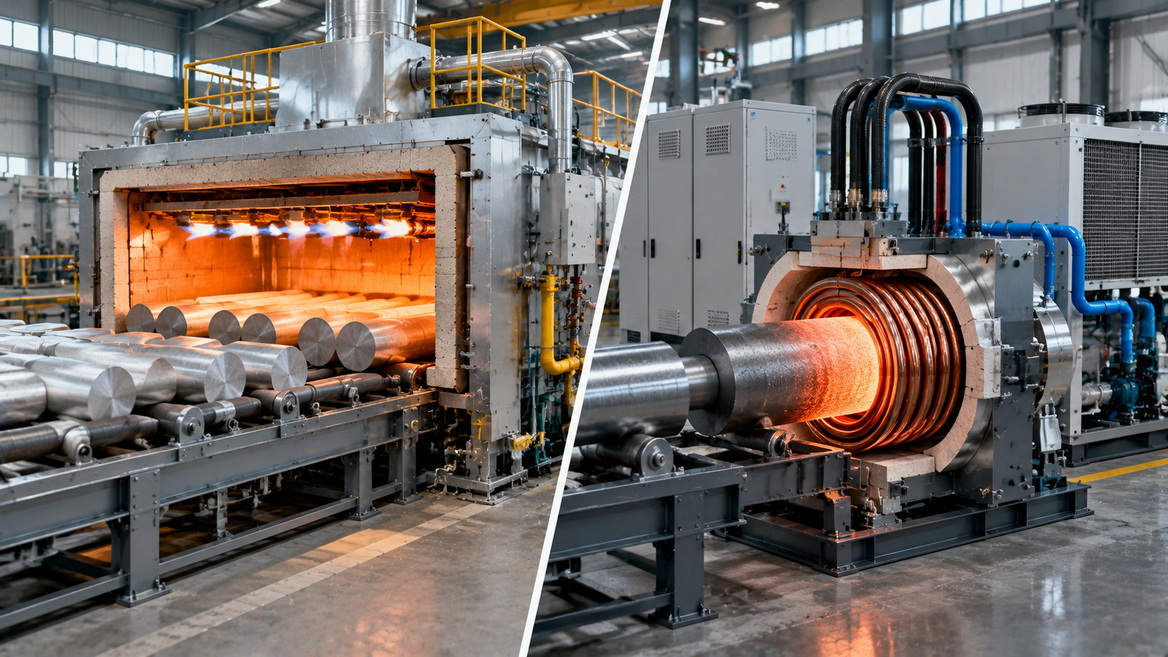
Aluminum extrusion suppliers may offer single-log, multi-log, or short-billet heating arrangements. Some systems combine heating with hot shearing, making furnace output part of a larger billet preparation process. Jingye, Dynamax, and Huitai publicly list equipment in these categories.
The purchasing question is not simply how quickly the furnace heats metal. It is whether the system can deliver the required billet size and temperature profile at the extrusion press's actual production rhythm.
Induction equipment heats the workpiece through induced electrical currents. Coil design, operating frequency, power distribution, and material properties influence heating performance. Suppliers such as HLQ offer systems for steel, copper, aluminum, and other hot-forming applications.
Do not compare induction systems solely by installed kilowatts. Temperature uniformity, billet geometry, transfer time, cooling requirements, and usable throughput must also be considered.
A supplier's experience with melting or homogenizing furnaces does not, by itself, establish competence in billet heating before extrusion or forging.
Ask for references involving the exact process you intend to purchase. This distinction is particularly important when a supplier advertises a broad aluminum furnace portfolio.
- Location: Foshan, Guangdong.
- Founded: 1991, according to its corporate website.
- Reported markets: Southeast Asia, Europe, and the United States.
- Relevant portfolio: Copper and aluminum extrusion presses, billet heating furnaces, homogenizing furnaces, die furnaces, and quenching systems.
Xinxinke deserves consideration when the billet heating furnace must work closely with a new or existing extrusion press. Its public portfolio combines primary extrusion equipment with auxiliary systems, creating a relevant starting point for buyers seeking coordinated line engineering rather than a standalone furnace purchase.
For small and midsized extrusion businesses, its potential value proposition is a customized package that balances equipment scope, integration requirements, and capital expenditure. This should be evaluated through a detailed quotation; a lower total cost cannot be established from company descriptions alone.
Its website describes customized solutions and in-house machining capabilities. Relevant OEM engineering discussions should therefore cover billet dimensions, furnace-to-press interfaces, automation, workshop layout, and documentation. Buyers should confirm which furnace components Xinxinke manufactures internally and which are sourced from partners.
To assess flexibility and communication efficiency objectively, request a named project engineer, a written clarification schedule, and a revision-controlled proposal. These commitments are more useful than an unsupported claim of unusually fast service.
The company reports annual output of around 200 equipment units, but this is not a verified billet-heating-furnace production figure. Ask separately about furnace build slots, thermal guarantees, and commissioning resources.
- Location: Foshan, Guangdong.
- Founded: 1992, according to its website.
- Market orientation: Aluminum extrusion equipment; regional sales distribution was not established from the reviewed page.
- Relevant portfolio: Automatic single-log, multi-log, and multi-billet heating production lines.
Jingye is a relevant candidate for buyers comparing different billet preparation architectures. Its published range includes several heating-line configurations rather than one generic furnace category.
Its principal attraction is the ability to discuss heating as part of extrusion auxiliary equipment planning.
For OEM or project-specific engineering, request written confirmation of log loading, shear integration, billet length control, discharge arrangements, and press communication interfaces. Private-label or exclusive ODM arrangements should not be assumed without contractual confirmation.
A useful procurement question is whether the quoted heating line can maintain its performance when billet lengths and production recipes change.
- Location: Foshan, Guangdong.
- Founded: 2008 in its marketplace registration; the company introduction also refers to a predecessor engineering business established in 2006.
- Market orientation: Aluminum extrusion equipment, including participation in an India-focused industry exhibition directory.
- Relevant portfolio: Single-billet and multi-billet furnaces, hot log shears, die ovens, aging furnaces, and handling systems.
Dynamax is worth investigating when a buyer wants to coordinate furnace discharge with pullers, cooling tables, and other downstream equipment.
Its broad auxiliary-equipment range makes line interfaces a meaningful discussion point. However, the distinction between the 2006 business history and the 2008 registered entity should be resolved before contracting.
Potential customization discussions include heating-line layout, hot-shear coordination, handling equipment, and control interfaces. Ask the supplier to identify the legal entity responsible for design, manufacturing, warranty, and overseas service.
Marketplace listings indicate a one-set minimum order for relevant equipment, but the exact commercial terms must be reconfirmed for the selected model.
- Location: Foshan, Guangdong.
- Founded: Not established from the reviewed corporate page.
- Reported markets: Domestic and overseas aluminum producers; individual export regions were not specified.
- Relevant portfolio: Multi-log billet heating furnaces with log shears, melting and holding furnaces, homogenizing furnaces, casting equipment, and regenerative burner systems.
Huitai offers a broad aluminum thermal-processing portfolio. It is a relevant supplier to investigate when billet heating is one element of a wider casting or extrusion investment.
Its website reports more than ten senior engineers and more than twenty installation and commissioning personnel. These are supplier statements, not independently audited staffing figures.
Project-specific engineering discussions can cover furnace configuration, burner arrangements, billet handling, and connections to adjacent equipment.
Huitai also displays conformity-related documents for several product categories. Buyers should not treat documentation for a homogenizing furnace or casting machine as proof that a particular billet heating furnace model meets the destination market's requirements.
- Location: Foshan, Guangdong.
- Founded: Not confirmed in the reviewed material.
- Market orientation: Aluminum-processing customers; a verified regional export breakdown was unavailable.
- Relevant portfolio: Energy-saving aluminum-processing furnaces, with industry listings describing short-billet heating and single- and multi-log hot-shear furnaces.
Xianneng is a furnace-focused candidate for buyers prioritizing thermal equipment rather than a complete press package.
Its corporate profile describes a development team formed around engineers with more than twenty years of aluminum-profile industry experience. This is a statement about personnel experience, not proof of the company's founding year.
Ask about customized chamber dimensions, burner zoning, billet residence time, discharge arrangements, and integration with an existing line. The supplier should define the engineering scope in writing.
Any energy-saving claim should be supported by a test method that states inlet temperature, discharge temperature, alloy, loading rate, and whether auxiliary electricity is included.
- Location: Foshan, Guangdong.
- Founded: 1999, according to its company profile.
- Market orientation: Aluminum extrusion production equipment and turnkey plant projects; a regional sales breakdown was not established.
- Relevant portfolio: Aluminum billet heating furnaces and related extrusion equipment.
Winko is a relevant comparison candidate for buyers seeking furnace equipment within a broader extrusion-plant project.
Its stated turnkey orientation makes responsibility allocation especially important. A turnkey proposal should identify who designs the thermal system, supplies the controls, supervises installation, and guarantees complete-line performance.
Potential customization discussions include workshop layout, loading and discharge arrangements, and integration with press and handling equipment. Confirm whether these services are supplied directly or through subcontractors.
For OEM buyers, branding is secondary to access to drawings, spare-parts specifications, software backups, and maintainable control architecture.
- Location: Hebei.
- Founded: 1999, according to its corporate information.
- Reported markets: Global customers; individual regional sales shares were not disclosed.
- Relevant specialization: Induction heating technology and engineered induction heating systems.
Yuantuo provides an alternative to Foshan's extrusion-centered supplier base when the project requires induction heating.
Its stated focus on induction technology makes it relevant for procurement discussions involving power supply selection, process automation, and heating-line engineering. Buyers should request billet-specific references rather than relying on general induction experience.
For a customized project, ask the supplier to document its proposed frequency, coil geometry, billet feed method, cooling system, and temperature-control strategy.
Copper, aluminum, and steel should each be evaluated using the actual workpiece specification. A successful steel-heating reference is not sufficient evidence for a demanding nonferrous application.
- Location: Luoyang, Henan.
- Founded: 2012, according to its website.
- Reported markets: Domestic and overseas customers; the website reports exports to more than fifty countries.
- Relevant portfolio: Medium-frequency heating equipment and integrated metal thermal-processing lines.
Judian is a relevant candidate when billet heating forms part of a larger forging, rolling, casting, or heat-treatment project.
Its published development timeline identifies online billet heating technology in 2016, while its product scope includes broader metal-processing equipment.
The company describes overall plant design and production-line integration services. Buyers can therefore explore customized arrangements involving heating, material transfer, cooling, and adjacent processing stages.
For an aluminum extrusion project, request specific aluminum billet references. Experience in steel thermal processing should not be treated as interchangeable with extrusion-line expertise.
- Location: Cangzhou, Hebei.
- Founded: 1999, according to a third-party supplier directory.
- Market orientation: Industrial heating and induction equipment; verified regional sales information was unavailable.
- Relevant portfolio: Square-billet heating furnaces, induction billet heating furnaces, and bar-heating equipment.
Forever is a candidate for buyers investigating induction systems for billet and bar heating.
The reviewed directory lists several relevant product categories, but it does not replace a current factory audit or legal-entity check. Its founding date and manufacturing address should be verified against registration documents.
Customization discussions should address billet cross-section, target temperature, production rate, feeding, and integration with the forming operation.
The purchasing contract should identify the manufacturer of record, warranty provider, and engineering team responsible for the supplied system.
- Location: Dongguan, Guangdong.
- Founded: An exact legal founding year was not established; its website states more than fifteen years of relevant experience.
- Reported markets: International customers, with the website stating shipments to more than sixty countries.
- Relevant portfolio: Induction billet heaters for steel, copper, aluminum, and other hot-forming applications.
HLQ is a relevant option for buyers requiring an induction-focused solution rather than a conventional aluminum log-heating line.
Its public information describes customized electromagnetic heating equipment and applications including billet forging and brass extrusion heating.
Project discussions can cover power and frequency selection, coil design, feeding, cooling, temperature measurement, and line integration. Obtain a clear division between standard equipment and application-specific engineering.
Its website advertises a broad machine power range, but the available kilowatts must not be mistaken for guaranteed tonnes per hour on your billet specification.
Public supplier information does not provide a consistent, independently verified basis for comparing furnace throughput. Accordingly, the table distinguishes disclosed information from items requiring a formal quotation.
"Not verified" means that current, model-specific evidence was not established during this review. It does not mean the supplier lacks certification.
| Manufacturer | Capacity information available | MOQ position | Certification position |
|---|---|---|---|
| Xinxinke | Reports around 200 equipment units annually; furnace-only capacity undisclosed | Confirm by project quotation | Current model-specific documents not verified |
| Jingye | Several heating-line configurations listed; comparable throughput undisclosed | Confirm by project quotation | Not verified |
| Dynamax | Single- and multi-billet systems listed; model throughput requires confirmation | One-set marketplace indication; reconfirm | Not verified |
| Huitai | Multi-log heating/shearing listed; guaranteed output requires quotation | Confirm by project quotation | Documents displayed for several equipment types; billet furnace scope unverified |
| Xianneng | Multiple furnace types described; comparable output undisclosed | Confirm by project quotation | Not verified |
| Winko | Billet heating furnace listed; rated output requires quotation | Confirm by project quotation | Not verified |
| Yuantuo | Engineered induction systems; billet-specific output requires quotation | Confirm by project quotation | Not verified |
| Judian | Medium-frequency heating and integrated lines; project-specific output | Confirm by project quotation | Not verified |
| Forever | Billet and bar-heating categories listed; output requires confirmation | Confirm by project quotation | Not verified |
| HLQ | Broad equipment range advertised at 5–2,000 kW; not billet throughput | Confirm by project quotation | Current model-specific documents not verified |
The table summarizes the supplier information reviewed above. None of these entries establishes guaranteed production capacity for a particular alloy, billet size, or temperature cycle.
Send every shortlisted supplier the same request package:
- Alloy designation and condition, including the intended aluminum, copper, brass, or steel grade.
- Minimum and maximum billet diameter, length, or cross-section.
- Billet inlet temperature and required discharge temperature.
- Permitted surface-to-core and end-to-end temperature differences.
- Required accepted output per hour.
- Press or forging-machine cycle time.
- Normal interruptions, shift patterns, and product changeovers.
- Available electricity, gas, cooling water, and workshop space.
- Destination market and required documentation.
This prevents suppliers from quoting superficially similar machines against different assumptions.
Material grades matter in two separate ways: the grade being heated and the materials used to construct the furnace. Require both to be addressed.
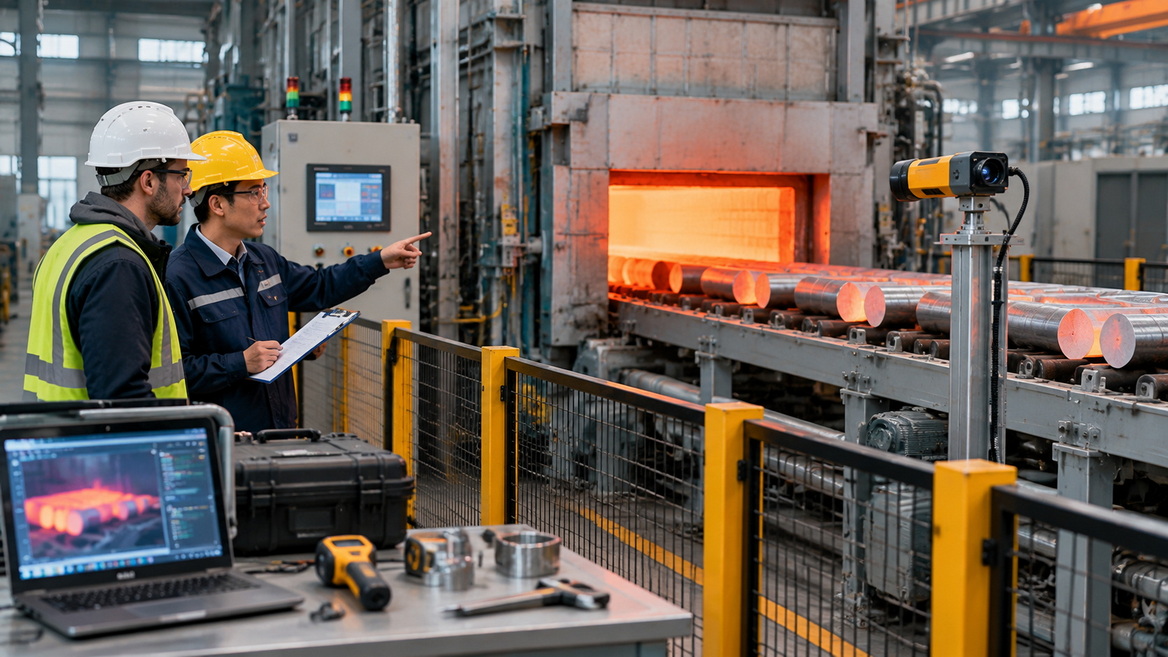
Use the audit to answer practical questions:
1. Does the contracting entity match the factory operator?
2. Which assemblies are made internally?
3. Are material and component substitutions controlled?
4. Are temperature instruments calibrated and traceable?
5. Are electrical cabinets and safety functions tested before shipment?
6. Can the supplier show an equivalent operating installation?
7. Is commissioning performed by employees or subcontractors?
For furnace construction, request an approved bill of materials covering insulation, refractories, hot-zone supports, sensors, burners, valves, drives, and control components.
The objective is not to demand the most expensive material everywhere. It is to prevent unapproved substitutions that reduce service life or change thermal performance.
A billet heating furnace is capital equipment. A demonstration video or one successfully heated billet is not an adequate substitute for an agreed acceptance test.
Provide representative billets and require a factory acceptance test covering:
- Cold startup.
- Stable production.
- Minimum and maximum workpiece sizes.
- Planned output.
- A controlled interruption and restart.
- Temperature distribution.
- Energy use within a defined measurement boundary.
Agree on the test duration, instruments, calibration records, pass/fail rules, and remedies before paying the main manufacturing balance.
CE marking is not a general environmental award or a blanket factory quality certificate. For equipment within applicable European rules, buyers should examine the relevant declaration, technical documentation, risk assessment, and conformity procedure—not just a logo on a quotation.
Timing matters for current purchases. Regulation (EU) 2023/1230 applies from January 20, 2027. Equipment scheduled for European market placement or commissioning around that transition requires a clear compliance review.
RoHS also requires a scope assessment. European Commission guidance identifies exclusions for qualifying large-scale stationary industrial tools and large-scale fixed installations. Do not assume that every furnace is automatically covered or automatically excluded.
Environmental requirements should be addressed separately through project-specific obligations for exhaust, workplace conditions, noise, and local permitting.
Require the shipping proposal to identify:
- Packed dimensions, weights, and centers of gravity.
- Containerized versus oversized transport requirements.
- Lifting points and unloading responsibilities.
- Moisture protection and preservation arrangements.
- Refractory installation or drying work remaining after delivery.
- Foundation and utility requirements.
- Commissioning travel, labor, and accommodation responsibilities.
- Initial spares and recommended replacement stock.
Delivery reliability is best assessed through a milestone schedule tied to drawings, purchasing, fabrication, assembly, testing, shipment, and installation.
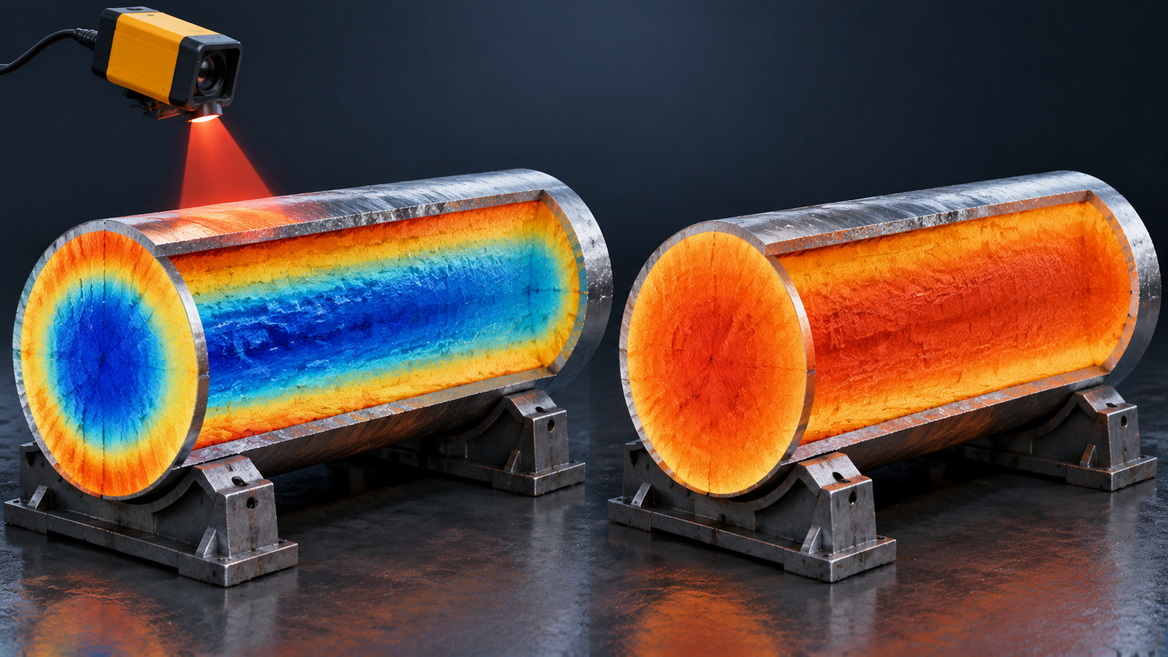
One of the most consequential acceptance-test mistakes is treating a furnace-exit pyrometer reading as proof that the whole billet is ready for forming.
A normal surface reading does not establish acceptable internal temperature distribution. Induction frequency, coil design, and process monitoring all affect heating uniformity.
Measurement itself can introduce uncertainty. Williamson's technical guidance identifies measurement location, timing, and the changing emissive behavior of aluminum and copper as important considerations in billet temperature measurement.
The practical risk is a machine that passes a short demonstration at the discharge point but delivers unsuitable billets after real transfer delays or production interruptions.
Reduce this risk by specifying:
- Measurement locations and timing.
- The method used to establish surface-to-core performance.
- Transfer time from furnace to forming equipment.
- Restart behavior after a line stop.
- Acceptance limits for rejected or overheated billets.
- The pyrometer setup and its validation method.
Where axial temperature variation is intentionally required, define that profile rather than demanding uniformity everywhere.
Also prevent energy comparisons from becoming misleading: state whether the reported consumption includes cooling equipment, conveyors, controls, exhaust fans, startup, and idle periods.
China offers several credible routes to sourcing a billet heating furnace, but the right shortlist depends on the process.
Foshan-based extrusion equipment companies are relevant when heating, shearing, and press coordination dominate the project. Induction-focused suppliers deserve consideration when material-specific heating, coil engineering, and power control are central requirements.
Xinxinke is worth including in the first quotation round for buyers seeking coordinated copper or aluminum extrusion equipment and customized auxiliary systems. Its published portfolio supports that discussion, while furnace performance, certification scope, delivery, and service commitments still require project-specific confirmation.
Send Xinxinke and two or three application-matched alternatives the same technical specification. Request a documented heating concept, guaranteed operating conditions, acceptance-test plan, and lifecycle support proposal before selecting a long-term partner.
Search the company name or certificate number in IAF CertSearch and compare the legal entity, site address, standard, scope, status, and issuing certification body.
The verification guidance distinguishes active, suspended, withdrawn, and expired certificates. Do not rely solely on the expiry date shown in a PDF: a certificate may have been suspended or withdrawn before that date.
If the certificate cannot be located, contact the issuing certification body through independently verified contact details. Database absence should trigger further investigation rather than an automatic conclusion of fraud.
Some induction suppliers offer equipment for all three material groups, but this does not establish that one unchanged configuration will achieve the required performance for each.
Require separate guarantees for each material, billet size, production rate, and temperature cycle. Induction system selection must account for material properties, frequency, coil design, and power distribution.
Require both suppliers to quote against the same billet specification and test conditions.
Define throughput as accepted billet output meeting the agreed temperature profile—not merely the mass passing through the equipment. State inlet temperature, discharge conditions, transfer time, allowable rejects, and whether startup or interruptions are included.
Surface temperature alone is insufficient evidence that the billet's internal temperature distribution meets the process requirement.
No. A generic certificate or CE logo does not establish that the exact supplied model meets every applicable requirement.
Review the relevant conformity declaration, equipment identification, applicable legislation, documentation, and responsibilities for complete-line integration. For deliveries spanning the January 20, 2027 machinery-rule transition, confirm which framework applies to the actual placing-on-the-market or commissioning circumstances.
Specify separate acceptance criteria for temperature distribution, accepted throughput, and energy consumption. Passing one criterion should not automatically satisfy the others.
Define the measurement boundary, test conditions, retest procedure, correction period, and remedies. Include performance after agreed interruptions, because a successful surface-temperature reading during steady operation does not establish acceptable internal heating under every operating condition.


