
Please Choose Your Language
Views: 233 Author: Xinxinke Extrusion Publish Time: 2026-10-09 Origin: Site


Content Menu
● How We Selected These Aluminum Extrusion Press Machine Manufacturers
>> Engineering and Development Capability
>> Customization and Communication
>> Delivery and After-Sales Support
● Why China Is an Important Sourcing Base
>> Access to Presses and Supporting Equipment
>> Industrial Cluster Advantages
>> What Recent Market Reports Indicate
● Top 10 Aluminum Extrusion Press Machine Manufacturers in China
>>> Company Profile
>>> Core Strengths
>>> OEM and Custom Engineering Scope
>> 2. Taiyuan Heavy Industry / TYHI
>>> Company Profile
>>> OEM and Custom Engineering Scope
>> 3. Foshan Yejing Machinery Manufacturing Co., Ltd.
>>> Company Profile
>>> OEM and Custom Engineering Scope
>> 4. Wuxi Weite Machinery Co., Ltd.
>>> Company Profile
>>> OEM and Custom Engineering Scope
>> 5. Foshan Sailixin Machinery Manufacturing Co., Ltd.
>>> Company Profile
>>> OEM and Custom Engineering Scope
>> 6. Foshan Nanhai Dynamax Industry Co., Ltd.
>>> Company Profile
>>> OEM and Custom Engineering Scope
>> 7. Foshan Nanhai Jinli Machinery Manufacture Co., Ltd.
>>> Company Profile
>>> OEM and Custom Engineering Scope
>> 8. Wuxi Yuanchang Machinery Co., Ltd.
>>> Company Profile
>>> OEM and Custom Engineering Scope
>> 9. Foshan Qisheng Machinery Technology Co., Ltd.
>>> Company Profile
>>> OEM and Custom Engineering Scope
>> 10. Foshan Nanhai Wangeshi Machinery Equipment Co., Ltd.
>>> Company Profile
>>> OEM and Custom Engineering Scope
● Comparison Table: Equipment Scope, MOQ, and Certification
● Buyer's Guide: How to Purchase the Right Extrusion Press
>> Start with Your Product Requirements
>> Verify Critical Materials and Components
>> Separate Factory Certification from Machine Compliance
>> Replace Generic Samples with Representative Trials
>> Plan Logistics Before Shipment
>> Material or Component Substitution
>> Turnkey Supply Without Turnkey Responsibility
>> Comparing Prices with Different Scope
>> Accepting Delivery Dates Without Milestones
● An Overlooked Procurement Trap: Rated Force Is Not a Production Guarantee
>> 1. How Can We Verify Whether a Manufacturer's ISO Certificate Has Expired or Been Suspended?
>> 2. Is a CE Certificate Enough for an Extrusion Line Imported into the EU?
>> 3. How Can We Compare Production Guarantees from Different Manufacturers?
>> 4. What Should We Do If a Supplier Will Not Provide PLC Access?
>> 5. How Can We Detect Material or Component Substitution Before Shipment?
Choosing an aluminum extrusion press machine manufacturer means selecting a production partner whose decisions will affect your factory for years.
The right supplier can help you improve process stability, control maintenance costs, and produce profiles that consistently meet customer requirements. The wrong supplier can leave you with an underperforming press, difficult spare-parts sourcing, and expensive commissioning delays.
China offers a diverse manufacturing base for aluminum extrusion equipment. Buyers can find specialist press manufacturers, complete-line providers, and heavy-equipment engineering companies serving large industrial projects.
Foshan, particularly its Nanhai district, is an important sourcing location because aluminum processing and machinery manufacturing operate within the same regional industrial environment. Wuxi and Taiyuan provide additional options for buyers evaluating different extrusion technologies and project scales.
This guide presents ten manufacturers worth investigating. It also explains how to compare their capabilities, assess compliance, and turn a quotation into a clearly defined purchasing agreement.
The list is a procurement shortlist rather than an audited ranking by sales, quality, or market share. Xinxinke appears first because this article was commissioned for its website. Other companies are included to help buyers understand the range of available sourcing options.
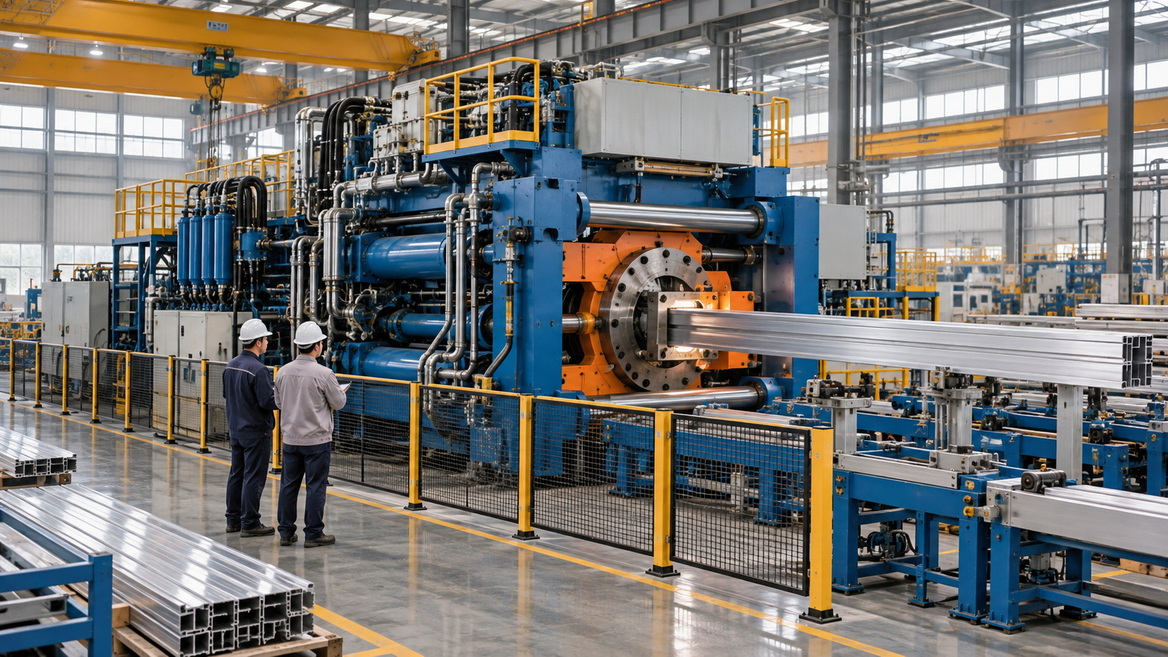
A useful supplier shortlist should be based on verification, not impressive adjectives.
The manufacturers below were evaluated through their published product information, company descriptions, industry profiles, and relevance to aluminum extrusion equipment procurement.
However, public information cannot establish actual delivery reliability, current certificate validity, or the performance of an individual machine. These require direct due diligence.
Buyers should determine whether a company manufactures the press, assembles equipment from subcontractors, integrates a complete line, or primarily trades machinery.
Each model can be commercially legitimate. The important issue is whether responsibilities are transparent.
A competent manufacturer should explain why a particular press configuration suits the buyer's production requirements.
The discussion should cover:
- Alloy families and extrusion difficulty.
- Billet dimensions.
- Profile geometry.
- Required force and operating speed.
- Hydraulic and control-system configuration.
- Integration with heating, handling, and cooling equipment.
A credible quality-control system should extend beyond final visual inspection.
Buyers should request evidence covering material identification, critical-component inspection, machining accuracy, assembly checks, hydraulic testing, and documented acceptance procedures.

For an aluminum extrusion press, customization is usually more important than private-label branding.
The supplier should be able to discuss factory layout, electrical requirements, automation, production interfaces, maintenance access, and destination-market documentation.
Communication efficiency should be assessed through the quotation process. Clear technical responses and controlled revisions provide stronger evidence than promises of "excellent service."
Delivery commitments should be connected to engineering approvals, component purchasing, assembly, testing, and shipment readiness.
Long-term support should include spare-parts arrangements, operator training, troubleshooting procedures, and access to essential control-system backups.
Chinese suppliers offer different combinations of extrusion presses, billet heating furnaces, pullers, cooling tables, cutting systems, aging ovens, and line integration.
This gives buyers flexibility.
A factory replacing an existing press may prefer a standalone machine. A new operation may benefit from a coordinated production-line proposal.
The supplier's equipment portfolio is only the starting point. Buyers must still determine who is responsible for the complete operating sequence.
Foshan's concentration of aluminum-related businesses can make supplier visits and equipment comparisons more efficient.
Buyers may be able to inspect several manufacturers and review supporting machinery during the same sourcing trip.
Nevertheless, industrial proximity does not guarantee consistent workmanship or shared engineering standards. Every supplier still needs its own qualification process.
Recent commercial reports underline the scale of China's aluminum extrusion market.
Grand View Research estimates 2025 market revenue at approximately USD 41.1 billion. MarketsandMarkets provides a separate estimate of approximately USD 53.2 billion.
These figures should not be combined. Different definitions and methodologies can produce materially different estimates.
They also describe aluminum extrusion products, not extrusion-press manufacturing revenue. Their value is in understanding the broader demand environment—not ranking machinery suppliers.
Xinxinke is a Foshan-based manufacturer specializing in copper and aluminum profile extrusion equipment.
Its published positioning emphasizes manufacturing experience, customized solutions, and a broad range of extrusion presses.
- Location: Foshan, Guangdong.
- Establishment history: Its website traces manufacturing experience to 1991, while an industry exhibition profile states establishment in 2006.
- Reported markets: Southeast Asia, Europe, and South America.
- Published equipment scope: Copper and aluminum extrusion presses, with its website advertising a 600T–20,000T range.
The difference between the two historical dates should be clarified during qualification. Manufacturing origins, predecessor businesses, and current legal incorporation dates are not necessarily the same.
Xinxinke is worth evaluating for projects requiring a direct discussion between the buyer and a specialist extrusion-equipment manufacturer.
For small and midsized extrusion businesses, the useful question is whether the proposed machine matches the actual production plan without unnecessary investment in features that will not be used.
Its potential value proposition includes configuration flexibility, buyer-specific engineering discussions, and coordination around customized requirements.
Buyers should discuss:
- Press configuration and billet compatibility.
- Automation level.
- Factory layout.
- Electrical requirements.
- Supporting equipment.
- Maintenance access.
- Installation and training responsibilities.
Cost-effectiveness, communication efficiency, and engineering flexibility should be demonstrated in a written proposal. Request a clear distinction between essential equipment, optional upgrades, and future expansion provisions.
TYHI is relevant to buyers assessing large industrial extrusion projects.
Its published equipment information describes extrusion presses ranging from 5MN to 235MN and a history of extrusion-press development beginning in 1962.
- Location: Taiyuan, Shanxi.
- Establishment history: 1962 refers to extrusion-press development rather than the incorporation date of every associated contracting entity.
- Reported markets: Its technology-center information identifies overseas projects across several countries.
- Core focus: Heavy extrusion equipment and substantial industrial engineering applications.
TYHI deserves consideration when the project requires large extrusion force, substantial product sections, or specialized industrial engineering.
Buyers should request references involving comparable aluminum alloys and product geometries. Experience in another metal-forming application does not automatically prove suitability for a specific aluminum extrusion project.
Yejing specializes in aluminum extrusion presses and complete production solutions.
Its website identifies a company history dating to 1990 and describes service to domestic and international customers.
- Location: Foshan, Guangdong.
- Established: 1990, according to its website.
- Reported markets: China and overseas customers.
- Core focus: Aluminum extrusion presses and integrated production equipment.
Yejing's published offerings include coordinated extrusion lines involving billet heating, press operation, and downstream handling.
It is a relevant candidate when buyers want to compare production-line integration rather than press specifications alone.
Ask the company to define the scope of supply and identify which performance obligations apply to the complete line.
Weite offers several metal-extrusion configurations, making it relevant to buyers whose requirements extend beyond conventional architectural profiles.
Its official company information states that it was founded in 1989.
- Location: Wuxi, Jiangsu.
- Established: 1989.
- Reported markets: Domestic and foreign-trade activities are described; a verified regional sales breakdown should be requested.
- Published equipment scope: 500T–10,000T presses.
- Core focus: Direct, indirect, single-action, double-action, and short-stroke extrusion configurations.
Weite is worth investigating when process selection is a central purchasing issue.
Buyers should provide alloy details, geometry, mechanical-property requirements, and production sequences before asking for a recommended machine.
A supplier should explain the engineering reasons behind its proposal rather than simply recommend the largest available press.
Sailixin is based in Foshan and focuses on aluminum extrusion presses and associated production-line solutions.
Its company information and exhibition profile identify 2011 as its establishment year.
- Location: Foshan, Guangdong.
- Established: 2011.
- Reported markets: Domestic and overseas customers.
- Core focus: Aluminum extrusion presses, including short-stroke designs.
- Published equipment scope: A current product page advertises 700T–7,500T presses.
Sailixin is a candidate for projects evaluating press configuration, production sequencing, and supporting equipment.
Because published model ranges can vary between company pages, request a current technical schedule for the exact machine being quoted.
Customization discussions should include handling equipment, cooling arrangements, control integration, and the intended product mix.
Dynamax combines extrusion-press offerings with supporting equipment.
Its website describes operations focused on aluminum extrusion machinery since 2008.
- Location: Foshan, Guangdong.
- Establishment history: Operations since 2008 are reported; confirm the current legal registration separately.
- Reported markets: A country-level sales breakdown was not established from the reviewed company information.
- Published equipment scope: Press specifications from 600T to 7,500T.
- Core focus: Presses, billet heating, die ovens, aging ovens, handling systems, and related machinery.
Dynamax is relevant when a buyer wants a coordinated proposal for several production stages.
Clarify which machines are manufactured internally and which are sourced from partners.
The contract should assign responsibility for interfaces, commissioning, safety integration, and line-level troubleshooting.
Jinli is identified in supplier profiles and industry coverage as a manufacturer of aluminum and copper profile extrusion presses.
- Location: Foshan, Guangdong.
- Establishment history: Public descriptions contain both 1995 and 2006; verify the legal entity and predecessor relationship.
- Reported markets: Domestic customers and regions including Southeast Asia, the Middle East, South America, and Africa.
- Core focus: Aluminum and copper extrusion equipment.
- Published equipment scope: Supplier profiles show differing ranges, including 660MT–5,000MT.
Jinli can be considered for press and supporting-equipment proposals.
The differences between published descriptions make model-level verification important. Request a dated quotation, controlled specification, and evidence of comparable installed equipment.
Confirm whether the quoted project includes only machinery supply or broader production-line responsibility.
Yuanchang appears in industrial supplier listings for extrusion presses and hydraulic presses.
- Location: Wuxi, Jiangsu.
- Established: Not independently verified from the reviewed information.
- Reported markets: A reliable current breakdown was not established.
- Core focus: Extrusion and hydraulic pressing equipment.
- Published equipment scope: XJ-series extrusion equipment appears in supplier listings.
The extent of customization and integration support should be confirmed directly.
Yuanchang can broaden an exploratory sourcing exercise, but buyers should obtain more technical evidence before treating it as a qualified supplier.
Request a factory inspection, business-license details, current model information, and customer references matching the proposed application.
Qisheng's supplier profile lists aluminum extrusion machinery, extrusion lines, and related parts.
- Location: Foshan, Guangdong.
- Established: Not independently verified.
- Reported markets: Not sufficiently documented in the reviewed profile.
- Core focus: Extrusion machinery, production-line equipment, and related components.
Request a written explanation of available customization, engineering resources, and equipment-sourcing arrangements.
Qisheng may be useful as an additional quotation candidate, particularly when machinery and spare-parts support are evaluated together.
However, a product listing is not proof of manufacturing capacity. Verify assembly facilities, inspection procedures, control documentation, and installed customer references.
Wangeshi's website presents the company as a manufacturer of aluminum extrusion equipment and supporting systems.
- Location: Foshan, Guangdong.
- Established: Not independently verified.
- Reported markets: Worldwide supply is stated, but a current country-level breakdown was not established.
- Core focus: Extrusion presses, log furnaces, pullers, cooling tables, and auxiliary systems.
- Published equipment scope: The website advertises customized solutions from 600T to 25,000T.
Its broad advertised range should prompt detailed verification, especially for high-tonnage installations.
Ask for comparable completed projects, manufacturing arrangements, structural engineering documentation, and a realistic acceptance plan.
Confirm that the capabilities demonstrated during the visit correspond to the machine actually being purchased.
The following table compares published press offerings, not verified annual factory output.
Press force does not establish production throughput. Actual output depends on alloy, profile geometry, billet dimensions, operating speed, yield, downtime, and supporting equipment.
| Manufacturer | Published press capability or equipment scope | MOQ position | Certification and compliance checks |
|---|---|---|---|
| Xinxinke | Website advertises 600T–20,000T copper and aluminum extrusion presses | Confirm directly | Request current management-system certificates and destination-specific machine documentation |
| TYHI | Published extrusion range of 5MN–235MN | Project quotation required | Verify contracting entity, relevant certificates, and project conformity responsibilities |
| Yejing | Aluminum extrusion presses and integrated production lines | Confirm directly | Request current certificates and model-specific documentation |
| Weite | Published 500T–10,000T range and several extrusion configurations | A marketplace listing states one set; reconfirm | Verify certificate validity and the quoted machine’s compliance package |
| Sailixin | Current product page advertises 700T–7,500T | Confirm directly | Do not equate industry recognition with machine conformity |
| Dynamax | Published 600T–7,500T specifications and auxiliary equipment | Confirm directly | Establish press-level and integrated-line responsibilities |
| Jinli | Public profiles include 660MT–5,000MT; descriptions vary | Confirm directly | Match all documents to the actual manufacturer and model |
| Yuanchang | Extrusion and hydraulic pressing equipment | Not verified | Obtain certificates and technical evidence directly |
| Qisheng | Extrusion machinery, lines, and related parts | Not verified | Verify manufacturing identity and documentation |
| Wangeshi | Website advertises 600T–25,000T solutions | Confirm directly | Require model-specific evidence and compliance documents |
No supplier should be assumed to hold a currently valid certificate solely because it appears on this list.
Also require force to be expressed in a clearly defined unit. Metric ton-force, US short ton-force, and meganewtons must not be compared as though they were identical labels.
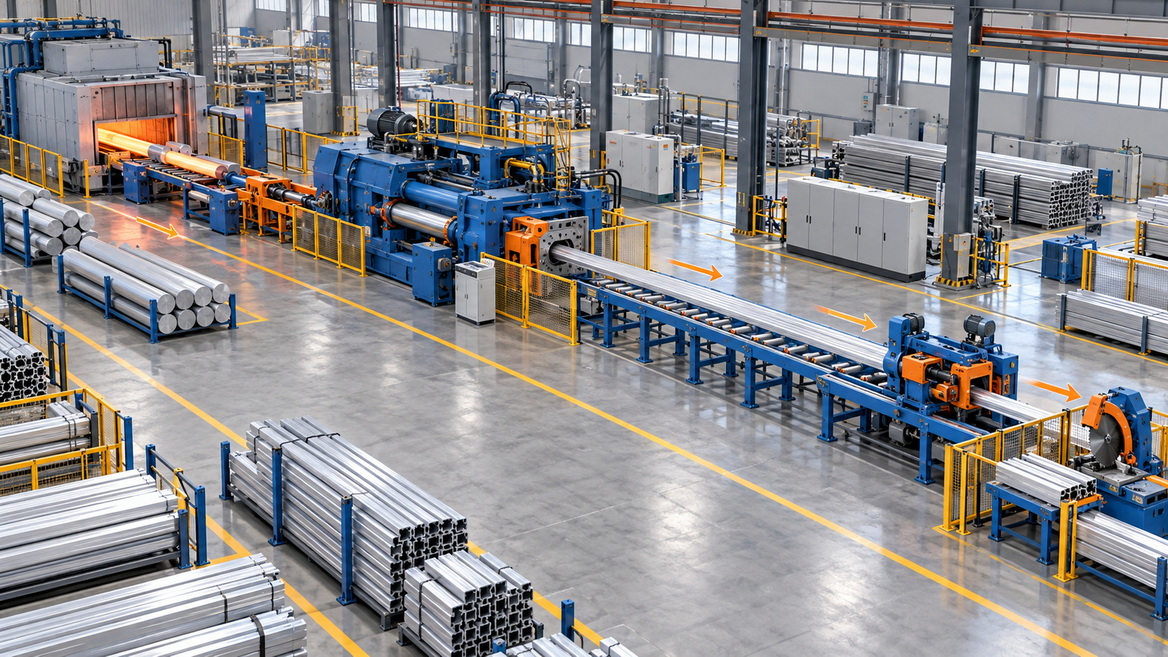
Prepare a technical package before requesting quotations.
Include:
- Alloy designations.
- Representative profile drawings.
- Dimensional and surface-quality requirements.
- Solid, hollow, or tube classifications.
- Expected batch sizes.
- Production targets.
- Billet dimensions.
- Available utilities.
- Factory layout.
- Destination-country requirements.
For projects involving hard alloys, discuss whether direct or indirect extrusion is appropriate. A configuration suitable for common architectural profiles may not be the right choice for a demanding industrial application.
Descriptions such as "premium steel" or "high-quality hydraulics" are not purchasing specifications.
Require documented material selections for critical structural and pressure-bearing components.
Where appropriate, request:
1. Material identification and traceability.
2. Heat-treatment records.
3. Nondestructive inspection results.
4. Machining and alignment checks.
5. Hydraulic test records.
6. Final assembly inspection.
Agree on a controlled component list. Any substitution should require written approval.
A management-system certificate does not prove that an individual extrusion press meets every legal requirement in its destination market.
For EU-bound machinery, assess the applicable conformity process, risk assessment, technical documentation, declaration, marking, and operating instructions.
Projects spanning 2026 and 2027 need particular attention because the EU Machinery Regulation becomes mandatory from 20 January 2027.
RoHS applicability also requires a scope assessment. Qualifying large-scale stationary industrial tools and fixed installations may fall outside its scope, but buyers should not assume that every machine or separately supplied electrical product qualifies.
For an extrusion press, a demonstration video is not equivalent to a meaningful production trial.
Use agreed billets, representative dies, and defined inspection criteria.
If the trial runs on another installed machine, document how that machine differs from the proposed purchase.
Specify both factory acceptance testing and site acceptance testing. Define the materials, measurement methods, responsibilities, and consequences of unresolved defects.
Review:
- Packing dimensions and transport restrictions.
- Component weights and lifting points.
- Port handling.
- Preservation during storage.
- Foundation requirements.
- Site access.
- Lifting equipment.
- Installation sequence.
- Commissioning resources.
The selected Incoterms rule does not automatically define installation, operator training, or final performance acceptance. Address these separately.
A supplier may quote a recognized component brand while retaining the right to supply an "equivalent."
Avoid disputes by defining specifications, approval procedures, and inspection rights before purchase.
A line assembled from several manufacturers can work well, but responsibility must be explicit.
Identify who owns mechanical interfaces, electrical interfaces, safety integration, sequencing, commissioning, and performance troubleshooting.
A lower quotation may exclude foundations, cabling, cooling systems, installation, tooling, travel costs, or training.
Use a common scope checklist so every supplier prices the same project boundaries.
Require a schedule linked to drawing approval, long-lead purchasing, assembly, testing, and shipment.
Ask which activities are subcontracted and which inspection opportunities will be available.
One frequently overlooked mistake is comparing presses only by nominal tonnage and unloaded movement speed.
The commercial requirement is usable production performance under representative operating conditions.
A meaningful performance agreement should address:
- Available force at the required extrusion speed.
- Dead-cycle measurement points.
- Repeatability over consecutive billets.
- Temperature-control conditions.
- Dimensional acceptance.
- Handling and cooling limitations.
- Yield and scrap definitions.
- Operating assumptions.
Apply the same discipline to energy-saving claims.
A percentage reduction is meaningful only when the baseline, product mix, operating conditions, and measurement boundary are defined.
The most useful supplier question is therefore not "How many tons is this press?" It is "Can this configuration meet our agreed production requirements, and how will that be demonstrated?"
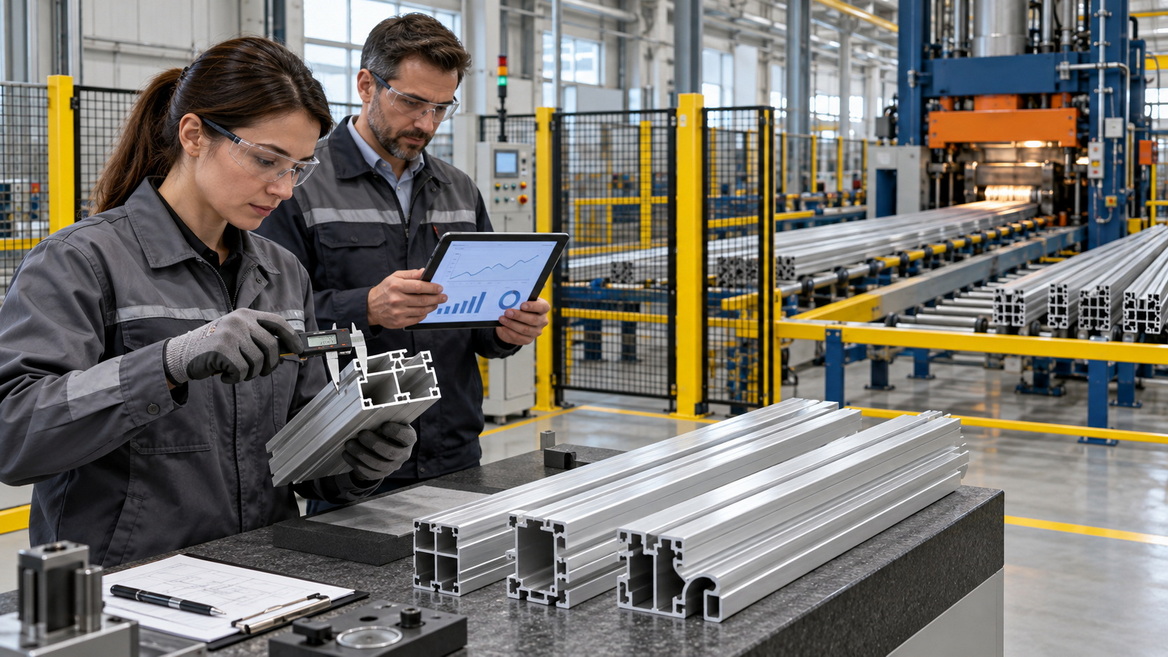
China provides a broad aluminum extrusion press machine supply base, but the companies on this shortlist serve different project needs.
Xinxinke is worth evaluating for buyer-specific copper and aluminum extrusion projects. TYHI is relevant to large industrial installations. Yejing, Sailixin, and Dynamax offer options for press-and-line discussions, while Weite provides several extrusion-process configurations.
Jinli, Yuanchang, Qisheng, and Wangeshi can expand the sourcing exercise when their current capabilities and contractual responsibilities are properly verified.
The strongest decision is not necessarily the lowest quotation. It is the proposal supported by suitable engineering, documented quality controls, realistic acceptance testing, and accountable after-sales support.
For a project-specific discussion with Xinxinke, prepare your alloy list, representative drawings, target output, billet specifications, factory layout, and destination-market requirements. Request a proposal that clearly separates the press, supporting equipment, customization, installation, training, spare parts, and acceptance testing.
Search the company name or certificate number in IAF CertSearch and review the available status, scope, certification body, and accreditation details.
Confirm that the certified legal entity and factory address match the proposed manufacturer.
If information is missing or unclear, contact the issuing certification body directly. An unsuccessful database search should not automatically be treated as proof of fraud.
No. A certificate presented by the supplier is not, on its own, a complete compliance assessment.
Review the applicable legislation, declaration of conformity, risk assessment, technical documentation, instructions, and responsibilities for the assembled line.
For projects approaching January 2027, confirm which framework applies to the planned market-placement date.
Give every supplier the same product drawings, alloy specifications, billet conditions, and operating assumptions.
Define whether output means extruded weight or accepted finished production.
Clarify scrap, downtime, staffing, die changes, and downstream limitations. Without common boundaries, output guarantees may not be comparable.
Resolve the maintenance implications before purchase.
Define the access required for operation, fault diagnosis, backups, and recovery. Clarify software ownership, remote-access permissions, licensing costs, and support if control components become obsolete.
Full source-code access may not be available, but the resulting dependence on the supplier should be understood contractually.
Use an approved material and component schedule with written change-control requirements.
Inspect critical nameplates and serial numbers, review relevant inspection records, and compare the assembled equipment with the approved specification.
For higher-risk projects, appoint an independent inspector. Keep factory acceptance and site acceptance as separate, clearly defined stages.
- [Xinxinke official website] — Published manufacturing-history claims, copper and aluminum extrusion-equipment scope, and customization positioning. [xxkextrusion]
- [Xinxinke manufacturing-experience article] — Company-reported overseas regions. [xxkextrusion]
- ALUMINIUM CHINA's Xinxinke exhibitor profile — Establishment-date cross-check stating 2006. [aluminiumchina]
- [TZ/TYHI extrusion press information] — Published force range and extrusion-development history. [tzpress]
- [TYHI Technology Center] — Engineering history, large projects, and reported overseas activities. [tc.tyhi]
- [Yejing official website] — Company history and extrusion-equipment positioning. [yjing-extrusion]
- [Yejing intelligent extrusion production line] — Published integrated-line scope. [yjing-extrusion]
- [Weite company profile] — Establishment year, press range, and extrusion configurations. [weitepress]
- [Weite product listings] — Marketplace MOQ information requiring direct reconfirmation. [yjeseryrit.goldsupplier]
- [Sailixin official website] — Company information and establishment year. [slxextrusionpress]
- [Sailixin extrusion press range] — Advertised press range and supporting equipment. [slxextrusionpress]
- [Dynamax official website] — Reported operating history, press specifications, and auxiliary equipment. [extrusion-machine-alu]
- [Jinli supplier profile] — Company descriptions and published equipment range. [jinlimachinery.en.made-in-china]
- [Jinli market profile] — Reported market regions and alternative published specifications. [jinlijixie.goldsupplier]
- [Yuanchang supplier profile] — Extrusion and hydraulic pressing equipment categories. [fr.made-in-china]
- [Qisheng supplier profile] — Extrusion machinery, lines, and related parts. [qshmalu.en.made-in-china]
- [Wangeshi official website] — Advertised equipment scope and customized solutions. [wgs-extrusionline]


