
Please Choose Your Language
Views: 230 Author: Xinxinke Extrusion Publish Time: 2026-11-19 Origin: Site


Content Menu
● Standard Extrusion Press vs. Customized Extrusion Press: Key Differences
● What Is a Standard Extrusion Press?
>> When a Standard Aluminum Extrusion Press Makes Sense
● What Is a Customized Extrusion Press?
>> Customization Should Solve a Documented Constraint
● Profile Complexity and Press Capacity: Look Beyond Tonnage
>> Evaluate the Entire Profile Envelope
● Dimensional Accuracy: A Customized Press Is Not a Guarantee
>> Separate Equipment Performance from Product Acceptance
● Productivity: Compare Saleable Output, Not Peak Speed
>> Measure the Full Production Cycle
● Energy Efficiency: Specify the Measurement Boundary
>> An Industry Example with an Important Limitation
● Investment and Maintenance: Compare Total Ownership Cost
● A Practical Payback Model for Press Customization
● A Five-Step Selection Process for OEM Aluminum Profiles
>> 1. Build a Representative Product Matrix
>> 2. Establish a Standard-Platform Baseline
>> 4. Define Acceptance Tests Before Ordering
>> 5. Compare Identical Commercial Boundaries
● How Xinxinke Approaches Standard and Customized Extrusion Equipment
>> Can a standard extrusion press manufacture custom OEM aluminum profiles?
>> When is a customized extrusion press worth the additional investment?
>> Does a customized press always produce tighter tolerances?
>> Which option is better for small-batch manufacturing?
>> How should buyers compare energy consumption?
Choosing between a standard extrusion press and a customized extrusion press for OEM aluminum profiles starts with one question: can the proposed equipment consistently manufacture your required products at an acceptable cost? A standard press can produce many custom-designed profiles. A customized press becomes valuable when your production requirements exceed an established machine platform's capabilities.
At Xinxinke Co., Ltd., our perspective as a copper and aluminum extrusion equipment manufacturer with more than 30 years of industry experience is straightforward: start with the profile drawings and production targets—not the machine catalogue.
This guide compares both approaches, explains the engineering trade-offs, and provides a practical framework for evaluating your investment.
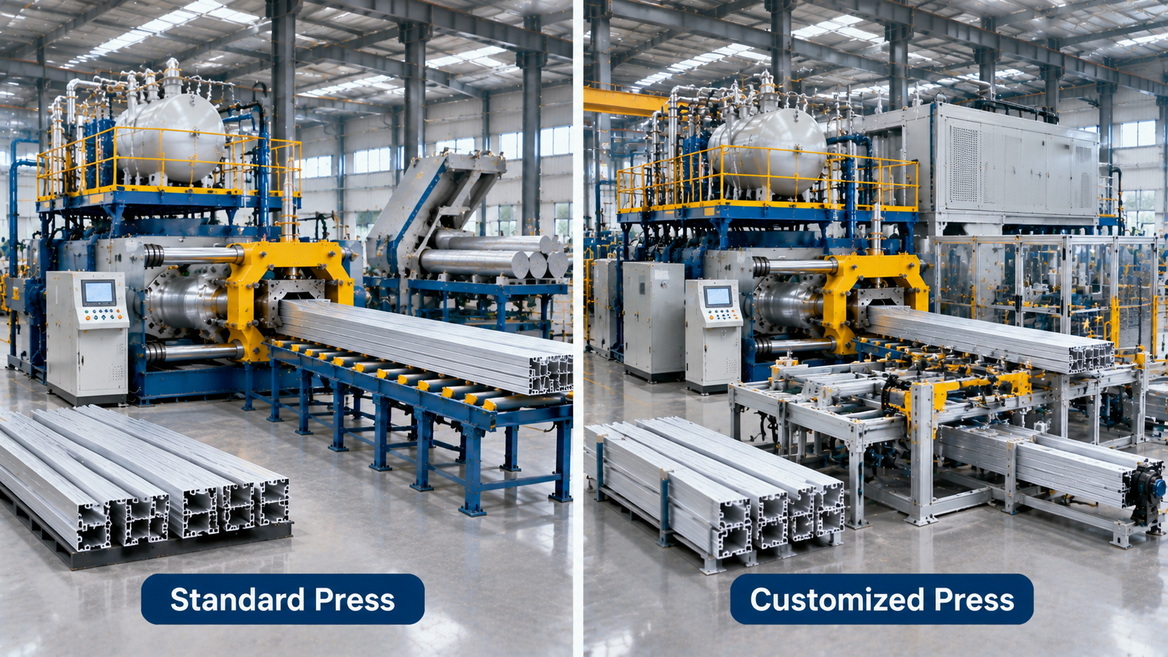
"Standard" and "customized" describe equipment configurations, not universal quality grades. Suppliers may define these terms differently, so compare documented specifications rather than labels.
| Selection factor | Standard extrusion press | Customized extrusion press |
|---|---|---|
| Equipment platform | Established design with predefined options | Platform modified or engineered around specific requirements |
| Profile capability | Products within its validated operating envelope | Requirements beyond the available standard configuration |
| Initial investment | Often lower with comparable scope | Often higher because of additional engineering |
| Delivery | May be shorter when designs and components are established | May require longer design, manufacturing, and validation |
| Production flexibility | Useful across a compatible product mix | Depends on whether customization supports variety or specialization |
| Maintenance | Often benefits from common components | May require additional documentation and specialized spares |
| Best justification | Requirements fit proven equipment capabilities | Measurable production constraints require targeted changes |
Neither option automatically delivers better quality, lower energy consumption, or higher output. Those outcomes depend on the complete configuration and its match to the application.
A standard extrusion press uses an established mechanical structure, hydraulic arrangement, control platform, and operating range. Buyers typically select from available capacities, billet sizes, loading arrangements, and automation options.
Crucially, a standard machine does not limit you to standard profile shapes.
In aluminum extrusion, heated billet material passes through a die that defines the cross-section. A purpose-designed die can therefore produce a customer-specific profile on a conventional press, provided the alloy, dimensions, force requirements, and downstream equipment are compatible.
A standard platform deserves serious consideration when:
- Your profile family fits its billet and tooling envelope.
- Required force and speed fall within demonstrated capabilities.
- Existing heating, cooling, and handling equipment can support production.
- Available controls provide sufficient repeatability and production records.
- Maintenance simplicity matters more than specialized functionality.
For many OEM aluminum profiles, the real requirement is a suitable die and a stable process—not a uniquely engineered press.
A customized extrusion press incorporates changes intended to solve defined production or installation requirements.
Customization can range from adding recipe management to modifying the press structure, hydraulic system, loading sequence, or line interfaces. It does not necessarily mean developing every component from scratch.
Potential customization areas include:
- Billet diameter, length, and loading arrangements.
- Force availability across the required operating speed range.
- Container and die temperature management.
- Die-changing systems and tooling interfaces.
- Hydraulic pump control and auxiliary movements.
- Quench, puller, stretcher, and saw coordination.
- Production data collection and customer-system interfaces.
A useful customization request identifies the limitation first.
For example, "improve productivity" is too vague. "Reduce non-extrusion time while maintaining the agreed quality acceptance criteria" creates a requirement that engineers can evaluate and buyers can verify.
My recommendation is to customize the constraint, not the entire machine by default.
Press force matters, but it is not a complete specification.
Extrusion behavior also depends on alloy, billet temperature, extrusion ratio, die design, friction, and speed. A machine with sufficient nominal force may still be unsuitable for a particular production target.

Provide prospective suppliers with more than maximum profile width. Include:
- Cross-sectional drawings and profile weight per meter.
- Minimum wall thickness and changes in wall thickness.
- Solid, hollow, or semi-hollow geometry.
- Alloy and required temper.
- Finished length and critical tolerances.
- Surface appearance and finishing requirements.
An asymmetric hollow section, for example, can create different metal-flow and handling challenges from a simpler section of similar overall size.
Ask suppliers to explain the proposed combination of billet size, tooling arrangement, operating conditions, and downstream capacity. Do not accept tonnage alone as proof of suitability.
A customized aluminum extrusion press can provide controls suited to demanding products. It cannot independently guarantee finished-profile accuracy.
Dimensions and properties emerge from a process chain involving tooling, thermal conditions, extrusion speed, cooling, stretching, and subsequent treatment.
Your specification should distinguish between:
1. Machine requirements, such as alignment, controllability, and cycle repeatability.
2. Process requirements, including temperature and speed settings.
3. Product requirements, including dimensions, straightness, twist, and mechanical properties.
Agree which dimensional standard applies and identify drawing-specific exceptions. Published tolerances vary by profile geometry and other conditions; a single blanket tolerance is rarely an adequate purchasing specification.
Where statistical capability is required, define the measurement method, sample size, and stable production conditions before setting acceptance targets.
Maximum extrusion speed is useful only when the resulting profiles meet requirements.
A faster press may provide little benefit if the billet heater cannot keep up, the quench limits allowable output, or the handling system causes interruptions.
Compare:
- Billet loading and preparation time.
- Extrusion time.
- Discard removal and return movements.
- Die-change duration.
- Planned and unplanned downtime.
- Scrap, rework, and final accepted output.
A standard extrusion press with well-matched auxiliaries can outperform a customized machine installed in an unbalanced line.
For mixed production, evaluate changeovers as carefully as sustained running speed. The best configuration for one long-running profile may not be the best choice for frequent product changes.
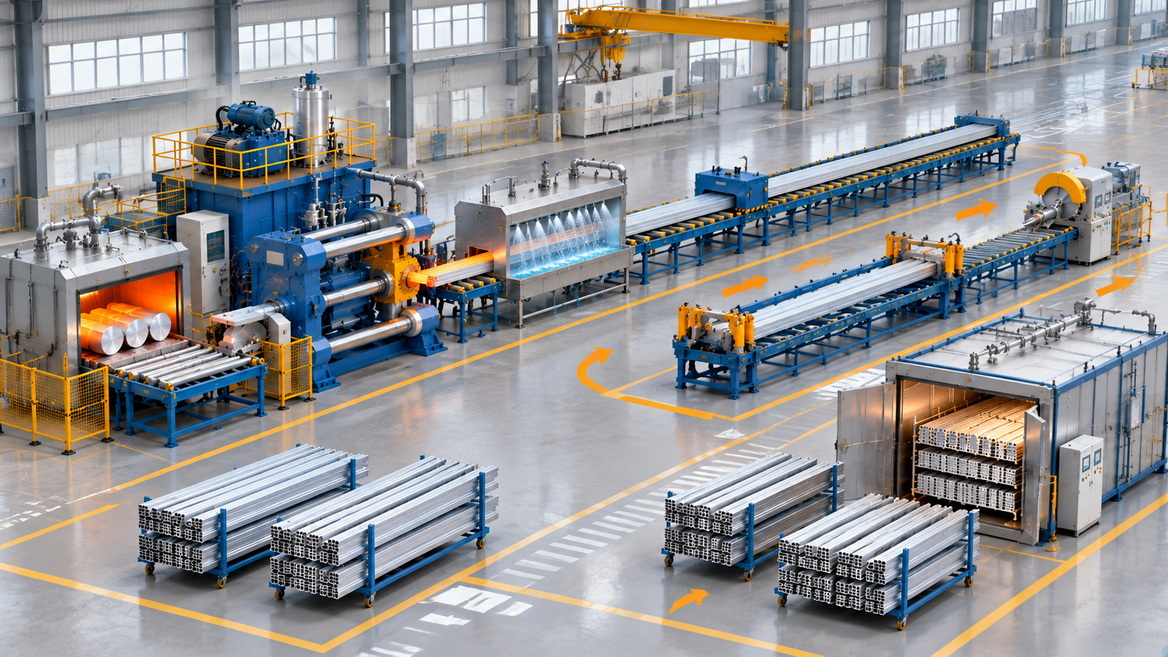
Energy efficiency comes from engineering choices and operating conditions—not from the word "customized."
Demand-controlled pumps, improved auxiliary drives, and coordinated operating sequences can reduce unnecessary consumption. These features may be available on standard platforms, customized installations, or retrofit projects.
In a published modernization account, SMS group reported that Nedal Aluminium achieved more than 10% energy savings in the main drives after installing its ecoDraulic pump-control system.
The qualification matters: this concerned the main drives, not necessarily the complete extrusion line.
For procurement, compare kWh per saleable tonne under an agreed product mix. State whether measurement includes the press, billet heating, cooling, compressed air, and aging. Otherwise, two apparently comparable energy figures may describe different boundaries.
This published example is not a Xinxinke performance guarantee.
The purchase price captures only part of the financial decision.
A standard machine may reduce engineering expense and simplify spare-parts planning. A customized machine may justify its premium through improved yield, additional product capability, or fewer production interruptions.
Neither outcome should be assumed without a production-based calculation.
Include the following in your comparison:
- Equipment, tooling, installation, and commissioning.
- Foundations, utilities, and auxiliary equipment.
- Energy and staffing.
- Preventive maintenance and replacement components.
- Training, troubleshooting, and technical support.
- Scrap, rework, and downtime.
- Future modifications and production expansion.
For customized equipment, clarify component availability, software backups, documentation, and replacement procedures. Specialized functionality becomes a liability if routine recovery depends on unavailable parts or inaccessible technical information.
Consider this illustrative scenario—not an actual customer result:
| Assumption | Illustrative value |
|---|---|
| Additional customization investment | $180,000 |
| Annual energy savings | $18,000 |
| Annual reduction in scrap and rework costs | $27,000 |
| Annual contribution from additional saleable output | $35,000 |
| Additional annual maintenance expense | $5,000 |
| Net annual benefit | $75,000 |
| Simple payback | 2.4 years |
The calculation divides the additional investment by the net annual benefit.
Keep the assumptions conservative. Additional output creates value only if customers buy it and downstream operations can handle it. Use contribution after relevant variable costs, not sales revenue.
Avoid double-counting material savings and additional output benefits. Simple payback also excludes financing, taxes, discounting, and commissioning risk; larger investments deserve a fuller financial assessment.
Group profiles by alloy, geometry, dimensions, tolerance, and expected volume.
Include difficult products, not just high-volume or easy-to-run sections. This reveals whether a proposed machine supports the actual production mix.
Ask the manufacturer to identify which requirements its established design can meet.
Record every exception. This turns customization into a targeted engineering discussion rather than an open-ended list of desirable features.
Review billet heating, die heating, quenching, pulling, stretching, cutting, and aging requirements.
A press upgrade will not resolve a bottleneck elsewhere unless the project addresses that interface.
Agree on representative alloys and profiles, tooling responsibilities, measurement methods, and test conditions.
Distinguish factory acceptance from site acceptance. Some integrated performance checks require the installed line and actual production utilities.
Ensure quotations cover the same auxiliaries, installation responsibilities, training, spares, and support.
A lower price may reflect excluded scope rather than better value.
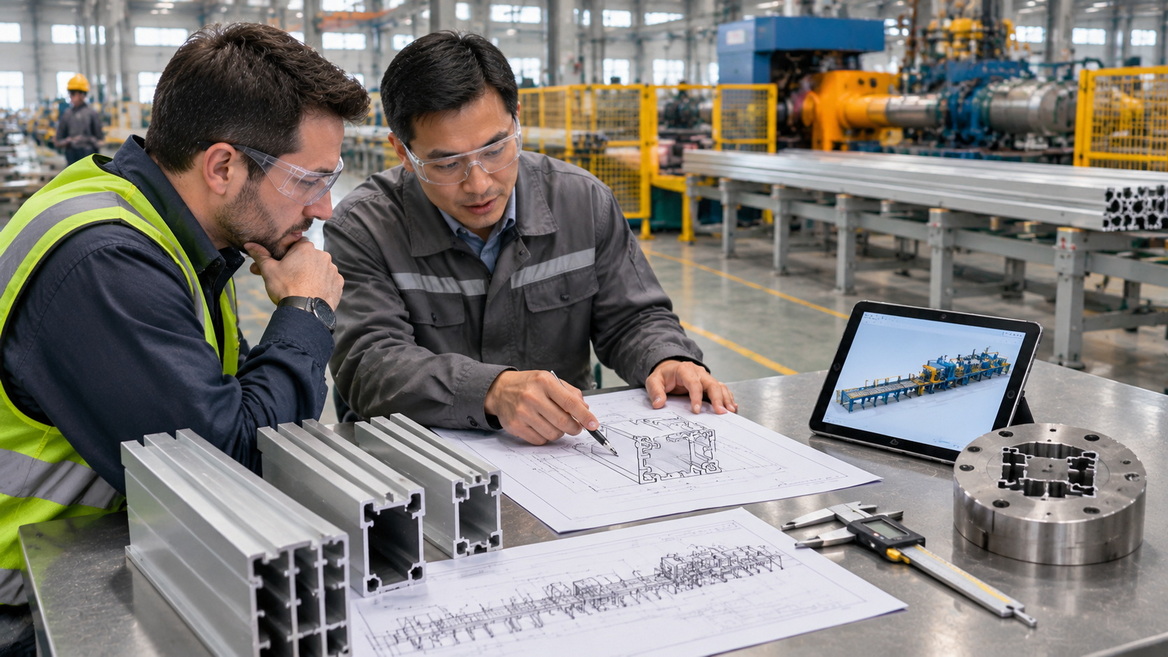
Xinxinke Co., Ltd. manufactures copper and aluminum profile extrusion equipment and provides customized solutions, supported by more than 30 years of industry experience.
Our equipment-selection approach should begin with understanding your products, production targets, and factory conditions. Advanced manufacturing, strict quality control, and technical support matter most when translated into clear specifications and verifiable acceptance criteria.
Send Xinxinke your profile drawings, alloy and temper requirements, annual production targets, critical tolerances, and available factory layout. Request a standard-platform proposal alongside clearly itemized customization options, so you can evaluate what each change contributes.
The objective is not maximum customization. It is the right equipment configuration for reliable, commercially viable production.
Yes. Custom dies define the profile cross-section. A standard press can manufacture customer-specific profiles when their geometry, alloy, tooling, and processing requirements fit its capabilities.
Customization is justified when it addresses a documented limitation and offers measurable value. Examples include otherwise unsupported products, reduced changeover losses, better integration, or specific installation constraints.
No. Finished accuracy depends on the die and the complete manufacturing process. Additional controls may help, but product tolerances must be validated under agreed production conditions.
The machine with better changeover performance and product compatibility may be preferable. A flexible standard platform can be effective; selected customization can help when scheduling, tooling changes, or traceability create specific challenges.
Use the same alloy, profile mix, production conditions, and measurement boundary. Compare energy per saleable tonne rather than relying only on installed power or an unexplained percentage saving.
1. The Aluminum Association. [Processing 101]. Technical background on extrusion, die-defined geometry, processing variables, and downstream fabrication. [aluminum]
2. The Aluminum Association. [Understanding Aluminum Extrusion Tolerances]. Guidance on interpreting dimensional tolerances for aluminum extrusions. [aluminum]
3. The Aluminum Association. [Understanding Aluminum Extrusion Tolerances Video Series]. Explanations of straightness, twist, flatness, and dimensional measurement categories. [aluminum]
4. The Aluminum Association. [Extruded Aluminum: Environmental Product Declaration]. Description of billet heating, extrusion, cooling, stretching, cutting, aging, and finishing. [aluminum]
5. SMS group. [Light Metal Extrusion Presses]. Manufacturer information on press configurations, product-mix considerations, drive systems, and auxiliary equipment. Manufacturer performance claims are application-dependent. [sms-group]
6. SMS group. [ecoDraulic: Energy Efficient Operation of an Extrusion Press for Aluminum], February 11, 2020. Published account of the Nedal Aluminium modernization and main-drive energy savings. [sms-group]


