
Please Choose Your Language
Views: 276 Author: Xinxinke Extrusion Publish Time: 2026-11-15 Origin: Site


Content Menu
● Small Extrusion Press vs. Large Extrusion Press: The Main Differences
● How Press Capacity Affects Profile Size and Complexity
>> Extrusion Force Is Only One Selection Variable
>> Specific Pressure Explains Why Tonnage Can Mislead
● Small Extrusion Press Advantages for Mixed-Size Production
>> Matching Equipment to the Most Frequent Orders
>> Keeping Small Jobs Off a Larger Production Line
● Large Extrusion Press Advantages for Mixed-Size Production
>> Supporting a Wider Product Envelope
>> Increasing Output When the Whole Line Is Balanced
● Extrusion Ratio: A Critical Check for Small and Large Presses
● Precision and Surface Quality: Which Press Performs Better?
● Energy Consumption: Compare Saleable Output, Not Motor Ratings
● A Practical Mixed-Size Production Scenario
● A Six-Step Method for Choosing the Right Extrusion Press
>> 1. Build a Representative Product Matrix
>> 2. Identify the Most Difficult Profiles
>> 3. Validate Billet, Die, and Force Compatibility
>> 4. Model the Real Production Schedule
>> 5. Calculate Total Production Cost
>> 6. Agree on Acceptance Trials
● Copper and Aluminum Require Separate Process Validation
>> Can a Large Extrusion Press Produce Small Profiles?
>> Is a Small Extrusion Press Better for Thin-Wall Profiles?
>> Does Higher Tonnage Always Increase Production Speed?
>> Should a Mixed-Size Manufacturer Install Two Presses?
>> What Information Should I Send an Extrusion Press Manufacturer?
Choosing a small extrusion press vs. large extrusion press for mixed-size profile production is not simply a question of buying more tonnage. The right investment must match your everyday orders, your most demanding profiles, and the cost of switching between them.
A small extrusion press can be a strong choice for compact sections and repeatable small-batch production. A large extrusion press can expand your product envelope and support larger billets. Neither option automatically delivers better precision, lower energy consumption, or higher profitability.
At Xinxinke Co., Ltd., our equipment-selection perspective starts with the production mix rather than the largest machine available. Drawing on more than 30 years in copper and aluminum extrusion equipment manufacturing, we recommend evaluating the complete production system—not the press alone.

"Small" and "large" are relative descriptions, not universal capacity standards. Compare actual force, billet dimensions, tooling capacity, and operating performance.
| Selection factor | Small extrusion press | Large extrusion press |
|---|---|---|
| Production focus | Smaller sections within its validated envelope | Larger sections and greater billet capacity |
| Investment | Typically lower equipment and infrastructure requirements | Typically higher equipment and infrastructure requirements |
| Small-order suitability | Attractive when tooling and billet sizes match demand | Depends heavily on setup time and utilization |
| Output potential | Limited by billet capacity and cycle performance | Higher potential when the complete line can keep pace |
| Profile flexibility | Restricted by force and tooling envelope | Broader dimensional capability, but not unlimited |
| Energy performance | Must be measured against saleable output | Must be measured against saleable output |
| Principal risk | Buying insufficient process capacity | Paying for capacity the order book rarely uses |
The practical question is not "Which press is better?" It is "Which production arrangement makes our actual product mix most profitable?"
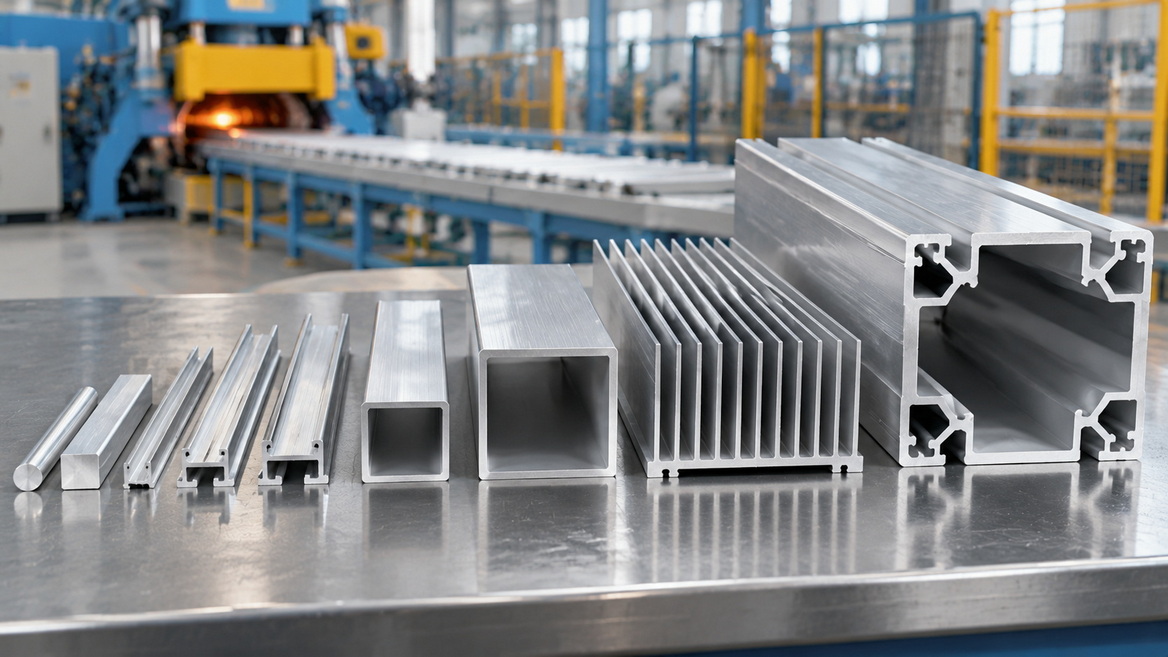
Rated tonnage describes available force. It does not independently define maximum profile width, minimum wall thickness, or achievable production speed.
A credible extrusion press sizing assessment also considers:
- Alloy and billet condition.
- Billet diameter, length, and temperature.
- Profile cross-sectional area and circumscribing circle.
- Solid, hollow, or semi-hollow geometry.
- Die construction and supported tooling dimensions.
- Required exit speed and dimensional tolerances.
The circumscribing circle is the smallest circle enclosing the profile cross-section. It helps describe the profile envelope, but it does not replace a tooling review.
Two profiles with similar overall dimensions can require very different processing conditions because their wall distribution and metal-flow paths differ.
At the same available force, increasing billet diameter reduces this calculated pressure.
This explains why a higher-tonnage press should not automatically be described as more capable for every difficult small profile. Container size and the required deformation conditions also matter.
Use this relationship for preliminary comparison, not as a substitute for force calculations covering friction, alloy behavior, temperature, and die resistance.
A smaller press deserves serious consideration when most orders involve compact sections that fit comfortably within its validated operating envelope.
Its commercial advantage comes from matching equipment to recurring work. Buyers may avoid paying for larger infrastructure and tooling capacity that their regular products do not need.
However, a smaller machine is not inherently faster to change over. Die handling, billet supply, cleaning procedures, recipe management, and operator practices determine actual setup performance.
For high-mix production, request a demonstrated changeover time covering the complete interval from the last acceptable profile of one order to the first acceptable profile of the next.
Where two presses are economically justified, a smaller machine can handle repeat small-profile orders while the larger line processes products that genuinely require its capacity.
This arrangement can reduce scheduling competition between product families.
It also creates additional costs: another production asset, maintenance responsibilities, tooling arrangements, and potentially more staffing. A two-press strategy should therefore be justified by workload and contribution margin—not flexibility alone.
A larger press can provide the force and tooling envelope required for larger industrial sections and more demanding billet configurations.
This matters when large-profile orders are commercially important and cannot be produced reliably on smaller equipment.
Nevertheless, greater nominal force does not guarantee that every hollow or thin-wall profile is feasible. Die strength, flow balance, thermal management, and downstream handling remain limiting factors.
Ask suppliers to validate representative drawings rather than approving a machine from its tonnage label.
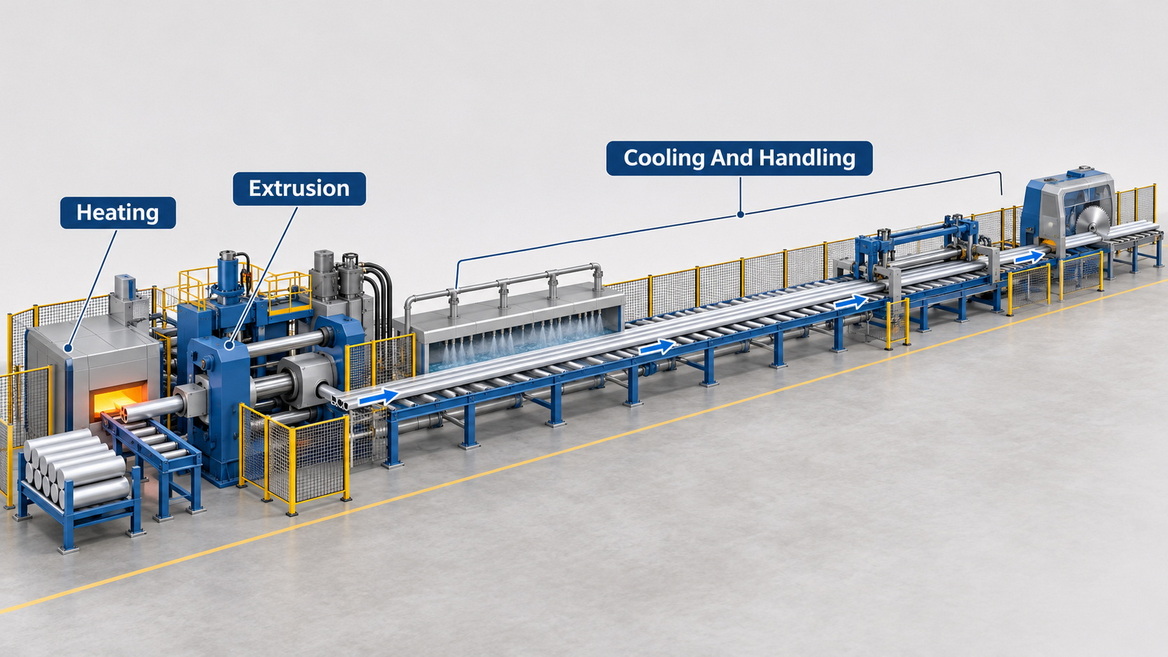
Larger billets can increase material processed per cycle. That creates higher output potential, but it does not guarantee higher saleable production.
The benefit may disappear if the line is constrained by:
- Billet heating capacity.
- Die availability.
- Quenching or cooling capability.
- Puller speed and runout length.
- Stretching, sawing, or handling.
- Inspection and packing capacity.
A large extrusion press should be evaluated as part of a balanced production line. Otherwise, investment simply moves the bottleneck downstream.
A larger billet feeding the same single profile increases this ratio. A multi-hole die increases total exit area and changes the ratio accordingly.
This distinction matters when producing small profiles on a large extrusion press. Multi-hole tooling may improve the production match, provided flow distribution, strand separation, cooling, and handling are suitable.
There is no single ideal ratio for every alloy and shape. Excessively broad rules can hide differences in deformation resistance, geometry, and metallurgical requirements.
Require a profile-specific calculation and a documented process window.
Neither press size guarantees superior accuracy.
A small press operating near its limits may struggle to maintain the required process conditions. A large press with unsuitable low-speed control or poorly matched tooling may also produce inconsistent results.
Evaluate the factors that directly influence quality:
1. Stable ram-speed control throughout the working stroke.
2. Billet, container, and die temperature management.
3. Press alignment and tooling support.
4. Die design, condition, and correction procedures.
5. Cooling, stretching, and handling practices.
6. Repeatable inspection methods.
For cosmetic profiles, inspect surface condition after the intended finishing process where practical.
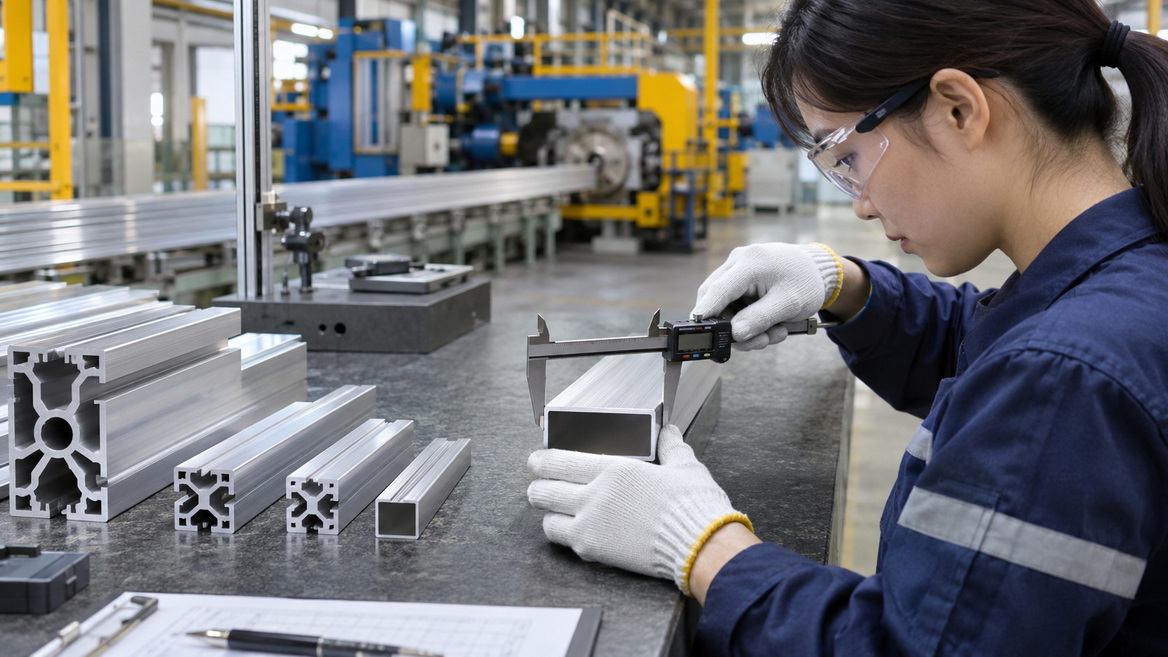
For dimensionally demanding products, define the measurement locations, sampling frequency, temperature condition, and acceptance limits before the trial.
The correct comparison is repeatable accepted production—not the best sample from either machine.
Installed motor power is not the same as actual energy consumption.
Hydraulic design, pump management, idle periods, cycle timing, and auxiliary equipment all affect consumption. Modern controls can reduce unnecessary pump operation, so machine size alone is a poor efficiency predictor.
For purchasing decisions, compare kWh per saleable tonne under an agreed production schedule.
Define the measurement boundary. Does it include only the press, or also billet heating, die ovens, cooling, and handling?
Also record:
- Energy used during warm-up and standby.
- Rejected material and startup scrap.
- Product alloy and profile geometry.
- Actual operating and waiting time.
- Accepted output during the measurement period.
A larger press can be competitive on a well-loaded production program. A smaller press can be attractive when it closely matches recurring work. Neither outcome should be assumed without comparable measurements.
Consider a hypothetical manufacturer producing frequent small-profile orders and occasional large structural sections.
Three configurations deserve evaluation:
| Configuration | Potential advantage | Main issue to test |
|---|---|---|
| One smaller press | Investment aligned with regular small-profile work | Outsourcing cost and availability for larger sections |
| One larger press | More production retained in-house | Small-order economics and scheduling losses |
| Separate smaller and larger presses | Product-family specialization | Utilization sufficient to justify two lines |
This is an illustrative decision framework, not a reported customer result.
The useful insight is that occasional large orders can determine equipment capability without generating enough annual margin to justify the investment.
Conversely, outsourcing those orders may be unacceptable when delivery control, confidentiality, or strategic customer relationships are critical.
Compare these consequences explicitly rather than treating every technically producible product as equally valuable.
List your actual profile drawings, alloys, tolerances, order sizes, annual quantities, and delivery requirements.
Separate recurring products from speculative future opportunities.
Select products that challenge width, thin walls, hollow geometry, alloy resistance, surface finish, or dimensional stability.
The heaviest profile is not necessarily the most demanding.
Require proposed billet dimensions, extrusion ratios, tooling arrangements, and engineering assumptions.
Document any products requiring special containers, dies, or operating restrictions.
Include heating, changeovers, trial pieces, die correction, maintenance, inspection, and downstream waiting.
Use saleable kilograms per scheduled hour—not theoretical extrusion speed—as the primary output measure.
Compare annualized equipment cost, labor, energy, maintenance, tooling, scrap losses, and outsourced work.
Avoid double-counting recycled scrap as a complete material loss; account for its recovery value and associated handling or remelting costs.
Test a representative mix of products under clearly defined conditions.
Record accepted output, quality, energy boundaries, setup time, and sustained operating performance. Put the acceptance criteria in the purchase agreement.
Experience with aluminum does not automatically establish suitability for copper or copper alloys.
Material behavior, operating temperatures, oxidation, tooling exposure, and lubrication requirements differ by alloy and process route.
For copper extrusion equipment, confirm the proposed thermal system, container and tooling materials, lubrication method, and product-quality requirements.
For aluminum extrusion equipment, verify the applicable cooling and subsequent treatment arrangements.
A shared manufacturer does not mean an identical machine configuration. Xinxinke's customized-solution approach should begin with the specific metal, alloy, profile, and production objective.
Yes, when billet size, extrusion ratio, tooling, controls, and downstream equipment are compatible. Technical feasibility does not automatically mean the lowest production cost.
Not automatically. Thin-wall capability depends on die design, alloy, temperature, available pressure, flow control, and handling. Compare validated results on representative profiles.
No. Available force is only one constraint. Die performance, temperature limits, surface requirements, cooling, and handling can restrict practical speed.
Possibly, when distinct product families generate enough recurring work. Compare the scheduling benefit against the additional investment, staffing, maintenance, and floor-space requirements.
Provide drawings, alloy grades, tolerances, surface requirements, order quantities, annual demand, target output, and site constraints. Include both common products and difficult exceptions.
- Bonnell Aluminum — "Aluminum Extrusion Process." Technical background on extrusion variables, billet-to-profile area ratio, and the relationship between pressure, alloy, geometry, and process conditions. [bonnellaluminum]
- SMS group — "ecoDraulic: Energy Efficient Operation of an Extrusion Press for Aluminum." Published February 11, 2020. Manufacturer explanation of hydraulic pump start-stop management; its reported energy results concern a specific application, not a universal guarantee. [sms-group]
- International Wrought Copper Council — "Best Practice for Copper Alloy Extrusion Toolings." Technical presentation addressing copper-alloy extrusion tooling and elevated-temperature service conditions. [coppercouncil]
- Kautec — "Aluminum Extrusion Press Guide: Force & Energy Efficiency." Discussion of force selection, process matching, and energy-per-tonne evaluation. No advertised percentage saving has been generalized in this article. [kautec]
- Kautec — "Aluminum Extrusion Press Equipment." Equipment-level discussion of pressure stability, temperature, tooling condition, hydraulic control, and automation. [kautec]
Company background and experience statements were supplied by Xinxinke for this article and have not been independently verified. The production scenario is hypothetical; the selection framework represents editorial engineering guidance rather than a machine-specific performance guarantee.


