
Please Choose Your Language
Views: 232 Author: Xinxinke Extrusion Publish Time: 2026-11-17 Origin: Site


Content Menu
● Horizontal vs. Vertical Extrusion Press: Key Differences
● How a Horizontal Extrusion Press Supports Specialized Profiles
>> Long Aluminum Profiles and Integrated Production Lines
>> Copper Sections and Tube Production
● Where a Vertical Extrusion Press Can Make Sense
>> Specialized Components and Upright Production Cells
>> Compact Footprint Does Not Mean Compact Installation
● Precision, Surface Quality, and Metal Flow
>> Does Vertical Orientation Improve Accuracy?
>> Thin Walls and Hollow Profiles Need Tooling Expertise
● Material-Specific Considerations for Aluminum and Copper
>> Aluminum Extrusion Requires Coordinated Thermal Control
>> Copper Requires Its Own Process Assessment
● Productivity, Energy Use, and Ownership Cost
>> Compare Saleable Output Rather Than Maximum Speed
>> Measure Energy Across the Same System Boundary
● Three Application Scenarios: Applying the Comparison
>> Scenario 1: Long, Thin-Fin Aluminum Heat Sinks
>> Scenario 2: Short Copper Components in an Automated Cell
>> Scenario 3: Precision Copper Tubes
● A Practical Five-Step Press Selection Method
>> 1. Prepare a Product-Family Specification
>> 2. Establish the Process Route
>> 3. Validate Capacity and Layout Together
>> 4. Agree on a Representative Acceptance Trial
>> 5. Compare Commercial Assumptions
>> Is a horizontal extrusion press better for long aluminum profiles?
>> Can a vertical extrusion press process aluminum and copper?
>> Which orientation produces tighter tolerances?
>> Does a vertical extrusion press always save space?
>> Is horizontal extrusion more energy-efficient?
Choosing a horizontal vs. vertical extrusion press for specialized profile applications starts with the product—not the machine orientation. For long aluminum profiles and copper sections requiring coordinated cooling, pulling, and finishing, a horizontal extrusion press is generally the more practical starting point. A vertical extrusion press deserves consideration when component length, forming sequence, and factory layout support an upright production cell.
At Xinxinke Co., Ltd., our equipment-selection philosophy is straightforward: define the alloy, geometry, quality requirements, and production target before specifying the press. Drawing on more than 30 years of experience manufacturing copper and aluminum profile extrusion equipment, we focus on matching the complete production system to the application.
This comparison explains where each configuration fits, which performance claims require caution, and how buyers can make a technically grounded investment.

A horizontal extrusion press positions its main working axis parallel to the factory floor. A vertical extrusion press positions that axis upright, with upward or downward movement depending on the design.
Orientation must not be confused with extrusion method. Direct versus indirect extrusion describes the relationship between material flow and tooling movement—not whether the press stands vertically or horizontally.
| Selection factor | Horizontal extrusion press | Vertical extrusion press |
|---|---|---|
| Typical evaluation starting point | Long profiles, bars, and tubes | Length-compatible components and specialized forming cells |
| Product handling | Integrates naturally with horizontal runout equipment | Requires an engineered vertical receiving or extraction arrangement |
| Space assessment | Press plus runout, cooling, and finishing length | Press footprint plus height, access, and possible pit requirements |
| Automation | Billet loading, pullers, saws, and transfer systems | Feeding, extraction, transfer, and guarding around the vertical axis |
| Precision priorities | Alignment, tooling, thermal control, and handling | The same fundamentals, plus vertical extraction and support |
| Main selection risk | Underestimating downstream line requirements | Underestimating height and product-removal constraints |
Neither configuration automatically delivers better precision, lower energy consumption, or higher productivity. Those outcomes depend on the engineered system and the product being manufactured.
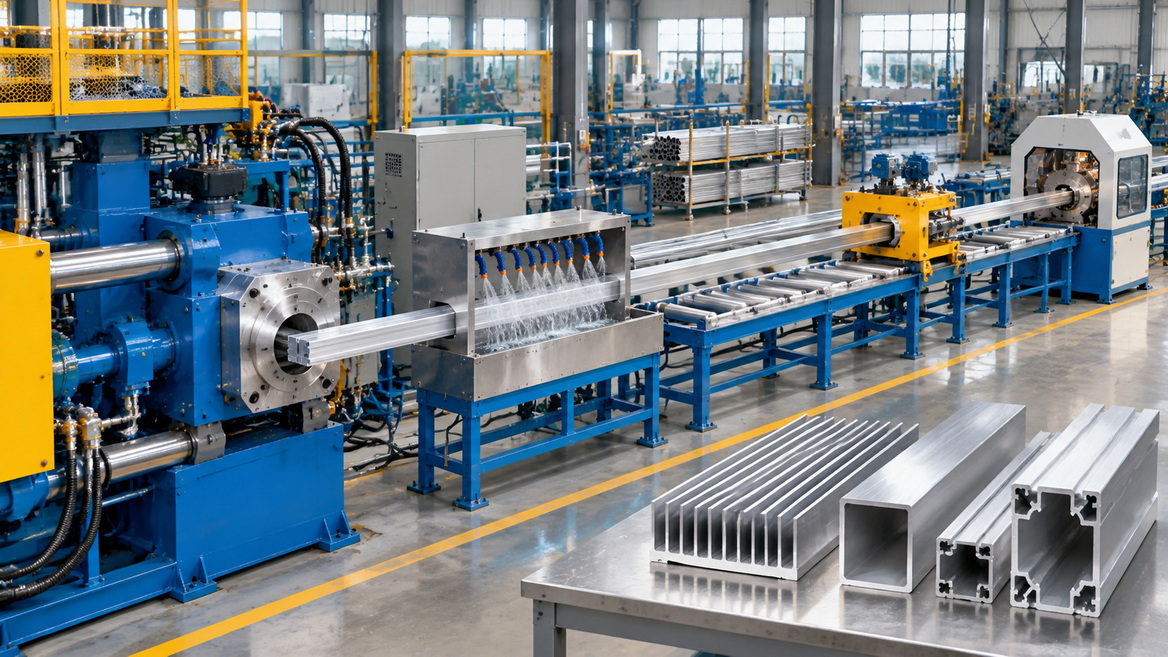
A horizontal aluminum extrusion press provides a straightforward route from the die to runout equipment, cooling systems, pullers, and cutting stations.
This arrangement is particularly relevant when evaluating:
- Heat-sink profiles with thin fins.
- Multi-cavity structural sections.
- Equipment frames and industrial rails.
- Transportation profiles.
- Long architectural sections.
The practical advantage is production continuity. The emerging profile can move through a coordinated handling sequence without requiring its full length to remain within a vertical receiving space.
However, the press cannot compensate for poorly synchronized downstream equipment. Inadequate support, unsuitable cooling, or incorrect pulling conditions can compromise otherwise acceptable extrusion.
Horizontal extrusion systems also warrant evaluation for copper and copper-alloy bars, sections, and tubes.
For tube applications, the tooling route becomes especially important. A system incorporating piercing and mandrel tooling addresses different requirements from a die arrangement that divides and rejoins metal flow.
When reviewing a copper extrusion press, we would examine:
- Alloy-specific deformation requirements.
- Available force throughout the working stroke.
- Container, stem, and tooling alignment.
- Piercing and mandrel capability where required.
- Temperature control and transfer arrangements.
- Downstream cooling and handling.
The essential question is not simply whether the machine can extrude copper. It is whether the complete process can repeatedly produce the specified copper product.
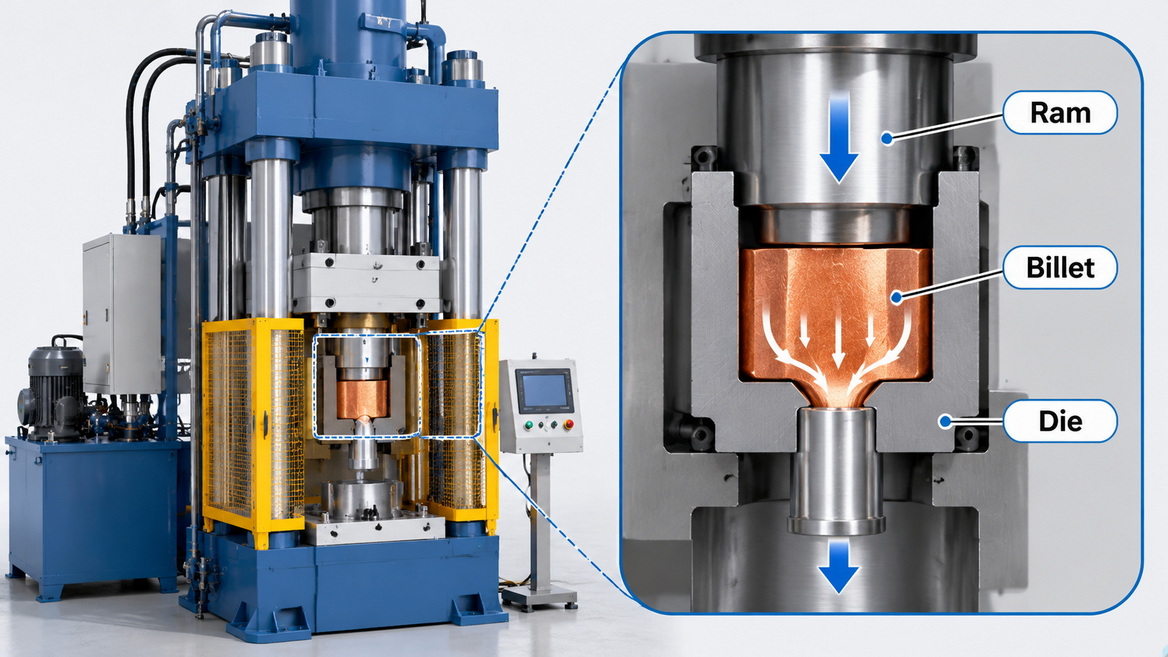
Vertical extrusion presses are available in upward- and downward-stroking configurations. Their suitability depends on the relationship between tooling, material feeding, working stroke, and finished-part extraction.
An upright arrangement may be worth investigating when:
- The component fits the available receiving space.
- Robotic loading and extraction suit the production sequence.
- The process benefits from integration into a vertical forming cell.
- The plant can accommodate the necessary height and maintenance access.
An important distinction is application scope. A vertical press used for short-component extrusion or forming is not automatically a substitute for a horizontal line producing long, constant-cross-section profiles.
Buyers should therefore request evidence from comparable materials, geometries, and production routes.
A vertical extrusion press may reduce the plan area occupied by certain machine arrangements. That does not establish a smaller total installation.
A realistic layout must include:
- Foundation and any pit requirements.
- Overall machine height.
- Crane and lifting clearance.
- Tool-changing access.
- Product extraction equipment.
- Operator protection and service space.
A smaller press footprint has limited value if the building requires extensive modification or maintenance becomes difficult.
Not inherently.
A vertical axis changes how gravity acts relative to the workpiece, but dimensional accuracy also depends on frame stiffness, alignment, die deflection, material flow, temperature, and post-extrusion handling.
Likewise, horizontal orientation does not inevitably cause unacceptable bending. Support and handling systems must be designed around the profile's temperature, stiffness, geometry, and exit conditions.
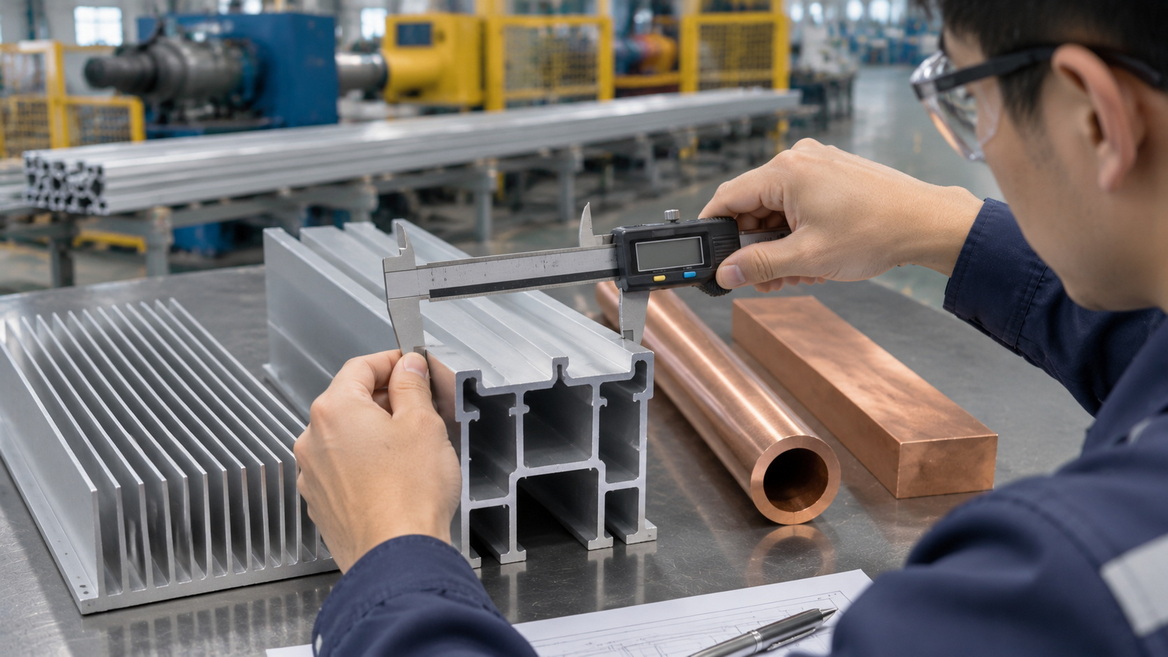
For demanding profiles, request measurable acceptance criteria:
- Cross-sectional dimensions.
- Straightness and twist.
- Wall-thickness variation.
- Surface condition.
- Tube eccentricity, where applicable.
- Mechanical properties after required processing.
Compare measured parts—not broad claims about orientation.
For intricate aluminum sections, die design frequently matters more than machine orientation.
Uneven wall thickness, unsupported die features, and unbalanced flow resistance can make a profile difficult to extrude consistently. Hollow dies introduce additional considerations because divided metal streams must rejoin under suitable conditions.
For this reason, "hollow" and "seamless" should not be treated as interchangeable specifications.
Where pressure containment, fatigue performance, or a customer standard makes seam condition important, define the required manufacturing route before selecting equipment.
The Aluminum Extruders Council describes aluminum extrusion as a solid-state process using preheated billets and tooling. Its process overview gives a broad billet-heating range extending from above approximately 375°C to around 500°C, depending on alloy and operating conditions.
These figures provide context, not a universal operating recipe.
For specialized aluminum profiles, the control strategy should address:
- Billet and die temperatures.
- Temperature development during extrusion.
- Ram speed and profile exit speed.
- Cooling or quenching requirements.
- Subsequent stretching and aging, where specified.
Selecting a faster press without validating thermal stability can create a bottleneck elsewhere—or reduce saleable output.
Do not transfer an aluminum operating recipe directly to copper.
Copper and copper alloys require alloy-specific assessment of forming conditions, tooling, lubrication, heating, and downstream treatment.
For precision copper tubing, for example, alignment and piercing arrangements deserve close attention. For solid electrical sections, dimensional control and surface condition may drive different equipment priorities.
A credible proposal should connect each major machine specification to the actual material and product requirements.
Maximum ram speed is not the same as production capacity.
A useful comparison includes the entire cycle:
1. Billet preparation and loading.
2. Extrusion.
3. Butt handling and tooling-related movements.
4. Product transfer and cooling.
5. Cutting and finishing.
6. Inspection and changeovers.
A faster extrusion stroke may provide little commercial benefit if handling or cooling limits the line.
Use saleable kilograms per hour as a practical comparison metric, supported by an agreed product mix and quality standard.
Neither horizontal nor vertical orientation guarantees lower energy consumption.
A fair assessment should define whether energy measurements include:
- Billet and die heating.
- Hydraulic power.
- Cooling systems.
- Compressed air.
- Handling equipment.
- Idle and standby consumption.
Compare energy per saleable tonne under equivalent production conditions. Otherwise, one supplier may quote press-only consumption while another includes the complete line.
Total ownership cost should also account for tooling, maintenance, installation, scrap, staffing, spare parts, and unplanned downtime.
The following are illustrative selection exercises, not reported customer projects.
Begin by evaluating a horizontal extrusion line because long profiles need coordinated receiving, support, cooling, and cutting.
The decisive technical questions concern fin geometry, die strength, flow balance, surface requirements, and handling.
Choosing vertical orientation alone would not resolve an unstable die design or unsuitable cooling strategy.
Compare both orientations after establishing the exact forming route.
A vertical arrangement may suit robotic feeding and extraction when the component and tooling sequence fit the available space. A horizontal arrangement may still offer advantages depending on transfer requirements and access.
The correct comparison is between complete, application-specific cells—not isolated press frames.
Start with tube quality requirements, including concentricity, wall thickness, surface condition, and any restrictions on manufacturing seams.
Then evaluate piercing, mandrel guidance, thermal control, and downstream processing.
Orientation becomes one part of a broader process decision rather than the defining quality feature.
Provide drawings, alloy designations, delivery condition, section dimensions, finished lengths, tolerances, surface requirements, and expected annual quantities.
Include difficult profiles—not just the easiest reference part.
Confirm whether the application requires direct or indirect extrusion, hollow-die tooling, piercing, mandrel extrusion, or another specialized sequence.
Specify any customer or industry requirements that constrain the manufacturing route.
Ask the supplier to explain the force, billet size, stroke, tooling envelope, and handling provisions.
Review the complete installation drawing, including utilities, access, foundations, height restrictions, and product flow.
Define the trial before ordering.
Record the alloy, billet dimensions, tooling, temperatures, speeds, cooling conditions, sampling locations, and inspection methods.
Measure performance across an agreed production sequence rather than accepting one visually satisfactory sample.
Require both proposals to use the same production hours, product mix, yield assumptions, energy boundary, and maintenance scope.
This exposes differences that a headline press price can hide.
It is generally the more practical starting point because it integrates naturally with horizontal runout, cooling, pulling, and cutting equipment. Final suitability still depends on profile geometry, alloy, capacity, and plant layout.
Vertical extrusion systems can be engineered for nonferrous materials, including aluminum and copper. However, material compatibility does not prove suitability for a particular profile. Confirm the forming route, force, tooling, thermal system, and extraction arrangement.
Neither orientation guarantees tighter tolerances. Compare demonstrated results for equivalent products, considering die design, alignment, thermal stability, cooling, and inspection conditions.
No. It may reduce certain floor-area requirements, but building height, foundations, extraction equipment, lifting access, and maintenance clearance can offset that advantage.
Not automatically. Energy performance depends on the hydraulic system, heating, cycle utilization, auxiliaries, and yield. Compare measured consumption per saleable tonne using the same system boundary.
1. [Aluminum Extruders Council — Aluminum Extrusion Process Basics]. Technical background on solid-state aluminum extrusion, billet heating, hydraulic presses, and hollow-die metal flow. [aec]
2. [SMS group — Light Metal Extrusion Presses]. Manufacturer information on aluminum extrusion systems, direct extrusion applications, press-frame rigidity, and billet-loading equipment. [sms-group]
3. [SMS group — Extrusion Presses for Heavy Metals]. Manufacturer information on heavy-metal extrusion, integrated production systems, internal piercing, and guidance for seamless tube production. [sms-group]
4. [Macrodyne — Hydraulic Extrusion Presses]. Manufacturer documentation covering nonferrous material capability and upward-, downward-, and horizontal-stroking configurations. [macrodynepress]
5. [Aluminum Extruders Council — Extrusion & Die Research and Development]. Technical research topics covering die mechanics, thermal behavior, seam-weld integrity, simulation, and dimensional stability. [aec]
6. [Aluminum Extruders Council — Extrusion & Die Process Application]. Technical material on extrusion process control, thermal alignment, quenching, tooling, and the relationship between speed and thermal stability. [aec]


