
Please Choose Your Language
Views: 289 Author: Xinxinke Extrusion Publish Time: 2026-11-13 Origin: Site


Content Menu
● High-Tonnage vs. High-Speed Extrusion Press: The Essential Difference
>> What a High-Tonnage Extrusion Press Offers
>> What a High-Speed Extrusion Press Offers
● How Automotive Profile Geometry Changes the Decision
>> Large Structural Profiles Need More Than Nominal Tonnage
>> Complex Hollow Sections Require Controlled Metal Flow
>> Smaller Profiles May Favor Faster Cycles
● Alloy, Temperature, and Speed Must Be Evaluated Together
>> Why Alloy Choice Changes the Operating Window
>> Why Maximum Speed Is Not a Quality Guarantee
>> Why Cooling Belongs in the Press Specification
● Ram Speed vs. Profile Exit Speed: A Critical Purchasing Distinction
● Calculate Accepted Output Instead of Theoretical Output
>> Illustrative Production Comparison
● Two Automotive Production Scenarios
>> Scenario 1: Complex Battery Enclosure Members
>> Scenario 2: Established High-Volume Profile Families
● Compare Cost per Accepted Tonne
>> Purchase Price Is Only the Starting Point
>> Measure Energy Under Comparable Conditions
● A Practical Five-Step Press Selection Workflow
>> 1. Define Representative Products
>> 2. Establish the Capability Envelope
>> 3. Review the Complete Production Line
>> 4. Agree on Measurable Acceptance Tests
● Specify Your Automotive Extrusion Line with Xinxinke
>> Is a high-tonnage extrusion press always slower?
>> Which press is better for automotive battery profiles?
>> Can higher tonnage solve thin-wall extrusion problems?
>> Does faster extrusion reduce automotive profile quality?
>> What is the most useful productivity figure?
Choosing a high-tonnage vs. high-speed extrusion press for automotive profiles starts with one question: does your production program need more forming capability, faster repeatable output, or both? A large, complex structural section and a compact, high-volume profile place different demands on the same extrusion line.
My recommendation is to prioritize capability before speed. First establish whether a press can produce the specified alloy and geometry consistently. Then determine how quickly the complete line can deliver acceptable profiles.
Xinxinke Co., Ltd. manufactures copper and aluminum profile extrusion equipment and customized solutions, drawing on more than 30 years of industry experience. This comparison focuses on aluminum automotive profiles, where press force, thermal control, tooling, and downstream equipment must operate as one production system.

High tonnage describes available extrusion force. High speed describes motion or production capability—but the term requires clarification.
A supplier may quote ram speed, profile exit speed, rapid approach speed, or a shorter non-extrusion cycle. These measurements are not interchangeable.
More importantly, force and speed are not mutually exclusive. Modern presses can combine substantial extrusion force with fast auxiliary movements. SMS group, for example, describes hybrid presses that reserve hydraulics for high-force operations while using electric drives for selected movements.
Higher available force can support demanding combinations of billet size, alloy resistance, extrusion ratio, and die complexity.
However, tonnage alone does not establish the largest producible profile. Container dimensions, die space, press stiffness, tooling, and handling capacity also constrain production.
A speed-focused configuration aims to increase productive throughput through controlled extrusion, shorter auxiliary movements, or both.
Its commercial value depends on maintaining dimensional accuracy, surface quality, and mechanical properties—not simply achieving a higher maximum speed.
| Selection factor | High-tonnage emphasis | High-speed emphasis |
|---|---|---|
| Primary objective | Provide sufficient forming force | Increase repeatable production output |
| Likely application | Demanding structural sections | Stable, repeat-volume profile families |
| Main engineering question | Can the press form this product reliably? | Can the entire line sustain this output? |
| Important supporting systems | Rigid structure, suitable container, capable tooling | Responsive controls, rapid handling, matched cooling |
| Main purchasing risk | Paying for unused capacity | Buying speed that cannot be used consistently |
| Best acceptance measure | Approved product under realistic loads | Accepted output over a complete production cycle |
These are selection priorities, not rigid equipment categories.
Battery enclosure members, side sills, and structural beams may combine substantial overall dimensions with thin walls and internal chambers.
Such profiles require a coordinated assessment of force, die support, flow balance, and thermal behavior. Increasing press capacity cannot independently solve poor metal distribution or an unsuitable die design.
European Aluminium identifies medium- and high-strength 6xxx-series alloys as important materials for automotive structural applications. The required alloy and final properties therefore belong in the machine specification from the beginning.
Automotive crash-management profiles frequently use closed or multi-chamber sections. Internal webs help manage deformation, but they also make tooling and material selection more demanding.
European Aluminium explains that moving from a single-chamber to a multi-chamber beam can require an alloy with better extrudability. This illustrates why geometry and alloy cannot be evaluated separately.
For a complex hollow profile, I would ask for evidence of stable production before accepting a faster cycle as an advantage.
For a repeatable profile family with adequate force margin, shorter handling and loading cycles can improve output without requiring a higher extrusion speed.
This distinction matters. A press that saves time between billets may create more useful capacity than one that pushes metal faster through a temperature-sensitive die.
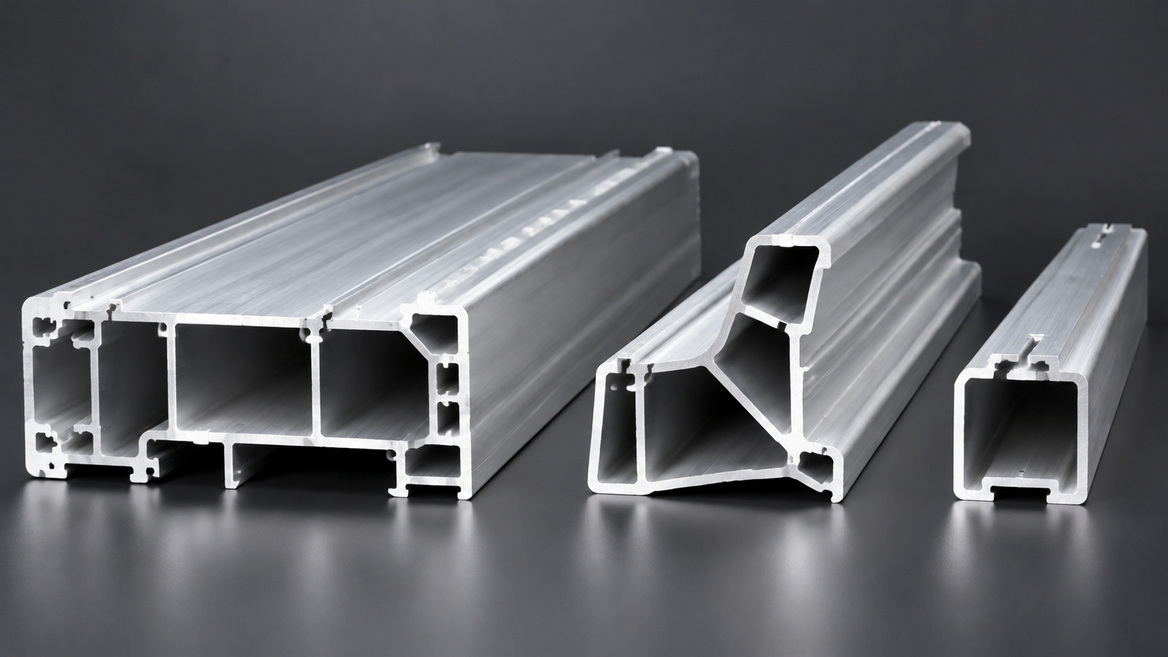
Different aluminum alloys offer different combinations of strength, extrudability, corrosion resistance, and formability.
The 6xxx family is widely used in extrusion, but a common alloy designation does not guarantee identical production behavior. Automotive component requirements also vary: a crash box and a structural beam may need different deformation characteristics and heat-treatment conditions.
Consequently, quotations should identify the actual alloy, billet condition, product geometry, and required final properties.
Increasing extrusion speed changes the thermal and deformation conditions experienced by the material.
A 2025 study in Scientific Reports examined how process conditions affected peripheral coarse grain formation. In the investigated profiles, increasing ram speed generally expanded the coarse-grained surface layer, although local behavior varied. The study also explains why this defect can impair crash performance. These findings are profile-specific, not a universal speed limit.
The practical lesson is to validate the operating window rather than assume that faster production preserves the same microstructure.
Higher output requires compatible quenching and profile handling.
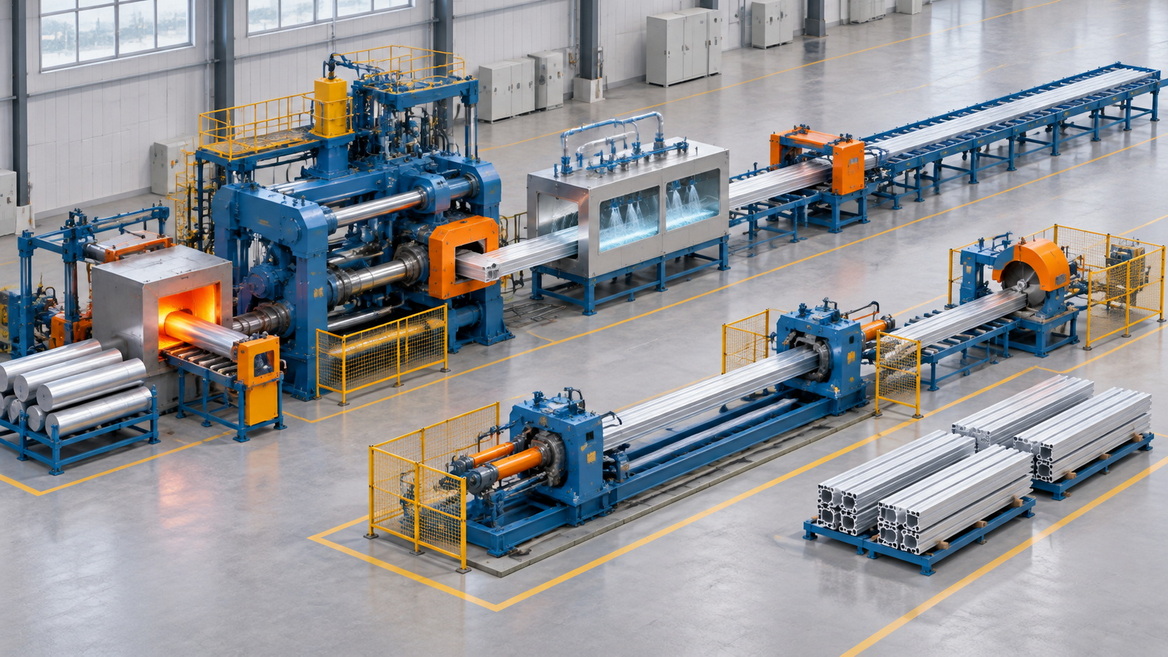
An SMS group automotive-related extrusion project combined its press with billet heating and an intensive air/water spray cooling system. This integrated configuration illustrates why a press should be assessed as part of a line rather than as an isolated machine.
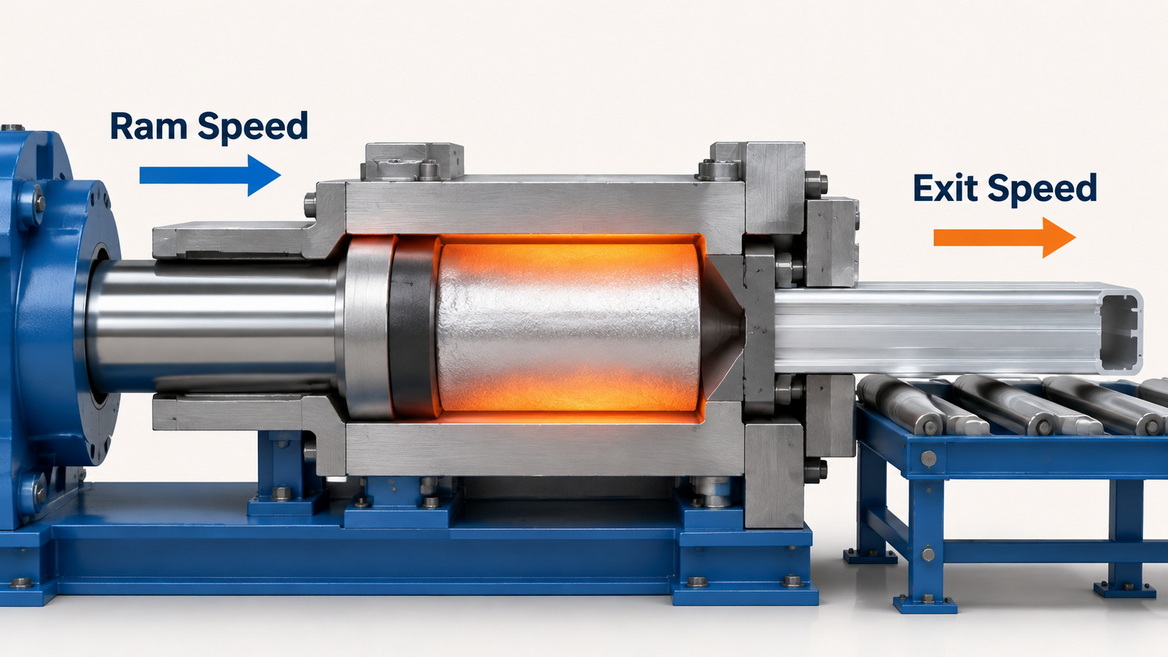
Ram speed measures the movement pushing the billet. Profile exit speed measures the material emerging from the die.
For a simplified steady-state calculation:
vexit≈vram×R
Here, \(R\) is the extrusion ratio: billet cross-sectional area divided by the total extruded metal area. Multiple die openings must be included in that total.
This relationship explains why two machines with identical ram speeds may produce different exit speeds. Published extrusion research likewise reports distinct exit-speed conditions associated with different ram speeds and profile configurations.
When comparing quotations, request:
- Maximum and controlled ram-speed ranges.
- Expected exit speed for each representative profile.
- Force available across the proposed operating range.
- Complete billet-to-billet cycle time.
- Measurement conditions and quality acceptance criteria.
A speed figure without a defined product and test condition has limited purchasing value.
The most useful production measure is accepted material per operating hour.
The following figures are hypothetical planning assumptions, not machine specifications or customer results.
| Planning assumption | Configuration A | Configuration B |
|---|---|---|
| Billet mass | 100 kg | 100 kg |
| Complete cycle | 120 seconds | 100 seconds |
| Accepted mass yield | 90% | 82% |
| Operating availability | 85% | 85% |
| Accepted output | 2,295 kg/hour | Approximately 2,509 kg/hour |
Configuration B completes cycles roughly 17% faster, but delivers only about 9% more accepted output because its assumed yield is lower.
This is why a purchasing comparison should include discard, startup scrap, dimensional rejection, and downstream bottlenecks. Faster cycles are valuable only when their output remains commercially usable.
Consider a manufacturer evaluating large, multi-chamber enclosure members with demanding straightness requirements.
The first priorities should be:
1. Confirm profile and die fit.
2. Establish required force under realistic process conditions.
3. Evaluate die support and flow balance.
4. Match quenching and handling to the section.
5. Verify dimensional stability after subsequent processing.
A higher-force configuration may be appropriate, but the conclusion should follow engineering assessment rather than a general rule that all battery profiles require the largest press.
Now consider a plant producing recurring profiles with stable tooling and demonstrated quality.
If sufficient force is already available, the larger opportunity may lie in shorter loading, shearing, and handling cycles.
SMS group's published ESTRAL project provides an industry example of combined priorities: a 28 MN press with a quoted maximum speed of 20 mm/s and high-speed electric auxiliary drives, intended for precision profiles including automotive applications. These specifications illustrate the architecture, not guaranteed output for every profile.
A larger press may require greater investment in foundations, utilities, tooling, and handling equipment. A faster press may require downstream upgrades before its additional capacity becomes usable.
Compare both options using the same production mix and annual operating assumptions.
Include:
- Equipment and installation.
- Electrical infrastructure.
- Tooling and die correction.
- Maintenance and consumables.
- Labor and changeovers.
- Scrap and rework.
- Cooling, stretching, sawing, and aging capacity.
Do not infer energy efficiency from tonnage or advertised speed alone.
Request energy consumption per accepted tonne for comparable alloys, profiles, and production conditions. Also establish whether the measurement covers the press alone or the complete line.
Hybrid architecture can change how a press generates force and performs auxiliary movements, but equipment architecture by itself does not establish your plant's final energy cost.
Provide drawings, alloys, wall thicknesses, profile dimensions, required temper, tolerances, annual volumes, and inspection requirements.
Include difficult products, not only the easiest section in the portfolio.
Ask the manufacturer to document billet diameter, die dimensions, available force, operating speed, and product-handling limits.
Identify which products require trials or further die-development work.
Check billet heating, loading, quenching, puller operation, runout length, stretching, sawing, and aging.
An isolated press-speed improvement is insufficient if another operation determines output.
Specify the alloy, profile, sampling plan, stabilization period, and test duration.
Evaluate:
- Accepted kilograms per hour.
- Dimensional compliance.
- Surface condition.
- Required mechanical properties.
- Recorded temperature and speed conditions.
- Energy use within a defined measurement boundary.
Evaluate spare parts, training, maintenance access, diagnostic support, and future product flexibility alongside the purchase price.
My preferred decision sequence is straightforward: prove manufacturability, demonstrate stable quality, and then optimize productivity.
Xinxinke Co., Ltd. brings more than 30 years of industry experience to copper and aluminum profile extrusion equipment manufacturing and customized solutions.
For your next automotive project, send Xinxinke your profile drawings, alloy specifications, required properties, annual production targets, and existing line constraints.
Request a project-specific comparison covering force requirements, workable speed ranges, billet configuration, auxiliary equipment, and acceptance testing. The objective is not simply a larger or faster press. It is a production system matched to the profiles you need to sell.
No. Force capacity and speed are different specifications. Modern designs can combine substantial force with fast auxiliary movements. Compare the complete cycle and the operating speed available under the required load.
Neither category is automatically better. Large, complex members may emphasize force and tooling capacity, while established, repeat-volume sections may benefit more from shorter cycles. Evaluate the actual drawings, alloy, quality requirements, and downstream constraints.
Not independently. Additional force does not eliminate the need for balanced flow, suitable tooling, temperature control, and compatible alloy selection. Complex multi-chamber automotive profiles make these interactions especially important.
It can, but the outcome depends on the product and process window. Research shows that speed can affect microstructure, with consequences for crash-related performance. Validate speed changes through product-specific trials and testing.
Accepted kilograms per hour under an agreed production cycle is more useful than maximum ram speed alone. It captures the commercial effect of cycle time, yield, and operating availability.
1. SMS group. "Light Metal Extrusion Presses." Manufacturer information on press configurations, hybrid drives, and extrusion processes. [sms-group]
2. European Aluminium. "The Aluminium Automotive Manual: Extruded Products." Technical guidance on extrusion alloys and automotive applications. [european-aluminium]
3. European Aluminium. "Applications—Car Body—Crash Management Systems." Guidance on hollow sections, alloy selection, and crash deformation requirements. [european-aluminium]
4. Scientific Reports. "Smart Extrusion via Data-Driven Prediction of Grain Size and Peripheral Coarse Grain Defect Formation." Published March 19, 2025. [link.springer]
5. SMS group. "UACJ Awards FAC for HybrEx®40 Extrusion Press Line." Published equipment specifications and integrated heating, handling, and cooling scope. [sms-group]
6. GIFA. "ESTRAL Once Again Counts on Extrusion Technology from SMS Group." Report on press force, speed, and auxiliary-drive architecture. [gifa]
7. SMS group. "Extrusion Presses for Light Metal," presentation reproduced by SlideToDoc. Includes separate light- and heavy-metal application specifications. [slidetodoc]


