
Please Choose Your Language
Views: 261 Author: Xinxinke Extrusion Publish Time: 2026-10-17 Origin: Site


Content Menu
● How Metal Extrusion Processing Differs from Plastic Extrusion
● What Auxiliary Equipment Does an Extrusion Line Need?
● Upstream Extrusion Auxiliary Equipment: Prepare Billets Consistently
>> Billet Storage, Cutting, and Loading
>> Billet Heating and Temperature Verification
>> Die Heating and Tooling Preparation
● Downstream Equipment for Aluminum Profile Extrusion
>> Quenching: Match Cooling to the Alloy and Section
>> Pullers and Runout Tables: Protect the Hot Profile
>> Stretching, Cutting, and Aging
● Copper Extrusion Equipment: Avoid Copying an Aluminum Recipe
● How to Match Auxiliary Equipment to Real Production Capacity
>> Find the Constraint Across the Whole Line
>> Measure Accepted Output, Not Only Gross Output
● A Practical Troubleshooting Framework for Extrusion Lines
● Commissioning Steps That Turn a Quotation into a Production Standard
● Planning a Customized Extrusion Line with Xinxinke
>> What Is Auxiliary Equipment in Metal Extrusion Processing?
>> Can Plastic Extrusion Equipment Be Used as a Metal Extrusion Checklist?
>> Is a Puller the Same as a Stretcher?
>> Does Every Aluminum Profile Need Water Quenching?
>> Should Copper and Aluminum Use the Same Processing Recipe?
Extrusion processing depends on more than a powerful press. For copper and aluminum profile manufacturers, auxiliary equipment connects billet preparation, temperature control, profile handling, cooling, and finishing into one coordinated production line. Choosing the right extrusion auxiliary equipment helps manufacturers control dimensional accuracy, protect surface quality, and avoid bottlenecks between production stages.
At Xinxinke Co., Ltd., we bring more than 30 years of industry experience to copper and aluminum profile extrusion equipment. Our manufacturing capabilities, quality-control practices, and technical team support high-performance extrusion presses and customized solutions for customers worldwide.
Our equipment-planning perspective starts with a practical question: can the entire line consistently deliver the required finished product—not simply generate enough pressing force?
This guide explains the equipment involved, where aluminum and copper requirements differ, and how to evaluate a proposed extrusion line.
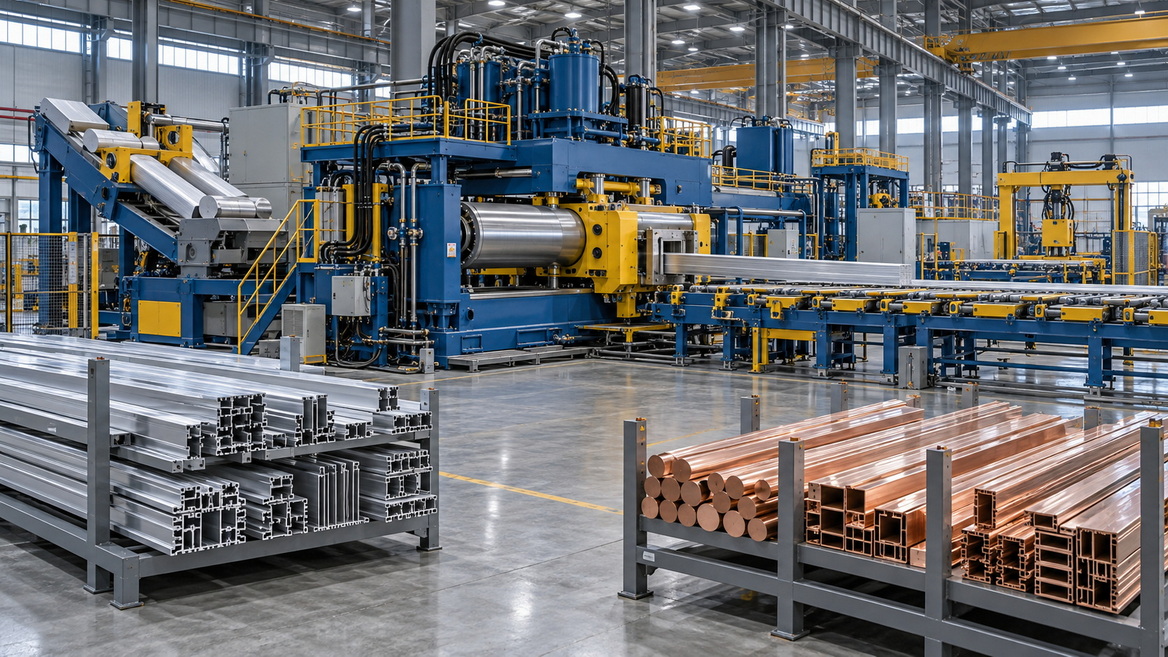
Plastic extrusion typically uses a rotating screw to melt and continuously push polymer through a die. Its auxiliary equipment includes resin conveying, drying, blending, cooling, and granulation systems.
Conventional billet-based metal extrusion follows a different route. A press forces a prepared billet through tooling to produce a profile. Aluminum extrusion is a solid-state forming process: the billet is heated to improve formability, not melted into a liquid.
This distinction changes the equipment specification.
A copper or aluminum extrusion line requires attention to billet heating, tooling temperature, press-cycle coordination, hot-profile handling, and material-specific finishing. Plastic resin dryers and granulators cannot simply be transferred into a metal extrusion equipment checklist.
It also changes how production capacity should be discussed. Metal extrusion involves billet changes and other interruptions, so buyers should evaluate the complete operating cycle rather than assume uninterrupted output.
A useful way to organize extrusion auxiliary equipment is by its position and purpose. The table below is a planning framework, not a universal configuration: the final equipment package depends on alloy, profile geometry, production route, and customer requirements.
| Production stage | Typical equipment | Main planning objective |
|---|---|---|
| Billet preparation | Storage racks, transfer equipment, log cutting or billet shearing | Supply suitable billets safely and consistently |
| Thermal preparation | Billet heaters, die ovens, temperature instruments | Establish repeatable processing conditions |
| Press support | Loading systems, hydraulic cooling, lubrication systems | Support reliable press operation |
| Profile discharge | Runout tables, pullers, hot-cutting equipment | Coordinate handling with extrusion speed |
| Cooling | Air, water, or combined cooling systems | Meet material and dimensional requirements |
| Finishing | Stretchers, straightening equipment, saws, aging ovens where required | Achieve specified geometry, length, and properties |
| Inspection and handling | Measuring instruments, racks, stacking systems | Verify quality and protect finished profiles |
The important purchasing principle is integration. A capable press cannot compensate for an undersized heater, poorly coordinated puller, or finishing section that cannot clear material quickly enough.

Billet preparation should begin with traceability. Keep alloy grades and production lots identifiable throughout storage, cutting, heating, and loading.
When reviewing a loading system, check:
- Accepted billet diameters and lengths.
- Compatibility with the proposed press and container.
- Handling arrangements for different production recipes.
- Space for inspection and rejected material.
- Recovery procedures after a transfer interruption.
These questions turn a generic equipment quotation into a workable material-flow plan. They also help expose assumptions that might otherwise remain hidden until installation.
Billet heating affects extrusion quality, process stability, and equipment performance. Recent industry discussions emphasize measuring temperature uniformity and thermal consistency rather than judging a heater only by its nominal capacity.
Ask the supplier how temperature will be verified. A displayed setpoint does not, by itself, demonstrate a uniform billet temperature.
A practical specification should address measurement locations, instrument calibration, heating consistency, and recipe changes. Where thermal gradients are deliberately used, the control system should support the intended profile rather than treat every variation as an error.
Do not apply one temperature recipe to every copper or aluminum alloy. The processing window must be established for the actual material, section, tooling, and production objectives.
Tooling deserves a defined preparation procedure, not an informal "ready when hot" judgment.
For copper extrusion, specialist guidance highlights container material selection, heating, cooling, and design as factors connected with safety, stability, and quality.
Our recommended procurement approach is to include tooling preparation in the line specification. Define die identification, heating verification, transfer arrangements, and responsibility for approving tooling before production begins.
Aluminum profile cooling is more than a handling convenience. Quenching and subsequent processing influence the mechanical properties of suitable heat-treatable alloys. Industry research identifies quench rate, exit temperature, aging practice, and stretching among the variables affecting final strength.
Air, water, or combined cooling arrangements should therefore be selected around the actual product.
Complex sections may need adjustable cooling distribution. Excessive or uneven cooling can create deformation, while inadequate cooling may compromise the required properties. Industry developments increasingly focus on controlling cooling intensity for different cross-sections and alloy sensitivities.
Ask for evidence that the proposed cooling system suits your product family—not merely its maximum water flow or installed fan power.
Pullers guide newly extruded profiles through the downstream section. Runout and cooling tables support the material before subsequent processing.
When evaluating this equipment, examine speed coordination, gripping arrangements, section compatibility, and recovery after an interrupted cycle.
For appearance-sensitive profiles, ask how contact surfaces and handling transitions will avoid damage. A quotation should explain the handling route from the die exit to the next production stage, including any changes in support or gripping.
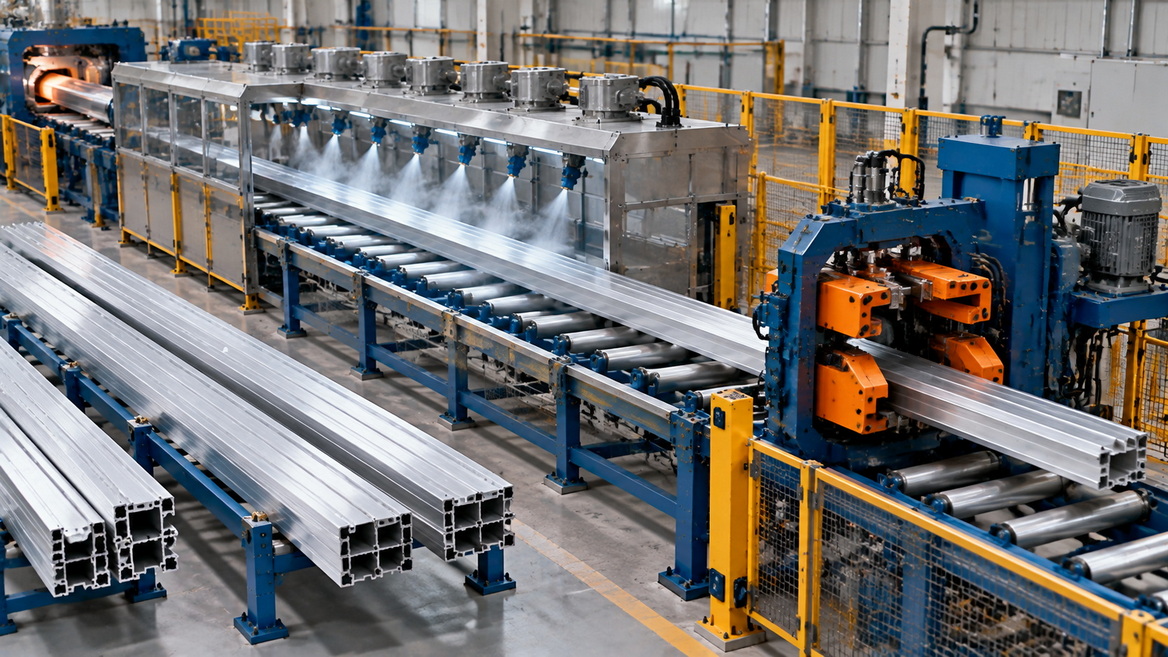
After quenching, aluminum profiles may be stretched to improve straightness and reduce residual stresses. Artificial aging, where required by the alloy and temper specification, develops the intended properties through a controlled thermal cycle.
These operations have different functions and should not be treated as interchangeable finishing steps.
The finishing specification should establish:
- Permitted straightness and dimensional variation.
- Available gripping length and stretcher capacity.
- Finished-length requirements.
- Sawing and chip-management arrangements.
- Aging requirements for the specified alloy and temper.
- Handling provisions before inspection and packing.
A complete line proposal should explain how these requirements will be verified.
Copper extrusion requires its own engineering assessment. Tooling and container selection, together with heating and cooling arrangements, are important considerations in copper-alloy extrusion practice.
"Copper" also covers multiple material families. The Copper Development Association distinguishes numerous wrought copper and copper-alloy designations; a material name alone is not an adequate equipment specification.
Provide the exact grade, profile drawing, required properties, and downstream route before requesting a final configuration.
Our recommended approach is to confirm:
1. Material-specific processing requirements.
2. Press and tooling suitability.
3. Billet-heating and container-control arrangements.
4. Required cooling or subsequent thermal processing.
5. Straightening, cutting, and inspection needs.
Do not automatically specify an aluminum-style quench, stretch, and aging sequence for every copper product. Establish the route from the material and finished-product requirements.
For procurement purposes, rated press capacity and finished-product throughput are different measures.
Use a simple planning worksheet to compare each stage:
| Stage | Question to resolve |
|---|---|
| Billet heating | Can prepared billets arrive at the required operating rhythm? |
| Extrusion press | What cycle is achievable with representative profiles? |
| Runout and cooling | Can the section accommodate profile length and discharge speed? |
| Stretching and cutting | Can finishing keep pace without excessive accumulation? |
| Thermal treatment | Is capacity sufficient for the planned alloy and temper mix? |
| Inspection and packing | Can accepted product leave the line without blocking production? |
This worksheet is a proposed evaluation method, not a claim about any particular installation.
Require suppliers to state the assumptions behind throughput estimates. Product geometry, billet changes, tooling changes, interruptions, and rejection criteria should not disappear inside a headline capacity figure.
For line evaluation, we recommend defining saleable output as finished material that passes the agreed inspection requirements.
Pair that measure with:
- First-pass acceptance rate.
- Scrap by defect category.
- Changeover duration.
- Unplanned downtime.
- Energy per unit of accepted production.
These indicators make improvement discussions more useful. A faster cycle is not necessarily a better result if it increases rejection or overloads downstream operations.
An extrusion defect should trigger a coordinated investigation, not an immediate adjustment to the press alone. Aluminum properties, for example, depend on interacting variables including exit temperature, cooling, stretching, and aging.
The following table provides investigation prompts rather than definitive diagnoses.
| Observed problem | Areas to investigate | Useful first check |
|---|---|---|
| Inconsistent properties | Material identity, thermal conditions, cooling, treatment route | Review batch and process records |
| Bent or twisted profiles | Cooling distribution, support, handling, straightening | Identify when distortion first appears |
| Surface damage | Tooling condition, contact surfaces, transfers | Locate the earliest visible mark |
| Variable cut length | Measurement, gripping, cutting sequence | Check calibration and operating records |
| Repeated production stops | Heating supply, transfer timing, equipment alarms | Rank stops by frequency and duration |
Change one relevant variable at a time where practical. Record the setting, observation, and inspection result. This creates a usable troubleshooting history instead of relying on memory.
A detailed commissioning plan is one of the most useful additions to an extrusion equipment purchase.
We recommend the following sequence:
1. Select representative alloys and profile geometries.
2. Agree on dimensions, properties, surface criteria, and measurement methods.
3. Verify instruments, recipes, alarms, and equipment interfaces.
4. Test the coordinated line at the agreed production conditions.
5. Evaluate finished output, interruptions, and rejection reasons.
6. Document operating limits and approved settings.
7. Complete operator training and maintenance handover.
Do not accept a single easy profile as proof of the complete product range.
For thermal-control equipment, discuss how actual heating or cooling performance will be measured. Industry work on instrumented billets and profile cooling-curve measurement illustrates the value of verifying the process rather than relying only on equipment settings.
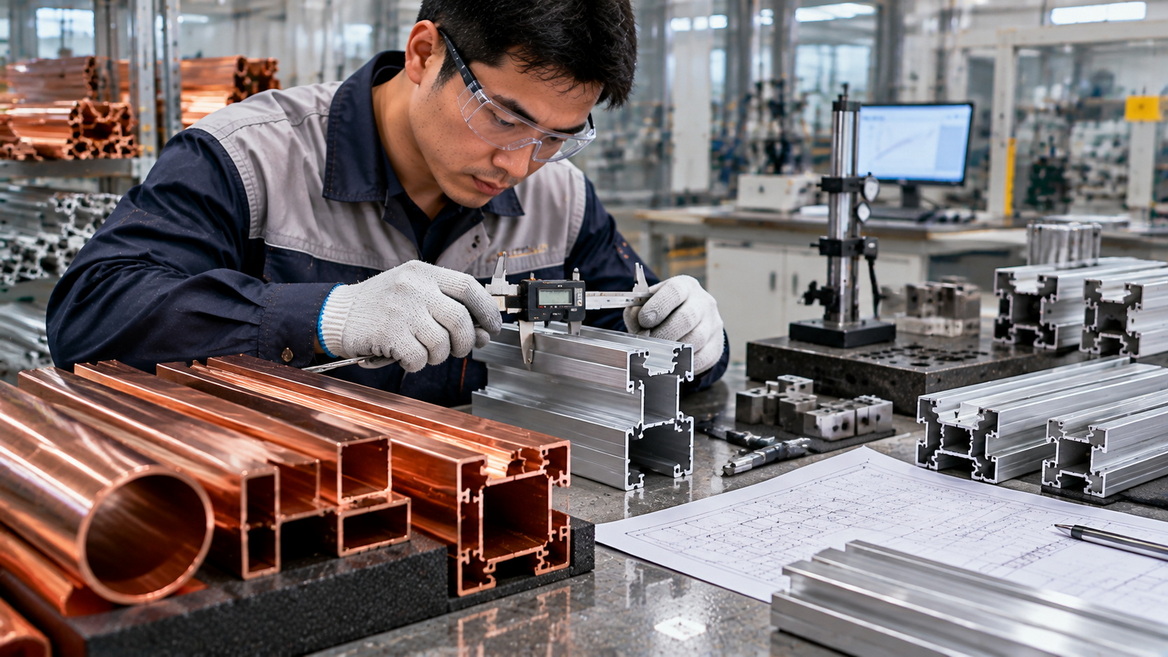
Xinxinke Co., Ltd. provides copper and aluminum profile extrusion equipment and customized solutions, supported by more than 30 years of industry experience.
To begin a meaningful technical discussion, send our team:
- Alloy grades and representative profile drawings.
- Required tolerances, surface condition, and mechanical properties.
- Target finished output and expected product mix.
- Billet dimensions and available plant space.
- Existing equipment and utility constraints.
- Automation, inspection, and handling requirements.
Request an extrusion-line assessment that addresses both the press and its supporting equipment. A clear project brief allows the discussion to focus on production compatibility, measurable acceptance criteria, and the equipment configuration your products actually require.
It is the equipment supporting the extrusion press, including billet heaters, handling systems, cooling equipment, pullers, stretchers, saws, and finishing systems. The required combination depends on the production route.
No. Plastic extrusion commonly requires resin conveying, drying, blending, and granulation. Metal extrusion requires a different approach to billet preparation, press support, thermal processing, and profile handling.
No. A puller handles the profile during extrusion discharge. A stretcher performs a separate operation on cooled aluminum profiles to improve straightness and reduce residual stresses.
No single cooling arrangement suits every product. Cooling selection depends on alloy sensitivity, profile geometry, required properties, and deformation control. Adjustable air or water-based systems may be appropriate.
No. Establish material-specific requirements. Copper-alloy tooling and thermal considerations must be assessed separately, and an aluminum finishing sequence should not be assumed suitable for a copper product.


