
Please Choose Your Language
Views: 275 Author: Xinxinke Extrusion Publish Time: 2026-11-01 Origin: Site


Content Menu
● How Direct and Indirect Extrusion Presses Work
>> Direct Extrusion: The Billet Moves Toward a Stationary Die
>> Indirect Extrusion: The Die Moves Relative to the Billet
● Direct vs. Indirect Extrusion Press: Key Differences
● What Solar Frame Profiles Actually Require
>> Cross-Section Accuracy and Assembly Fit
>> Alloy, Temper, and Finished Performance
● Production Performance: Force, Speed, and Saleable Output
>> Lower Extrusion Force Does Not Guarantee Higher Throughput
>> Compare Accepted Kilograms per Hour
● Dimensional Accuracy and Surface Quality
>> Why Indirect Extrusion Can Improve Consistency
>> Why Billet Preparation Can Decide the Outcome
>> Inspect Finished Appearance, Not Just Fresh Extrusions
● Tooling, Profile Size, and Maintenance
>> Confirm the Complete Profile Envelope
>> Evaluate Maintenance as a Production Issue
● A Better Financial Comparison: Cost per Accepted Kilogram
● A Practical Acceptance-Test Plan for Solar Frame Presses
>> Step 1: Select Representative Frame Profiles
>> Step 2: Fix the Trial Conditions
>> Step 3: Run Beyond Startup Conditions
>> Step 4: Inspect Finished Components
>> Step 5: Define Acceptance Before Ordering
● Which Extrusion Press Should You Choose?
>> Is Indirect Extrusion Always Better for Solar Frame Profiles?
>> Can a Direct Extrusion Press Produce Precision Solar Frames?
>> Does Indirect Extrusion Always Produce a Better Surface Finish?
>> How Should I Select Extrusion Press Tonnage?
>> Will an Indirect Press Reduce Total Energy Consumption?
Choosing a direct vs. indirect extrusion press for solar frame profiles is not simply a comparison of extrusion force. It is a decision about profile geometry, dimensional consistency, billet preparation, finishing quality, and the cost of producing accepted frames.
For a plant focused on conventional aluminum solar frames, my starting point would be to evaluate a direct extrusion line first. An indirect extrusion press deserves closer consideration when process consistency, demanding alloys, or a specific product requirement can justify its additional constraints.
The most useful purchasing principle is validation: compare both technologies against your actual frame drawings, production mix, and acceptance criteria—not isolated machine specifications.
At Xinxinke Co., Ltd., our stated background includes more than 30 years in copper and aluminum extrusion equipment manufacturing. This guide applies a manufacturing-focused perspective without presenting hypothetical calculations as verified customer results.
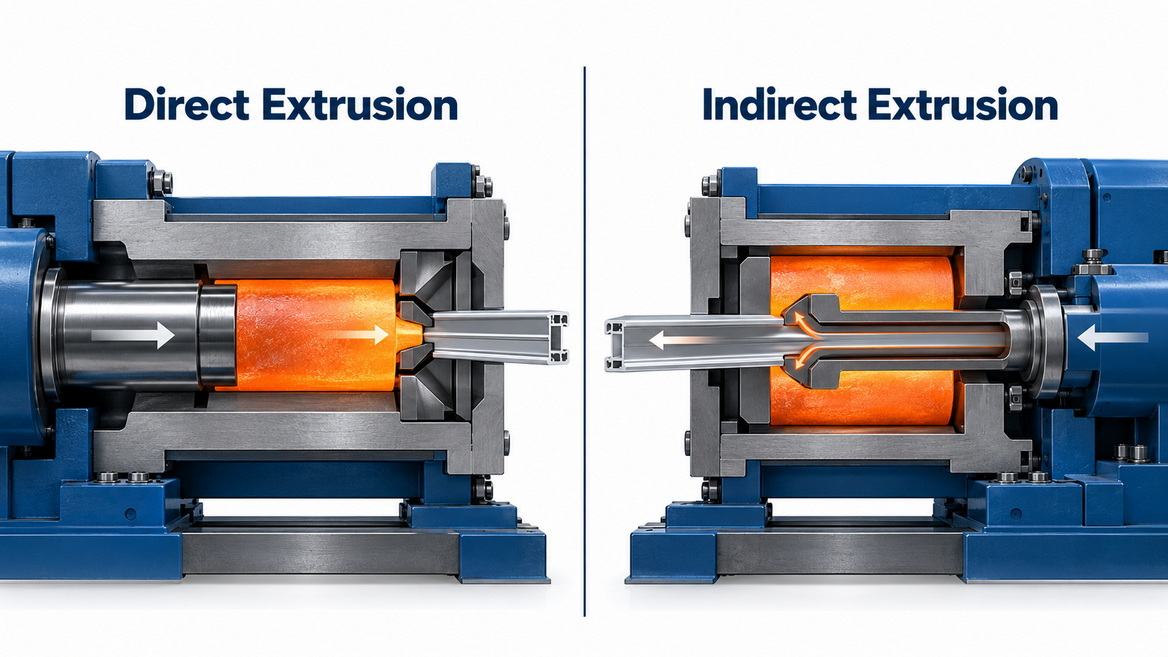
In direct extrusion, a ram pushes the heated aluminum billet through a stationary die. The profile exits in the same general direction as the ram's movement.
Because the billet moves relative to the container wall, friction adds to the required extrusion force. This frictional contribution changes as the billet becomes shorter.
A direct extrusion press for solar frame profiles offers a practical platform for evaluating different cross-sections, tooling arrangements, and production schedules. However, consistent results still depend on billet temperature, die design, extrusion speed, and downstream handling.
In indirect extrusion, the die moves into the billet, and the extruded material passes back through a hollow supporting stem. The billet remains stationary relative to the container.
This eliminates the sliding friction contribution between the billet and container wall. It does not eliminate friction throughout the process: deformation and die-interface friction remain.
The result is generally lower extrusion force and more consistent loading. The trade-off is that the profile must pass through the supporting structure, restricting the available product envelope.
| Evaluation factor | Direct extrusion press | Indirect extrusion press |
|---|---|---|
| Billet–container movement | Billet slides along the container | No relative sliding during extrusion |
| Extrusion force | Includes billet–container sliding friction | Lower friction-related force requirement |
| Load consistency | Friction contribution changes through the stroke | Generally more consistent loading |
| Profile envelope | Not constrained by an indirect hollow stem | Restricted by the stem passage |
| Billet surface preparation | Still important for quality | Especially important because surface contamination can enter the extrusion |
| Dimensional stability | Depends on tooling and process control | More consistent loading can support dimensional stability |
| Surface appearance | Depends on billet, die, process, and finishing | Not automatically superior; billet preparation is critical |
| Productivity | Must be assessed across the entire line | Potential speed advantages require application-specific proof |
| Best purchasing evidence | Trials using representative frame dies | Trials confirming geometry, finish, and net output |
Neither process guarantees a finished solar frame's strength, corrosion resistance, or assembly accuracy. Those outcomes depend on the complete manufacturing route.
A solar frame profile is more than an aluminum section with an attractive surface. It must integrate with module glass, sealants, corner connectors, mounting interfaces, and assembly equipment.
Important characteristics can include:
- Glass-channel width and depth.
- Corner-key cavity dimensions.
- Screw-port geometry.
- Wall thickness and local material distribution.
- Straightness, twist, and cut-end squareness.
A small deviation at a functional interface can create assembly problems even when the overall profile dimensions appear acceptable.
My recommendation is to identify critical-to-function dimensions before discussing press capacity. A machine quotation cannot meaningfully promise "high precision" without knowing which dimensions matter.
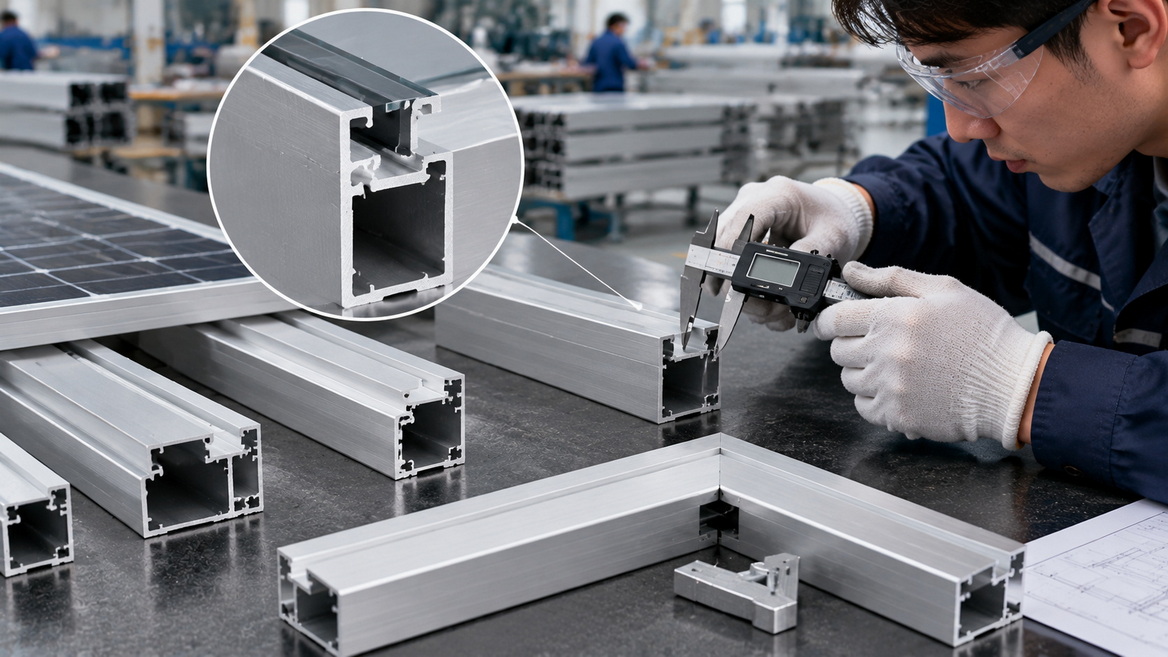
Commercial solar-frame offerings include alloys such as 6063 and 6005 in specified tempers. These choices should follow the module designer's structural and finishing requirements, rather than a general claim that one alloy is always better.
Press selection must therefore consider the actual alloy and intended thermal processing.
Do not assume that replacing direct extrusion with indirect extrusion will automatically increase finished strength. Quenching, aging, section geometry, and alloy chemistry remain essential.
Indirect extrusion reduces the billet–container friction contribution. That can create opportunities for different operating speeds or process conditions.
However, the fastest extrusion stroke does not necessarily produce the most finished frames per shift.
Other constraints may include:
- Billet loading and heating.
- Die changes and setup.
- Quench capacity.
- Puller coordination and runout length.
- Stretching, sawing, and aging.
- Anodizing and final inspection.
A press capable of higher exit speed provides limited value when the cooling system or handling table cannot maintain product quality at that speed.
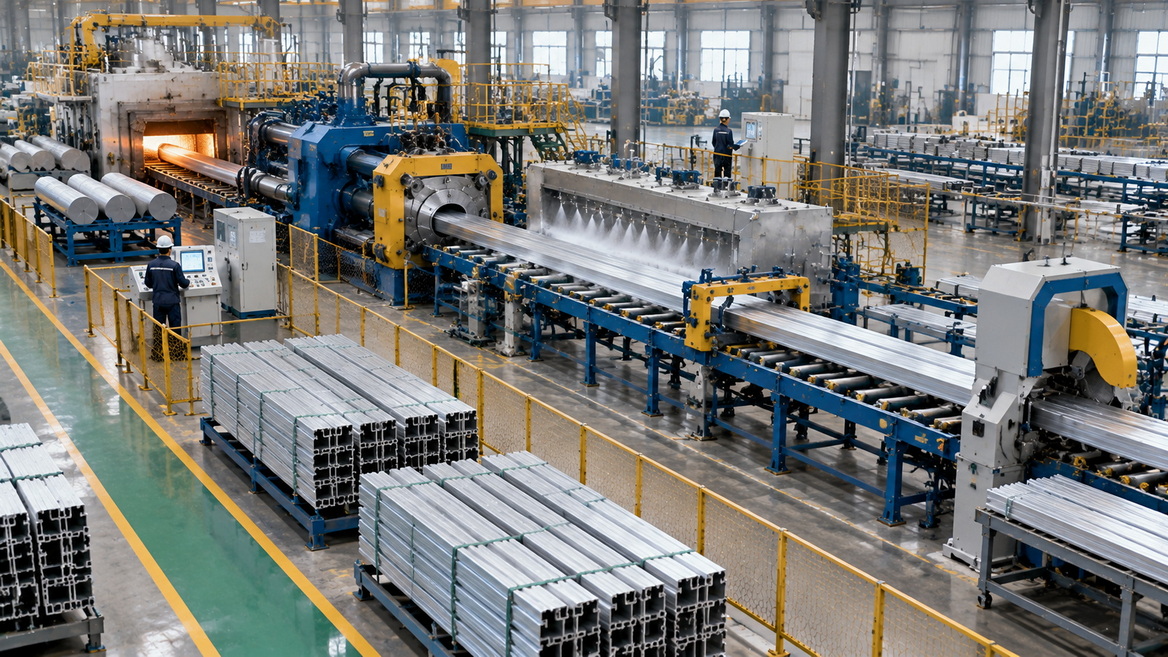
A useful comparison is:
Accepted output = gross throughput × saleable yield.
Consider an illustrative scenario—not a Xinxinke customer result:
| Production measure | Direct line | Indirect line |
|---|---|---|
| Gross throughput | 1,200 kg/hour | 1,100 kg/hour |
| Saleable yield | 91% | 95% |
| Accepted output | 1,092 kg/hour | 1,045 kg/hour |
Here, the higher-yield line still produces fewer accepted kilograms per hour.
The lesson is not that direct extrusion is always more productive. It is that yield and throughput must be evaluated together, using the same product specification and accounting boundaries.
More consistent loading in indirect extrusion can reduce changes associated with die deflection during the stroke. Hydro identifies this as a reason to consider the process for demanding dimensional requirements.
That advantage is valuable only if it improves the dimensions your customer controls.
For solar frames, inspection should include profile samples from the beginning, middle, and end of the extrusion—not just one convenient sample.
Also inspect after stretching, aging, and finishing. Acceptable dimensions immediately after extrusion do not establish compliance at shipment.
An often-overlooked issue is the billet surface.
In indirect extrusion, surface contamination or the as-cast surface layer can affect the extruded product. Hydro specifically highlights the need to remove the as-cast layer and maintain clean billet surfaces.
This means an indirect press proposal should address:
1. Billet surface preparation.
2. Storage and handling cleanliness.
3. Lubricant contamination control.
4. Inspection and traceability.
A buyer who compares only press prices may miss the investment and operating requirements associated with billet preparation.
A bright profile at the press does not prove acceptable anodized appearance.
For appearance-sensitive solar frames, trial material should complete the intended finishing process. Review surface lines, visible defects, color consistency, and handling marks under agreed inspection conditions.
Both technologies require a controlled route from billet to finished frame.
The hollow stem in an indirect press limits the profile envelope. Buyers should submit the full cross-section drawing rather than only the profile's width and height.
The review should cover:
- Circumscribing circle.
- Die and support arrangement.
- Hollow or semi-hollow features.
- Number of extrusion cavities.
- Required exit clearance.
A narrow profile may fit individually while a proposed multi-cavity arrangement does not. This can change the economics of the entire project.
Avoid assuming that either design is automatically cheaper to maintain.
Request an equipment-specific maintenance plan covering hydraulic components, alignment, container tooling, die-support components, inspection intervals, and replacement procedures.
For procurement, the important question is practical: how quickly can your team diagnose a problem, obtain parts, and restore qualified production?
Include operator training, maintenance documentation, and spare-parts responsibilities in the commercial discussion.
Purchase price alone is an incomplete decision metric.
A practical model is:
Conversion cost per accepted kilogram = defined conversion costs ÷ accepted production mass.
Keep the cost boundary identical for both proposals. Include, where applicable:
- Electricity and fuel.
- Labor and routine maintenance.
- Tooling consumption.
- Billet surface preparation.
- Scrap handling and metal recovery.
- Rework and rejected finishing.
- Downtime and capital-related costs.
Lower extrusion force should not be translated directly into an identical percentage reduction in total factory electricity. Heating, hydraulic efficiency, idle operation, and downstream equipment affect the result.
Likewise, compare scrap on a consistent financial basis. Recoverable aluminum scrap is not economically equivalent to unrecoverable material loss or a rejected finished frame.
This is where a technically attractive proposal becomes a measurable purchasing decision.
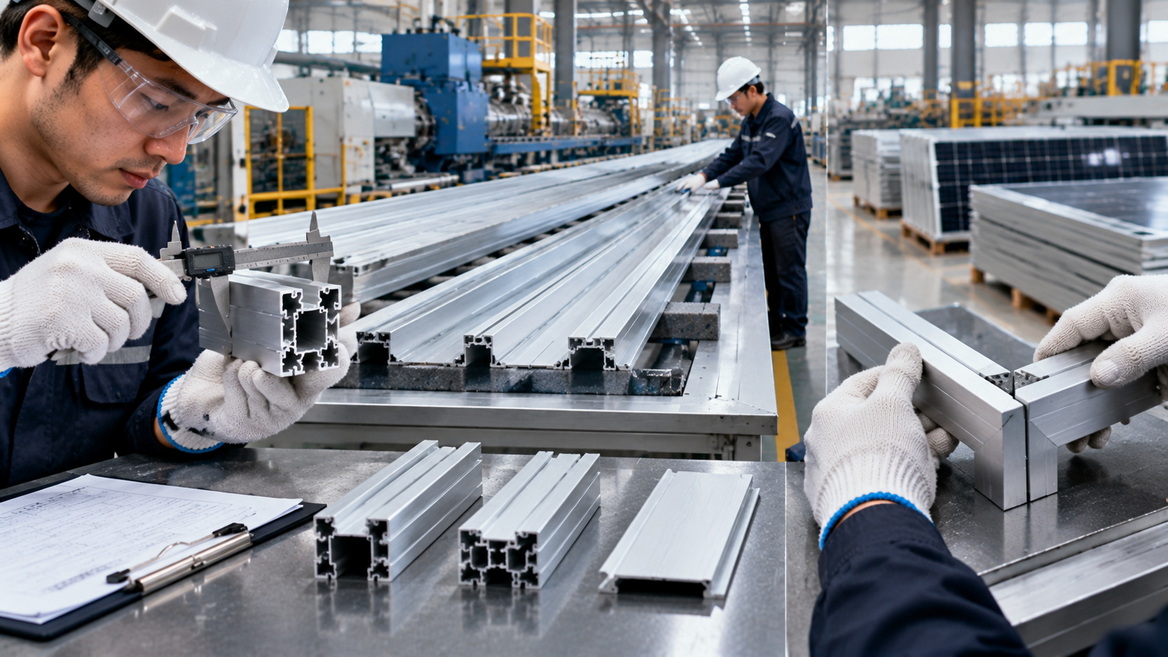
Choose several drawings that reflect actual production:
- A high-volume standard frame.
- A thin-wall or demanding profile.
- A section with critical assembly interfaces.
Do not qualify the entire investment using only the easiest profile.
Record alloy, billet dimensions, billet preparation, die identification, temperatures, production route, and inspection method.
Any meaningful difference between trials should be documented rather than hidden inside a headline output figure.
A short demonstration can conceal thermal drift, recurring interruptions, or gradual surface deterioration.
Agree on a trial duration that captures stable production and the normal operating cycle. Record stops, adjustments, scrap, and accepted output.
Check dimensional compliance, mechanical properties where specified, surface appearance, and assembly fit after the intended downstream processes.
For frame applications, a successful corner assembly trial may reveal issues that isolated profile measurements miss.
Write the requirements into the agreement:
- Eligible trial products.
- Measurement methods.
- Accepted output.
- Quality thresholds.
- Utility measurement boundaries.
- Responsibilities if targets are missed.
This prevents "machine running successfully" from being confused with "line producing commercially acceptable frames."
Start with direct extrusion when your priority is a flexible solar-frame production platform, particularly where different cross-sections and tooling layouts must be accommodated.
Investigate indirect extrusion when a measurable requirement—such as dimensional consistency or a demanding material application—creates enough value to offset its geometry and billet-preparation constraints.
Equipment manufacturers also offer combined direct-and-indirect configurations. These deserve a separate technical and financial review; flexibility is useful only when the production plan genuinely needs both processes.
For Xinxinke, the appropriate conversation starts with drawings and production requirements, not a predetermined machine recommendation.
No. It offers lower billet–container friction and more consistent loading, but its profile-envelope restrictions and billet-preparation requirements can outweigh those advantages for a particular frame production program.
Yes, provided the tooling, thermal control, handling equipment, and inspection system support the required tolerances. Press type alone does not determine finished dimensional capability.
No. More consistent processing can help, but billet surface contamination can adversely affect indirect extrusions. Assess finished, treated samples rather than relying on a general surface-quality claim.
Provide the supplier with alloy specifications, billet dimensions, complete profile drawings, cavity requirements, and production targets. Tonnage cannot be selected reliably from wall thickness or product width alone.
It reduces the friction-related extrusion load, but total energy savings require measurement. Compare identical system boundaries and report energy per accepted kilogram, including relevant preparation and downstream operations.
1. Hydro. "Do You Know When to Use the Indirect Extrusion Process?" February 3, 2020. Technical explanation of process mechanics, loading consistency, dimensional effects, billet-surface preparation, and profile-envelope limitations. [shapesbyhydro]
2. SMS group. "Light Metal Extrusion Presses." Equipment-manufacturer guidance on direct, indirect, and combined configurations, including indirect extrusion applications for hard aluminum alloys. [sms-group]
3. Aluminum Extruders Council. "Design Resources." Industry resources addressing extrusion design, alloy selection, dies, tolerances, and manufacturing considerations. [aec]
4. ScienceDirect Topics. "Indirect Extrusion." Technical overview of friction, extrusion load, metal flow, and thermal characteristics. Individual results remain dependent on operating conditions and material. [sciencedirect]
5. FONNOV Aluminium. "Solar Panel Frame Aluminum Extrusions." Commercial product information illustrating the use of 6063 and 6005 alloys in solar-frame applications; not a universal material specification. [fonnovaluminium]


