
Please Choose Your Language
Views: 261 Author: Xinxinke Extrusion Publish Time: 2026-09-08 Origin: Site


Content Menu
● What Is Billet Extrusion Force?
● How Direct Extrusion Presses Work
>> Direct Extrusion Process Steps
>> Direct Extrusion Force Curve
>> Advantages of Direct Extrusion Presses
>> Limitations of Direct Extrusion Presses
● How Indirect Extrusion Presses Work
>> Indirect Extrusion Process Steps
>> Why Indirect Extrusion Reduces Billet Extrusion Force
>> Indirect Extrusion Force Stability
>> Limitations of Indirect Extrusion Presses
● Direct vs. Indirect Extrusion Press Comparison
● Key Factors That Affect Billet Extrusion Force
>> Alloy Grade and Material Properties
>> Die Design and Die Condition
● How to Select the Right Extrusion Press
>> Step 1: Define Your Product Requirements
>> Step 2: Determine the Required Force Range
>> Step 3: Evaluate Profile Quality Requirements
>> Step 4: Compare Long-Term Operating Costs
● Direct Extrusion Press: Best Applications
● Indirect Extrusion Press: Best Applications
● Summary
>> What is the main difference between direct and indirect extrusion?
>> Why does indirect extrusion require less billet extrusion force?
>> Is indirect extrusion always better than direct extrusion?
>> Which extrusion press is better for large aluminum profiles?
>> Can a direct extrusion press still produce high-quality profiles?
Selecting between a direct extrusion press and an indirect extrusion press can significantly influence billet extrusion force, energy consumption, profile quality, tooling performance, and long-term production efficiency.
For aluminum and copper profile manufacturers, lower extrusion force is not simply a matter of choosing the highest-tonnage hydraulic press. The most effective solution depends on how the billet moves, how friction develops inside the container, how metal flows through the die, and how consistently the press can control temperature and pressure throughout the extrusion cycle.
At Xinxinke Co., Ltd., our engineering experience in copper and aluminum extrusion equipment has shown that the best press configuration is always application-specific. An indirect extrusion press can reduce force by minimizing billet-container friction. A direct extrusion press, however, remains highly valuable for broad profile flexibility, large section sizes, and versatile industrial production.
This article compares direct and indirect extrusion presses from the perspective of billet extrusion force reduction, profile quality, process stability, operating efficiency, and equipment selection.
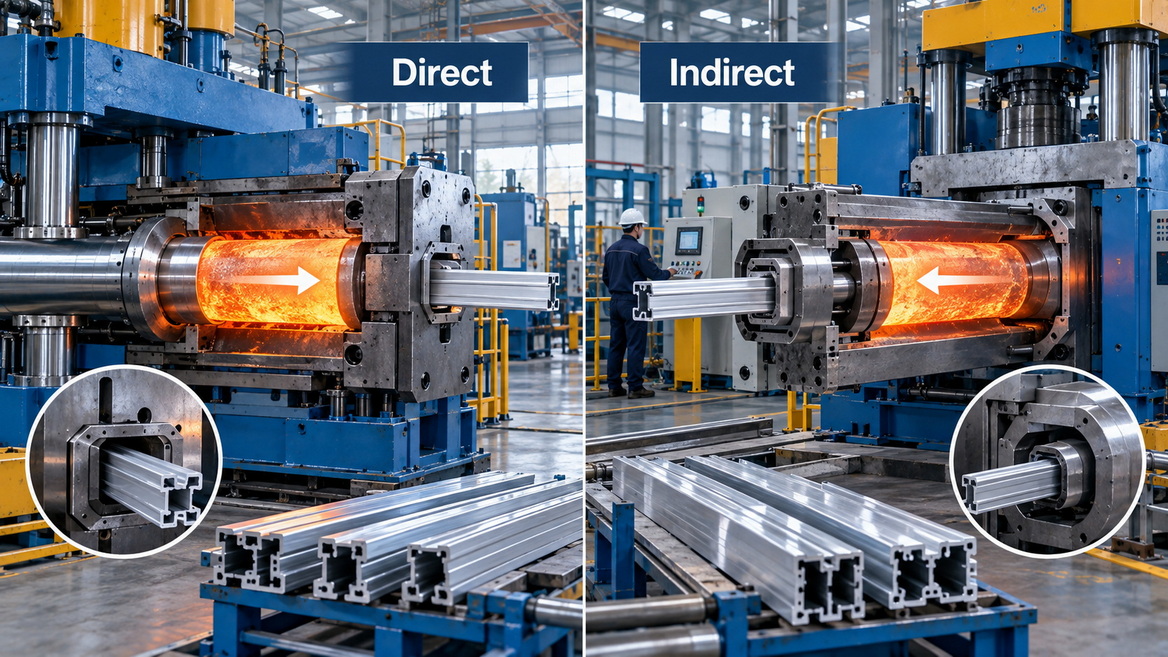
Billet extrusion force is the hydraulic force required to push or compress a heated metal billet through an extrusion die.
During aluminum or copper extrusion, the press must generate enough force to overcome several sources of resistance. These include the material's natural deformation resistance, friction between the billet and container, die resistance, metal flow resistance, and the effects of profile complexity.
The required extrusion force is influenced by:
- Billet diameter and billet length
- Aluminum or copper alloy grade
- Billet temperature
- Container and die temperature
- Extrusion ratio
- Profile cross-sectional area
- Wall thickness
- Hollow, semi-hollow, or solid profile design
- Die bearing length
- Ram speed
- Container condition and liner wear
- Billet surface quality
The extrusion ratio is one of the most important technical parameters. It compares the cross-sectional area of the billet with the final cross-sectional area of the extruded profile.
A higher extrusion ratio means the metal must undergo greater deformation before it exits the die. In general, higher deformation requires higher extrusion force.
However, extrusion ratio alone cannot determine the correct press tonnage. Two profiles with the same extrusion ratio may require very different forces because of their alloy composition, wall thickness, profile perimeter, die geometry, temperature range, and surface-quality requirements.
For this reason, extrusion press selection should always consider the complete production condition rather than relying on one calculation parameter.
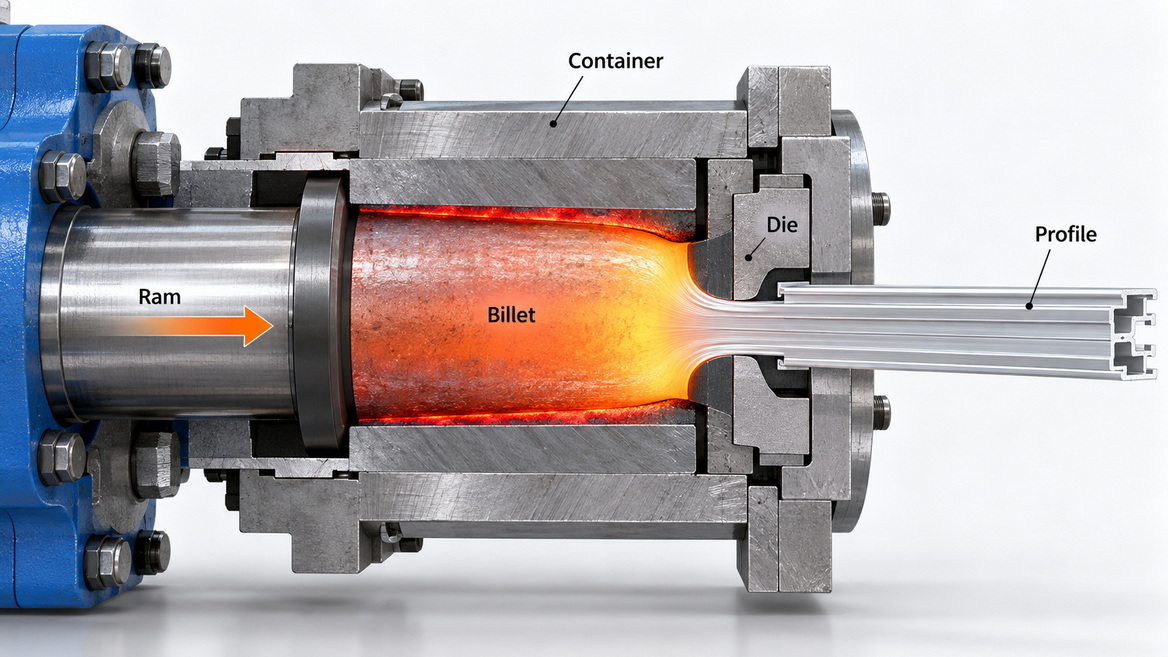
A direct extrusion press is also known as a forward extrusion press. It is the most widely used type of press for aluminum profile extrusion, copper extrusion, and many industrial profile applications.
In direct extrusion, the die remains fixed at the front of the press. The hydraulic ram pushes the billet forward through the container and into the die. The metal flows through the die opening in the same direction as the ram movement.
A typical direct extrusion process follows these steps:
1. The billet is heated to the specified extrusion temperature.
2. The billet is transferred into the container.
3. The ram advances and pushes the billet against the die.
4. The billet expands and fills the inside of the container.
5. Pressure increases until the metal begins flowing through the die.
6. The extruded profile exits from the die and moves along the runout system.
7. A remaining billet butt is removed before the next extrusion cycle begins.
In a direct extrusion press, the billet moves along the inner wall of the container. This creates friction between the billet surface and the container liner.
That friction is one of the main reasons direct extrusion generally requires higher billet extrusion force.
A simplified way to understand the force requirement is:
Fdirect=Fmetal deformation+Fdie resistance+Fbillet-container friction
The force required to deform the metal and push it through the die is unavoidable in every extrusion process. The additional friction component is what makes direct extrusion force higher in many applications.
The force curve in direct extrusion changes during the press cycle.
At the beginning of the cycle, the press must generate enough force to compress the billet and fill the container. The pressure then rises to the breakthrough point, where metal starts flowing through the die.
This stage often produces the highest extrusion force.
As extrusion continues, the billet becomes shorter. The contact area between the billet and the container wall decreases. As a result, friction-related resistance can gradually decline.
The force curve in direct extrusion often follows this general pattern:
- Initial force increase as the billet is upset and fills the container.
- Peak breakthrough force when metal starts flowing through the die.
- Gradual force reduction as the billet length becomes shorter.
- Final-stage variation as the remaining billet butt approaches the end of the cycle.
This changing force condition can influence die deflection, metal temperature, surface finish, profile dimensions, and exit speed consistency.
For high-quality profile production, operators need to control billet temperature, container temperature, die temperature, ram speed, and cooling conditions with precision.
Direct extrusion presses remain highly popular because they offer strong production flexibility.
Their key advantages include:
- Suitable for a broad range of aluminum and copper profiles
- Compatible with solid, hollow, and semi-hollow sections
- Practical for larger profile sizes
- Well suited for architectural profiles
- Effective for industrial and transportation applications
- Compatible with conventional die designs
- Easy to integrate with automated handling systems
- Widely supported by tooling and maintenance practices
- Suitable for diversified product ranges
- Efficient for high-volume production lines
For manufacturers producing a wide variety of profile shapes, a direct extrusion press often provides the most adaptable production platform.
It is especially useful when a factory must switch between different profile sizes, wall thicknesses, customer specifications, and alloy conditions.
The main limitation of direct extrusion is the friction between the moving billet and the container wall.
This friction can lead to:
- Higher required press tonnage
- Higher hydraulic energy demand
- Additional heat generation
- A changing force curve
- Greater sensitivity to container wear
- Higher risk of process variation
- Potentially greater die deflection
- More challenging control of profile consistency
- Increased importance of billet and die temperature management
Direct extrusion can still produce excellent results, but the press must be engineered with adequate tonnage, high-quality hydraulic control, durable container liners, precise billet heating, and stable die-management practices.
An indirect extrusion press is also called a backward extrusion press.
In this process, the billet remains stationary relative to the container. Instead of pushing the billet forward through a stationary die, the die moves toward the billet.
The die is mounted on a hollow ram. As the ram moves forward, the die presses into the stationary billet. The metal then flows backward through the hollow ram and exits in the direction opposite to ram movement.
This design changes the friction behavior inside the container.
The indirect extrusion process generally follows these steps:
1. The billet is heated to the correct extrusion temperature.
2. The billet is loaded into the container.
3. The billet remains stationary against the container wall.
4. A hollow ram carrying the die advances toward the billet.
5. The die begins compressing the billet.
6. Metal flows through the die and backward through the hollow ram.
7. The extruded product exits through the ram assembly.
Because the billet does not slide through the container, the billet-container friction is largely eliminated.
A simplified force relationship is:
Findirect=Fmetal deformation+Fdie resistance
The absence of major billet-container friction can reduce the total force needed for extrusion.
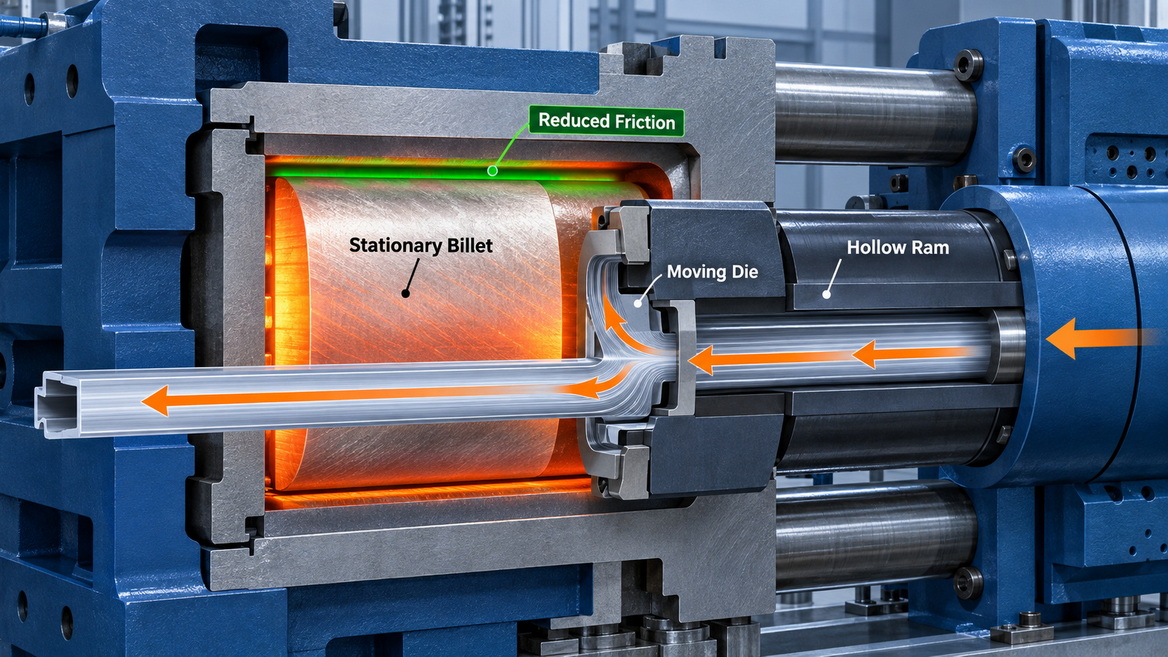
Indirect extrusion reduces force because the billet does not move along the container wall.
In direct extrusion, the entire billet slides through the container. This creates friction over the full contact length between the billet and liner.
In indirect extrusion, the billet remains fixed. The container wall does not create the same level of sliding resistance.
This produces several important process benefits:
- Lower overall extrusion force
- More stable force during the extrusion cycle
- Reduced friction-generated heat
- More uniform metal flow
- Lower variation between the front and rear of the extrusion
- Potential improvement in dimensional consistency
- Potential improvement in metallurgical uniformity
- More efficient use of available press tonnage
For manufacturers operating near press capacity, indirect extrusion can make it possible to produce certain profiles that would require excessive force in a direct press configuration.
One of the most valuable characteristics of indirect extrusion is its relatively stable force curve.
Since billet-container friction does not gradually decline as the billet becomes shorter, the force condition can remain more consistent over the length of the extrusion cycle.
This can support more stable metal flow and reduce variation in profile dimensions.
A more consistent pressure condition can be especially valuable for:
- Precision rods
- Bars for machining
- Selected tube applications
- Profiles with strict tolerance requirements
- Products requiring uniform mechanical properties
- Applications with demanding surface-quality standards
For some manufacturers, the advantage is not only lower force. It is the ability to maintain more consistent quality from the beginning of the extrusion length to the end.
Indirect extrusion is not the ideal solution for every aluminum or copper extrusion project.
The hollow ram and moving die design create practical limitations that must be considered during equipment selection.
Potential limitations include:
- Profile size may be restricted by the hollow ram opening
- Die support requirements can limit available profile geometry
- Billet surface quality becomes more critical
- Oxides, contaminants, or surface defects may transfer more easily
- Tooling design can be more specialized
- Press alignment requirements are stricter
- Equipment configuration can be more complex
- Production layout may require specialized handling systems
- Large or highly complex profiles may be more practical on a direct press
The indirect process is often a strong choice for targeted production applications rather than a universal replacement for direct extrusion.
| Comparison Factor | Direct Extrusion Press | Indirect Extrusion Press |
|---|---|---|
| Die position | Die remains stationary | Die moves with the hollow ram |
| Billet movement | Billet moves through the container | Billet remains stationary in the container |
| Metal flow direction | Same direction as ram movement | Opposite direction to ram movement |
| Billet-container friction | Present | Largely eliminated |
| Required extrusion force | Usually higher | Usually lower |
| Force curve | Changes during the extrusion cycle | More stable during the extrusion cycle |
| Temperature variation | Can vary due to friction and changing billet length | Often more uniform |
| Profile size flexibility | Generally broader | May be limited by hollow ram and die-support design |
| Billet surface requirements | Important | Especially critical |
| Tooling arrangement | Conventional and widely used | More specialized |
| Equipment complexity | Mature and widely applied | More complex in design and alignment |
| Suitable product range | Broad profile range and larger sections | Precision bar, rod, selected tubes, and force-sensitive products |
| Production flexibility | Very high | More application-specific |
| Use of press tonnage | Higher force demand for comparable products | More efficient when friction reduction is beneficial |
The most important difference is that a direct extrusion press must overcome billet-container friction, while an indirect extrusion press largely avoids this friction.
However, force reduction should never be the only decision factor. The required profile size, product geometry, alloy range, surface expectations, output target, and plant layout must all be evaluated.
Different aluminum and copper alloys behave differently during extrusion.
High-strength aluminum alloys generally require more extrusion force than softer alloys. Copper and copper alloys can also require substantial force because of their material strength and flow behavior.
When selecting a press, manufacturers should consider the most demanding alloy in the planned production range.
The press must safely handle:
- Maximum alloy strength
- Lowest acceptable billet temperature
- Most difficult profile geometry
- Highest expected extrusion ratio
- Peak breakthrough load
- Expected die resistance
- Required production speed
A press selected only for average production conditions may lack sufficient capacity when processing difficult alloys or high-demand customer profiles.
Billet temperature has a direct effect on metal flow resistance.
A higher billet temperature can reduce extrusion force because the metal becomes easier to deform. However, excessive billet temperature may create new quality risks.
Potential problems caused by excessive billet temperature include:
- Surface tearing
- Hot cracking
- Excessive grain growth
- Poor surface appearance
- Dimensional instability
- Uneven metal flow
- Reduced control over exit temperature
A lower billet temperature can improve surface finish and profile control, but it requires more press force.
The most effective operating strategy is to maintain a controlled billet temperature window that balances force reduction, extrusion speed, surface quality, and mechanical performance.
Profile geometry can influence extrusion force as much as billet size.
A profile with a small cross-sectional area may still require substantial force if it includes thin walls, long tongues, narrow openings, deep cavities, or complex hollow sections.
Important geometry factors include:
- Circumscribing circle diameter
- Profile perimeter
- Wall thickness
- Tongue ratio
- Hollow or semi-hollow structure
- Die bearing length
- Internal cavity design
- Surface-finish requirements
- Total profile area
- Extrusion ratio
A high-quality die design is essential for controlling metal flow and maintaining balanced pressure across the profile.
The extrusion die has a major influence on both force and final product quality.
Poor die design can increase resistance, create uneven metal flow, cause profile twisting, lead to dimensional variation, and shorten die life.
A well-designed die helps distribute metal evenly through the profile shape. It also reduces the risk of excessive localized pressure and minimizes unnecessary force demand.
Important die-related factors include:
- Die bearing length
- Bearing balance
- Porthole design
- Bridge strength
- Mandrel support
- Welding chamber design
- Die material
- Nitriding condition
- Die temperature
- Die maintenance condition
For complex aluminum profiles, die engineering and press capability must be matched closely.
In direct extrusion, container condition strongly affects billet-container friction.
A worn container liner can create uneven contact, increase friction, damage billet surfaces, and cause instability during extrusion.
Regular inspection and maintenance of the following components can improve process reliability:
- Container liner
- Container bore
- Dummy block
- Ram alignment
- Stem condition
- Die slide
- Shear system
- Hydraulic components
A high-performance extrusion press requires more than hydraulic tonnage. It requires accurate alignment and stable mechanical condition throughout the complete extrusion path.
The best equipment decision begins with a clear understanding of the production target.
Before choosing a direct or indirect extrusion press, create a full product matrix.
This should include:
- Alloy types
- Billet diameters
- Billet lengths
- Maximum profile size
- Wall thickness range
- Solid, hollow, or semi-hollow profile categories
- Maximum extrusion ratio
- Required tolerances
- Surface-finish standards
- Mechanical-property requirements
- Target annual output
- Expected customer industries
A plant focused on precision copper rods may need a different press strategy than a plant producing architectural aluminum window profiles.
The selected press should be able to handle the most difficult realistic production conditions.
The force evaluation should include:
- Breakthrough force
- Steady-state extrusion force
- Alloy strength
- Billet temperature range
- Extrusion ratio
- Profile complexity
- Container friction
- Die resistance
- Operating safety margin
For direct extrusion, billet-container friction must be included in the calculation.
For indirect extrusion, the lower friction condition can reduce force demand, but the calculation must still account for deformation resistance, die resistance, ram structure, and tooling limitations.
If your products require highly stable dimensions, uniform mechanical performance, and consistent quality over the entire extrusion length, indirect extrusion may offer meaningful benefits.
If your factory needs to produce a broad range of profile sizes and shapes, direct extrusion may provide greater overall versatility.
The equipment decision should reflect the product quality that your customers require, not only the minimum force that the press can achieve.
A complete extrusion press investment review should consider total operating costs.
Important cost factors include:
- Initial equipment investment
- Hydraulic energy consumption
- Tooling cost
- Die maintenance
- Container maintenance
- Billet preparation
- Scrap rate
- Butt loss
- Labor requirements
- Automation level
- Changeover time
- Production speed
- Finished-product yield
- Spare-parts availability
- Technical service support
The most economical extrusion press is not always the press with the lowest purchase price.
It is the press that consistently produces conforming profiles at the lowest total cost per kilogram, per meter, or per finished part.
A direct extrusion press is often the preferred choice when a manufacturer needs high flexibility across many profile categories.
It is particularly suitable for:
- Architectural aluminum profiles
- Window and door profiles
- Curtain wall sections
- Industrial aluminum profiles
- Transportation profiles
- Solar mounting profiles
- Heat sink profiles
- Large-section aluminum extrusions
- General-purpose copper and aluminum profiles
- Production lines with diversified customer requirements
Direct extrusion is often the practical choice when profile size and variety are more important than achieving the lowest possible billet extrusion force.
With strong hydraulic control, precise temperature management, durable tooling, and optimized production parameters, direct extrusion can deliver excellent productivity and stable product quality.
An indirect extrusion press is especially valuable when lower extrusion force and improved process consistency are key priorities.
It is often suitable for:
- Precision aluminum rods
- Copper rods and bars
- Machining stock
- High-tolerance bar products
- Selected tube applications
- Profiles requiring consistent mechanical properties
- Products with demanding dimensional requirements
- Applications limited by direct-extrusion force
- Specialized production lines with controlled billet preparation
Indirect extrusion may provide a substantial technical advantage when a manufacturer needs to maximize available press capacity while maintaining consistent metal flow.
However, its equipment configuration, tooling requirements, and practical profile-size limitations must be evaluated carefully before investment.
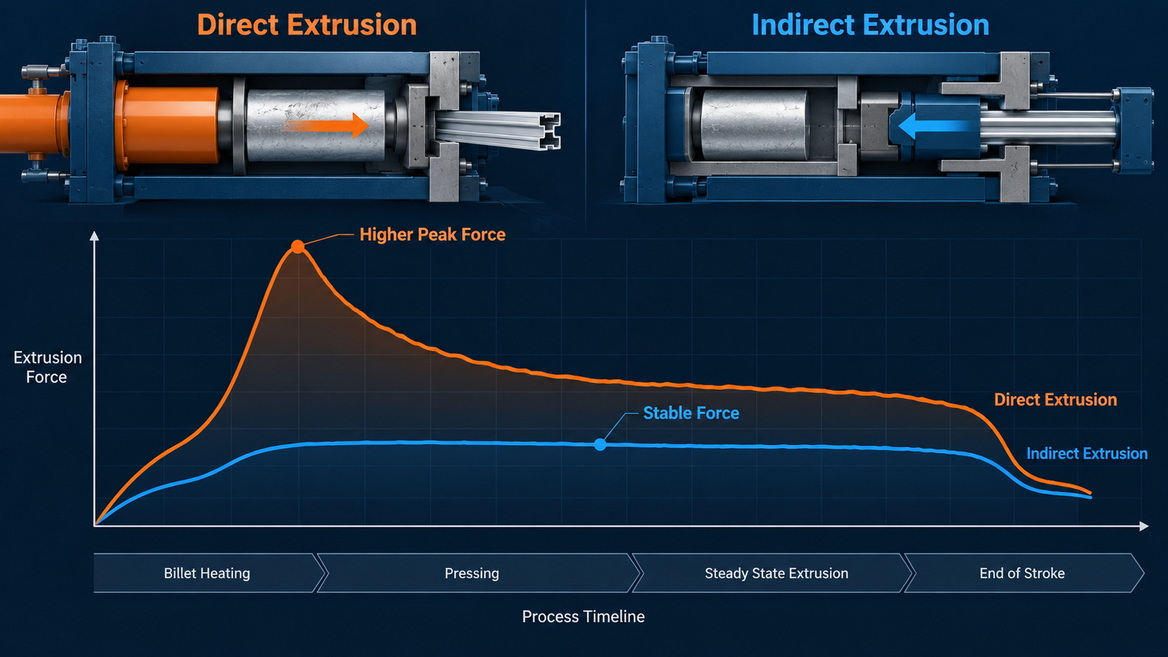
An indirect extrusion press generally provides the greatest advantage for reducing billet extrusion force because it largely eliminates the friction created when a billet moves along the container wall.
This lower-friction process can create a more stable force curve, reduce frictional heat, improve pressure consistency, and support better dimensional uniformity in selected aluminum and copper extrusion applications.
A direct extrusion press generally requires higher force because the billet moves through the container and experiences friction along the container wall. Despite this limitation, direct extrusion remains a powerful and widely used solution because it offers excellent flexibility, broad profile compatibility, and practical capability for larger and more diverse extrusion products.
The correct equipment choice depends on your production goals.
Choose a direct extrusion press when your business requires broad profile flexibility, larger profile capacity, conventional tooling, and versatile high-volume production.
Choose an indirect extrusion press when reducing force, improving consistency, and producing precision rods, bars, or selected specialized profiles are central priorities.
Xinxinke Co., Ltd. provides copper and aluminum extrusion presses designed around real production conditions. A well-matched extrusion solution considers billet size, alloy behavior, profile geometry, force requirements, temperature control, automation needs, and long-term manufacturing efficiency.
The main difference is billet movement. In direct extrusion, the billet moves through the container toward a stationary die. In indirect extrusion, the billet remains stationary while a die mounted on a hollow ram moves toward the billet.
Indirect extrusion requires less force because the billet does not slide along the container wall. This largely eliminates billet-container friction, which is a major source of resistance in direct extrusion.
No. Indirect extrusion is advantageous when force reduction, pressure stability, and precision consistency are important. Direct extrusion is often better for larger profiles, wider product ranges, conventional tooling, and flexible high-volume production.
A direct extrusion press is generally more suitable for large aluminum profiles because it offers greater flexibility in profile size and does not require the extrusion to pass through a hollow ram structure.
Yes. A direct extrusion press can produce high-quality aluminum and copper profiles when the billet temperature, die condition, container alignment, hydraulic system, ram speed, cooling process, and handling system are properly controlled.
1. Hydro. [Do You Know When to Use the Indirect Extrusion Process?]
2. Society of Manufacturing Engineers. [Extrusion Processes: Fundamental Manufacturing Processes Study Guide]
3. Bonnell Aluminum. [Aluminum Extrusion Process]
4. ASM International. [Machinery and Equipment for Direct and Indirect Hot Extrusion]


