
Please Choose Your Language
Views: 241 Author: Xinxinke Extrusion Publish Time: 2026-10-07 Origin: Site


Content Menu
● How Direct and Indirect Extrusion Work
>> Direct Extrusion Press: Forward Metal Flow
>> Indirect Extrusion Press: Backward Metal Flow
>> Why the Mechanical Difference Matters
● High-Speed Aluminum Extrusion Performance
>> Direct vs. Indirect Extrusion Press Comparison
>> Ram Speed Is Not Finished Output
>> Temperature Sets the Sustainable Operating Window
>> Lower Extrusion Force Does Not Prove Lower Energy Cost
>> Profile Geometry Remains Critical
● Choosing Equipment for Your Production
>> Match the Press to Your Product Portfolio
>> Compare Accepted Output With a Simple Calculation
>> Use a Five-Step Supplier Trial
>> Check the Complete Production Line
>> Require Transparent Performance Commitments
>> Is Indirect Extrusion Always Faster Than Direct Extrusion?
>> Which Press Is Better for a Varied Aluminum Profile Range?
>> Why Consider Indirect Extrusion for Hard Aluminum Alloys?
>> Does a Higher Billet Temperature Improve Productivity?
>> Does Indirect Extrusion Guarantee Better Surface Quality?
Choosing between a direct and an indirect extrusion press for high-speed aluminum extrusion requires more than comparing machine speeds. The two methods differ in metal flow, billet–container friction, force requirements, and suitability for different production portfolios.
Direct extrusion is a strong starting point for manufacturers producing varied aluminum profiles in small batches. Indirect extrusion deserves particular consideration when processing difficult alloys and when reducing billet–container friction offers a meaningful production advantage.
At Xinxinke Co., Ltd., we manufacture copper and aluminum profile extrusion equipment and provide customized solutions. Our company brings more than 30 years of industry experience to helping customers assess equipment against their production requirements.
From an equipment-selection perspective, the most useful question is not, "Which press is faster?" It is, "Which system can consistently produce more accepted material within the required quality limits?"
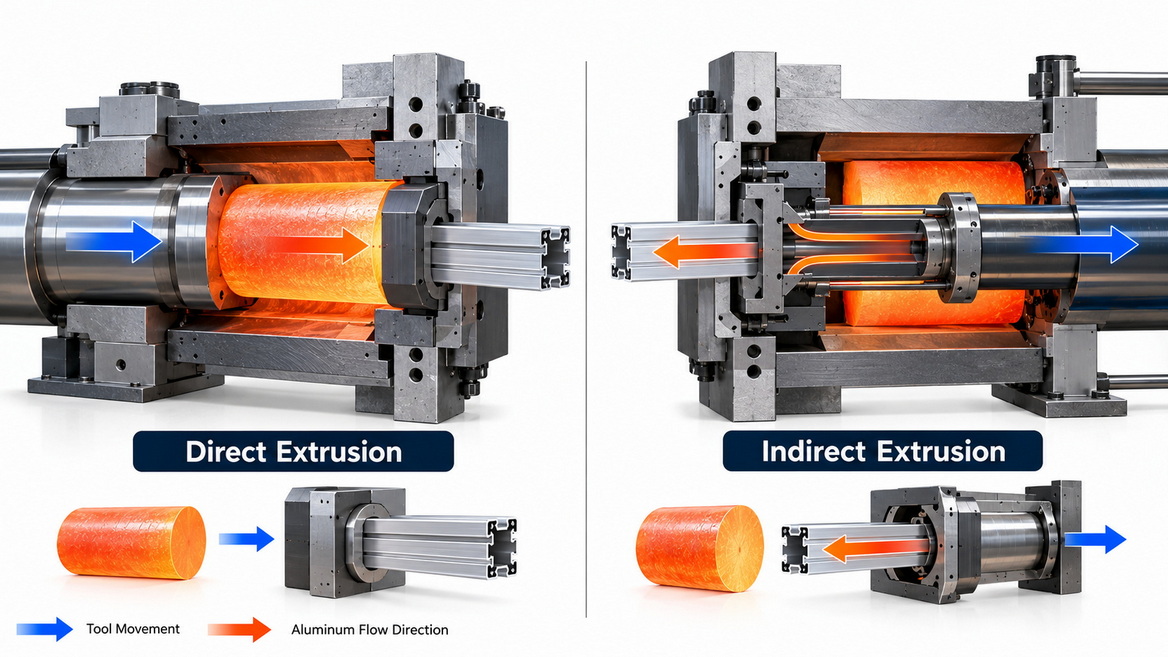
In direct extrusion, a ram pushes a heated aluminum billet through a stationary die. The aluminum profile exits in the same direction as the ram movement.
As extrusion proceeds, the billet moves relative to the container wall. This sliding introduces friction, which adds to the force needed to deform the aluminum and push it through the die.
Direct extrusion is an established option for manufacturers managing varied products and smaller production batches. However, its usefulness still depends on matching the press, tooling, and auxiliary equipment to the intended product range.
For buyers, flexibility should be evaluated through representative profiles—not assumed from the press configuration alone.
In indirect extrusion, a die mounted on a hollow stem advances into the billet. The extruded material flows backward relative to the die's movement and passes through the hollow stem.
The billet does not slide against the container wall during extrusion. Removing that sliding-friction contribution reduces the force required for the process.
However, indirect extrusion is not completely friction-free. Resistance remains as the metal deforms and flows through the die.
This distinction matters when assessing supplier claims. Lower billet–container friction is a real mechanical advantage, but it does not automatically establish higher output, lower total energy consumption, or better quality for every product.
The friction difference changes how the extrusion load develops and how the material flows. It is especially relevant when evaluating difficult aluminum alloys.
Indirect extrusion is an important candidate for high-strength alloy families such as AA2xxx and AA7xxx. Nevertheless, alloy designation alone is insufficient for selecting equipment.
The supplier should also review billet dimensions, profile geometry, extrusion ratio, temperature requirements, and the intended production sequence.
| Evaluation factor | Direct extrusion press | Indirect extrusion press |
|---|---|---|
| Metal-flow direction | Same direction as ram movement | Opposite to advancing die movement |
| Billet–container sliding | Present during extrusion | Absent during extrusion |
| Force requirement | Includes billet–container sliding friction | Removes that particular friction contribution |
| Product-mix suitability | Strong starting point for varied profiles and small batches | Particularly relevant when alloy difficulty and material flow dominate |
| Alloy considerations | Must be matched to the complete production portfolio | Worth evaluating for difficult alloys, including AA2xxx and AA7xxx |
| High-speed performance | Depends on tooling, temperature limits, and complete-cycle operation | Lower friction may help, but does not guarantee higher finished output |
| Quality assessment | Requires control of geometry, temperature, tooling, and speed | Still requires application-specific quality validation |
| Purchasing focus | Demonstrate flexibility and repeatable production | Demonstrate compatibility and measurable benefits on target products |
A press quotation may state ram speed, profile exit speed, or hourly production capacity. These measurements describe different aspects of performance.
The extrusion ratio—the relationship between billet cross-sectional area and total extruded cross-sectional area—helps explain why ram speed and profile speed are not interchangeable.
More importantly, a high exit speed does not necessarily deliver high accepted output. The complete cycle also includes non-extruding operations, and rejected material does not contribute to saleable production.
A useful equipment comparison should report:
- Accepted kilograms per production hour.
- Complete billet-to-billet cycle time.
- Accepted profile length per billet.
- Scrap and rework rates.
- Production availability during the agreed test period.
The objective is repeatable production, not a single impressive stroke.
For high-speed aluminum extrusion, temperature is a production constraint rather than a secondary setting.
An aggressive speed increase can cause quality problems if the thermal conditions become unsuitable. Excessive temperature combined with high extrusion speed can contribute to surface tearing, dimensional instability, waves, and twisting.
Published process guidance includes minimum exit-temperature examples of 930°F, approximately 499°C, for alloys including 6063, and 950°F, approximately 510°C, for 6005A and 6061.
These examples are not universal operating instructions. They are not maximum safe temperatures, and they should not be applied without considering alloy, profile geometry, and the required product condition.
The practical goal is a validated temperature–speed window that supports both productivity and quality.

Indirect extrusion removes the force contribution associated with billet–container sliding friction. Buyers should not translate that benefit into an unsupported percentage reduction in total energy consumption.
Define the measurement boundary before comparing energy figures. A press-drive measurement is different from a measurement that includes billet heating, die heating, cooling, and handling.
Request energy consumption per accepted tonne under clearly documented production conditions.
This approach helps distinguish a genuine process advantage from a broad savings claim that has not been demonstrated on the proposed line.
Neither process can be evaluated without examining the profile itself.
Alloy, cross-sectional shape, wall thickness, extrusion ratio, temperature, and pressure interact during production. A lightweight profile can still be demanding if its geometry creates difficult flow conditions.
The technical specification should therefore include:
- Maximum profile dimensions.
- Minimum wall thickness.
- Solid or hollow section requirements.
- Dimensional tolerances.
- Surface acceptance criteria.
- Required alloy and final product condition.
Reduced friction does not eliminate the need for suitable tooling or controlled processing. Compare inspected trial products rather than relying on the extrusion-method label.
For varied profiles and smaller batches, direct extrusion is a well-supported starting point. When difficult alloys are central to the production plan, indirect extrusion deserves a detailed application review.
The best evaluation includes more than your easiest product. Ask the supplier to assess your highest-volume profile, your most demanding section, and an important future product.
This portfolio-based approach reduces the risk of selecting equipment that performs well during a simple demonstration but struggles with commercially important orders.
Combination direct–indirect presses also exist. Their additional capability should be justified by your production requirements rather than treated as an automatic upgrade.
Consider two hypothetical equipment proposals processing an equivalent 100 kg input allocation per complete cycle.
Proposal A completes the cycle in 120 seconds and achieves 90% accepted yield. Proposal B takes 135 seconds and achieves 96% accepted yield.
| Hypothetical proposal | Complete cycle time | Accepted yield | Accepted output |
|---|---|---|---|
| A | 120 seconds | 90% | 2,700 kg/h |
| B | 135 seconds | 96% | 2,560 kg/h |
Proposal B achieves better yield but lower hourly output under these assumptions. It might still be attractive if its quality advantage reduces costly downstream rejection or rework.
This example is not customer data or a direct-versus-indirect performance benchmark. It assumes continuous cycling and excludes additional downtime.
Its value is to show why speed, yield, and commercial results must be considered together.
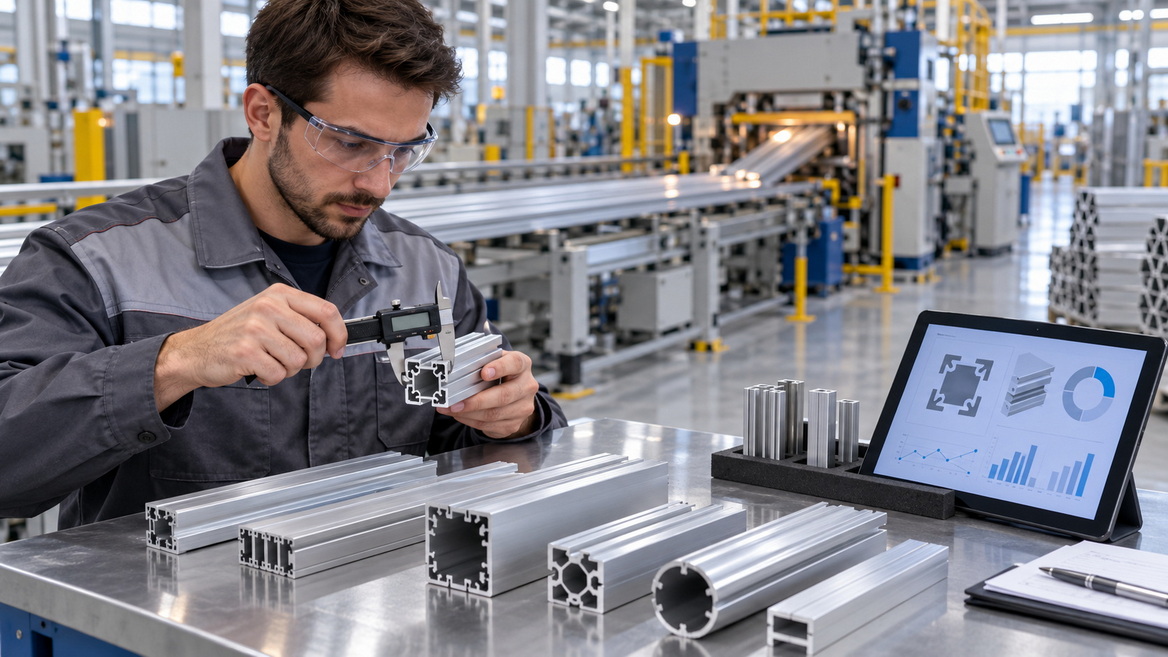
A meaningful trial should establish repeatable performance on representative products.
1. Define the alloy, profile drawings, tolerances, surface requirements, and minimum wall thickness.
2. Record billet dimensions, tooling, thermal settings, and the downstream equipment used for each proposal.
3. Agree on quality acceptance criteria before testing, including how scrap and rework will be counted.
4. Run repeated cycles and document cycle time, exit temperature, accepted output, and interruptions.
5. Compare the results and investigate the reasons for differences in productivity, quality, and energy consumption.
This is a practical purchasing framework, not a formal testing standard.
Where the proposals require different tooling or process settings, document those differences. The purpose is to compare workable production solutions fairly—not to force different technologies into artificially identical conditions.
The press is only one part of an aluminum extrusion system. Quenching equipment, pullers, cooling tables, stretchers, and cutting equipment also influence line performance.
Before purchasing a higher-speed press, identify the likely downstream bottleneck.
Can the puller accommodate the proposed operating speed? Can the quench support the required product condition? Can cutting and handling keep pace without creating interruptions?
These questions are especially important when replacing a press while retaining existing auxiliary equipment.
A faster press cannot, by itself, prove that the entire line will produce more accepted finished material.
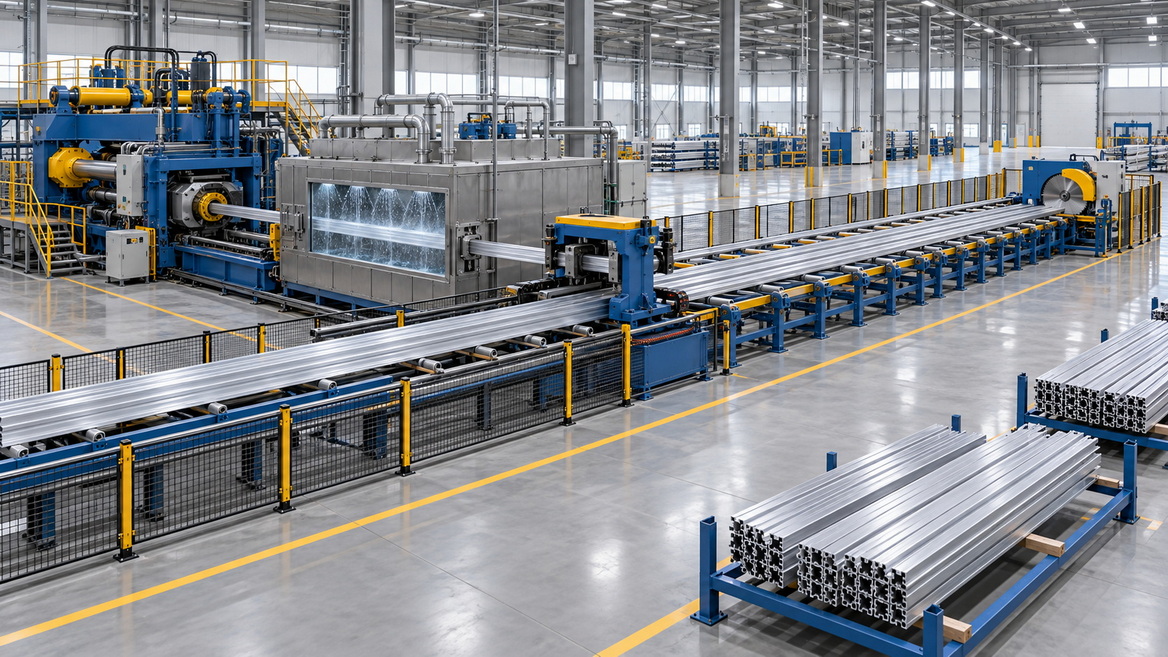
A useful proposal should explain what the supplier expects the equipment to achieve and how those expectations will be tested.
Ask for documented assumptions covering products, billet conditions, tooling, cycle definitions, acceptance criteria, and production boundaries.
Avoid purchasing decisions based on unexplained claims such as "maximum speed," "best quality," or "lowest energy consumption."
For Xinxinke, advanced manufacturing capabilities and strict quality control should be supported by application-specific specifications and measurable project acceptance requirements.
The choice between direct and indirect extrusion should be based on production requirements rather than a universal ranking.
Direct extrusion is a strong option for varied profiles and smaller batches. Indirect extrusion offers a meaningful friction advantage and deserves close consideration for difficult alloys. Neither method guarantees the highest accepted output without suitable tooling, thermal control, and coordinated downstream equipment.
At Xinxinke Co., Ltd., our objective is to help customers connect equipment selection with practical manufacturing needs.
Contact our team with your profile drawings, alloy specifications, billet dimensions, quality requirements, and production targets. Request a customized assessment that compares suitable extrusion configurations, identifies potential bottlenecks, and establishes measurable acceptance criteria.
The right investment is not simply a faster press. It is a production system that can consistently deliver the products your customers require.
No. Indirect extrusion removes billet–container sliding friction, but accepted output also depends on alloy, geometry, temperature, cycle time, and handling. Its mechanical advantage must be evaluated through production trials rather than assumed to create a universal speed increase.
Direct extrusion is a strong starting point for varied products and small batches. The final decision should still consider representative drawings, alloy requirements, tooling arrangements, and the complete production cycle.
The main advantage is reduced billet–container friction and favorable material-flow characteristics. This makes indirect extrusion worth evaluating for demanding alloy families such as AA2xxx and AA7xxx. Product-specific testing remains necessary.
Not necessarily. Increasing temperature may ease deformation, but excessive temperatures and speeds can damage surface quality or dimensional stability. The useful target is a validated operating window, not the highest possible temperature.
No. Lower friction does not remove the effects of tooling, alloy, profile geometry, temperature, or operating speed. Compare actual profiles against agreed acceptance criteria before drawing conclusions about quality.


