
Please Choose Your Language
Views: 249 Author: Xinxinke Extrusion Publish Time: 2026-10-16 Origin: Site


Content Menu
● Direct vs. Indirect Copper Extrusion: The Essential Comparison
● How a Direct Extrusion Press Works for Copper Profiles
>> Forward Extrusion and Billet Movement
>> Why Manufacturers Consider Direct Extrusion
● How an Indirect Extrusion Press Works for Copper Profiles
>> Backward Extrusion and Reduced Container Friction
● Extrusion Force, Temperature, and Production Speed
>> Compare Force Under Equivalent Conditions
>> Reduced Friction Does Not Eliminate Thermal Control
>> Evaluate Accepted Output, Not Ram Speed Alone
● Profile Complexity, Surface Quality, and Dimensional Accuracy
>> Thin-Walled and Asymmetric Copper Profiles
>> Hollow Copper Profiles Need a Separate Tooling Review
>> Neither Process Guarantees Superior Surface Finish
● Copper Alloy Selection Changes the Comparison
● Engineering Insight: Compare Cost per Accepted Kilogram
● Research Insight: Why Simulations Need Production Validation
● Practical Procedure: Validate a Copper Extrusion Press Before Purchase
>> Step 1: Select Representative Profiles
>> Step 2: Agree on Trial Conditions
>> Step 3: Measure the Complete Cycle
>> Step 4: Inspect Product Consistency
>> Step 5: Establish Repeatability
● Which Extrusion Press Should Your Factory Choose?
>> When Direct Extrusion Deserves Priority
>> When Indirect Extrusion Deserves Priority
>> When a Combined Arrangement Is Worth Investigating
● Plan Your Copper Extrusion Project with Xinxinke
>> 1. What is the main difference between direct and indirect copper extrusion?
>> 2. Does indirect extrusion always require less force?
>> 3. Is indirect extrusion always better for complex copper profiles?
>> 4. Can both processes produce hollow copper products?
>> 5. Which process consumes less energy?
Choosing between a direct extrusion press and an indirect extrusion press for copper profile extrusion starts with one question: which machine can produce your required profile reliably at the lowest cost per accepted kilogram? Direct extrusion offers a versatile arrangement for varied products. Indirect extrusion reduces billet-to-container sliding friction, but introduces tooling and product-handling constraints.
At Xinxinke Co., Ltd., our focus is matching equipment to production requirements—not recommending one process for every application. With more than 30 years of experience manufacturing copper and aluminum profile extrusion equipment, we approach press selection through profile geometry, alloy behavior, production targets, and downstream requirements.
This comparison explains the mechanical differences, their practical consequences, and the evidence buyers should request before investing.

The fundamental difference is how the billet moves relative to the container.
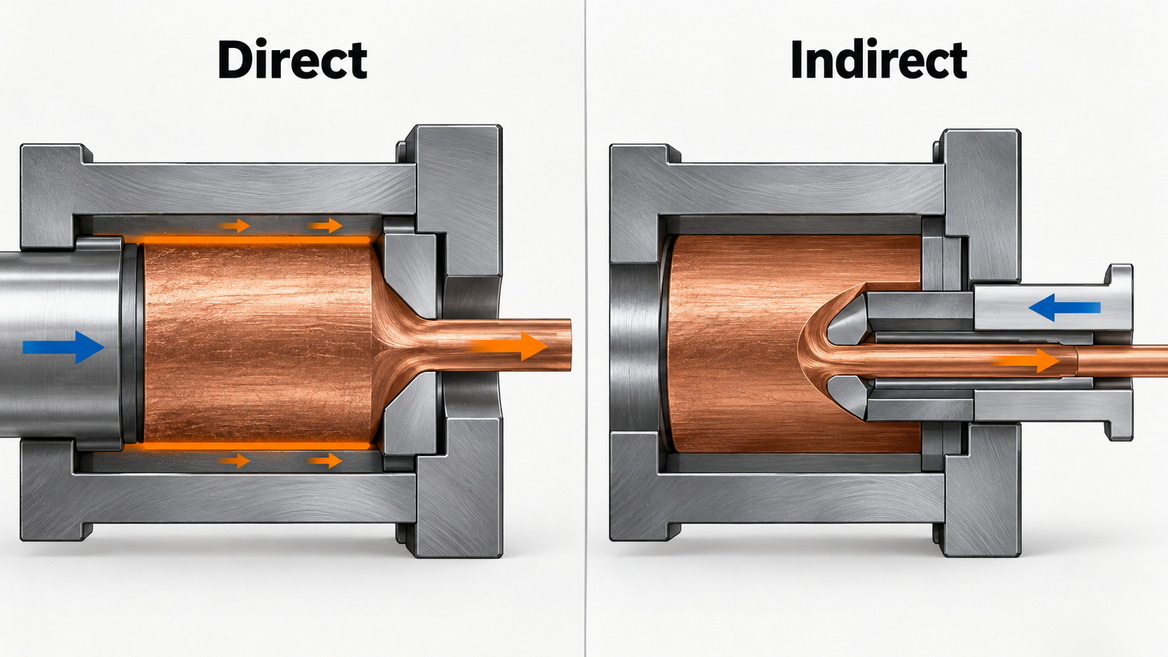
In direct extrusion, the ram pushes the billet toward a stationary die. The billet slides along the container wall.
In conventional indirect extrusion, a die supported by a hollow stem moves into the billet. The extruded material flows through the stem, opposite to the die's movement. The billet does not undergo the same sliding motion against the container.
| Selection factor | Direct extrusion press | Indirect extrusion press |
|---|---|---|
| Billet-container contact | Sliding generates friction | Sliding friction is substantially reduced |
| Required extrusion force | Higher under otherwise comparable conditions | Lower container-friction contribution |
| Force throughout the stroke | Often declines as billet contact length decreases | Often steadier after initial breakthrough |
| Tooling arrangement | Stationary die with conventional forward discharge | Die supported by a hollow stem |
| Profile accommodation | Flexible, subject to press and die limits | Must fit the stem passage and support arrangement |
| Product handling | Forward run-out arrangement | Requires compatible discharge and support systems |
| Thermal behavior | Additional container-friction heating | Reduced container-friction heating |
| Main purchasing question | Can force, temperature, and quality be controlled? | Can the tooling and handling accommodate the product? |
Neither arrangement guarantees better tolerances, higher output, or lower total energy consumption. Those outcomes depend on the complete production line.
A heated copper billet is loaded into the container. The ram advances, compressing the billet and forcing metal through the die opening.
The die establishes the cross-sectional geometry. The emerging profile then requires appropriate support, cooling, cutting, and any specified finishing operations.
Because the billet moves against the container wall, the press must overcome both deformation resistance and container friction. This distinction matters when sizing the machine and establishing a stable operating window.
Direct extrusion provides a practical starting point when a factory needs to evaluate different profile families or integrate extrusion with a conventional forward handling line.
Potential advantages include:
- A familiar tooling and discharge arrangement.
- Flexibility in accommodating different product geometries.
- Straightforward integration with suitable run-out equipment.
- Options for dedicated tube-extrusion configurations.
However, flexibility is not unlimited. Thin walls, uneven section thicknesses, demanding extrusion ratios, and difficult alloys still require careful die and process development.
From a purchasing perspective, I would assess the proposed product range before treating direct extrusion as the default.
An indirect extrusion press advances the die into the billet using a hollow supporting stem. Metal passes through the die and exits through the stem.
Removing most billet-container sliding reduces one component of the extrusion load. It does not remove deformation resistance or friction at the die.
This distinction is important: indirect extrusion is not a friction-free process.
Lower container friction can support more favorable force and thermal conditions. However, the hollow stem must withstand the operating load while providing sufficient internal clearance for the extrusion.
Buyers therefore need to verify:
- The profile's external envelope.
- Stem strength and stiffness.
- Die support and alignment.
- Product discharge clearance.
- Maximum supported product length.
- Tool-change and maintenance access.
A process that looks attractive in a force calculation may become unsuitable when the actual profile cannot pass through the available stem arrangement.
A meaningful direct vs. indirect extrusion comparison must hold the main production variables consistent:
1. Copper alloy and billet condition.
2. Billet dimensions.
3. Profile cross-sectional area.
4. Extrusion ratio.
5. Billet and tool temperatures.
6. Die geometry and lubrication.
7. Extrusion speed.
Otherwise, the comparison may reflect different operating conditions rather than the press arrangement.
Indirect extrusion generally requires less force under comparable conditions because the container-friction contribution is reduced. Nevertheless, a universal percentage reduction is not a reliable basis for buying equipment.
Request predicted and trial-measured force curves for your product.
Copper extrusion still generates heat through plastic deformation and friction at tooling interfaces.
The operating window must balance deformation resistance against surface integrity, dimensional consistency, and the required metallurgical condition.
Indirect extrusion may offer additional thermal headroom, but this does not automatically justify higher speed. Exit temperature, die performance, and downstream capacity must remain acceptable.
A faster extrusion stroke is useful only if the line produces more conforming material.
Total productivity also depends on:
- Billet loading and heating.
- Tool changes.
- Discard removal.
- Cooling and cutting.
- Inspection.
- Unplanned downtime.
Ask suppliers to estimate accepted kilograms per hour for a defined product mix, rather than presenting maximum ram speed as the principal performance measure.
Thin walls and uneven cross-sections create challenges in distributing metal flow through the die. Local differences in flow can affect dimensions, straightness, and surface condition.
Selecting indirect extrusion does not remove these challenges.
The engineering review should consider wall thickness, section transitions, die-bearing geometry, alignment, and product support. For either process, a demanding profile needs representative trials rather than assurances based solely on nominal press capacity.
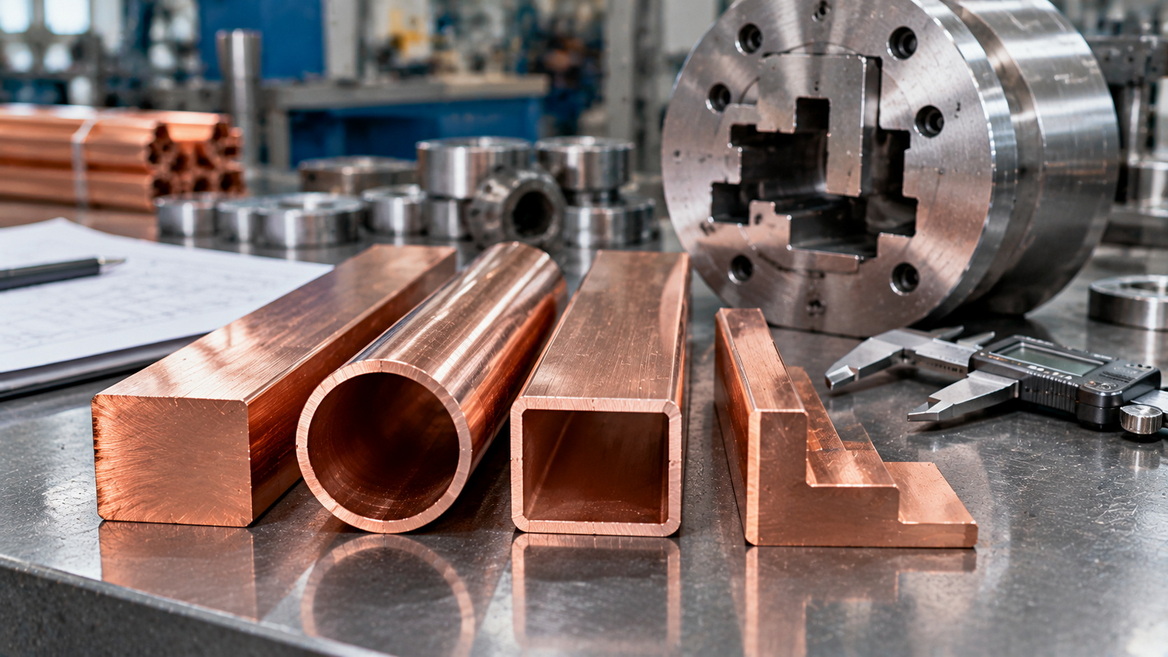
A hollow profile introduces questions beyond direct versus indirect movement.
Buyers should establish:
- Whether the product must be seamless.
- How the internal cavity will be formed.
- Whether piercing or a mandrel arrangement is required.
- What eccentricity and wall-thickness limits apply.
- Whether any proposed joining mechanism is acceptable.
Do not assume that tooling practices used for aluminum hollow profiles transfer unchanged to copper products.
Reduced container friction can improve operating conditions, but surface quality remains sensitive to billet condition, lubrication, die condition, temperature, and speed.
Likewise, dimensional accuracy depends on tooling stability, press alignment, thermal behavior, and downstream handling.
Require inspection results from the beginning, middle, and end of representative extrusions. One attractive sample does not demonstrate repeatable production.
"Copper" is not a sufficiently detailed material specification for press selection.
Different copper grades and copper alloys require different processing assessments. Pure copper, brass, and other copper alloys should not be treated as interchangeable materials.
Before requesting a copper profile extrusion press quotation, provide:
- The alloy designation.
- Required material condition.
- Billet preparation details.
- Mechanical-property requirements.
- Conductivity requirements, where relevant.
- Any subsequent drawing, machining, or heat treatment.
The press must meet the alloy's production requirements as well as the profile's geometry. A successful trial with one material does not automatically validate another.
For an equipment investment, yield connects process performance with commercial value.
A lower extrusion load is valuable, but it does not prove that the finished product costs less.
Use consistent accounting boundaries. Relevant costs may include material losses, heating, electricity, tooling, labor, maintenance, and capital-related costs.
Measure rejected material and production interruptions as well as successful output.
A hypothetical indirect line might consume less press electricity yet require longer changeovers. A hypothetical direct line might offer easier handling yet lose more material during process stabilization.
These are comparison scenarios, not guaranteed process outcomes. The purpose is to identify which factors dominate your factory's economics.
Published research on indirect extrusion of copper-clad aluminum rods illustrates the importance of checking predictions against actual trials.
A 2021 study used 29 numerical runs to investigate five process variables, then validated a near-optimal parameter set experimentally. The trial produced an approximately two-meter rod without copper-sleeve fractures.
However, actual loading took around 60 seconds rather than the 10 seconds assumed in the model. The additional heating affected material flow and contributed to a longer aluminum-only leading section than predicted.
This was composite extrusion, not monolithic copper profile extrusion. Its temperature settings and performance figures should not be transferred directly to copper production.
The transferable lesson is narrower and more useful: handling time, thermal history, and model limitations can materially affect extrusion results. Simulation should guide trials, not replace them.
Choose products that expose the real production challenges:
- The thinnest wall.
- The widest profile envelope.
- The most asymmetric section.
- The highest expected extrusion ratio.
- The most demanding alloy.
Testing only the easiest product can hide equipment limitations.
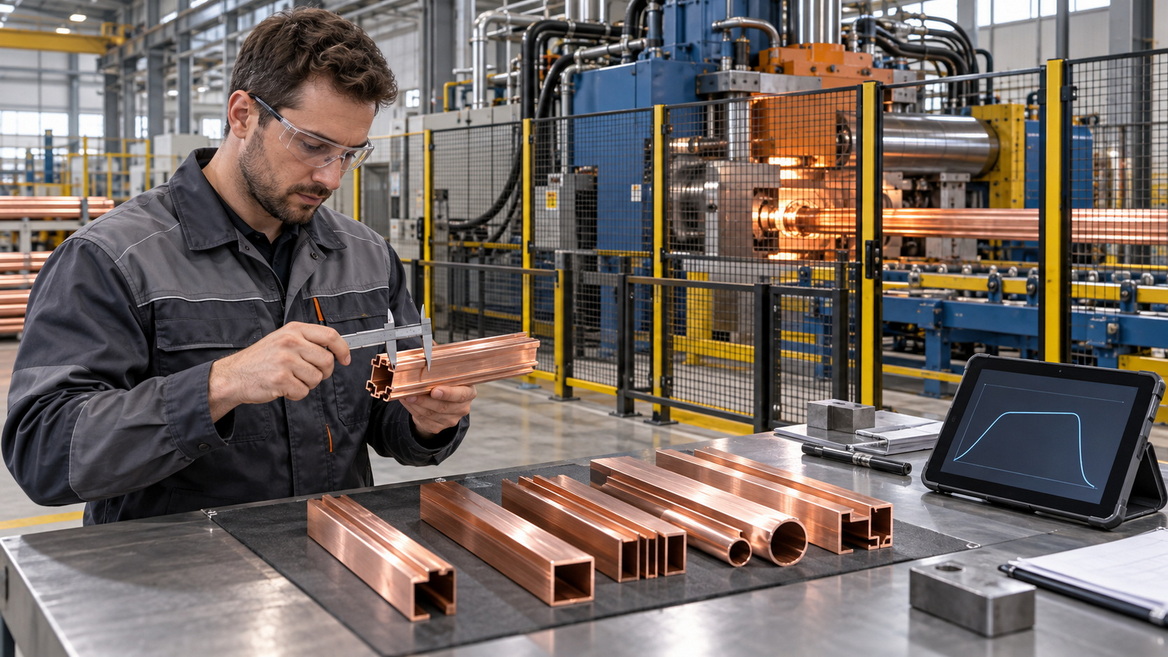
Record billet dimensions, temperatures, lubrication, die condition, speed, handling time, and discard practice.
For a fair comparison, use equivalent product requirements and clearly document unavoidable differences between the two arrangements.
Capture peak force, force through the stroke, exit temperature, cycle time, energy consumption, and accepted output.
Evaluate heating and auxiliary systems separately from press electricity where possible. This prevents a lower press load from being mistaken for lower total line consumption.
Measure dimensions, straightness, surface condition, and specified material properties at agreed sampling positions.
Acceptance criteria should match the customer drawing and applicable product requirements—not a supplier's general description of "high precision."
Repeat the trial sufficiently to assess variation between billets and cycles. Include normal loading and operating conditions.
Define acceptance limits before testing, and incorporate the agreed criteria into the equipment specification.
Give direct extrusion serious consideration when your business needs a varied product range, compatible forward handling, or profile dimensions that challenge an indirect stem passage.
Confirm that the proposed force capacity and thermal control can handle the most demanding products.
Evaluate indirect extrusion when container friction materially constrains force or operating conditions, and the intended profiles fit the stem and discharge arrangement.
Its benefits are strongest when they translate into measurable production improvements—not merely a lower calculated load.
A combined direct-indirect concept may suit a mixed production strategy. However, switching requirements, tooling, handling, maintenance, and material compatibility need project-specific review.
Do not assume that a combined machine provides every advantage without additional complexity.
Xinxinke Co., Ltd. manufactures copper and aluminum profile extrusion equipment and provides customized solutions supported by advanced manufacturing capabilities, strict quality control, and a professional technical team.
Send Xinxinke your profile drawings, alloy specifications, billet dimensions, required tolerances, and target annual output. Request a project-specific assessment covering press configuration, tooling compatibility, handling requirements, and an agreed validation plan.
The right investment starts with a defined product requirement and a testable performance specification.
Direct extrusion pushes the billet toward a stationary die, creating billet-container sliding. Indirect extrusion moves the die into the billet and routes the product through a hollow stem, substantially reducing that sliding friction.
It generally requires less force under comparable conditions because container friction is reduced. The actual difference depends on alloy, temperature, geometry, lubrication, and extrusion ratio.
No. Complex profiles still require suitable dies and flow control. The hollow stem's passage, stiffness, and product-support arrangement may restrict feasible dimensions.
Both can use configurations for hollow products, but the required tooling differs. Seamlessness, piercing, mandrel support, wall thickness, and eccentricity must be reviewed for the specific product.
Indirect extrusion can reduce the force-related demand, but total energy includes heating, hydraulics, auxiliaries, and cycle losses. Compare energy per accepted kilogram under equivalent production conditions.
1. SMS group GmbH. "Extrusion Presses for Heavy Metals." Industrial equipment reference covering heavy-metal press arrangements, tube piercing, alignment, and downstream handling. [sms-group]
2. ScienceDirect Topics. "Indirect Extrusion." Technical overview of reduced billet-container friction, extrusion load, thermal behavior, and material-flow considerations. [sciencedirect]
3. Al-Mustansiriyah University. "Extrusion Process." Engineering lecture material explaining direct and indirect extrusion, container friction, hollow-stem rigidity, and product-support limitations. [uomustansiriyah.edu]
4. Frontiers in Materials. "Optimization of the Indirect Extrusion Process of Copper-Clad Aluminum Rods by Methods of Statistical Experimental Designs and Numerical Analyses." Published May 13, 2021. DOI: 10.3389/fmats.2021.663306. Source for the numerical study, validation trial, and handling-time comparison; findings concern copper-clad aluminum rather than monolithic copper profiles. [frontiersin]
5. Frontiers in Materials. "Numerical Investigations on Material Flow During Indirect Extrusion of Copper-Clad Aluminum Rods." Published June 9, 2020. Technical research on die-interface friction, material-flow differences, and composite-extrusion defects. [frontiersin]
6. Company background supplied for this article: Xinxinke Co., Ltd.'s manufacturing focus, more than 30 years of experience, customized solutions, manufacturing capabilities, quality-control approach, and technical team. These statements were supplied by the company and were not independently verified.


