
Please Choose Your Language
Views: 281 Author: Xinxinke Extrusion Publish Time: 2026-09-11 Origin: Site


Content Menu
● Why Aluminum Extrusion Connectors Are Important
● What Are Aluminum Extrusion Connectors?
● External and Internal Aluminum Profile Connectors
● Common Types of Aluminum Extrusion Connectors
>> Hinges and Pivot Connectors
● How to Choose the Right Aluminum Extrusion Connector
>> Identify the Aluminum Profile Series
>> Evaluate the Load Direction
>> Consider Vibration and Dynamic Motion
● Installation Steps for Stronger Aluminum Profile Joints
>> 1. Confirm Hardware Compatibility
>> 2. Inspect Profile Cut Faces
>> 3. Insert T-Nuts Before Closing the Frame
>> 4. Assemble the Frame Loosely
>> 5. Measure Frame Squareness
>> 6. Tighten Bolts in a Controlled Sequence
>> 7. Apply Appropriate Torque
>> 8. Perform a Final Inspection
● Common Connector Selection Mistakes
>> Selecting Connectors Only by Appearance
>> Mixing Metric and Imperial Fasteners
>> Overlooking Corrosion Risks
>> Underestimating Future Modifications
● Connector Reliability Begins with Extrusion Quality
● Summary
● FAQ
>> What are aluminum extrusion connectors used for?
>> What is the strongest aluminum extrusion connector?
>> Can aluminum extrusion connectors be reused?
>> Do internal connectors require profile machining?
>> How do I choose the correct T-nut for an aluminum profile?
Aluminum extrusion connectors are the essential components that turn individual T-slot aluminum profiles into stable workstations, machine frames, safety enclosures, conveyor supports, automation cells, and custom industrial structures. Choosing the right aluminum extrusion connector is not only about matching the profile size. It also requires a clear understanding of slot geometry, joint direction, load requirements, vibration, assembly access, corrosion exposure, and future modification needs.
A well-designed aluminum profile structure relies on the combined performance of the extrusion, connector, fastener, and assembly method. When these elements work together, the result is a frame that is rigid, accurate, easy to install, and reliable throughout its service life.
Xinxinke Co., Ltd. has more than 30 years of experience in copper and aluminum extrusion equipment manufacturing. With advanced manufacturing capabilities, strict quality control, and a professional technical team, Xinxinke supports aluminum profile producers around the world with high-performance extrusion presses and customized solutions designed to improve productivity, dimensional consistency, and finished-profile quality.
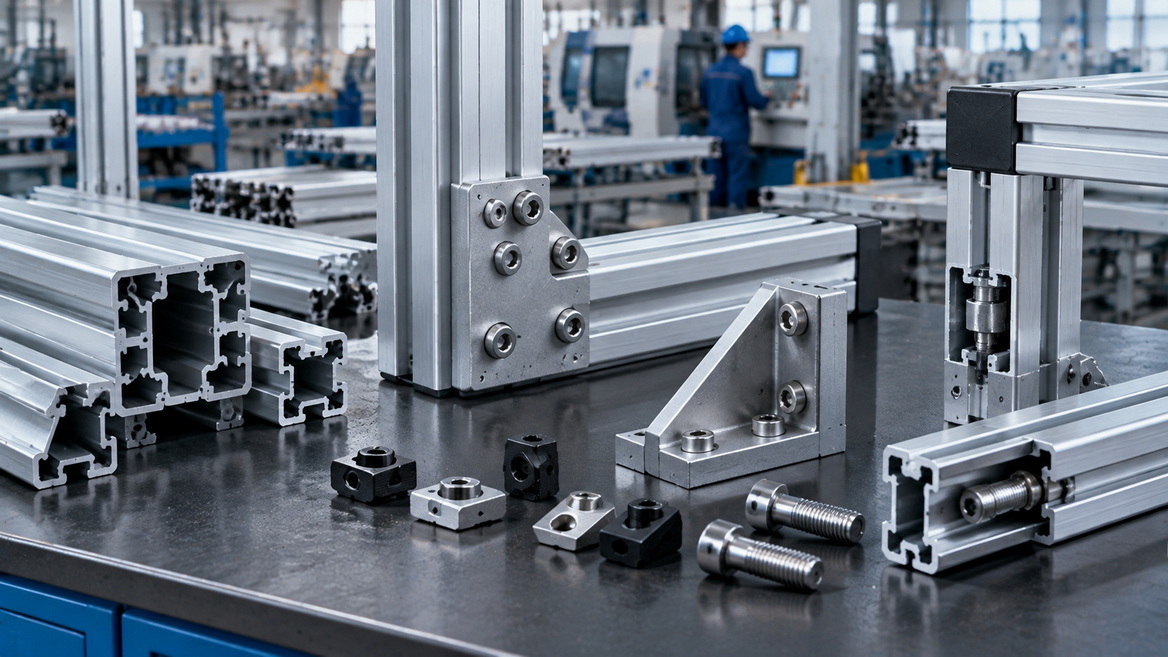
T-slot aluminum profiles are widely used because they enable fast, modular construction without welding, grinding, or repainting. However, the flexibility of an aluminum profile system also means that every connection point must be carefully selected and properly installed.
A high-quality aluminum extrusion connector helps maintain structural integrity, improves assembly precision, and reduces the risk of loosening during long-term operation.
The correct connector selection can influence:
- Structural rigidity under static loads
- Frame alignment during assembly
- Resistance to vibration from motors, conveyors, pneumatic cylinders, and robots
- Assembly speed and labor efficiency
- Maintenance access for later modifications
- Machine appearance and enclosure design
- Service life in humid, corrosive, or high-use environments
For example, a lightweight display frame may only need basic corner brackets and standard T-nuts. A high-speed automated production line, however, may require reinforced brackets, internal anchors, precise cut faces, controlled bolt torque, and additional vibration-resistant hardware.
The extrusion profile itself also plays a major role. Slot dimensions, wall thickness, straightness, flatness, twist, cutting accuracy, and internal cavity design can all affect how securely a connector fits and performs.
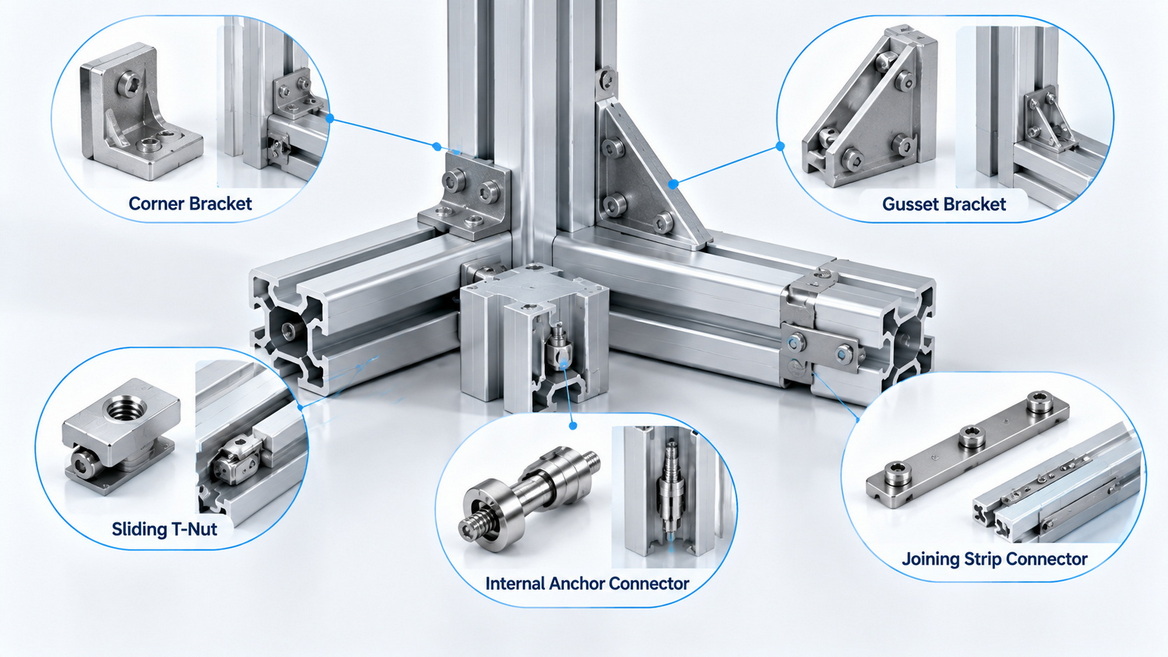
Aluminum extrusion connectors are mechanical hardware components used to join two or more aluminum profiles. They can connect profiles at 90-degree angles, extend profiles end to end, create adjustable mounting points, support moving doors, or secure accessories such as sensors, panels, cable trays, guards, and brackets.
Most T-slot aluminum profile systems use a combination of connectors and fasteners, including:
- Corner brackets
- Gusset brackets
- T-nuts
- Sliding nuts
- Drop-in nuts
- Bolts and screws
- Internal anchor connectors
- Joining strips
- Hinge connectors
- Pivot joints
- End fasteners
- Cover caps and decorative trims
The best connector is determined by the design purpose of the frame. It must transfer loads effectively while keeping the structure square, secure, and easy to assemble.
The first connector decision is often whether the hardware should remain visible on the outside of the frame or be concealed inside the aluminum profile.
External connectors are mounted on the surface of the profiles. They are commonly used for fast assembly, simple adjustments, and applications where appearance is less important than accessibility.
Typical external connectors include:
- Standard corner brackets
- Reinforced corner brackets
- Gusset brackets
- Flat joining plates
- Angle brackets
- Brackets with adjustable slots
External connectors are easy to install because they generally require only T-nuts and bolts. They are also convenient for prototypes, production fixtures, workbenches, safety guards, modular conveyor frames, and equipment that may be modified later.
The main limitation is that external brackets use space around the profile and may block T-slots needed for panels, cable management, sensors, or future accessories.
Internal connectors are installed inside the profile cavity or through access holes in the profile. They create a clean, professional appearance and keep exterior slots open for additional components.
Common internal connector options include:
- Anchor fasteners
- Hidden screw connectors
- End fasteners
- Internal brackets
- Central-bore connectors
- Concealed joining systems
Internal connectors are often selected for machine frames, cleanroom equipment, laboratory structures, display systems, and premium industrial assemblies where a smooth exterior surface is preferred.
Their main advantage is visual cleanliness. Their main challenge is installation complexity. Depending on the connector design, the profile may need to be drilled, tapped, or machined before assembly.
T-nuts are among the most common components in T-slot aluminum profile systems. They fit into the slot of the extrusion and create a threaded mounting point for bolts, brackets, panels, and accessories.
T-nuts are available in several forms:
- Sliding T-nuts are inserted from the open end of a profile before the frame is closed.
- Drop-in T-nuts can be placed into an open slot after the main frame has already been assembled.
- Spring-leaf T-nuts use a spring element to stay in position during vertical installation.
- Ball-spring T-nuts reduce unwanted sliding and help maintain placement during assembly.
- Heavy-duty T-nuts are used for higher-load brackets and industrial machine frames.
T-nuts provide excellent flexibility. However, they must match the profile slot dimensions and the required thread size. A nut that is too narrow may rotate or slip inside the slot. A nut that is too large may not insert correctly or may damage the profile.
Corner brackets are used to create 90-degree joints between aluminum profiles. They are one of the most practical connector choices for modular frames because they are simple, visible, adjustable, and easy to install.
Corner brackets are suitable for:
- Workstations
- Assembly tables
- Equipment enclosures
- Safety guarding
- Storage racks
- Display structures
- Light-duty machine frames
For medium-duty applications, standard corner brackets can provide reliable performance when used with compatible T-nuts and properly tightened bolts.
Gusset brackets are reinforced angle brackets that add support to high-load or vibration-prone corners. Their larger contact area helps improve the frame's resistance to bending, racking, and torsional movement.
Gusset brackets are often recommended for:
- Heavy-duty workbenches
- Long-span aluminum frames
- Conveyor supports
- Industrial automation cells
- Machine bases
- Robot guarding structures
- High-vibration equipment
Using a gusset bracket on both sides of a joint can provide better load distribution than using only one bracket. This is especially important when the frame must resist side loads or repeated movement.
Internal anchor connectors create strong, concealed joints between aluminum profiles. These connectors are usually installed through a drilled access hole and tightened with a screw or bolt inside the profile.
They are commonly used when the structure needs:
- A cleaner exterior appearance
- Open T-slots for accessories
- More compact joint geometry
- Better visual integration with machine panels
- A higher-end finished appearance
Internal anchor connectors are effective when the profile ends are accurately cut and the access holes are correctly positioned. Poor machining can make assembly difficult and may reduce joint alignment.
Joining strip connectors are used to connect two aluminum profiles end to end. They are useful for creating long frames, extending conveyor structures, building transportable modular systems, or assembling large equipment from shorter profile sections.
For a reliable end-to-end connection:
1. Make sure both profile ends are cut square.
2. Remove sharp burrs and chips.
3. Align the profiles on a flat reference surface.
4. Position joining strips evenly around the profile.
5. Tighten the fasteners gradually and evenly.
6. Avoid placing the joint at the center of a long unsupported span.
A joining strip connector can create a practical extension, but it should not be treated as a substitute for correct structural design. Long spans still require adequate profile size, appropriate supports, and consideration of bending forces.
Hinges and pivot connectors are used when a frame includes doors, inspection panels, access covers, movable guards, or rotating assemblies.
Typical applications include:
- Machine safety doors
- Aluminum profile cabinets
- Access panels
- Inspection windows
- Folding workstations
- Adjustable display frames
When selecting hinges, consider the weight of the door, opening frequency, hinge material, mounting orientation, and required opening angle. Large or heavy doors may need multiple hinges, reinforced profile sections, or gas springs.
The strongest connector is not always the best choice. The right option is the connector that meets the actual structural, assembly, appearance, and maintenance requirements of the project.
Start by confirming the exact aluminum profile series. Common profile sizes include 2020, 2040, 3030, 3060, 4040, 4080, 4545, and 8080.
However, profiles with similar outside dimensions may not use identical connector systems. Different manufacturers can use different slot widths, slot depths, internal cavities, center bores, and accessory standards.
Before purchasing connectors, confirm:
- Profile cross-section drawing
- Slot width and slot depth
- Center-bore diameter
- Recommended T-nut style
- Compatible bolt size
- Profile material grade
- Temper condition
- Straightness tolerance
- Twist tolerance
- Wall thickness
- Recommended machining method
A connector should be tested with the exact profile system before large-scale production or field installation.
Understanding the load direction is essential. A connector may hold a vertical load well but perform poorly under side loading, vibration, pulling force, or torsional stress.
Consider the following load conditions:
- Static equipment weight
- Moving-axis loads
- Motor torque
- Conveyor loading
- Cantilevered components
- Door weight
- Robot acceleration
- Pneumatic cylinder force
- Repeated impact
- Vibration from rotating equipment
Vibration is one of the most common causes of loose fasteners and unstable aluminum profile structures. A frame that appears rigid during manual inspection may begin to shift after hundreds of hours of operation.
Applications with higher vibration often include:
- CNC equipment
- Cutting machines
- Packaging machines
- High-speed conveyors
- Industrial robots
- Pick-and-place systems
- Pneumatic presses
- Automated inspection equipment
- Reciprocating mechanisms
For these systems, use reinforced brackets, robust T-nuts, properly tightened fasteners, and additional support where needed. Avoid relying on a single small bracket at a critical joint.
It is also important to inspect the frame after initial operation. Early inspection can reveal joint settling, bolt loosening, or profile movement before these issues affect machine accuracy.
Many aluminum profile projects are modified after installation. New sensors, cable trays, guards, brackets, lights, control boxes, and conveyors may need to be added later.
If future adjustment is likely, prioritize:
- Open exterior T-slots
- Drop-in T-nuts
- External corner brackets
- Adjustable mounting plates
- Modular panel systems
- Accessible fasteners
If the frame will remain fixed and appearance is important, internal connectors may be a better choice.
A practical design should balance current needs with possible future changes. Building every connection as a permanent hidden joint may look clean, but it can make maintenance and upgrades more difficult.
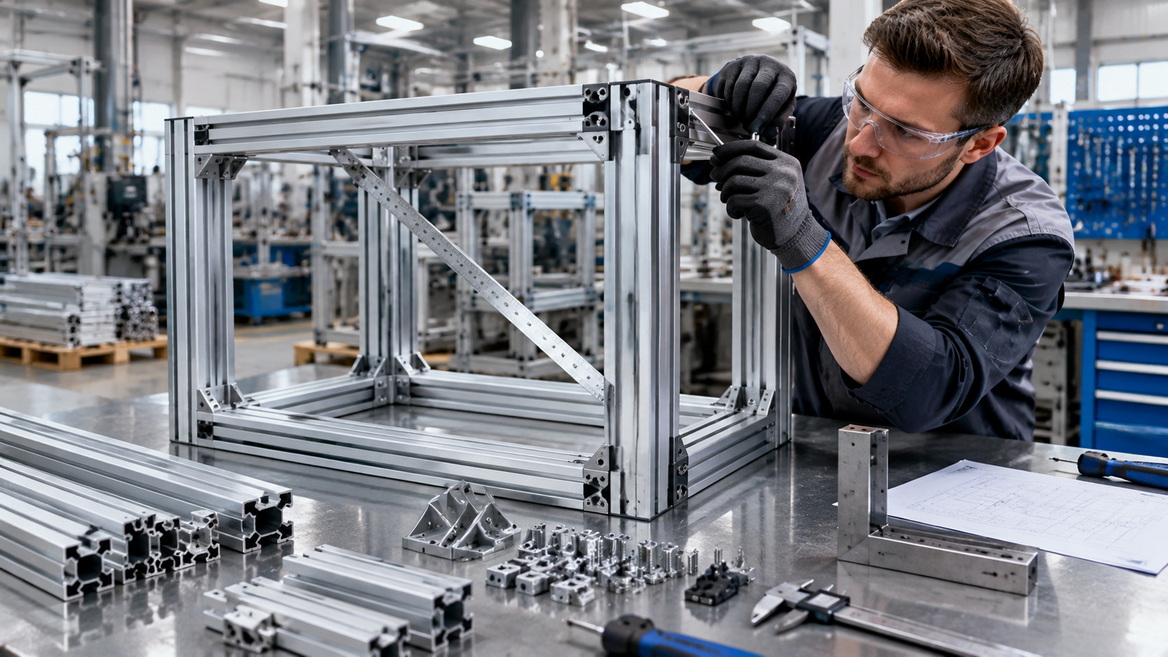
Correct installation is as important as connector selection. Even high-quality brackets and T-nuts can loosen, shift, or fail if the profiles are poorly cut or the fasteners are not tightened consistently.
Verify that the T-nuts, bolts, washers, brackets, and profiles belong to the same system or have been confirmed as compatible. Do not assume that parts from different suppliers will fit correctly.
Profile ends should be square, smooth, and free from burrs. Uneven cut faces can create gaps between profiles and reduce joint stiffness.
Use a deburring tool or suitable finishing process to remove sharp edges, aluminum chips, and cutting residue before assembly.
Sliding T-nuts must usually be inserted from the end of the profile. Before completing a closed frame section, consider which accessories may be added later.
For later additions, use drop-in T-nuts where compatible.
Install the connectors and bolts without fully tightening them. This allows the frame to be adjusted for squareness and alignment before the final tightening sequence.
For rectangular frames, compare the diagonal measurements. If both diagonals are equal, the frame is generally square.
This simple step is especially important for machine guards, sliding doors, panel enclosures, conveyor frames, and assemblies with moving components.
Start from the primary reference corner and tighten hardware gradually. For larger structures, work across the frame in a balanced sequence.
Avoid tightening one side completely before the rest of the structure has been aligned. Uneven tightening can pull the frame out of square.
Bolts should be tightened according to the connector and fastener specification. Excessive torque can damage threads, deform components, or strip T-nuts. Insufficient torque can allow joints to loosen under vibration.
A documented torque process is particularly useful for repeatable production of industrial frames.
Before installing equipment or panels, inspect the completed structure for:
- Loose bolts
- Rocking brackets
- Uneven profile joints
- Misaligned panels
- Blocked T-slots
- Unsupported cantilevers
- Sharp edges
- Access restrictions
- Visible profile damage
A T-nut that does not match the slot geometry may rotate, slide, or fail to create sufficient clamping force. Always verify slot compatibility before ordering in quantity.
A small concealed connector may create a clean design, but it may not be suitable for a large machine frame or dynamic industrial application. Structural requirements should guide the selection.
Connectors depend on accurate aluminum profiles. Oversized slots, distorted walls, poor straightness, inconsistent center bores, or rough cut faces can reduce joint performance.
High-quality extrusion production supports better connector engagement, more consistent assembly, and improved structural alignment.
Metric and imperial thread systems are not interchangeable. Using the wrong screw can damage the T-nut, strip the thread, or create a weak joint that fails later.
Clearly specify the fastener standard in technical drawings, bills of materials, and procurement documents.
Aluminum profiles are frequently used with steel or stainless-steel fasteners. In dry indoor conditions, this is often manageable. In outdoor, marine, humid, washdown, or chemical environments, moisture can increase the risk of galvanic corrosion between dissimilar metals.
To reduce corrosion risks:
- Use suitable coated or corrosion-resistant fasteners
- Keep water from accumulating around joints
- Use insulating washers or barriers when necessary
- Select compatible protective coatings
- Avoid trapping moisture inside profile cavities
- Inspect hardware regularly in demanding environments
A frame may be perfect at the time of installation but difficult to upgrade later. Consider leaving selected T-slots open and allowing space for cable routes, brackets, sensors, and guarding additions.

The performance of an aluminum extrusion connector depends heavily on the quality of the aluminum profile. A strong bracket cannot fully compensate for distorted slots, inaccurate center bores, uneven wall thickness, poor straightness, or inconsistent profile dimensions.
For aluminum profile manufacturers, extrusion equipment directly influences the quality and repeatability of the final product. Stable billet heating, accurate die design, controlled extrusion force, dependable cooling, precise puller operation, and reliable handling equipment all contribute to profile consistency.
Xinxinke Co., Ltd. provides copper and aluminum extrusion equipment for manufacturers seeking higher efficiency, stable profile production, and customized technical solutions. With more than three decades of industry experience, the company combines advanced manufacturing capability, strict quality control, and professional engineering support to help customers meet demanding production requirements.
For T-slot profiles, industrial framing profiles, custom aluminum sections, and other precision extrusions, controlled equipment performance helps profile producers deliver products that are easier to assemble, more reliable in use, and better suited to connector-based applications.
Aluminum extrusion connectors are fundamental to the strength, accuracy, appearance, and long-term reliability of T-slot profile projects. Selecting the correct bracket, T-nut, internal anchor, joining strip, or hinge requires consideration of profile compatibility, load direction, vibration, corrosion exposure, assembly access, and future modification needs.
The strongest aluminum profile structures are created when the extrusion and connector are treated as one integrated system. Accurate profile dimensions support secure hardware engagement. Correct connector selection improves rigidity. Consistent assembly practices reduce misalignment and long-term maintenance issues.
For manufacturers producing industrial aluminum profiles, high-performance extrusion equipment and reliable process control provide the foundation for connector-ready profiles that meet the needs of global machine builders, automation integrators, and industrial fabricators.
Xinxinke Co., Ltd. is ready to support aluminum profile manufacturers with high-performance extrusion presses and customized equipment solutions built for stable production, improved efficiency, and consistent profile quality.
Aluminum extrusion connectors are used to join T-slot aluminum profiles and build modular structures such as workstations, machine frames, conveyor supports, safety guards, equipment enclosures, storage systems, and automated production cells.
For heavy-duty applications, reinforced gusset brackets and internal anchor connectors are often strong choices. The best connector depends on the profile system, load direction, vibration, joint geometry, and assembly requirements.
Yes. Many brackets, T-nuts, bolts, and internal connectors can be reused if they are not damaged, corroded, stripped, or deformed. Always inspect threads, fastener heads, and bearing surfaces before reusing hardware.
Some internal connectors require access holes, drilled holes, or tapped center bores. External corner brackets and T-nut-based connections usually require less machining and are easier to install.
Check the exact slot width, slot depth, slot geometry, and required thread size. Use the profile drawing and compatible accessory specifications to make sure the T-nut fits securely.
1. [European Aluminium — Extruded Products]
2. [Aluminum Extruders Council — Aluminum Extrusion Tolerances]
3. [Phidgets Support — T-Slot Guide]
4. [Airline Hydraulics — Aluminum T-Slot Hardware Guide]
5. [Gap Engineering — How to Choose the Right T-Slot Aluminum Profile]


