
Please Choose Your Language
Views: 277 Author: Xinxinke Extrusion Publish Time: 2026-09-09 Origin: Site


Content Menu
● Why Magnesium Is Added to Aluminum Alloys
● How Magnesium Improves Aluminum Alloy Performance
>> Magnesium Strengthens Aluminum Through Solid Solution
>> Magnesium and Silicon Form Mg₂Si in 6xxx Alloys
>> Magnesium Supports Corrosion Resistance
>> Magnesium Influences Extrusion Behavior
● Magnesium Content in Common Aluminum Alloys
● What Happens When Magnesium Content Is Too Low?
● What Happens When Magnesium Content Is Too High?
● How to Add Magnesium During Aluminum Melting
>> 1. Confirm the Required Alloy Chemistry
>> 2. Analyze the Initial Melt
>> 3. Calculate the Magnesium Addition
>> 4. Select the Appropriate Addition Material
>> 5. Add Magnesium Safely and Consistently
>> 7. Degas, Filter, and Verify Chemistry
● Magnesium Control and Billet Quality
● The Connection Between Magnesium and Extrusion Press Performance
● Practical Recommendations for Stable Magnesium Control
● Xinxinke Supports Reliable Aluminum Extrusion Production
>> What is the purpose of adding magnesium to aluminum?
>> Why is magnesium important in 6063 aluminum?
>> Can too much magnesium affect aluminum extrusion?
>> What happens if magnesium content is too low?
>> Is it better to use magnesium ingots or aluminum-magnesium master alloy?
Magnesium is far more than a minor ingredient in aluminum melting and casting. It is one of the elements that determines whether an aluminum billet can deliver the expected strength, surface quality, corrosion resistance, and extrusion stability.
For aluminum profile producers, foundries, and extrusion plants, magnesium control begins at the furnace. A small deviation in magnesium content can affect the entire production chain, from molten metal treatment and billet casting to extrusion speed, mechanical properties, anodizing performance, and final customer acceptance.
At Xinxinke Co., Ltd., we have worked with copper and aluminum profile production equipment for more than 30 years. Through our experience with extrusion machinery and customized production solutions, we understand that consistent profile quality depends on more than press capacity alone. It requires stable alloy chemistry, reliable billet preparation, controlled heating, suitable tooling, and disciplined process management.
This article explains why magnesium ingots are added during aluminum melting and casting, how magnesium changes alloy behavior, what can happen when magnesium content is incorrect, and how production teams can improve billet consistency before extrusion.
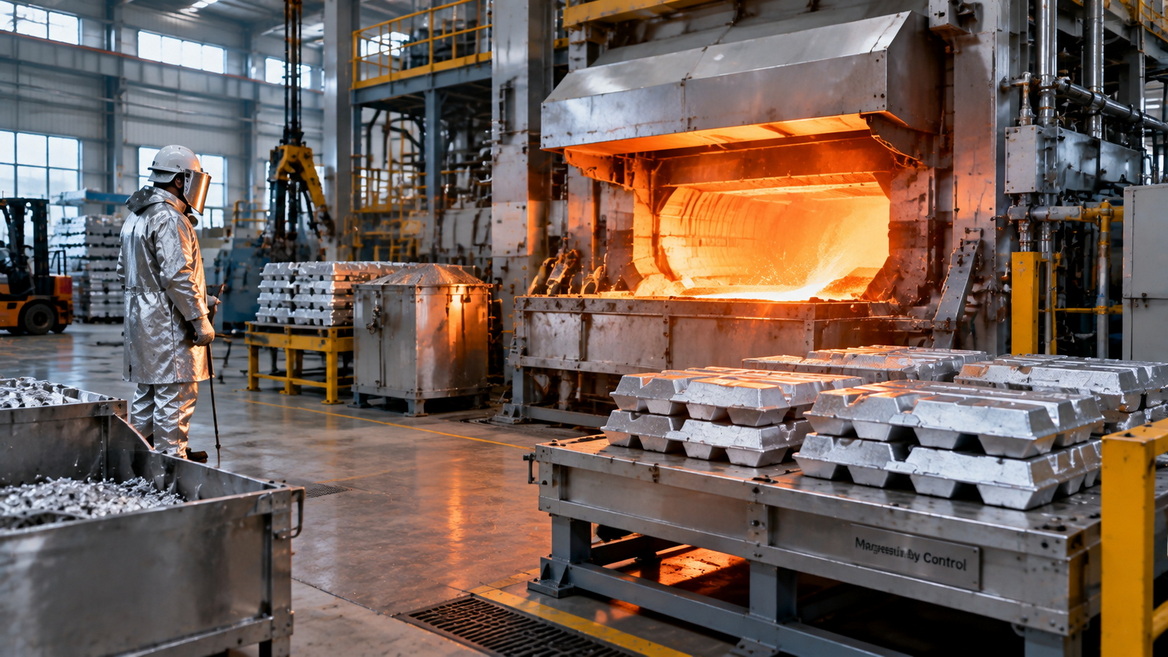
Magnesium is one of the most widely used alloying elements in commercial aluminum alloys. It can improve the balance between strength, formability, weldability, corrosion resistance, and processing performance.
During melting and casting, magnesium may be introduced through pure magnesium ingots, aluminum-magnesium master alloys, or other controlled alloying materials. The appropriate method depends on the target alloy, furnace size, batch weight, melting temperature, safety procedures, recovery rate, and required composition accuracy.
For aluminum extrusion producers, magnesium is especially important in 5xxx-series and 6xxx-series aluminum alloys.
| Alloy Family | Main Role of Magnesium | Typical Applications |
|---|---|---|
| 5xxx Series | Primary strengthening element that supports corrosion resistance and weldability | Marine structures, tanks, transport panels, sheet and plate |
| 6xxx Series | Combines with silicon to form Mg₂Si for heat treatment and strengthening | Windows, doors, curtain walls, industrial profiles, transport components |
| 7xxx Series | Works with zinc and other elements to produce high-strength alloys | Aerospace parts, structural components, high-load applications |
The value of magnesium depends on control. A correct addition can help achieve the intended alloy properties. An uncontrolled addition can create composition variation, casting difficulties, higher metal loss, extrusion instability, and final-product defects.
The goal is not to add the highest possible magnesium content. The goal is to add the right amount of magnesium for the specific alloy, profile design, temper requirement, and end-use application.
Magnesium atoms dissolve into the aluminum structure and make it more difficult for the metal to deform under load. This mechanism is known as solid-solution strengthening.
In simple terms, magnesium increases the resistance of aluminum to permanent deformation. It can improve tensile strength, yield strength, hardness, and durability while preserving useful levels of ductility.
This is particularly important in 5xxx-series aluminum alloys, where magnesium is the main strengthening element. These alloys are commonly selected for applications that require good corrosion resistance, weldability, and moderate-to-high strength.
Typical applications include:
- Marine structures and boat components
- Storage tanks and pressure vessels
- Transportation panels
- Truck bodies and trailers
- Chemical processing equipment
- Architectural sheet products
- Industrial fabricated parts
In higher-magnesium alloys, mechanical strength can increase significantly. However, the production process may also become more demanding. Higher magnesium content can increase oxidation risk during melting and make hot working more difficult.
In 6xxx-series aluminum alloys, magnesium works with silicon. When the chemistry is properly balanced, magnesium and silicon form a strengthening phase known as magnesium silicide, written as Mg₂Si.
This phase is extremely important for aluminum extrusion products. It allows 6xxx alloys to respond to heat treatment and artificial aging.
After extrusion, the profile may be cooled, quenched, and aged. During aging, fine particles develop within the alloy structure. These particles help improve the final mechanical properties of the profile.
This is why 6xxx alloys are widely used for:
- Aluminum windows and doors
- Curtain wall systems
- Solar mounting structures
- Furniture profiles
- Electrical enclosures
- Heat sinks
- Industrial machine frames
- Automotive components
- Rail transport profiles
- General-purpose structural profiles
The relationship between magnesium and silicon must be managed carefully. If magnesium is too low, the alloy may not achieve the desired strength after aging. If magnesium or silicon is excessively unbalanced, the alloy may behave differently during extrusion, heat treatment, and finishing.
For many aluminum profile manufacturers, 6063 is one of the most important 6xxx alloys. It is widely used because it offers a practical combination of extrudability, surface finish, corrosion resistance, and post-aging strength.
Magnesium can improve corrosion resistance in many aluminum alloy systems, especially in Al-Mg alloys used in demanding outdoor, humid, marine, and industrial environments.
This is one reason why magnesium-containing alloys are commonly selected for products exposed to rain, salt spray, moisture, chemicals, and temperature changes.
However, corrosion resistance does not depend on magnesium alone. Final performance is influenced by several factors:
- Overall alloy composition
- Magnesium and silicon balance
- Iron and copper content
- Surface cleanliness
- Extrusion temperature
- Cooling and aging conditions
- Welding method
- Anodizing quality
- Powder-coating system
- Environmental exposure conditions
- Product design and drainage
A well-designed alloy can provide strong corrosion performance. But poor melt cleanliness, contamination, incomplete coating, or unsuitable product design may still create corrosion risks.

Magnesium content affects the way aluminum flows through the die during extrusion. This makes magnesium control especially important for profile manufacturers producing complex shapes, thin-wall sections, precision industrial profiles, and high-surface-quality architectural products.
A stable magnesium level can help support:
- More predictable extrusion pressure
- Better metal flow through the die
- Improved dimensional consistency
- Stable profile strength after aging
- More reliable production scheduling
- Consistent billet-to-billet performance
- Better repeatability in surface finishing
- Reduced risk of quality variation
However, an alloy outside its target magnesium range can create process instability.
For example, when magnesium content is higher than intended, the aluminum may require more extrusion force. The press may operate at higher pressure, and the available speed range may become narrower. For complex dies, this can make it more difficult to maintain stable exit temperatures and consistent profile dimensions.
When magnesium content is too low, the alloy may extrude more easily but fail to reach the required mechanical strength after aging.
Different aluminum alloys require different magnesium levels. Production teams should always follow the approved alloy recipe, applicable material standard, internal quality requirements, and customer specifications.
| Aluminum Alloy | Main Alloy System | Typical Magnesium Range | Common Uses |
|---|---|---|---|
| 5052 | Aluminum-Magnesium | 2.2–2.8% | Sheet, panels, marine parts, truck components |
| 5083 | Aluminum-Magnesium-Manganese | 4.0–4.9% | Marine structures, tanks, pressure vessels |
| 6060 | Aluminum-Magnesium-Silicon | 0.35–0.60% | General architectural and decorative profiles |
| 6063 | Aluminum-Magnesium-Silicon | 0.45–0.90% | Windows, doors, curtain walls, furniture profiles |
| 6061 | Aluminum-Magnesium-Silicon-Copper | 0.8–1.2% | Industrial structures, transport parts, machined components |
| 6005A | Aluminum-Magnesium-Silicon | 0.4–0.7% | Structural profiles, transport systems, solar products |
| 6082 | Aluminum-Magnesium-Silicon-Manganese | Higher-strength 6xxx system | Heavy-duty profiles, machinery, transport structures |
These values are intended as general reference points. The final alloy chemistry must be confirmed according to the specific grade, product standard, regional requirement, and customer-approved composition range.
When magnesium content is below the target range, the alloy may not develop the required strength or heat-treatment response.
This issue is especially important in 6xxx aluminum extrusion alloys. Magnesium and silicon need to work together to form a sufficient amount of Mg₂Si. If the magnesium level is too low, the alloy may have limited precipitation-hardening capability after cooling and aging.
Possible consequences include:
- Lower tensile strength
- Lower yield strength
- Reduced hardness
- Weak aging response
- Inconsistent mechanical-property test results
- Lower resistance to dents and deformation
- Reduced performance in structural applications
- Customer complaints or rejected material
- Inconsistent results between production batches
A low-magnesium problem may not be visible during melting. The billet may appear normal, and the profile may initially look acceptable. The issue may only appear later during tensile testing, hardness testing, final inspection, anodizing, or end-use performance evaluation.
This is why melt analysis and billet traceability are so important.
Too much magnesium can also create serious production challenges. Although magnesium can increase strength, excessive levels may make the alloy more difficult to process.
In extrusion operations, high magnesium content can increase the material's resistance to deformation. This means the extrusion press may require higher pressure to push the billet through the die.
Possible consequences include:
- Higher extrusion force
- Increased press pressure
- Reduced stable extrusion speed
- More difficult exit-temperature control
- Higher risk of die wear
- Increased risk of dimensional variation
- More surface defects on sensitive profiles
- Greater oxidation and dross formation during melting
- Higher magnesium burn-off
- Chemistry outside the approved alloy range
- Inconsistent anodizing or coating performance
Pure magnesium is lighter than molten aluminum and may remain near the surface if it is not added and mixed correctly. This can increase exposure to oxygen and raise the risk of oxidation losses.
The correct solution is not to add extra magnesium without control. Overcorrection can create a new chemistry problem. A better approach is to measure the actual melt composition, calculate the necessary addition, apply a validated recovery factor, mix properly, and confirm the final chemistry before casting.
Every aluminum plant should use its own approved operating procedures. The correct method depends on alloy type, furnace design, melt volume, temperature control, material form, safety requirements, and quality-control system.
However, the following process provides a practical framework for controlled magnesium addition.
Before adding magnesium, confirm the target alloy composition.
Review:
- Required magnesium range
- Silicon level for 6xxx alloys
- Manganese, iron, copper, chromium, and zinc limits
- Customer specifications
- Billet casting plan
- Intended extrusion profile type
- Final mechanical-property requirements
- Required temper, such as T4, T5, or T6
- Surface-finishing requirements
The target chemistry should always be based on the actual production order. A general alloy name is not enough when producing high-value profiles with tight mechanical or surface-quality requirements.
Take a representative sample from the molten aluminum and analyze the composition using calibrated equipment.
Do not rely only on the original material-charge calculation. Scrap content, remelt material, oxidation loss, furnace conditions, and previous melt handling can all change the actual magnesium level.
A reliable analysis helps prevent both under-addition and over-addition.
The theoretical addition amount must be based on the difference between actual magnesium content and target magnesium content.
For example, if a 10,000 kg aluminum melt requires a 0.10% increase in magnesium, the theoretical magnesium increase is 10 kg before considering recovery loss.
The actual addition amount must account for the plant's verified magnesium recovery rate.
Recovery can vary depending on:
- Furnace type
- Furnace temperature
- Melt surface condition
- Addition method
- Material form
- Holding time
- Stirring practice
- Protective flux use
- Oxidation level
- Operator technique
The best recovery factor is not a generic industry estimate. It is a value based on the plant's own production records.
Magnesium can be added in several forms:
- Pure magnesium ingots
- Aluminum-magnesium master alloys
- Pre-alloyed return scrap
- Controlled alloying additions
- Specialized addition products
Pure magnesium ingots may be suitable for some operations, but they require careful handling because magnesium can oxidize rapidly.
Aluminum-magnesium master alloys may offer more controlled addition, especially when precise dosing, improved handling, and lower oxidation-related loss are priorities.
The best material choice depends on the alloy grade, batch size, required accuracy, furnace process, cost structure, and operating experience.
Magnesium addition must follow approved safety procedures. The addition should be performed using appropriate tools, personal protective equipment, furnace controls, and melt-protection methods.
Depending on the production process, the operation may include:
- Controlled insertion below the melt surface
- Use of plunging tools
- Protective cover flux
- Controlled stirring
- Furnace atmosphere management
- Dross removal
- Temperature monitoring
- Timed holding and homogenization
The objective is to dissolve the magnesium efficiently while minimizing oxidation, dross formation, hydrogen pickup, and uneven chemical distribution.
After magnesium has been added, the melt needs sufficient time and proper circulation to achieve a uniform composition.
Incomplete mixing can create local chemistry variation. This can lead to inconsistent billet composition and unpredictable extrusion behavior.
At the same time, excessive stirring can entrain oxides into the melt. The process must be controlled carefully.
The objective is a clean, uniform, and compositionally stable aluminum melt.
After alloy adjustment, the melt should pass through the appropriate refining, degassing, filtration, and sampling steps.
This stage is important because melt cleanliness influences billet quality. Hydrogen, oxides, inclusions, dross, and contamination can contribute to porosity, surface defects, poor extrusion behavior, and inconsistent final properties.
Before casting, take a confirmation sample and verify that the magnesium content and overall chemistry meet the approved specification.
If the chemistry is outside the target range, correct it using the established metallurgical process rather than making uncontrolled last-minute adjustments.
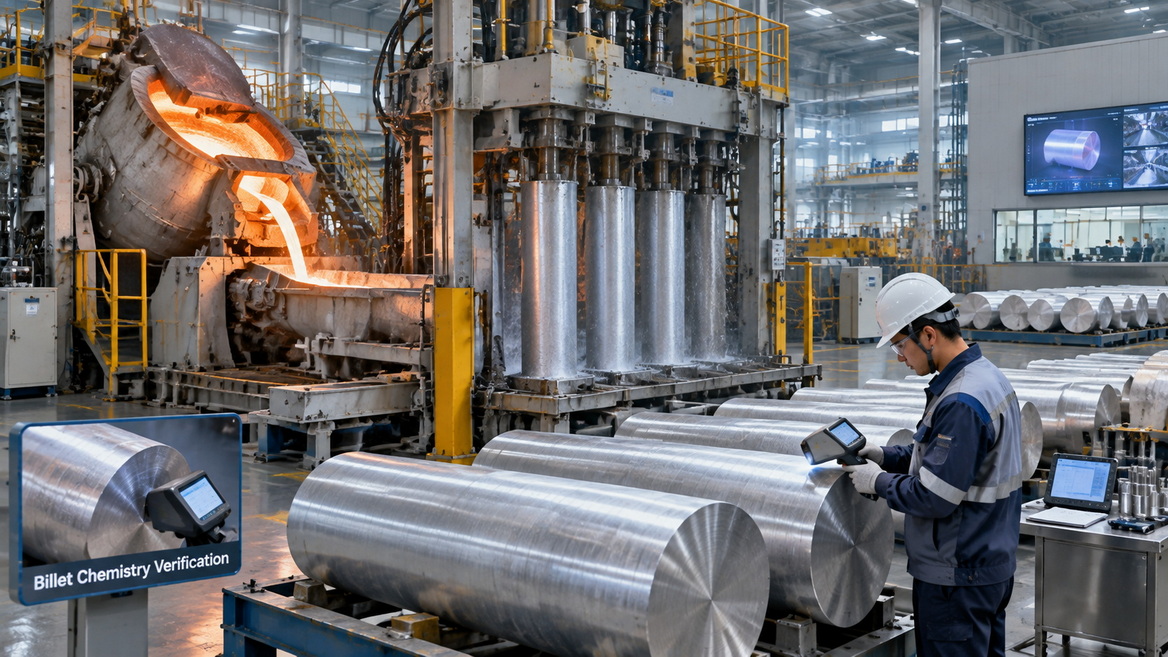
Billet quality has a direct effect on extrusion performance. A modern extrusion press can provide excellent force control, speed control, and automation, but it cannot fully compensate for unstable alloy chemistry or poor billet cleanliness.
For this reason, billet preparation should be treated as part of the extrusion process rather than as a separate upstream activity.
A well-controlled billet can help support:
- Stable extrusion pressure
- Predictable ram speed
- Better die performance
- Consistent profile dimensions
- Reduced surface defects
- Reliable mechanical properties
- Improved aging response
- Better anodizing consistency
- Lower scrap rates
- Higher overall production efficiency
An unstable billet may create problems that appear to be equipment-related but are actually connected to melt chemistry, casting quality, or homogenization conditions.
For example, a production team may experience:
- Unusual pressure fluctuation
- Inconsistent extrusion speed
- Uneven profile surface
- Poor hardness after aging
- Different anodizing color between batches
- Dimensional variation
- Die-line defects
- Higher rejection rates
When these issues occur, the investigation should include both equipment conditions and billet-quality data.
Extrusion is a system. The billet, die, container, press, heating system, cooling system, puller, aging process, and finishing line must work together.
Magnesium content can influence this system in several ways.
Higher-magnesium alloys can require greater force during extrusion. If the billet is harder or has higher flow stress, the press must generate more pressure to move the material through the die.
This is especially important when producing:
- Large cross-section profiles
- Thin-wall profiles
- Multi-void profiles
- Deep-pocket profiles
- High-strength industrial sections
- Structural transport components
- Precision profiles with narrow tolerances
Selecting the correct press tonnage is therefore not based only on profile size. It should also consider alloy type, magnesium level, billet diameter, extrusion ratio, die complexity, operating temperature, and target production speed.
Alloy chemistry affects the speed range that can be maintained safely and consistently.
A higher-strength alloy may require lower speed to control exit temperature and reduce the risk of surface defects. A lower-strength alloy may allow higher speed, but the final mechanical properties still need to meet customer requirements.
The most productive speed is not always the maximum possible speed. The best operating point balances output, profile quality, die life, temperature control, and scrap reduction.
Magnesium content can influence surface appearance, especially when combined with other alloying elements and process conditions.
For high-end architectural profiles, decorative profiles, and anodized products, surface consistency is critical. The quality of the billet, die surface, extrusion temperature, cooling method, handling process, and finishing line all influence the final appearance.
A stable chemical composition helps reduce one major source of variation.
For 6xxx-series profiles, magnesium and silicon balance strongly affects the response to aging.
If the alloy chemistry is stable, the aging process can be optimized more effectively. This helps manufacturers achieve consistent hardness and strength across multiple production lots.
If billet chemistry varies, the same aging cycle may produce different results from one batch to another.
The following practices can help aluminum plants improve magnesium control and reduce avoidable variation.
- Use actual chemical analysis before making alloy corrections.
- Calculate additions from measured melt weight and verified chemistry.
- Track magnesium recovery by furnace, alloy, and addition method.
- Control melt temperature to reduce unnecessary oxidation loss.
- Use consistent addition timing for each alloy family.
- Avoid excessive surface exposure of magnesium during addition.
- Choose pure magnesium or master alloy based on process needs.
- Allow sufficient time for dissolution and melt homogenization.
- Complete degassing and filtration before final chemistry approval.
- Maintain clear traceability between melt batch, billet lot, and extrusion production record.
- Compare chemical analysis with extrusion pressure, speed, scrap rate, tensile results, and surface-finish results.
- Train operators to follow a repeatable procedure rather than relying on personal judgment alone.
A stable alloy-control system can reduce rework, improve yield, protect die life, support predictable press performance, and strengthen customer confidence in the final aluminum profile.
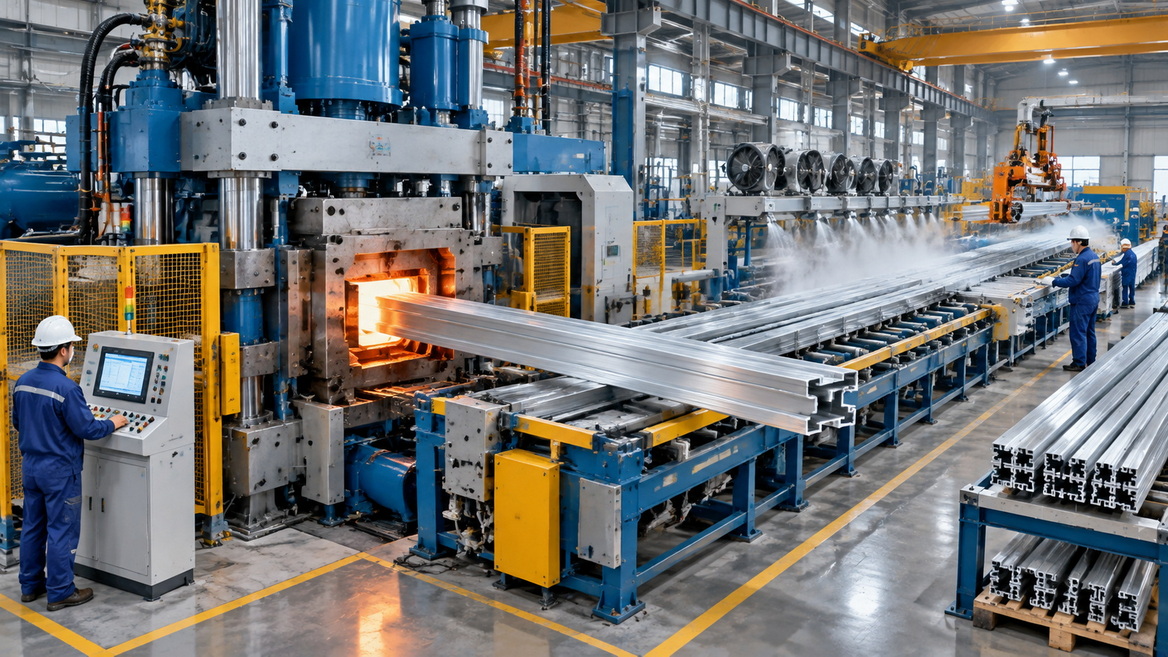
Magnesium control is only one part of a successful aluminum profile manufacturing process. Reliable production also requires stable billet heating, suitable extrusion force, precise control systems, dependable tooling, efficient handling, and consistent downstream processing.
Xinxinke Co., Ltd. is a professional manufacturer of copper and aluminum profile extrusion equipment with more than 30 years of industry experience. We provide high-performance extrusion presses and customized solutions for manufacturers producing architectural, industrial, transportation, solar, furniture, and specialty metal profiles.
Our team understands that every production plant has different requirements. Profile geometry, alloy type, billet diameter, automation level, production volume, floor layout, energy targets, and finishing requirements all influence equipment selection.
By combining advanced manufacturing capability, strict quality control, and practical engineering experience, Xinxinke helps global customers improve production efficiency, process reliability, and finished-profile quality.
For companies planning a new aluminum extrusion line, upgrading an existing press, increasing production capacity, or improving profile consistency, a complete process review can help identify the right equipment and configuration for long-term performance.
Magnesium ingots play an important role in aluminum melting and casting because they influence strength, corrosion resistance, heat-treatment response, extrusion behavior, and final profile quality.
For 5xxx alloys, magnesium is a major strengthening element. For 6xxx alloys, magnesium combines with silicon to form Mg₂Si, supporting the heat-treatment response that makes these alloys ideal for many extruded aluminum profiles.
The most important principle is control. Magnesium should be added according to the correct alloy target, verified melt analysis, realistic recovery data, safe handling procedures, proper homogenization, and final chemistry confirmation.
When alloy chemistry is stable, billet quality becomes more reliable. When billet quality is reliable, extrusion operations can achieve more consistent pressure, speed, dimensions, surface finish, and mechanical properties.
A disciplined approach to magnesium control supports a stronger foundation for efficient aluminum profile manufacturing.
Magnesium is added to aluminum to improve strength, corrosion resistance, weldability, and overall alloy performance. In 5xxx alloys, magnesium acts as a major strengthening element. In 6xxx alloys, it combines with silicon to support heat treatment and mechanical-property improvement.
Magnesium is important in 6063 aluminum because it works with silicon to form Mg₂Si. This supports the alloy's balance of extrudability, surface quality, corrosion resistance, and strength after aging. These characteristics make 6063 suitable for windows, doors, curtain walls, furniture profiles, and decorative architectural products.
Yes. Excess magnesium can increase the force required during extrusion, reduce the stable speed range, increase oxidation loss during melting, and make temperature control more difficult. It may also cause the final alloy chemistry to fall outside the approved specification.
If magnesium content is too low, the alloy may not achieve the desired strength after aging. This can result in lower tensile strength, reduced hardness, inconsistent mechanical-property results, and poor performance in structural or high-load applications.
Both materials can be suitable. Pure magnesium ingots may be used for direct alloy adjustment, while aluminum-magnesium master alloys can provide more controlled handling and dosing in certain operations. The best choice depends on alloy requirements, furnace conditions, batch size, recovery rate, safety practices, and production cost.
1. [Why Add Magnesium Ingot During Aluminum Melting and Casting?]
2. [The Aluminum Association: Standards]
3. [NIST / ASM: Aluminum and Aluminum Alloys]
4. [Aluminum Association: International Alloy Designations and Chemical Composition Limits]
5. [Hartmann Metalle: EN AW-6063 Material Data Sheet]
6. [Atlas Steels: Aluminium Alloy 6063 Data Sheet]
7. [ASM International: Molten Aluminum Processing and Casting]
8. [Total Materia: Master Alloys for Aluminum Alloys]
9. [Home of Foundry: AlSi7_Mg++ Smart Master Alloy]
10. [U.S. Patent US5676774A: Magnesium Alloy as an Aluminum Hardener]


