
Please Choose Your Language
Views: 241 Author: Xinxinke Extrusion Publish Time: 2026-09-21 Origin: Site


Content Menu
● Why China Is a Major Source of Aluminium Extrusion Auxiliary Equipment
● How to Evaluate a Reliable Supplier
>> Research and Engineering Ability
● What Is Aluminium Extrusion Auxiliary Equipment?
● Top 10 Aluminium Extrusion Auxiliary Equipment Manufacturers in China
>> 2. Foshan Jianeng Jingjin Technology Co., Ltd.
>> 3. Jiangsu Giansun Precision Technology Group Co., Ltd.
>> 4. Foshan Yuexing Heavy Industry Machinery Co., Ltd.
>> 6. Taiyuan Heavy Machinery Group Co., Ltd.
>> 7. Wuxi Weite Machinery Co., Ltd.
>> 8. Foshan Aluminium Extrusion Line Integrators
>> 9. Jiangsu Extrusion Die and Auxiliary Equipment Specialists
>> 10. Turnkey Aluminium Extrusion Production-Line Suppliers
● Manufacturer Comparison Table
● Key Technical Requirements for Buyers
>> Pullers and Handling Systems
>> Cooling and Quenching Systems
>> Stretching and Straightening Machines
>> Saws and Cut-Length Control
>> Ageing Ovens
● Common Procurement Problems and How to Avoid Them
>> Problem 1: Hidden Component Substitution
>> Problem 2: Capacity Claims That Do Not Match Real Production
>> Problem 3: Unclear Factory Identity
>> Problem 4: Incomplete Technical Documentation
>> Problem 5: Underestimated After-Sales Costs
● A Practical Factory Verification Process
>> Step 1: Verify the Supplier Before Paying a Deposit
>> Step 2: Conduct a Technical Review
>> Step 3: Confirm Factory Testing Requirements
>> Step 4: Prepare for Installation Before Shipment
>> 1. How can I verify whether a manufacturer's ISO certificate is valid?
>> 2. What is the usual MOQ for aluminium extrusion auxiliary equipment?
>> 3. What should be included in a factory acceptance test?
>> 4. How do I avoid buying equipment that cannot reach my required output?
>> 5. Should I buy all equipment from one turnkey supplier?
China is one of the world's most important manufacturing bases for aluminium extrusion machinery and supporting production-line equipment. For global aluminium-profile producers, the country offers access to mature machinery supply chains, experienced fabrication teams, hydraulic-system suppliers, automation specialists, furnace manufacturers, and profile-processing expertise.
However, sourcing Aluminium Extrusion Auxiliary equipment is not simply about comparing quotation prices. A supplier may offer a lower-cost cooling table, billet furnace, puller, stretcher, or ageing oven, but the actual performance of the equipment depends on engineering details that are often not visible in an initial quotation. These include structural rigidity, thermal uniformity, hydraulic component quality, PLC programming, material-handling synchronization, safety systems, component brands, commissioning support, and spare-parts availability.
For procurement managers seeking a long-term manufacturing partner, the more useful question is not "Which supplier offers the lowest price?" It is "Which supplier can deliver equipment that fits our alloy range, profile dimensions, production target, factory layout, operating conditions, and after-sales requirements?"
This article introduces ten Chinese manufacturers and supplier categories that international buyers should consider when sourcing aluminium extrusion auxiliary equipment. The list is designed to support factory owners, engineering managers, purchasing teams, and project investors who need practical information before requesting technical proposals.
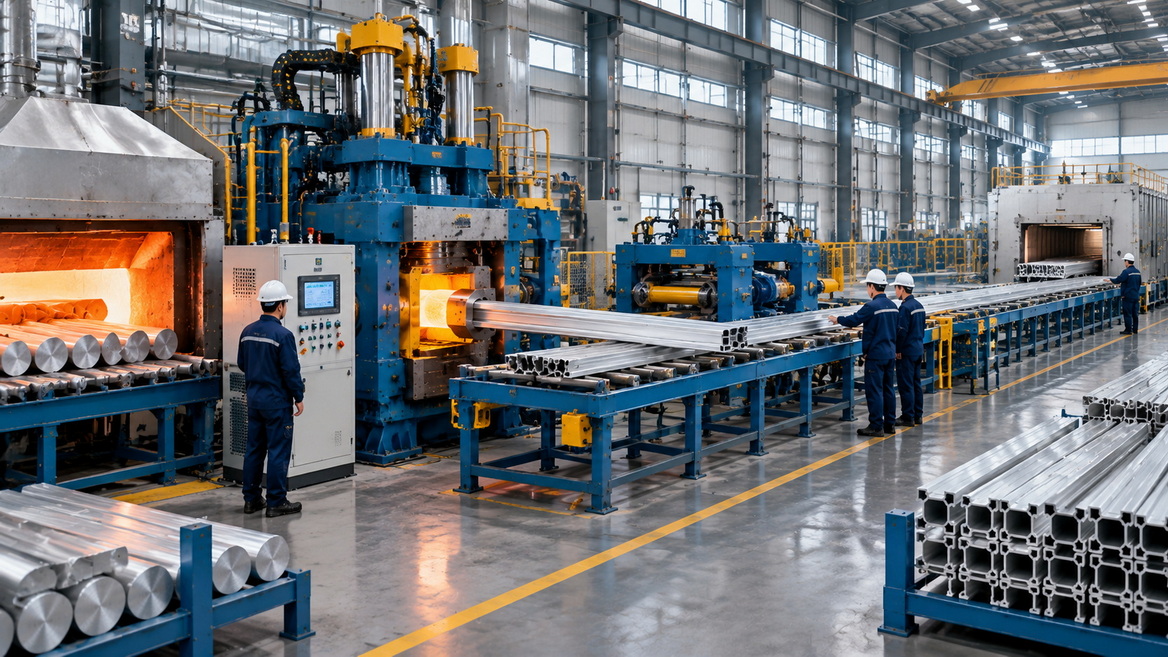
China's aluminium extrusion machinery industry has developed alongside its large domestic aluminium-profile manufacturing sector. This has created strong equipment clusters, particularly in Guangdong and Jiangsu.
Foshan, Guangdong, is widely recognized as a major centre for architectural aluminium profiles, industrial aluminium processing, extrusion machinery, die shops, hydraulic systems, electrical controls, and surface-treatment operations. The concentration of aluminium factories in and around Foshan gives machinery suppliers access to real production environments where they can improve pulling systems, cooling tables, hot-log shears, billet furnaces, quenching systems, and handling equipment.
Jiangyin and Wuxi in Jiangsu Province offer another important manufacturing base. This region is known for extrusion dies, industrial automation, precision machining, tooling, metalworking equipment, and production-line support systems. Buyers producing high-value industrial profiles, heat sinks, solar frames, transportation components, or complex hollow sections may find Jiangsu-based suppliers particularly relevant.
The main advantages of sourcing from China include:
- A broad supplier base for complete extrusion lines and individual auxiliary machines.
- Competitive manufacturing costs for fabricated structures, hydraulic systems, furnaces, and handling equipment.
- Flexible customization for press tonnage, billet diameter, profile length, plant layout, and automation level.
- Mature supply chains for motors, gearboxes, bearings, hydraulic valves, sensors, electrical cabinets, PLCs, and heating elements.
- Experience supporting architectural, industrial, transportation, solar, automotive, electrical, and general fabrication profile applications.
- Availability of both compact production-line upgrades and large turnkey extrusion projects.
At the same time, the large number of suppliers means buyers must carefully distinguish between original equipment manufacturers, assembly-based factories, trading companies, and project integrators. Each type of supplier can be useful, but the buyer must understand exactly who is responsible for engineering, fabrication, electrical integration, commissioning, and long-term service.
A dependable aluminium extrusion auxiliary equipment supplier should be assessed through engineering, manufacturing, quality-control, and service criteria. A polished website or a low-priced quotation is not enough to confirm actual production capability.
The following criteria provide a more transparent basis for supplier evaluation.
Buyers should determine whether the company has its own fabrication workshop, machining equipment, assembly area, electrical-panel workshop, testing area, and quality-control process.
Important questions include:
- Does the supplier manufacture key machine frames in-house?
- Are hydraulic power units assembled internally or sourced from another company?
- Who designs the PLC program and HMI interface?
- Which machines are fabricated by the supplier, and which are outsourced?
- Does the company have welders, machinists, electrical technicians, hydraulic engineers, and commissioning engineers?
- Can the supplier provide factory photos, workshop videos, and live video inspections?
- Can the supplier arrange an on-site audit before production begins?
A factory that performs core fabrication and assembly internally usually provides better control over delivery time, design changes, and quality consistency.
Aluminium extrusion auxiliary equipment must be adapted to the actual extrusion process. A standard cooling bed may not suit a high-speed architectural profile line. A generic puller may not work well for thin-wall, multi-cavity, hollow, or asymmetric industrial profiles. A furnace configuration designed for one billet diameter may be unsuitable for another.
A qualified supplier should be able to ask technical questions about:
- Aluminium alloy grade.
- Billet diameter and billet length.
- Extrusion press capacity.
- Container size.
- Profile cross-section.
- Wall-thickness range.
- Maximum profile length.
- Number of die cavities.
- Extrusion speed.
- Required surface quality.
- Cooling and quenching requirements.
- Stretching and straightness tolerance.
- Plant layout and available floor space.
- Crane capacity and installation conditions.
- Required automation level.
If a supplier can issue a quotation without requesting these details, the proposed equipment may be based on a generic configuration rather than a true engineering solution.
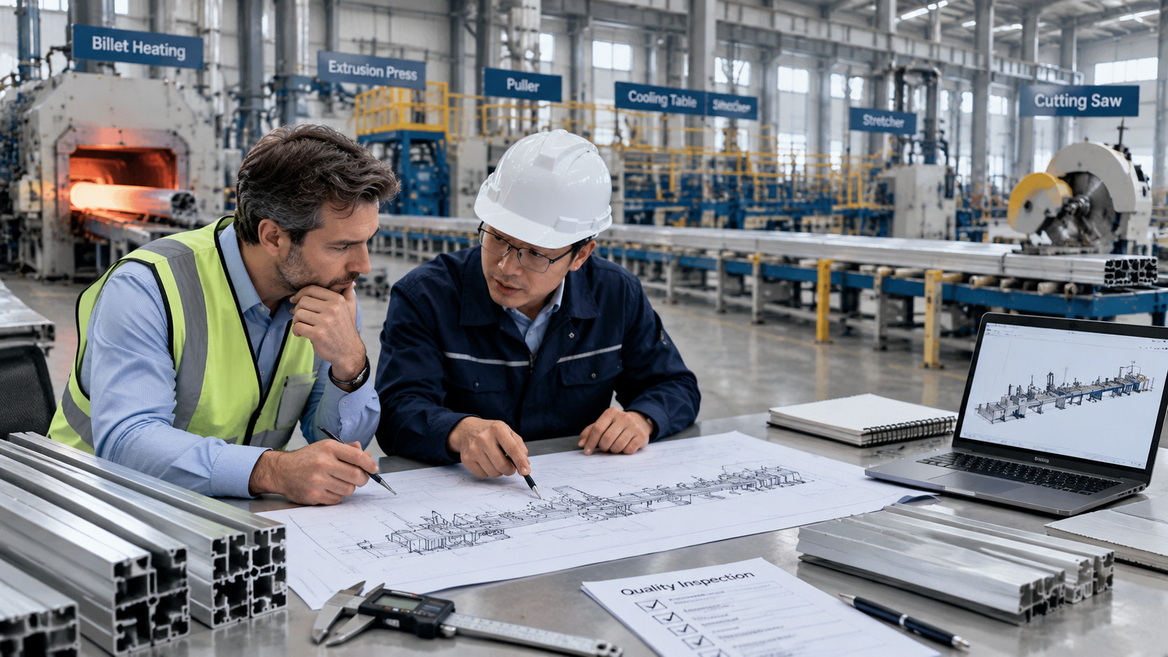
Quality control for auxiliary equipment should extend beyond appearance and paint finish. It should include material verification, welding inspection, machining inspection, hydraulic testing, electrical testing, safety-device checks, temperature testing, and final assembly inspection.
Buyers should request information about:
- Incoming inspection for hydraulic, electrical, and mechanical components.
- Welding procedures and welding inspection records.
- Dimensional inspection of machine frames and moving parts.
- Hydraulic-pressure testing.
- Leakage inspection.
- Electrical grounding and insulation testing.
- Furnace temperature testing.
- Safety interlock testing.
- Factory acceptance testing procedures.
- Final inspection reports before shipment.
The buyer should also request photos and videos of the actual equipment being manufactured, rather than relying only on catalogue images.
Large machinery projects require coordination between fabrication, machining, hydraulic assembly, electrical installation, trial operation, inspection, packing, and shipping. Delays can occur when suppliers rely heavily on outsourced processing or do not control critical components.
Before placing an order, buyers should ask for:
- A production schedule with major milestones.
- Estimated completion date.
- Factory testing date.
- Packing date.
- Shipping readiness date.
- List of long-lead components.
- Risk-management plan for delayed electrical or hydraulic parts.
- Weekly or biweekly production updates.
- A named project manager.
A supplier with a clear project schedule is generally easier to manage than one that only provides a broad delivery promise.
Communication quality is especially important for customized equipment. A supplier may have strong fabrication capability but weak documentation, delayed responses, or limited engineering communication in English.
Buyers should evaluate:
- Response time to technical questions.
- Ability to provide clear English drawings and manuals.
- Willingness to revise layout drawings.
- Speed of quotation updates after specification changes.
- Availability of remote troubleshooting.
- Availability of commissioning engineers.
- Spare-parts lead time.
- Warranty terms and exclusions.
- Ability to support electrical standards and local voltage requirements.
For many small and medium-sized profile manufacturers, responsive communication and practical problem-solving are as important as equipment capacity.
Aluminium extrusion auxiliary equipment refers to the systems that support the extrusion press before, during, and after profile formation. These machines determine how billets are heated, how profiles are pulled and cooled, how they are cut and straightened, and how they are aged or transferred for further processing.
Typical equipment includes:
- Billet loading systems.
- Billet heating furnaces.
- Long-stroke billet furnaces.
- Hot-log shears.
- Die-heating ovens.
- Die-handling systems.
- Single pullers.
- Double pullers.
- Multi-head pullers.
- Runout tables.
- Cooling tables.
- Air-cooling systems.
- Air-mist quenching systems.
- Water-mist quenching systems.
- Stretching and straightening machines.
- Fixed-length saws.
- Finished-product saws.
- Ageing ovens.
- Continuous ageing furnaces.
- Automatic stacking systems.
- Framing and packing systems.
- PLC and HMI control systems.
- Material-handling and transfer systems.
A complete extrusion line is only as efficient as its slowest stage. A high-capacity press cannot achieve its full output if the cooling table is too short, the puller cannot synchronize accurately, the stretcher has a slow cycle time, or the ageing oven lacks sufficient loading capacity.
For this reason, buyers should evaluate auxiliary equipment as a coordinated production system rather than as a group of unrelated machines.
Best for: Flexible aluminium and copper extrusion equipment projects, especially for small and medium-sized manufacturers that require customized machine configurations, responsive communication, and practical OEM support.
Xinxinke Co., Ltd. is an extrusion equipment manufacturer with more than 30 years of industry experience. The company provides high-performance extrusion presses and customized supporting solutions for aluminium and copper profile production.
For international buyers, Xinxinke is particularly relevant when the project requires more than a standard machine package. Many growing aluminium-profile factories need to adapt equipment to an existing building layout, add new equipment to an older extrusion line, work with a specific billet diameter, process a mix of architectural and industrial profiles, or operate within a limited investment budget.
In these cases, a supplier's flexibility can be more valuable than a broad catalogue. Xinxinke can be evaluated as a practical supplier for buyers that need direct communication with an engineering team and equipment configurations matched to specific production requirements.
The company's project suitability is strongest where buyers need a balance between performance, customization, cost control, and accessible technical support. Rather than focusing only on large standardized production lines, Xinxinke can support equipment adaptation for different profile categories, plant layouts, control preferences, and process requirements.
Core strengths
- More than 30 years of industry experience in extrusion equipment.
- Focus on aluminium and copper extrusion applications.
- Customized extrusion presses and supporting equipment.
- Flexible engineering support for non-standard layouts and equipment requirements.
- Suitable for small and medium-sized profile producers.
- Practical OEM and ODM project support.
- Responsive communication for technical discussions, drawing revisions, and equipment configuration.
- Potential fit for new projects, replacement projects, and production-line upgrades.
Typical equipment scope to discuss
- Aluminium extrusion presses.
- Copper extrusion presses.
- Billet heating furnaces.
- Hot-log shears.
- Die-heating ovens.
- Pullers and cooling tables.
- Quenching and cooling systems.
- Stretchers.
- Fixed-length cutting systems.
- Ageing ovens.
- Material-handling equipment.
- Electrical control systems.
- Custom equipment integration for existing lines.
Established: More than 30 years of industry experience.
Main markets: International aluminium and copper extrusion equipment customers.
OEM/ODM scope: Customized extrusion presses, auxiliary systems, plant-layout adaptation, control-system configuration, and line-integration support.
Best for: Aluminium extrusion plants sourcing billet furnaces, hot-log shears, pullers, cooling tables, and other supporting machinery for new lines or upgrades.
Foshan Jianeng Jingjin Technology Co., Ltd. was founded in 1999 and specializes in aluminium extrusion auxiliary equipment. The company is located in Foshan, Guangdong, an important manufacturing centre for aluminium profiles and related machinery.
Jianeng Jingjin provides equipment and line-support solutions for aluminium extrusion operations. Its product scope includes billet heating furnaces, hot-log shears, cooling tables, pullers, and customized extrusion supporting systems.
The company may be a suitable option for buyers that need to upgrade specific line sections rather than replace a complete extrusion press. For example, a factory may already have a working press but need a better cooling table, a more stable billet heating system, an upgraded puller, or improved profile-handling equipment.
One useful point for buyers is that cooling-table length should be selected according to press capacity, extrusion speed, profile type, and factory space. Cooling systems that are too short can create bottlenecks, profile distortion, insufficient cooling, and handling issues. Jianeng Jingjin offers equipment configurations for different press tonnage ranges, which can make it relevant for project-specific auxiliary equipment selection.
Core strengths
- Established specialization in aluminium extrusion auxiliary equipment.
- Experience with heating, pulling, cooling, and handling systems.
- Foshan location within a major aluminium-profile manufacturing cluster.
- Equipment suitable for line upgrades and replacement projects.
- Customization for different press capacities and production layouts.
- Potential fit for aluminium-profile plants operating in the 600T to 6,000T range.
Established: 1999.
Main markets: Aluminium extrusion factories and profile-processing plants.
OEM/ODM scope: Auxiliary equipment customization, cooling-table design, puller configurations, billet-heating systems, hot-log shears, and line-upgrade projects.
Best for: Buyers that require coordinated support across extrusion dies, tooling, auxiliary equipment, and precision mechanical components.
Jiangsu Giansun Precision Technology Group Co., Ltd. was established in 2001. The company has developed expertise across aluminium extrusion dies, extrusion auxiliary equipment, and precision mechanical components.
This combination can be valuable for buyers producing complex industrial profiles. In aluminium extrusion, tooling performance and auxiliary-equipment performance are closely connected. A well-designed die can still create production difficulties if the cooling, pulling, stretching, and cutting systems are not configured correctly. Likewise, a well-designed cooling table cannot fully compensate for poor die behavior.
Giansun's equipment coverage includes aluminium-rod heating furnaces, cold beds, online quenching systems, pullers, automatic stretching machines, finished-product saws, ageing furnaces, die ovens, and automated framing systems.
For buyers producing solar profiles, industrial structures, heat sinks, transportation components, electrical enclosures, or precision hollow profiles, Giansun may be worth evaluating because of its combined tooling and machinery capability.
Core strengths
- Integration of extrusion dies, tooling, auxiliary equipment, and precision components.
- Product coverage across major extrusion-line stages.
- Suitable for projects requiring coordinated die and equipment design.
- Potential fit for industrial and precision-profile applications.
- Experience with heating, quenching, pulling, stretching, cutting, ageing, and automatic handling.
- Suitable for buyers seeking a more integrated technical solution.
Established: 2001.
Main markets: Aluminium, copper, and magnesium profile extrusion-related industries.
OEM/ODM scope: Extrusion dies, tooling, billet heating furnaces, cooling beds, quenching systems, pullers, stretchers, saws, ageing equipment, and automated handling systems.
Best for: Buyers that want a coordinated aluminium extrusion line with presses, pullers, quenching systems, cooling systems, die ovens, and supporting equipment.
Foshan Yuexing Heavy Industry Machinery Co., Ltd. focuses on automated aluminium-profile extrusion-line equipment. The company provides extrusion presses and a range of auxiliary equipment, including intelligent pullers, multi-head pullers, hot shears, quenching systems, cooling systems, die ovens, and other supporting machinery.
Yuexing can be relevant for buyers planning a more integrated equipment purchase. Instead of sourcing a press from one company, a puller from another, a cooling table from a third supplier, and a furnace from a fourth supplier, buyers can consider suppliers capable of coordinating multiple equipment sections.
This approach can simplify project management, but it also requires stricter technical documentation. The buyer should confirm who designs the electrical interfaces, who controls PLC programming, who performs final testing, and who is responsible if one system does not synchronize with another.
Yuexing may be suitable for profile manufacturers producing architectural systems, industrial profiles, solar frames, and general aluminium extrusions.
Core strengths
- Complete aluminium extrusion-line equipment scope.
- Extrusion presses and supporting auxiliary machinery.
- Intelligent puller and multi-head puller options.
- Hot-log shears, quenching systems, cooling tables, and die ovens.
- Suitable for buyers seeking an integrated line supplier.
- Foshan manufacturing-cluster advantages.
- Potential fit for new factory projects and coordinated equipment upgrades.
Established: Buyers should verify the current legal-entity registration date and manufacturing history before order confirmation.
Main markets: Aluminium-profile manufacturers in architectural, industrial, solar, and general extrusion sectors.
OEM/ODM scope: Presses, pullers, cooling systems, quenching systems, billet-heating systems, die ovens, material-handling equipment, and line automation.
Best for: Larger aluminium extrusion projects that require high-tonnage press capability, intelligent-line integration, and industrial-scale equipment support.
HLT Industry Co., Ltd. was founded in 1957 and is a long-established Chinese industrial equipment manufacturer. Its aluminium extrusion equipment business includes extrusion presses and intelligent production-line systems covering billet heating, extrusion, quenching, pulling, cooling, stretching, cutting, and ageing.
HLT may be more suitable for buyers planning large-scale extrusion operations, high-capacity industrial-profile lines, automotive-related production, transportation profiles, or major factory expansions. Its equipment portfolio is associated with larger press capacities and complete production-line integration.
Buyers should confirm the exact press model, actual tonnage range, billet diameter, container size, extrusion speed, and auxiliary-equipment compatibility before making a decision. A high-tonnage press is not automatically the right solution if the downstream puller, cooling system, stretcher, saw, and ageing oven are not matched to the intended production volume.
HLT is worth considering when the buyer's project requires a supplier with heavy-industry experience and a broad equipment package.
Core strengths
- Long industrial manufacturing history.
- Large-capacity aluminium extrusion press capability.
- Integrated production-line equipment.
- Coverage from billet heating through ageing and handling.
- Suitable for larger capital-expenditure projects.
- Potential fit for high-output architectural and industrial-profile plants.
- Automation-oriented production-line solutions.
Established: 1957.
Main markets: Domestic and international aluminium-profile producers, industrial manufacturers, and large-scale extrusion projects.
OEM/ODM scope: High-tonnage presses, billet-heating equipment, quenching systems, pullers, cooling beds, stretchers, saws, ageing ovens, automated handling, and line-level controls.
Best for: Large industrial projects requiring heavy-machinery engineering resources, formal project processes, and high-capacity equipment capability.
Taiyuan Heavy Machinery Group Co., Ltd., commonly known as TZCO or Taizhong, was founded in 1950. The company is a major Chinese heavy-machinery manufacturer with experience across metallurgical equipment, hydraulic products, mining machinery, rail transit equipment, wind-power machinery, marine equipment, and other large industrial sectors.
For aluminium extrusion projects, Taiyuan Heavy Machinery Group may be more relevant to investors and industrial operators planning large-scale facilities or high-capacity equipment packages. The company's broad heavy-machinery background can be beneficial for projects that require structural engineering, hydraulic expertise, large fabrication capability, and formal project management.
However, buyers should verify that the assigned project team has recent experience with the specific aluminium extrusion equipment configuration required. A large machinery group may have strong general engineering capability, but the buyer must confirm practical experience with the desired press tonnage, alloy range, profile category, quenching design, and downstream auxiliary equipment.
Core strengths
- Founded in 1950 with extensive heavy-machinery experience.
- Suitable for large industrial projects.
- Broad hydraulic and metallurgical equipment background.
- Potential capability for high-capacity and complex engineering packages.
- Formal corporate and project-management structure.
- Suitable for buyers that prioritize industrial-scale manufacturing resources.
Established: 1950.
Main markets: Heavy industry, metallurgy, mining, rail transit, energy, and industrial equipment markets.
OEM/ODM scope: Large industrial machinery, hydraulic systems, high-capacity extrusion-related equipment, and project-specific engineering packages.
Best for: Buyers evaluating extrusion machinery for aluminium and copper applications, particularly where higher process loads and industrial-scale equipment are required.
Wuxi Weite Machinery Co., Ltd. is often included in Chinese extrusion equipment supplier comparisons for aluminium and copper extrusion machinery. The company is associated with industrial extrusion equipment rather than only standard auxiliary systems.
For buyers that process copper profiles or copper-alloy products in addition to aluminium, selecting a supplier with relevant copper extrusion experience can be important. Copper and aluminium behave differently during extrusion. Copper processing can require higher extrusion forces, different billet-heating approaches, specific die materials, more demanding lubrication, and stronger attention to tooling life.
A buyer should not assume that every aluminium extrusion equipment manufacturer can provide equally suitable machinery for copper production. When evaluating Wuxi Weite or another supplier for copper-related projects, request reference information for similar applications and confirm the designed working range of the press and downstream equipment.
Core strengths
- Relevance to aluminium and copper extrusion machinery.
- Potential fit for industrial-scale extrusion projects.
- Suitable for buyers considering press and auxiliary-equipment packages.
- Potentially relevant for copper-profile and copper-alloy applications.
- Worth screening for projects requiring higher-load extrusion equipment.
Established: Buyers should confirm the current company registration, manufacturing scope, and project references.
Main markets: Aluminium, copper, and metal-extrusion equipment customers.
OEM/ODM scope: Extrusion presses and matching auxiliary equipment packages, subject to project-specific technical confirmation.
Best for: Buyers who need practical plant-layout support, equipment coordination, retrofit management, and access to a concentrated aluminium machinery ecosystem.
Foshan is not only home to individual equipment manufacturers. It is also home to line integrators that coordinate presses, furnaces, pullers, cooling beds, quenching systems, stretchers, saws, ageing ovens, electrical controls, and packing equipment from multiple sources.
A good line integrator can be useful for buyers who do not have a large internal engineering team. The integrator can help prepare plant layouts, coordinate equipment dimensions, manage delivery schedules, and reduce interface problems between different machines.
However, buyers must understand that an integrator may not manufacture every machine itself. This is not necessarily a disadvantage, but transparency is essential.
Before selecting an integrator, buyers should ask:
- Which equipment is manufactured in-house?
- Which equipment is purchased from outside factories?
- Who is responsible for final mechanical assembly?
- Who is responsible for PLC and HMI programming?
- Who will commission the line on site?
- Who will provide spare parts after installation?
- Can the company provide direct factory information for key equipment?
- Are there previous reference projects using the same equipment configuration?
The buyer should ensure that one clearly identified company accepts responsibility for the full equipment package, even if individual machines are sourced from multiple manufacturers.
Core strengths
- Access to Foshan's dense aluminium manufacturing supply chain.
- Suitable for retrofit and integration projects.
- Potentially faster sourcing of components and replacement equipment.
- Useful for factory-layout planning.
- Can coordinate multiple line sections.
- May support buyers who need local production-line inspection opportunities.
Established: Varies by supplier.
Main markets: Domestic and international aluminium-profile producers.
OEM/ODM scope: Plant-layout planning, multi-supplier equipment coordination, line integration, retrofit work, and customized machinery packages.
Best for: Buyers producing high-precision industrial aluminium profiles that require close coordination between die design, thermal control, cooling, stretching, and cutting.
Jiangsu suppliers often have particular strengths in extrusion dies, tooling, precision machining, industrial components, and automated equipment. For complex aluminium profiles, these capabilities can provide a practical advantage.
Industrial profile production often involves greater technical difficulty than standard architectural sections. Examples include heat sinks, multi-void hollow profiles, rail-transit components, electric vehicle structures, solar mounting systems, machinery frames, industrial enclosures, and precision structural profiles.
These products may require tighter dimensional control, more consistent quenching, careful profile handling, controlled stretching, high cut-length accuracy, and better die maintenance.
Buyers sourcing from Jiangsu-based specialists should ask whether the supplier can support:
- Die heating and die-management systems.
- Profile-specific cooling recipes.
- Automated quenching control.
- Low-mark puller grips.
- High-precision stretching systems.
- Precision saws.
- Material-handling systems for long or delicate profiles.
- Spare dies, die repair, and process troubleshooting.
- Data collection for production monitoring.
Jiangsu Giansun is one example of this integrated approach because it combines extrusion tooling, auxiliary equipment, and precision mechanical parts.
Core strengths
- Strong connection between extrusion dies, equipment, and precision manufacturing.
- Suitable for industrial-profile and high-value profile applications.
- Potential support for process troubleshooting.
- Relevant for precision cooling, stretching, cutting, and handling needs.
- Useful for buyers that require die-related technical support.
Established: Varies by manufacturer.
Main markets: Industrial aluminium-profile manufacturers, die shops, precision metal processors, and equipment users.
OEM/ODM scope: Dies, die ovens, cooling systems, precision handling equipment, pullers, stretchers, saws, custom machine components, and retrofit projects.
Best for: New investors and expanding profile manufacturers that need one coordinated supplier for equipment layout, line interfaces, installation planning, and commissioning support.
Turnkey aluminium extrusion production-line suppliers can provide a full equipment package from billet handling through final ageing and packing. This may include billet storage, billet heating furnaces, hot-log shears, extrusion presses, pullers, cooling beds, quenching systems, stretchers, saws, ageing ovens, stacking equipment, and automation systems.
The main advantage of a turnkey approach is simplified coordination. Instead of managing separate suppliers for each machine, the buyer works with one lead supplier responsible for the full line.
The main risk is that the buyer may lose visibility into where individual machines are manufactured, how equipment interfaces are managed, and who is responsible if a bottleneck appears after commissioning.
A buyer should require a detailed technical proposal that defines:
- Equipment list and responsibilities.
- Layout drawing.
- Machine dimensions.
- Foundation requirements.
- Utility requirements.
- Electrical interfaces.
- Hydraulic interfaces.
- PLC communication interfaces.
- Cycle-time calculations.
- Production-capacity calculations.
- Installation sequence.
- Factory testing procedures.
- On-site commissioning scope.
- Training scope.
- Warranty terms.
- Spare-parts package.
- Exclusions and additional costs.
The most reliable turnkey supplier is not necessarily the supplier with the largest equipment catalogue. It is the supplier that can clearly explain how every section of the production line will work together.
Core strengths
- Single-point coordination for a full extrusion project.
- Suitable for new factories and major production expansions.
- Can simplify equipment interface management.
- Useful for buyers with limited in-house engineering resources.
- Potential support for layout planning, installation, commissioning, and training.
Established: Varies by supplier.
Main markets: New aluminium-profile plants, factory expansions, industrial investors, and turnkey production projects.
OEM/ODM scope: Complete aluminium extrusion lines, layout planning, equipment integration, automation, commissioning, and project-specific customization.
| Manufacturer or Supplier Type | Main Focus | Suitable Project Scale | Typical MOQ | Certification and Verification Focus | Customization Level |
|---|---|---|---|---|---|
| Xinxinke Co., Ltd. | Aluminium and copper extrusion presses plus customized auxiliary systems | Small to medium-sized projects | One project or one set | Verify quality documents, component list, factory testing records, and export support | High |
| Foshan Jianeng Jingjin | Furnaces, hot-log shears, pullers, cooling tables, and supporting equipment | Line upgrades and 600T–6,000T support systems | One unit or one line section | Verify equipment drawings, reference installations, and testing process | High |
| Jiangsu Giansun | Extrusion dies, tooling, auxiliary machinery, and precision components | Medium to large integrated projects | One set or one project | Verify tooling compatibility, quality systems, and equipment integration | High |
| Foshan Yuexing | Complete extrusion lines, presses, pullers, cooling, quenching, and die ovens | Small to medium-sized complete lines | One project | Verify manufacturing scope, control-system details, and current quality certificates | High |
| HLT Industry | High-tonnage presses and intelligent production lines | Medium to large industrial projects | One project | Verify model specifications, safety documentation, testing scope, and commissioning support | Medium to high |
| Taiyuan Heavy Machinery Group | Heavy machinery and large industrial equipment packages | Large industrial projects | One project | Verify recent extrusion references, assigned engineering team, and project scope | Medium |
| Wuxi Weite Machinery | Aluminium and copper extrusion equipment | Medium to large extrusion projects | One project | Verify copper-related references, press range, and auxiliary-equipment capability | Project-dependent |
| Foshan Line Integrators | Multi-supplier coordination and factory-layout support | Upgrades and practical line integration | One project | Confirm actual machine manufacturers and responsibility split | Variable |
| Jiangsu Specialists | Dies, precision components, and auxiliary equipment | Precision-profile projects | One unit or one project | Verify precision-control methods and die-equipment compatibility | High |
| Turnkey Line Suppliers | Complete line coordination | New factories and expansion projects | One project | Require detailed acceptance criteria and full responsibility matrix | High |
Billet heating is a critical stage in aluminium extrusion. Uneven billet temperature can lead to unstable extrusion, surface defects, inconsistent metal flow, die-related problems, and variation in profile quality.
When comparing billet furnaces, ask for:
- Maximum billet diameter.
- Maximum billet length.
- Heating capacity per hour.
- Heating-zone quantity.
- Temperature-control method.
- Temperature uniformity target.
- Thermocouple placement.
- Insulation type and thickness.
- Installed power.
- Energy consumption under normal production conditions.
- Loading and unloading method.
- Emergency-stop system.
- Over-temperature protection.
- Maintenance access.
- Heating-element replacement method.
Buyers should also confirm whether the furnace output is matched to the press cycle time. A furnace that cannot consistently supply billets at the required rate will reduce overall production capacity.
Hot-log shears cut heated aluminium billets to the required length before extrusion. A poorly designed shear can create inaccurate billet lengths, unstable cuts, downtime, material waste, or operator-safety concerns.
Key evaluation points include:
- Maximum billet diameter.
- Billet-length range.
- Cutting tolerance.
- Shear force.
- Blade material and expected service life.
- Hydraulic system configuration.
- Transfer synchronization with the billet furnace and press.
- Safety guards.
- Maintenance requirements.
- Availability of replacement blades.
For copper or copper-alloy applications, buyers should confirm whether the shear design, blade material, and hydraulic force are suitable for the intended material.
Pullers guide aluminium profiles after extrusion and help prevent deviation, scratching, sagging, and uncontrolled movement. The correct puller design depends on profile geometry, extrusion speed, number of die cavities, wall thickness, length, and surface-finish requirements.
Important technical questions include:
- Maximum pulling force.
- Maximum speed.
- Clamping design.
- Clamping material.
- Adjustment range for profile dimensions.
- Multi-profile handling capability.
- Synchronization method.
- Servo or hydraulic drive design.
- Emergency-release function.
- Profile-protection measures.
- Compatibility with thin-wall or polished profiles.
- Compatibility with multi-hole dies.
A puller should be tested based on representative profile conditions whenever possible. An empty-run demonstration only proves that the machine can move. It does not prove that it can handle the buyer's actual profile without scratching, slipping, twisting, or causing deformation.
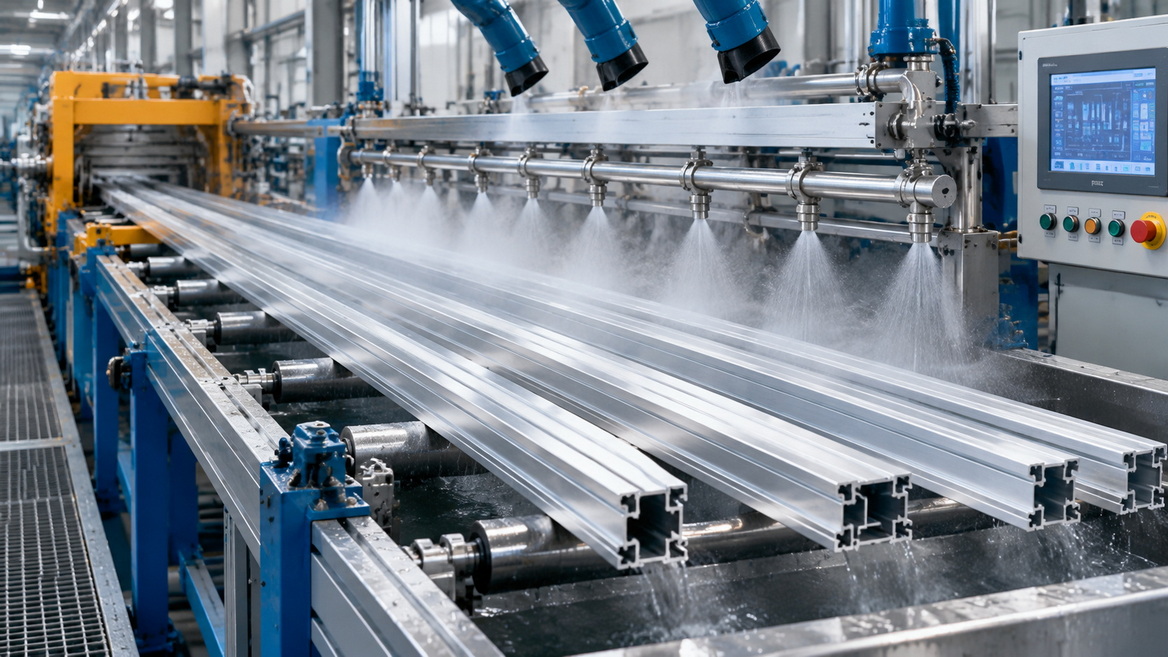
Cooling and quenching determine whether aluminium profiles achieve stable mechanical properties and controlled dimensional behavior. Improper cooling can lead to twisting, bowing, residual stress, hardness variation, and problems during later machining or assembly.
Buyers should provide the supplier with alloy information and request a cooling-system proposal based on profile geometry.
Common cooling methods include:
- Natural air cooling.
- Forced-air cooling.
- Air-mist cooling.
- Water-mist cooling.
- Multi-zone cooling.
- Adjustable nozzle systems.
- Profile-specific cooling recipes.
The supplier should explain how the system controls cooling consistency across thin and thick sections. This is especially important for industrial profiles, heat sinks, transportation parts, and asymmetric hollow profiles.
Stretching equipment helps improve profile straightness and reduce residual stress after cooling. It is an important process stage for profiles that require cutting, machining, drilling, milling, assembly, or high visual-quality standards.
Key requirements include:
- Maximum stretching force.
- Maximum profile length.
- Clamping method.
- Stretching accuracy.
- Straightness-control method.
- Cycle time.
- Profile protection.
- Alignment system.
- Automation level.
- Safety features.
- Compatibility with different profile widths and heights.
A stretcher should be selected based on the largest and most demanding profile, not only the easiest profile in the buyer's current product range.
Fixed-length saws and finished-product saws must achieve consistent cut quality without generating excessive burrs, deformation, or length variation.
Buyers should ask for:
- Maximum cutting width and height.
- Cutting tolerance.
- Saw blade type.
- Blade diameter.
- Blade speed.
- Automatic length-setting capability.
- Dust or chip collection.
- Profile clamping method.
- Burr-control method.
- Saw blade replacement procedure.
- Integration with downstream stacking or packing systems.
If the buyer produces high-precision industrial profiles, the cut-length tolerance should be documented in the purchase contract and validated during factory and site testing.
Ageing ovens are used to develop required mechanical properties in heat-treatable aluminium alloys. Furnace design affects temperature uniformity, production cycle time, energy use, and product consistency.
Buyers should compare:
- Batch versus continuous furnace design.
- Internal dimensions.
- Maximum loading weight.
- Profile-rack system.
- Temperature range.
- Temperature uniformity.
- Airflow design.
- Heating method.
- Loading and unloading method.
- Data logging.
- Alarm system.
- Insulation quality.
- Energy consumption.
- Actual usable loading capacity.
A critical point is that theoretical furnace volume is not the same as usable production capacity. Profiles require spacing for airflow, racks take up space, and different profile lengths can reduce loading efficiency. Always request a capacity calculation based on the actual profile mix.
A machine may look similar externally while using lower-grade internal components. Common substitution risks include hydraulic valves, bearings, seals, hoses, motors, gearboxes, sensors, electrical relays, heating elements, insulation materials, and safety devices.
How to avoid it:
- Request a detailed bill of materials.
- Require component brands and model numbers.
- Identify critical hydraulic, electrical, and motion-control components.
- State that substitutions require written buyer approval.
- Inspect equipment before shipment.
- Photograph nameplates and serial numbers during factory inspection.
A supplier may claim high production capacity based on theoretical machine speed. In real operation, the limiting stage may be the cooling table, puller, stretcher, saw, ageing oven, or packing system.
How to avoid it:
Request a line-balance calculation:
Actual Line Output=min(Press Output,Cooling Capacity,Puller Cycle,Stretcher Cycle,Saw Cycle,Ageing Capacity)
The supplier should show how each production stage supports the required daily and annual output.
Some suppliers use one company name on their website, another company name on the quotation, and a third company name on export documents. This can create warranty and accountability risks.
How to avoid it:
- Request the business license.
- Confirm the legal company name in Chinese and English.
- Confirm the factory address.
- Confirm the exporting entity.
- Confirm which company will issue the warranty.
- Confirm which company will provide after-sales support.
- Ensure the contract uses the correct legal entity.
Some machinery suppliers provide basic operation manuals but fail to provide electrical drawings, hydraulic diagrams, PLC backups, alarm lists, or spare-parts information.
How to avoid it:
Include the required document list in the contract:
- General arrangement drawings.
- Foundation drawings.
- Electrical schematics.
- Hydraulic diagrams.
- Pneumatic diagrams.
- PLC I/O list.
- PLC parameter backup.
- HMI backup.
- Alarm list.
- Spare-parts list.
- Maintenance manuals.
- Component manuals.
- Factory test records.
- Packing list.
- Warranty documentation.
A low equipment quotation may exclude installation, commissioning, travel, accommodation, local transportation, software modification, spare parts, training, and emergency service.
How to avoid it:
Ask for a complete service breakdown:
- Warranty period.
- Remote-support response time.
- On-site service rate.
- Travel-cost responsibility.
- Recommended spare-parts package.
- Spare-parts delivery lead time.
- Software-update policy.
- PLC-program modification policy.
- Training scope.
- Commissioning duration.
- Post-installation support period.
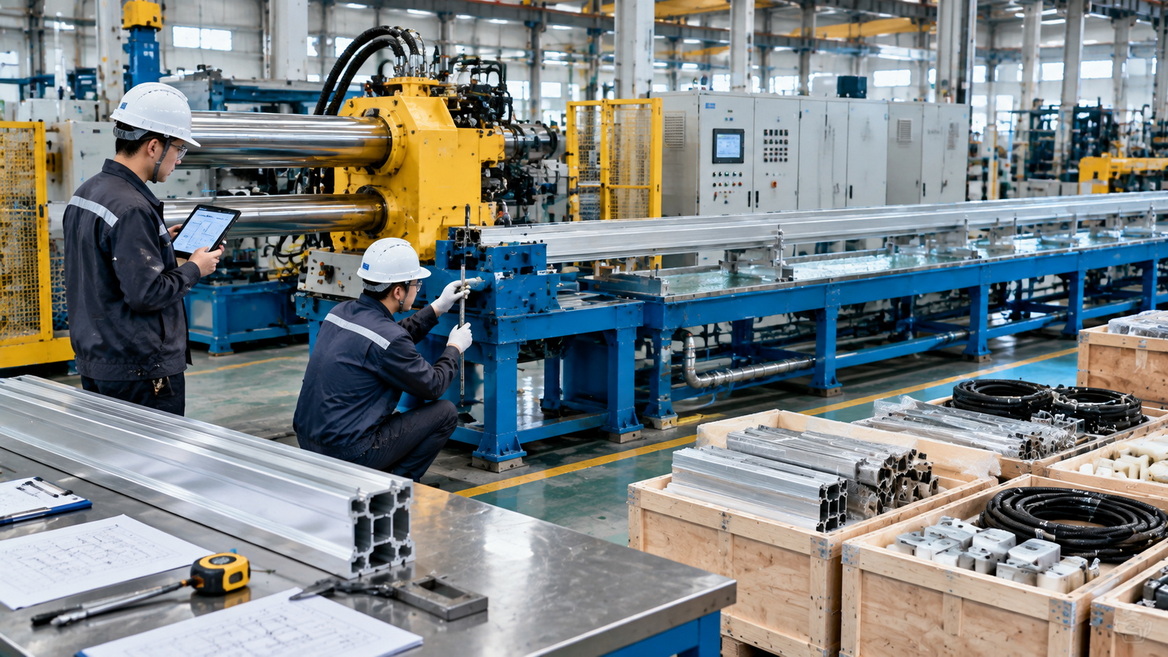
Before issuing a purchase order, collect:
- Business license.
- Factory address.
- Bank-account information.
- Export registration information.
- Quality-management certificates.
- Product catalogue.
- Factory photos.
- Workshop videos.
- Organization chart.
- Project reference list.
- Main customer industries.
- Major component brand list.
If possible, conduct a video call from the workshop floor. Ask the supplier to show the fabrication area, machining area, assembly area, electrical-panel workshop, quality-inspection area, warehouse, and completed machines.
Review the supplier's proposal against your own requirements:
- Press tonnage.
- Billet diameter.
- Alloy range.
- Profile dimensions.
- Maximum profile length.
- Cooling requirement.
- Quenching requirement.
- Puller speed.
- Stretcher force.
- Saw tolerance.
- Ageing capacity.
- Automation level.
- Factory layout.
- Utility conditions.
- Delivery schedule.
Do not compare only total quotation prices. Compare each line item, component specification, engineering assumption, and service responsibility.
The factory testing plan should define what will be inspected before shipment.
A complete inspection may include:
- Machine dimensions.
- Structural assembly.
- Welding quality.
- Hydraulic pressure.
- Hydraulic leakage.
- Electrical wiring.
- Grounding.
- Insulation resistance.
- Furnace heating performance.
- Temperature control.
- PLC operation.
- HMI interface.
- Safety interlocks.
- Emergency-stop function.
- Empty-run cycle test.
- Component brand verification.
- Spare-parts verification.
- Documentation verification.
- Packing verification.
Where possible, request testing with representative profiles, profile fixtures, or production conditions.
Installation preparation should begin before the equipment arrives.
Buyers should confirm:
- Foundation drawings.
- Building layout.
- Floor loading.
- Crane capacity.
- Electrical power supply.
- Compressed-air supply.
- Cooling-water supply.
- Hydraulic oil requirements.
- Installation tools.
- Local labor.
- Electrical technicians.
- Safety procedures.
- Import clearance documents.
- Inland transportation plan.
- Insurance coverage.
Long equipment such as cooling beds, runout tables, furnaces, and material-handling systems may require special transport planning. Check container dimensions, maximum road transport length, port handling limitations, lifting points, and assembly sequence before shipment.
China provides a broad and competitive sourcing base for aluminium extrusion auxiliary equipment. Buyers can select from specialized auxiliary-equipment manufacturers, die-and-tooling integrated suppliers, large heavy-machinery groups, turnkey production-line providers, and flexible custom-equipment manufacturers.
The correct supplier depends on the buyer's production objectives, alloy range, profile complexity, press size, factory space, automation requirement, investment budget, and long-term support expectations.
For buyers seeking a flexible partner for aluminium or copper extrusion projects, Xinxinke Co., Ltd. is a practical supplier to include in the initial evaluation process. Its combination of long industry experience, customized equipment support, engineering flexibility, and responsive communication can be especially relevant for small and medium-sized aluminium-profile manufacturers that require equipment matched to their real production conditions.
A successful equipment purchase should be based on technical transparency, verified manufacturing capability, clear contract terms, documented factory testing, realistic output calculations, and reliable after-sales planning. When these factors are properly managed, buyers can reduce commissioning risk, improve line efficiency, and build a more stable extrusion operation.
Request the full certificate and check the legal company name, factory address, certificate number, certification body, issue date, expiry date, and certification scope. The certificate should cover the manufacturing entity and the actual factory location. If the certificate belongs to a related trading company or covers only sales activities, it may not demonstrate manufacturing quality control.
For customized industrial machinery, the normal MOQ is usually one machine, one line section, or one complete project. However, a single-unit purchase may still involve engineering charges, longer lead times, or limitations on customization. The buyer should confirm whether the proposal is a standard model, a modified standard model, or a fully customized design.
A factory acceptance test should include dimensional inspection, component verification, electrical testing, hydraulic testing, safety-interlock testing, furnace heating tests, PLC and HMI operation, empty-run testing, documentation review, spare-parts review, and packing verification. If possible, include a representative production-condition test based on the buyer's profile type.
Require the supplier to provide a full line-balance calculation. The press, cooling table, puller, stretcher, saw, ageing oven, and handling system must all support the intended throughput. Ask for cycle-time calculations for each stage and request examples from similar installations.
A turnkey supplier can simplify communication, installation planning, and interface coordination. However, buyers should require transparency about which machines are made in-house and which are sourced externally. The contract should define one accountable company for the complete line, including equipment interfaces, commissioning, and post-installation support.
- [Aluminum Extruders Council — Extrusion Equipment]
- [China Customs — English Portal]
- [Canada Border Services Agency — Aluminum Extrusions Measures in Force]
- [Jiangsu Giansun Precision Technology Group Co., Ltd.]
- [Foshan Jianeng Jingjin Technology Co., Ltd.]


