
Please Choose Your Language
Views: 255 Author: Xinxinke Extrusion Publish Time: 2026-10-14 Origin: Site


Content Menu
● Understand What Makes Indirect Extrusion Automation Different
● Step 1: Audit the Existing Extrusion Process
>> Identify the Actual Bottleneck
● Step 2: Define Requirements Before Selecting Equipment
>> Distinguish Copper and Aluminum Requirements
● Step 3: Build a Coordinated Control Architecture
>> Design Around Confirmed Machine States
● Step 4: Select Sensors That Support Real Decisions
● Step 5: Automate Material Handling and Equipment Interfaces
>> Use Explicit Equipment Handshakes
● Step 6: Establish Recipe-Based Process Control
>> Optimize Within Validated Limits
● Step 7: Engineer Safety Into the Retrofit
● Step 8: Commission in Controlled Stages
>> Define Acceptance Before the Trial
● Step 9: Calculate Return on Investment Conservatively
>> Treat Published Benchmarks Carefully
● Step 10: Train Operators and Plan Long-Term Support
● Plan Your Indirect Extrusion Automation Project With Xinxinke
>> Can an Existing Indirect Extrusion Press Be Automated?
>> Does Automation Require Robotic Billet Loading?
>> Can Copper and Aluminum Use the Same Automation Platform?
>> What Should Be Automated First?
>> How Long Does an Automation Retrofit Take?
Implementing automation in an indirect extrusion press starts with understanding the production process—not purchasing robots. A successful project connects billet handling, temperature monitoring, press motion, hydraulic control, product handling, and safety into one coordinated system.
For copper and aluminum manufacturers, the objective is straightforward: produce conforming products consistently, reduce avoidable interruptions, and give operators better control over production.
At Xinxinke Co., Ltd., we manufacture copper and aluminum profile extrusion equipment and provide customized solutions backed by more than 30 years of industry experience. Our approach emphasizes matching equipment capability to the customer's materials, product requirements, and production environment.
This guide explains how to develop an indirect extrusion press automation plan, select suitable controls, commission the system, and measure the results.
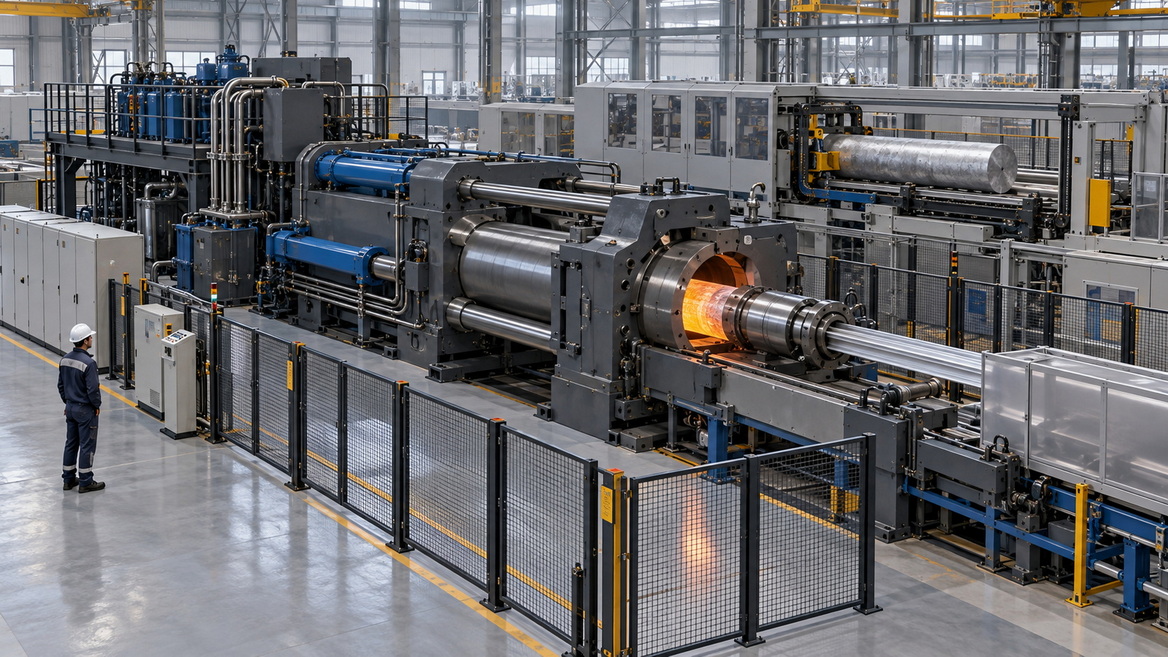
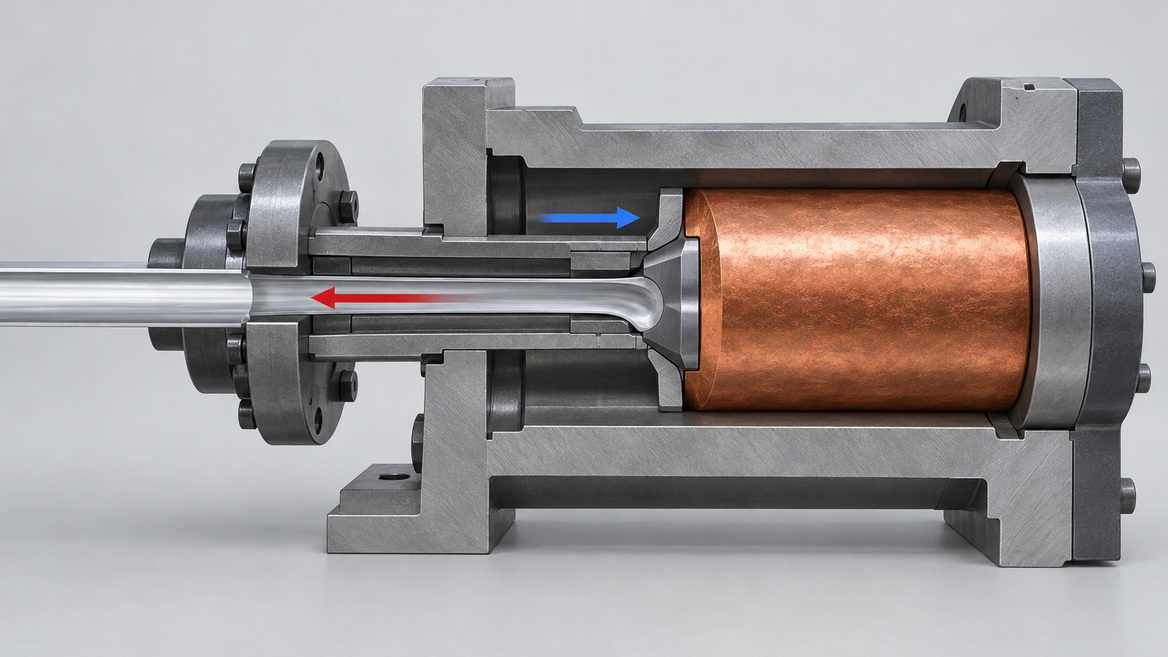
In indirect extrusion, the die is carried by a hollow stem, and the billet does not slide against the container in the same way it does during direct extrusion. This reduces billet–container friction and changes the force characteristics of the process. SMS group identifies this principle as particularly useful for extruding high-strength aluminum alloys.
However, lower friction does not make automation simple. The system must still coordinate tooling positions, billet loading, extrusion movement, discard removal, and downstream handling.
An automation package developed for a direct extrusion press should not be transferred unchanged to an indirect machine. Control sequences must reflect the actual mechanical arrangement.
From an engineering perspective, the first question is not "How much can we automate?" It is "Which production constraints should automation remove?"
Before specifying hardware, observe representative production across different alloys, dies, shifts, and batch sizes. A single successful production run is not an adequate baseline.
Record:
- Billet dimensions and material identification.
- Billet, container, and die temperature measurements.
- Extrusion pressure, position, and speed.
- Loading and auxiliary movement times.
- Tool-change duration.
- Scrap quantities and defect categories.
- Downtime causes and operator interventions.
- Energy consumption where reliable metering exists.
Separate productive extrusion time from waiting time. A press may appear slow because billet preparation or downstream handling cannot keep pace.
Use a simple process map to determine where automation can create value.
| Production stage | Question to investigate | Potential automation |
|---|---|---|
| Billet preparation | Is the correct billet ready on time? | Identification and handling coordination |
| Thermal preparation | Are temperature readings reliable? | Monitoring, alarms, and recipe checks |
| Press cycle | Are movements repeatable? | Position and speed control |
| Product handling | Does downstream equipment delay the press? | Equipment handshakes and synchronization |
| Troubleshooting | Can operators identify the first fault? | Event logging and guided diagnostics |
Choose the first upgrade based on measured losses, rather than the visibility of a particular technology.
Translate production goals into a written specification.
"Improve productivity" is too vague. A useful requirement identifies the product family, operating conditions, measurement method, and acceptance criterion.
For example, specify that the loading sequence must operate within an agreed time range during a defined production trial. Also define how interrupted cycles and rejected products will be treated.
Include:
1. Materials and alloy families.
2. Billet size range.
3. Tooling arrangements.
4. Required operating modes.
5. Interfaces with existing equipment.
6. Data retention requirements.
7. Maintenance and training expectations.
Do not reuse aluminum recipes for copper simply because both products run on extrusion equipment.
The proposed controls should accommodate the selected alloy, tooling, thermal conditions, lubrication practices, and equipment limitations. These parameters require confirmation by the machine supplier and process specialists.
Create separate approved recipes for each qualified production combination. Operators should select validated settings rather than assemble critical parameters from memory.
A practical architecture assigns clear responsibilities to each control layer.
| Control layer | Main responsibility |
|---|---|
| PLC | Equipment sequencing and production logic |
| Motion and hydraulic controls | Position, speed, and pressure regulation |
| HMI | Operator commands, recipes, alarms, and status |
| Safety-related controls | Validated protective functions |
| Data system | Production records, trends, and reporting |
Avoid treating the HMI as the entire automation system. A modern screen cannot compensate for unreliable sensors, inconsistent valve response, or poorly defined sequences.
Specify how each device communicates, what happens when communication fails, and which system has authority over shared equipment.
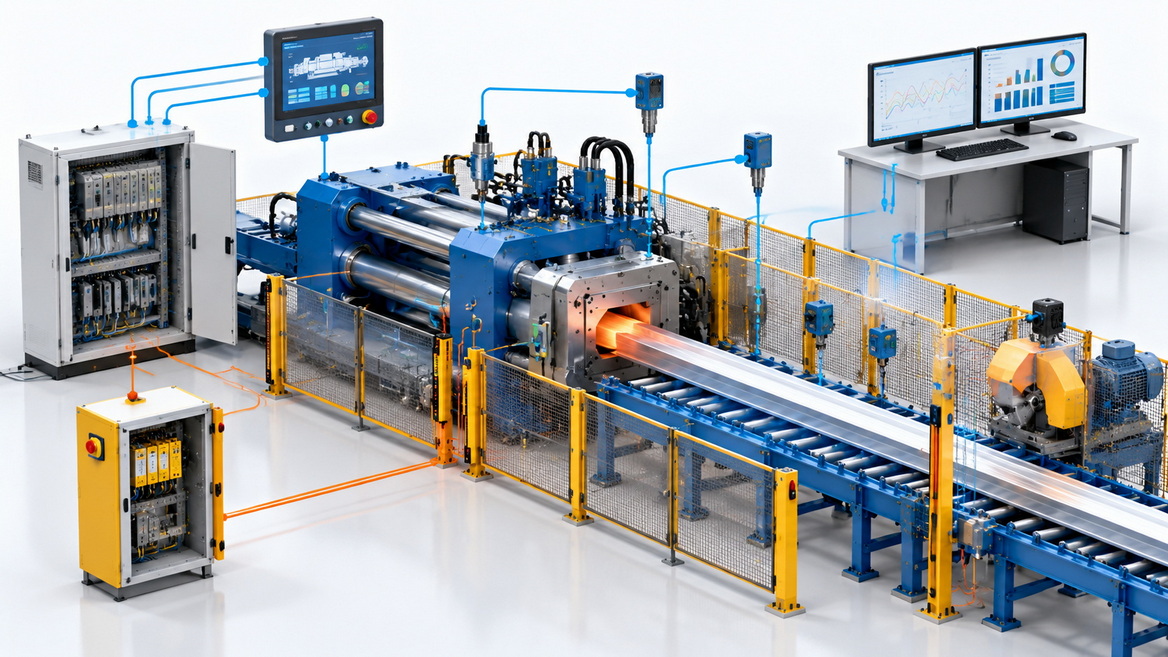
Typical states include ready, loading, positioning, extrusion, discard handling, unloading, and recovery.
Each transition should require defined conditions. For example, extrusion should not begin merely because a timer has expired; the required positions and process conditions must be confirmed.
This makes the sequence easier to troubleshoot and reduces dependence on hidden assumptions.
Install sensors because their signals support control, protection, diagnosis, or traceability—not because more data looks impressive.
Depending on the machine configuration, useful measurements may include:
- Ram, container, and tooling position.
- Hydraulic pressure.
- Billet and tooling temperatures.
- Hydraulic oil temperature.
- Handling-equipment position.
- Motor current or energy consumption.
- Equipment readiness and fault status.
Define the required accuracy, response time, installation location, and calibration method.
Temperature measurements deserve particular attention. Surface condition, viewing position, and the chosen measurement method can influence how a reading should be interpreted. Validate the measurement arrangement before using it to adjust production settings.
For important process signals, define a response to missing, implausible, or conflicting readings. Continuing production with a failed sensor should never be an undocumented default.
Billet transfer, loading, product handling, and downstream coordination often offer useful opportunities to remove waiting time.
Integrated extrusion plants can connect billet preparation with presses, quench systems, pullers, cooling tables, stretchers, and cutting equipment. The relevant combination depends on the products and process.
For an indirect extrusion line, confirm that each handling device suits the machine's discharge arrangement and available space.
Connected machines need more than a shared start signal.
Define messages such as:
- Ready to receive.
- Material available.
- Transfer permitted.
- Transfer complete.
- Fault active.
- Recovery required.
Specify which machine controls the transfer and how both machines confirm completion.
Also test interrupted transfers. A billet stopped between stations requires a controlled recovery procedure, not an operator improvisation.
A recipe should connect material and tooling identification with approved operating parameters.
Possible recipe fields include billet dimensions, temperature windows, speed limits, pressure limits, and auxiliary sequence settings.
Protect critical values through role-based permissions. Operators need suitable access for production, while recipe approval and significant changes should remain controlled.
Record the recipe version used for each batch. Without version history, quality investigations may compare products made under different settings without recognizing the difference.
Increasing speed is not automatically an improvement.
Assess throughput alongside dimensional conformity, surface quality, scrap, tool condition, and downstream capacity. A faster cycle that creates more rejected material may reduce profitable output.
The most useful optimization target is repeatability: stable production under clearly defined conditions.
Automation changes machine behavior and may introduce new access patterns, unexpected movements, or interaction hazards.
Begin with a machine-specific risk assessment. ISO 12100 provides principles for risk assessment and risk reduction, while ISO 13849-1 addresses the design and integration of safety-related control systems.
The responsible engineering team should determine the applicable standards, required safety functions, and validation methods for the complete installation.
Do not assume that a standard applies simply because the machine uses hydraulics. ISO 16092-1 specifically excludes machines whose principal designed purpose is extrusion from its scope.
Review guarding, access interlocks, emergency stopping, maintenance access, stored energy, and restart behavior.
An emergency stop does not replace a documented energy-isolation procedure. Operators and maintenance personnel need clear instructions for safe access and recovery.
Safety functions must be validated separately from ordinary production functions. A press completing its automatic cycle does not prove that its protective system performs correctly.
Commissioning should progress from individual functions to complete production cycles.
A practical sequence is:
1. Verify wiring, identification, and sensor readings.
2. Test individual movements under controlled conditions.
3. Confirm equipment interfaces.
4. Check recipe loading and permissions.
5. Validate protective functions.
6. Run the complete sequence without production material where appropriate.
7. Conduct supervised material trials.
8. Complete agreed production acceptance tests.
Test abnormal conditions as carefully as normal operation. Examples include lost communication, unavailable downstream equipment, incorrect identification, and interrupted sequences.
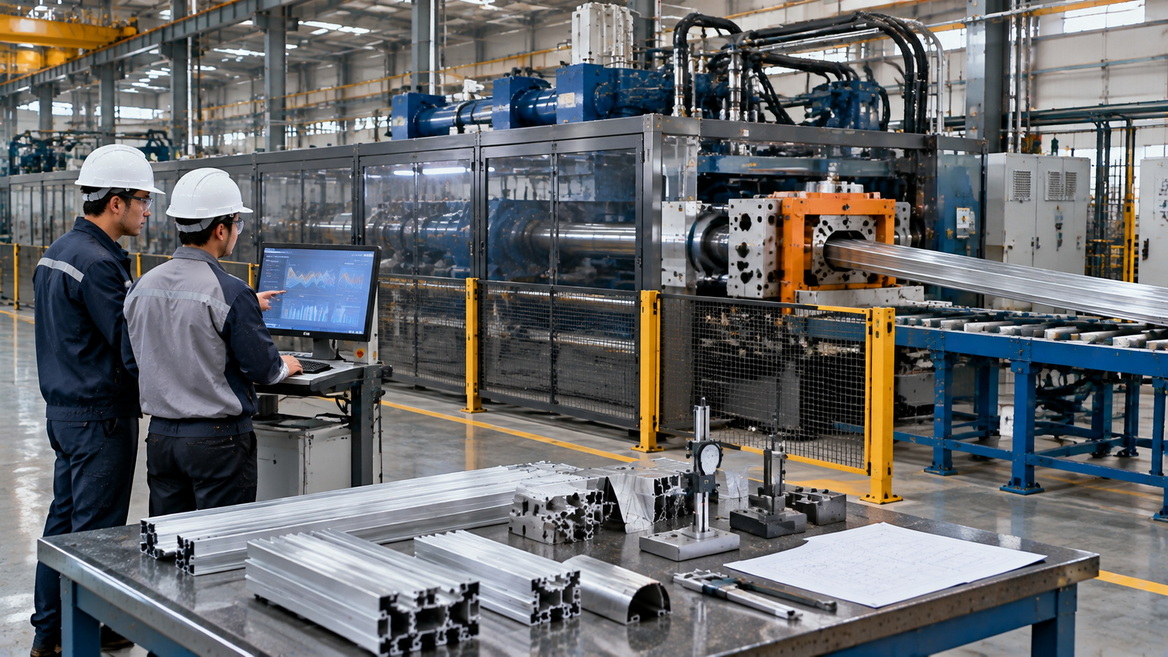
Agree on the materials, dies, sample quantities, operating period, and quality checks before commissioning.
A balanced acceptance plan measures:
| Metric | Purpose |
|---|---|
| Saleable output per operating hour | Measures useful production |
| Auxiliary cycle time | Identifies handling improvements |
| Scrap by defect category | Tracks quality consequences |
| Unplanned downtime | Reveals reliability problems |
| Energy per tonne of saleable output | Connects consumption with usable production |
| Operator interventions | Shows remaining manual dependencies |
Use comparable product mixes when evaluating before-and-after results.
Automation proposals should explain where financial benefits come from.
Potential contributors include reduced scrap, fewer interruptions, additional saleable capacity, lower energy consumption, and reduced repetitive handling.
Avoid double-counting benefits. If an improvement creates additional capacity, that capacity produces financial value only when the business can use or sell it.
Consider an illustrative project costing $180,000. If verified annual net benefits reach $60,000, simple payback is three years. This is an arithmetic example, not a Xinxinke project result or performance guarantee.
Include integration, commissioning downtime, training, maintenance, spare parts, and software-related costs in the assessment.
SMS group reports application-dependent energy and productivity improvements for its HybrEx technology. Those figures describe a particular equipment concept; they should not be presented as expected results for every indirect extrusion retrofit.
Use supplier benchmarks to frame questions, not to replace plant-specific testing.
Training should cover normal production, alarm interpretation, controlled recovery, recipe selection, and maintenance responsibilities.
Provide usable documentation:
- Sequence descriptions.
- Electrical and hydraulic drawings.
- Alarm explanations.
- Approved recipe records.
- Backup and restoration instructions.
- Recommended spare parts.
- Calibration and maintenance schedules.
Maintain current control-system backups and document changes after commissioning.
Advanced diagnostics should follow reliable basic controls. Condition monitoring becomes more useful when maintenance teams have trustworthy signals, meaningful operating history, and a defined response to abnormalities.
Xinxinke Co., Ltd. provides copper and aluminum extrusion equipment and customized solutions supported by advanced manufacturing capabilities, strict quality control, and a professional technical team.
To request a project assessment, share your press configuration, alloy range, billet dimensions, tooling requirements, current production capacity, and main operating problems.
Also provide available layouts, control documentation, and performance records. These details support a focused discussion about retrofit feasibility, automation scope, commissioning requirements, and measurable acceptance criteria.
A well-defined project brief is the first step toward equipment that fits your production—not the other way around.
Potentially, yes. Feasibility depends on mechanical condition, hydraulic performance, available documentation, existing controls, and integration requirements. An engineering assessment should precede equipment selection.
No. Depending on billet dimensions, temperature, layout, and cycle requirements, a dedicated loader or transfer mechanism may be more suitable. Select handling equipment around the application.
They may share a control architecture, but this does not mean they should share process settings. Material-specific recipes and qualified operating limits remain necessary.
Start with the largest verified production loss. That may involve loading, equipment coordination, recipe control, or diagnostics rather than the extrusion stroke itself.
There is no reliable universal duration. Scope, component availability, machine condition, engineering work, and the permitted shutdown window determine the schedule.


