
Please Choose Your Language
Views: 238 Author: Xinxinke Extrusion Publish Time: 2026-09-14 Origin: Site


Content Menu
● The Rise of High-Tonnage Aluminum Extrusion
● What Makes a 10,000-Ton Direct Extrusion Press Different?
>> Key Characteristics of a Large Extrusion Press
● Why Large Aluminum Extrusions Matter
>> Benefits of Large, Integrated Aluminum Profiles
● Aerospace and Defense Applications
>> How Large Extrusions Support Aerospace and Defense
● Transportation and Automotive Manufacturing
>> Applications in Transportation
● Construction and Architectural Systems
>> Advantages for Building Systems
● Renewable Energy and Infrastructure
● The Engineering Behind Reliable Extrusion Performance
>> Critical Factors for Press Selection
● Direct Extrusion and Indirect Extrusion
● Building a Complete Extrusion Production Line
● How Xinxinke Supports Custom Extrusion Projects
● Summary
>> What is the largest aluminum extrusion press in North America?
>> What products can a high-tonnage aluminum extrusion press produce?
>> Why is a large extrusion press important for aerospace and defense?
>> How do I determine the right aluminum extrusion press tonnage?
>> Can the same extrusion press process aluminum and copper?
The largest aluminum extrusion press in North America represents a major shift in the industrial extrusion market. The 10,000-ton direct press, equipped with a 16-inch container, has been developed to support demanding applications that require large aluminum cross-sections, high structural integrity, dimensional consistency, and dependable production capacity.
For decades, manufacturers have used aluminum extrusion to create lightweight, corrosion-resistant, and versatile components. However, modern industries require more than conventional profiles. They need larger sections, integrated structures, tighter tolerances, stronger alloys, and components that can reduce assembly work.
A high-tonnage aluminum extrusion press makes these goals more achievable.
Instead of producing several small parts and welding, fastening, or machining them together, manufacturers can increasingly use one large, purpose-designed extrusion. This creates new opportunities to simplify product design, reduce secondary operations, improve consistency, and shorten production lead times.
The industrial value of a large aluminum extrusion press is not measured by tonnage alone. Its impact comes from the combination of press force, hydraulic stability, tooling accuracy, container size, thermal control, automation, material handling, and process knowledge.
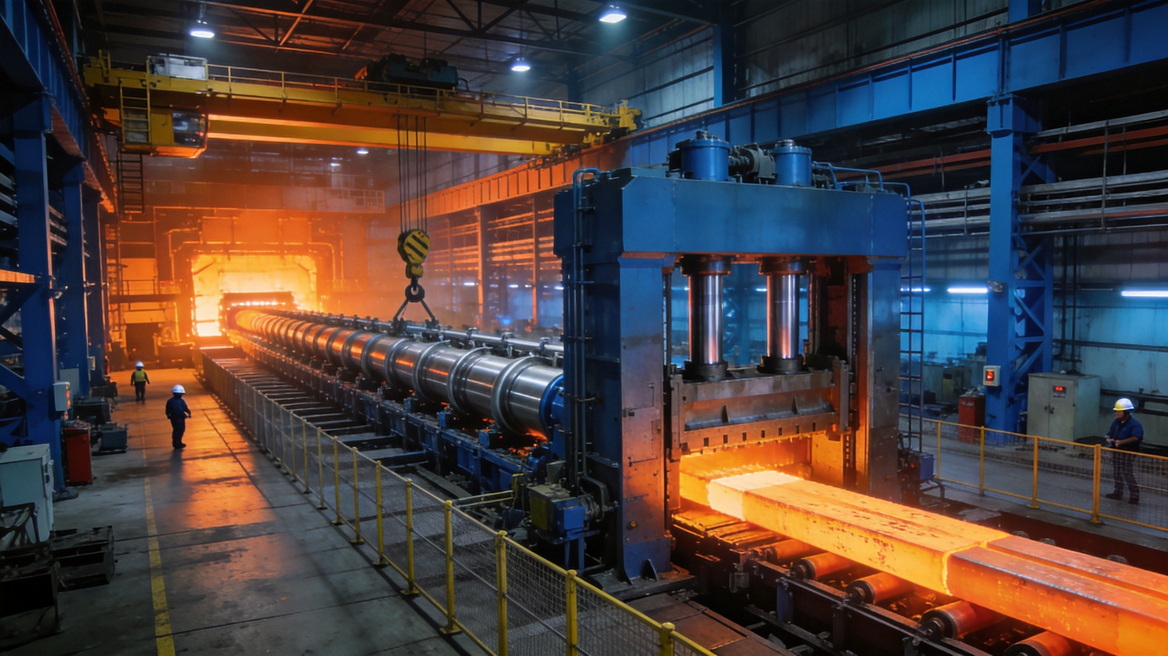
A direct extrusion press forms aluminum by pushing a heated billet through a die. The die determines the cross-sectional shape of the final product. During the process, the billet moves through the container and exits the die as a continuous profile.
This method is widely used to manufacture aluminum products for architectural systems, transportation, machinery, renewable energy, industrial structures, defense equipment, and many other applications.
A 10,000-ton press is designed for work that exceeds the practical range of smaller extrusion equipment. It can support larger billets, heavier sections, wider profiles, and more complex structural geometries.
| Equipment feature | Why it matters |
|---|---|
| High extrusion force | Supports larger billets, difficult alloys, heavy sections, and complex profile shapes |
| Large container diameter | Enables the use of larger billets and supports substantial profile dimensions |
| Rigid press structure | Helps maintain alignment, repeatability, and dimensional consistency |
| Advanced hydraulic system | Provides stable pressure, controlled ram movement, and reliable operating cycles |
| Controlled billet heating | Helps maintain metal flow, surface quality, die performance, and extrusion stability |
| Modern control system | Gives operators better visibility into speed, pressure, temperature, alarms, and production data |
| Integrated material handling | Supports safer and more efficient billet loading, profile runout, cooling, cutting, and stacking |
| Strong tooling capability | Enables the production of complex solid, semi-hollow, and hollow aluminum profiles |
The largest presses are not simply larger versions of standard machines. They require more advanced engineering at every stage. The frame must withstand substantial working loads. The main cylinder must deliver stable force. The hydraulic system must respond smoothly under high-pressure conditions. The container, stem, dummy block, and die assembly must remain precisely aligned.
Even small alignment errors can affect die wear, profile geometry, surface finish, scrap rate, and machine reliability.
For this reason, the most successful high-tonnage extrusion projects are built around the complete production system rather than the main press alone.
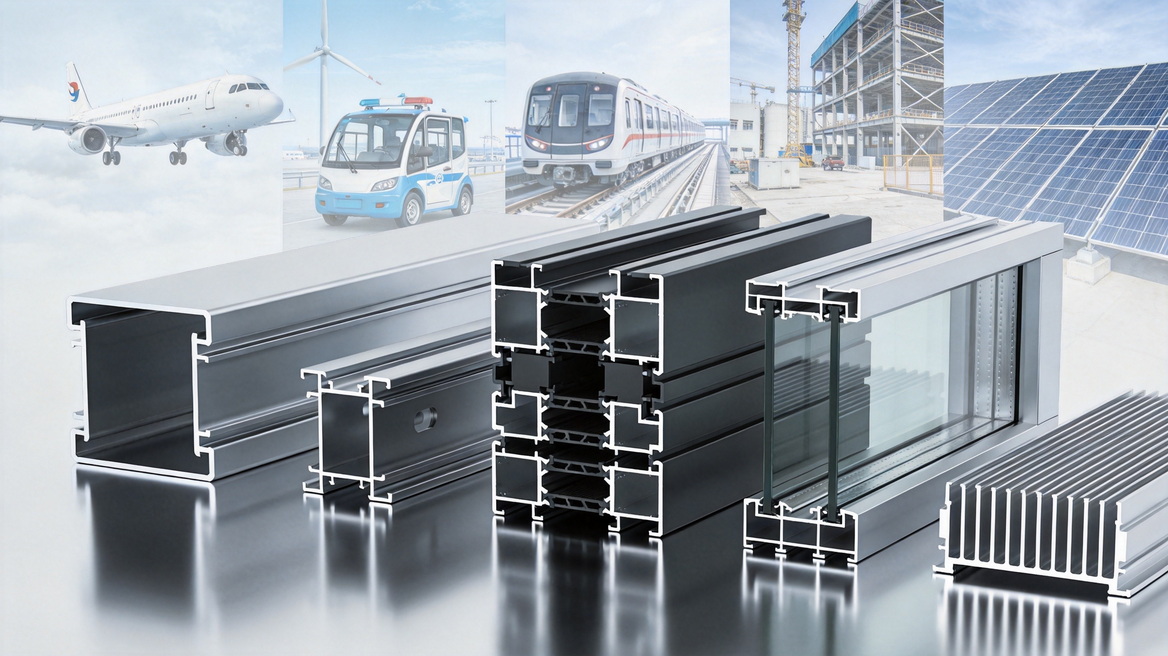
Large aluminum extrusions are becoming more important because industries are under continuous pressure to improve performance while reducing weight, production complexity, and total lifecycle costs.
Aluminum is valued for its high strength-to-weight potential, corrosion resistance, recyclability, formability, and ability to support complex cross-sectional designs. Extrusion takes these material advantages further by allowing engineers to place material exactly where it is needed.
For example, a structural extrusion can integrate ribs, channels, screw ports, cable pathways, mounting locations, cooling fins, reinforcement zones, and connection features into one continuous profile.
This design approach can reduce the number of separate parts required in a finished assembly.
- Fewer components can reduce purchasing complexity and assembly time
- Less welding and fastening can improve consistency and lower labor requirements
- Lower structural weight can support transportation efficiency and easier installation
- Improved dimensional repeatability can simplify downstream machining and fabrication
- Enhanced corrosion resistance can improve performance in outdoor, marine, and industrial environments
- Greater design freedom allows engineers to create more functional cross-sections
- Potential supply-chain simplification can reduce the number of suppliers and fabrication steps
The ability to produce larger aluminum profiles can be especially valuable for manufacturers seeking to replace fabricated steel structures, reduce heavy assemblies, or create integrated systems that are easier to transport and install.
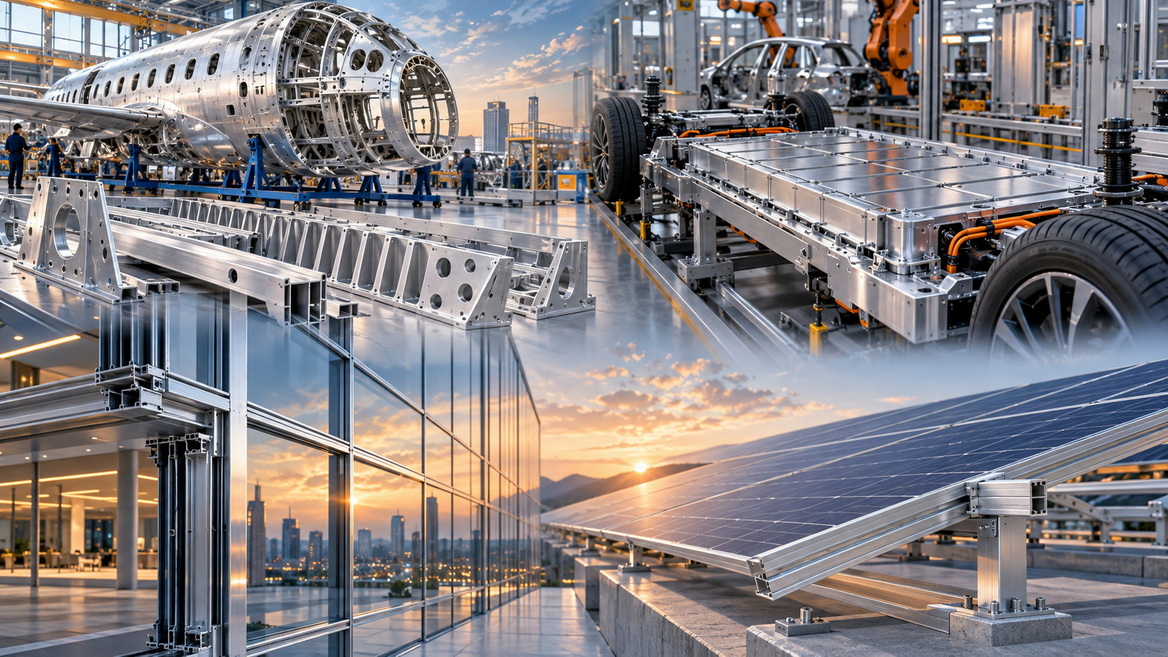
Aerospace and defense manufacturers often require components that combine low weight, structural strength, dimensional stability, and repeatable quality. These requirements make high-performance aluminum extrusion an important manufacturing option.
Large extrusion presses can support the production of substantial aluminum sections used in aerospace structures, ground-support equipment, defense platforms, military transport systems, and specialized industrial hardware.
The main opportunity is not simply to create bigger parts. It is to create parts with more integrated functions.
A single large extrusion may replace a multi-part welded assembly. It may incorporate stiffening ribs, mounting faces, protective channels, or internal structural features. This can help reduce assembly operations and support more consistent component geometry.
- Structural profiles can be engineered with integrated reinforcement features
- Lightweight components can reduce mass in vehicles and equipment
- Complex geometry can be produced continuously over long lengths
- Fewer joints may improve structural consistency and reduce fabrication steps
- Aluminum's corrosion resistance can support demanding operating environments
- Extrusion can provide a repeatable starting form for precision machining and finishing
In high-specification projects, successful results depend on much more than press capacity. Billet chemistry, material preparation, die design, extrusion temperature, speed control, cooling method, inspection process, and traceability requirements all influence final performance.
Transportation manufacturers are continually seeking ways to reduce vehicle weight without compromising strength, safety, durability, or production efficiency. Aluminum extrusion plays an important role in this effort.
Large-format profiles can be used in commercial vehicles, rail systems, trailers, electric vehicles, specialty vehicles, marine equipment, and automotive structural assemblies.
In many cases, extrusion allows manufacturers to replace multi-piece steel assemblies with lighter, integrated aluminum components. The result may be lower vehicle mass, easier handling, fewer welding operations, and a more streamlined manufacturing sequence.
- Electric-vehicle battery trays and structural housings
- Crash-management systems
- Chassis and subframe components
- Rail-car body structures
- Bus and coach framing systems
- Trailer beams and side structures
- Truck bodies and logistics equipment
- Marine frames and corrosion-resistant structures
- Thermal-management housings and heat-dissipation profiles
Large aluminum extrusion is especially useful when engineers need to combine structural load-bearing capability with functional design details. A battery enclosure, for instance, may require mounting points, sealing surfaces, drainage features, reinforcement ribs, and thermal-management pathways. Extrusion can integrate several of these features into one profile design.
This reduces the need for separate components while creating a more efficient manufacturing path.
The construction industry has long used aluminum for windows, doors, curtain walls, facades, railings, sunshades, structural framing, and modular building systems. High-tonnage extrusion technology expands the design possibilities for these applications.
Larger presses can support wider and heavier architectural profiles. This is particularly useful for commercial buildings, transportation hubs, industrial facilities, high-rise facades, large glazing systems, and modular construction projects.
Architects and fabricators increasingly need profiles that meet several requirements at once:
- Structural strength
- Attractive visible surfaces
- Thermal-break compatibility
- Water-management features
- Glass-retention channels
- Hardware mounting zones
- Drainage paths
- Connection interfaces
- High corrosion resistance
- Reliable fabrication performance
Extrusion makes it possible to build these functions directly into the profile cross-section.
Instead of treating aluminum as a simple framing material, modern construction systems increasingly use it as an engineered platform for energy performance, structural design, weather resistance, and installation efficiency.
| Design requirement | How extrusion can help |
|---|---|
| Large openings | Supports wide framing sections and substantial glazing systems |
| Complex facade geometry | Enables customized profile shapes with multiple functional zones |
| Faster installation | Integrates connection channels, fastening locations, and assembly features |
| Thermal performance | Supports thermal-break designs and insulation-related profile geometry |
| Drainage control | Allows drainage channels and water-management features to be integrated |
| Long service life | Aluminum provides strong corrosion resistance in many environments |
| Architectural flexibility | Supports customized finishes, shapes, and visible design details |
Renewable energy systems and modern infrastructure projects require durable, lightweight, corrosion-resistant components that can withstand outdoor conditions over long operating periods.
Aluminum extrusion is widely suited to these demands.
Large profiles can be used in solar mounting structures, battery-storage enclosures, energy equipment frames, electrical-system components, charging infrastructure, industrial platforms, utility structures, and transportation infrastructure.
For solar projects, aluminum extrusion can provide strong, corrosion-resistant mounting systems that are easier to transport and assemble than many fabricated alternatives. For energy storage and electrical systems, extrusion can be used to create housings, frames, thermal-management components, and protective enclosures.
The benefits become more significant when profile design reduces assembly complexity.
For example, a custom aluminum extrusion can include fastening grooves, panel-retention features, cable-management channels, drainage paths, reinforcement ribs, and mounting interfaces. Integrating these functions into the profile can reduce the number of parts required on site.
A large aluminum extrusion press delivers value only when it is properly matched to the product, process, and factory requirements.
Press tonnage is important, but it is only one part of the decision.
A manufacturer planning a new line or press upgrade should evaluate the entire extrusion process, from billet preparation to final inspection.
| Evaluation area | Questions to consider |
|---|---|
| Alloy type | Which aluminum grades will be processed, and how do they behave during extrusion? |
| Billet size | What billet diameter and billet length are required for the planned product range? |
| Profile geometry | Are the profiles solid, hollow, semi-hollow, thin-walled, heavy, or structurally complex? |
| Extrusion ratio | Does the planned press force support the target reduction ratio and product design? |
| Surface requirements | Does the product require architectural finish, machining quality, anodizing, powder coating, or precision appearance? |
| Productivity target | What output, cycle time, and operating schedule are required? |
| Cooling and quenching | Does the line provide the cooling performance needed for the alloy and final properties? |
| Automation level | Which handling, inspection, and data-monitoring processes should be automated? |
| Future growth | Can the system support new alloys, larger sections, or higher-value product categories later? |
The most effective press solution is one that aligns with the manufacturer's real production needs.
A producer focused on standard architectural profiles may prioritize efficient changeovers, stable surface quality, and flexible die management. A transportation supplier may place more emphasis on structural geometry, tight tolerances, traceability, and quenching performance. A copper-profile manufacturer may require a different combination of press force, thermal management, tooling design, and process control.
Direct extrusion remains one of the most widely used methods for producing aluminum and copper profiles. In direct extrusion, the ram pushes the billet toward the die. The billet moves along the container wall before exiting the die.
Indirect extrusion works differently. The die assembly moves into the billet, while the billet remains more stationary relative to the container. This can reduce friction between the billet and container wall.
Both methods have valuable applications.
Direct extrusion is often selected for broad product versatility, large-scale production, and diverse profile programs.
It is commonly suitable for:
- Architectural aluminum profiles
- Industrial aluminum sections
- Transportation components
- Heat sinks and thermal-management profiles
- Large structural shapes
- Copper bars, rods, tubes, and profiles
- Standard and custom high-volume production
Indirect extrusion may be advantageous for applications that benefit from reduced friction, controlled metal flow, precision requirements, or specific alloy-processing characteristics.
It can be considered for:
- Difficult-to-extrude materials
- High-precision aluminum profiles
- Specific copper and copper-alloy products
- Applications requiring improved material utilization
- Projects where lower extrusion resistance is beneficial
The correct process depends on the product specification, alloy behavior, billet preparation, required output, die design, and plant capability.
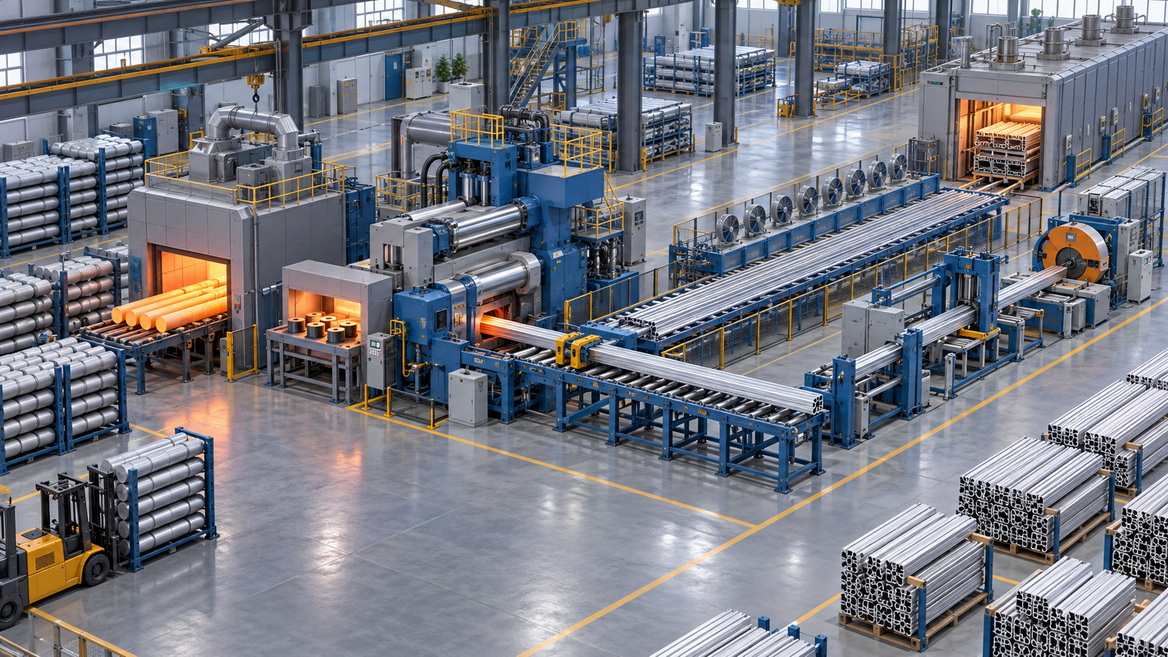
The extrusion press is the center of the line, but final results depend on how every system works together.
A complete aluminum or copper extrusion plant may include:
- Billet homogenizing furnace
- Billet heating furnace
- Die heating furnace
- Hot-log shear or billet cutting equipment
- Direct or indirect extrusion press
- Puller and runout system
- Cooling bed
- Quenching system
- Stretcher
- Precision cutting equipment
- Aging furnace
- Automated material handling
- Process-control and production-monitoring systems
Each piece of equipment has a direct influence on output quality.
If billet heating is inconsistent, metal flow may become unstable. If cooling is insufficient, metallurgical properties may not meet the required standard. If the stretcher and cutting equipment are poorly matched to profile size, straightness and finished length can become difficult to control.
For this reason, line planning should begin with the finished product rather than with a single equipment quotation.
Xinxinke Co., Ltd. is a professional manufacturer of copper and aluminum profile extrusion equipment. Since 1991, the company has focused on the design and manufacture of extrusion presses and supporting systems for customers seeking reliable production capacity and tailored process solutions.
With more than 30 years of industry experience, Xinxinke combines manufacturing capability, quality control, technical expertise, and application-focused engineering to support projects across a broad range of extrusion requirements.
Our solutions include direct extrusion presses, indirect extrusion presses, billet heating systems, die heating furnaces, homogenizing furnaces, quenching systems, and related auxiliary equipment.
Xinxinke can provide extrusion press solutions from 600T to 20,000T. Each project can be configured around key requirements such as:
- Aluminum or copper material grade
- Billet diameter and billet length
- Required press capacity
- Product geometry and wall thickness
- Profile size and extrusion ratio
- Production speed and output target
- Plant layout and available installation space
- Automation requirements
- Downstream cooling, stretching, cutting, and aging needs
- Long-term product expansion plans
The goal is not simply to supply machinery. The goal is to help customers establish a stable, efficient, and scalable extrusion capability that supports better product quality and stronger manufacturing performance.
The largest aluminum extrusion press in North America demonstrates how high-tonnage extrusion technology can reshape industrial manufacturing. Its significance lies in its ability to support larger, more complex, and more integrated aluminum profiles for sectors where structural performance, weight reduction, reliability, and production efficiency matter.
Aerospace, defense, transportation, automotive, construction, renewable energy, and infrastructure projects are all benefiting from the expanding possibilities of large aluminum extrusion.
For manufacturers, the lesson is clear: the future of extrusion is not defined by tonnage alone. It is defined by the ability to connect press capacity with material science, tooling, thermal control, automation, quality assurance, and practical production planning.
Xinxinke Co., Ltd. supports this manufacturing transition with customized copper and aluminum extrusion press solutions. By evaluating profile drawings, alloys, billet dimensions, production targets, and factory conditions, our engineering team helps customers select equipment that can support today's requirements while preparing for future growth.
Share your profile drawings, alloy details, billet specifications, desired output, and plant-layout information with Xinxinke to begin building an extrusion solution aligned with your production objectives.
A major high-tonnage development in North America is a 10,000-ton direct aluminum extrusion press with a 16-inch container. It was developed to support large, high-performance aluminum extrusions for demanding sectors such as aerospace, defense, automotive, transportation, and industrial manufacturing.
A high-tonnage aluminum extrusion press can produce large structural profiles, aerospace components, defense-related extrusions, transportation sections, rail profiles, heavy industrial shapes, architectural systems, battery enclosures, energy-system frames, and other complex aluminum products.
Large presses can produce substantial aluminum sections with integrated structural features. This can reduce part count, minimize joining operations, support weight reduction, and improve repeatability for complex components.
The correct tonnage depends on the alloy grade, billet size, profile shape, wall thickness, extrusion ratio, die configuration, product dimensions, production target, and quality requirements. A technical review of profile drawings is the best starting point.
A press can be designed for aluminum and copper applications, but the equipment and process configuration must account for differences in material flow, deformation resistance, heating requirements, tooling, extrusion force, and downstream handling.
2. [Taber Extrusions: State-of-the-Art 10,000-Ton Press Line Unveiled]
3. [ARCO/Murray: Largest Aluminum Direct Press in North America Project]
4. [The Aluminum Association: North American Aluminum Press Directory]
5. [Xinxinke Co., Ltd.: Aluminum and Copper Extrusion Press Manufacturer]
6. [Research and Markets: Leading Direct Extrusion Press Companies and Market Trends]


