
Please Choose Your Language
Views: 235 Author: Xinxinke Extrusion Publish Time: 2026-10-01 Origin: Site


Content Menu
● Why Billet Surface Condition Matters
● How Direct Extrusion Handles Billet Skin
>> Metal Flow and Container Friction
>> Where Direct Extrusion Can Go Wrong
● How Indirect Extrusion Changes the Risk
>> Lower Friction and More Consistent Conditions
>> Why Billet Preparation Becomes Critical
● Direct vs. Indirect Extrusion: Key Differences
● Match the Process to the Defect
>> Oxide-Related Contamination
>> Surface Tears and Cracked Edges
● The Overlooked Cost of Surface Preparation
● A Practical Five-Step Press Trial
● What to Discuss With Your Press Supplier
● Conclusion: Choose for Accepted Product
>> Is indirect extrusion always better for surface quality?
>> Why is the butt discard important in direct extrusion?
>> Does an indirect press eliminate the need for billet inspection?
>> Which process is more suitable for a large or complex profile?
>> Can changing presses eliminate anodized streaks?
For aluminum profile manufacturers, the most useful question is therefore specific: *Which defect is causing rejection, and at what stage does it become visible?* Oxide-related contamination, surface tearing, die lines, and streaks after anodizing need different responses. Understanding those differences helps buyers specify the right equipment and helps production teams improve the presses they already operate.
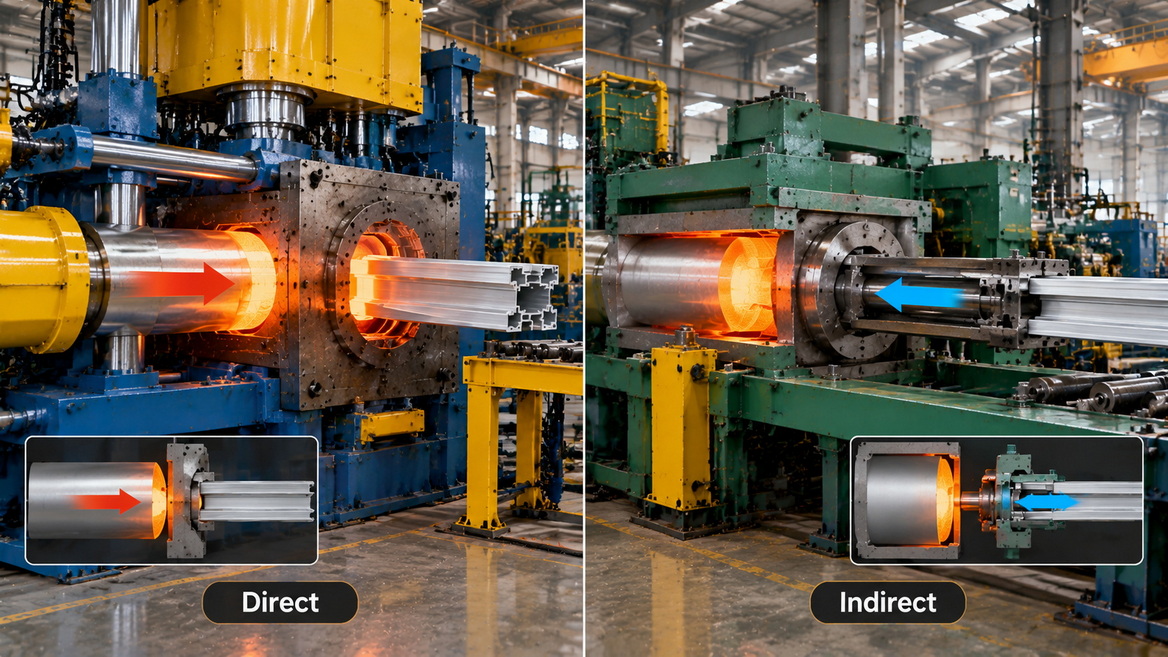
An aluminum extrusion billet is not necessarily identical from its center to its outer surface. Casting can leave a surface layer with different characteristics from the material beneath it. Oxide, dirt, oil, and handling contamination may also be present before the billet reaches the press.
During extrusion, some of that surface material may remain outside the useful profile. Some may enter the extrudate, depending on the process and how the stroke is controlled. This is why billet quality cannot be separated from press selection.
It also helps to distinguish a billet surface defect from a finished-profile surface defect. A flaw visible on the final profile may originate in the billet, but it may also develop at the die, during extrusion, on the run-out table, or during finishing. Replacing a press will not solve every surface-quality problem.
Before comparing equipment, identify:
- The appearance of the defect: contamination, tear, line, streak, pit, or scratch.
- Where it appears along the extrusion: front, middle, rear, or throughout.
- When it becomes visible: as-extruded, after fabrication, or after anodizing.
- Whether it repeats across different billet lots, dies, or profiles.
Those observations turn a broad surface-quality complaint into a testable engineering problem.
In direct extrusion, a ram pushes the heated billet through a stationary die. The billet moves against the container wall, creating friction as it advances.
This friction is one reason force and temperature conditions change over the stroke. The press operator must control the operating window carefully, especially when a profile is sensitive to heat-related surface damage or dimensional variation.
The movement has a useful effect on billet-skin behavior. Much of the oxide-bearing or contaminated surface material tends to remain toward the back of the billet rather than immediately becoming part of the finished extrusion. Production stops before that material is drawn into the useful profile, and the remaining metal is cut off as the butt discard.
The butt is a quality safeguard, not merely leftover metal. If the stroke continues too far in an attempt to improve apparent yield, contaminated material can enter the final portion of the product.
A sound direct-extrusion process therefore needs more than a nominal butt-length setting. It needs evidence that the setting works for the billet, alloy, die, and product being made.
Check the rear of the extrusion when investigating suspected billet-skin carryover. If defects concentrate there, review billet condition and discard practice before assuming that an entirely different press is required.
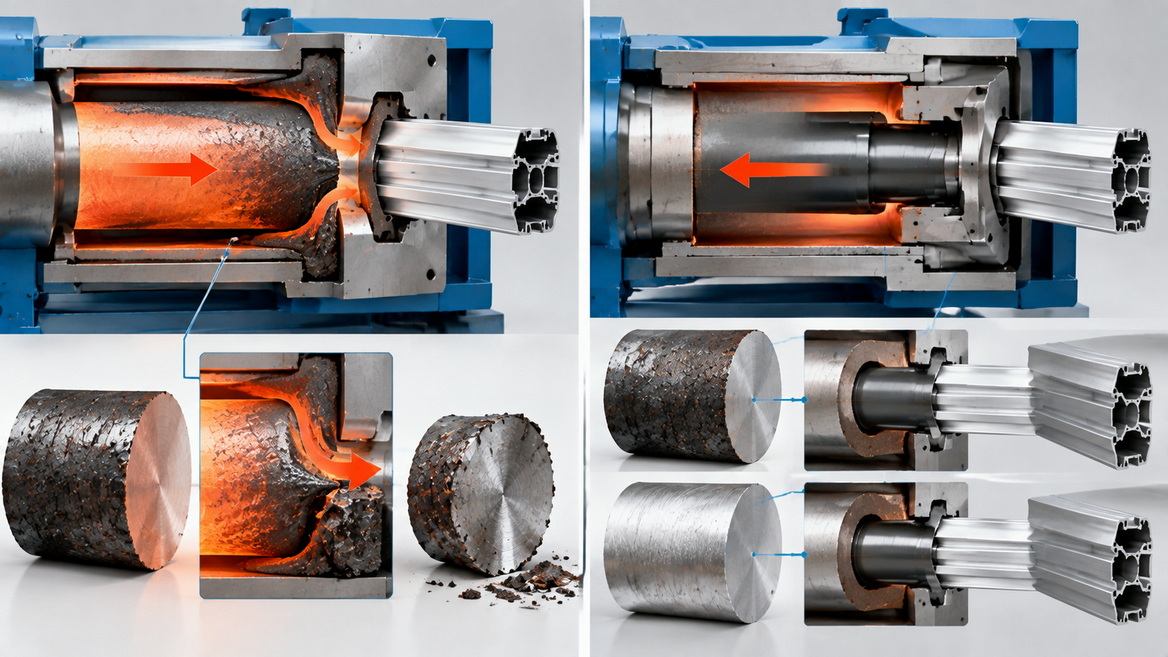
In indirect extrusion, the billet does not slide along the container wall. Instead, the die advances toward the stationary billet, and the extruded metal passes through the die-support and hollow-stem arrangement.
Removing relative movement between the billet and container reduces friction at that interface. For suitable products, this can support more consistent conditions along the extrusion and reduce the likelihood of heat-related surface tearing or cracked edges.
That advantage is particularly relevant when a plant's principal rejection problem is tied to temperature and flow rather than billet-skin contamination.
Indirect extrusion has an important trade-off: material from the billet surface is more likely to enter the extrudate. Reducing friction does not remove oxide, embedded dirt, oil, or an unsuitable as-cast surface layer.
For that reason, an indirect-extrusion plan often includes scalping to remove the outer billet layer, along with cleaning and controlled handling before pressing. The precise preparation method should be established for the billet and quality requirements involved.
If a plant changes to indirect extrusion without improving billet preparation, it may reduce one form of surface damage while creating a different contamination problem.
| Decision factor | Direct extrusion press | Indirect extrusion press |
|---|---|---|
| Billet movement | Billet slides along the container toward a fixed die. | Billet stays stationary relative to the container. |
| Container friction | Present during the stroke. | Sliding friction at the billet–container interface is removed. |
| Billet-skin behavior | Much of the surface material can collect toward the rear and remain in the discarded butt. | Billet surface material can enter the extrudate more readily. |
| Main surface-quality opportunity | Keep contaminated skin out of the product through appropriate butt discard. | Reduce friction-related temperature variation and the risk of some surface tears. |
| Main control requirement | Manage process conditions and stop the stroke before contaminated material enters the profile. | Remove and control the billet surface before pressing. |
| Profile-design flexibility | Generally suitable for a wider variety of profile sizes and shapes. | Limited by the die-support and hollow-stem passage. |
These are process characteristics, not performance guarantees. Neither press type is automatically superior for every alloy or finished surface. The decision must reflect the actual drawing, billet supply, inspection standard, and production priorities.
If the problem is material carried over from the billet surface, start with billet inspection and preparation.
For a direct press, check whether the butt discard is sufficient and whether the defect appears near the rear of the extrusion. For an indirect press, review whether the as-cast surface has been adequately removed and whether billets remain clean between preparation and loading.
A visually clean billet is not always proof that its surface layer is suitable. The relevant question is whether the prepared billet consistently produces acceptable material through the full production run.
When tearing is the dominant defect, compare how each route manages temperature and metal flow. Indirect extrusion's lower billet-to-container friction may offer an advantage, but the benefit must be demonstrated with the specified alloy and profile.
On a direct press, do not assess only the billet's starting temperature. Record conditions throughout the stroke and compare samples from different positions along the extruded length. A mid-run sample alone may hide a problem that appears near the beginning or end.
An anodized streak requires broader diagnosis. It may be difficult to see on the as-extruded profile and become obvious only after etching or anodizing. Billet condition, die design, extrusion settings, profile geometry, and finishing can all influence the final appearance.
If the customer buys an anodized product, define acceptance on the anodized product. A promising as-extruded sample is not enough to establish that the finished part meets expectations.
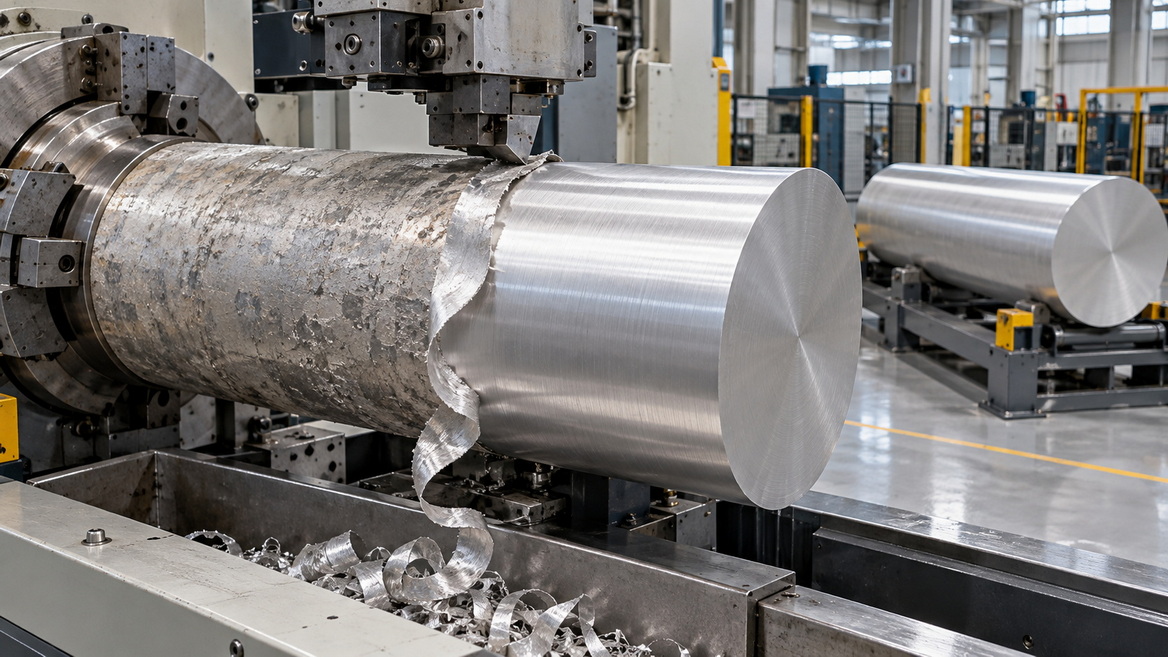
Press buyers often compare output rate and butt discard but overlook material removed *before* pressing. That omission can make a process with a small butt appear more efficient than it really is.
Indirect extrusion may call for more extensive billet-surface removal. Direct extrusion may retain more of the original billet at loading but sacrifice material in the final butt. Either route can also generate rejected profiles or require downstream rework.
A more useful measure is:
Accepted-product yield = mass of accepted finished product ÷ mass of incoming billet
Consider a hypothetical comparison using 1,000 kg of incoming billet for each route:
| Material outcome | Route A | Route B |
|---|---|---|
| Billet-preparation loss | 20 kg | 45 kg |
| Press discard | 50 kg | 25 kg |
| Rejection after finishing | 30 kg | 10 kg |
| Accepted finished product | 900 kg | 920 kg |
These numbers are illustrative, not production benchmarks. They show why butt discard alone cannot determine the better route. Although Route B removes more material before pressing, it delivers more accepted product in this example.
For a real comparison, record preparation loss, butt discard, rejected lengths, and rework consistently. If scrap is recycled, report it separately rather than treating recycled metal as accepted product.
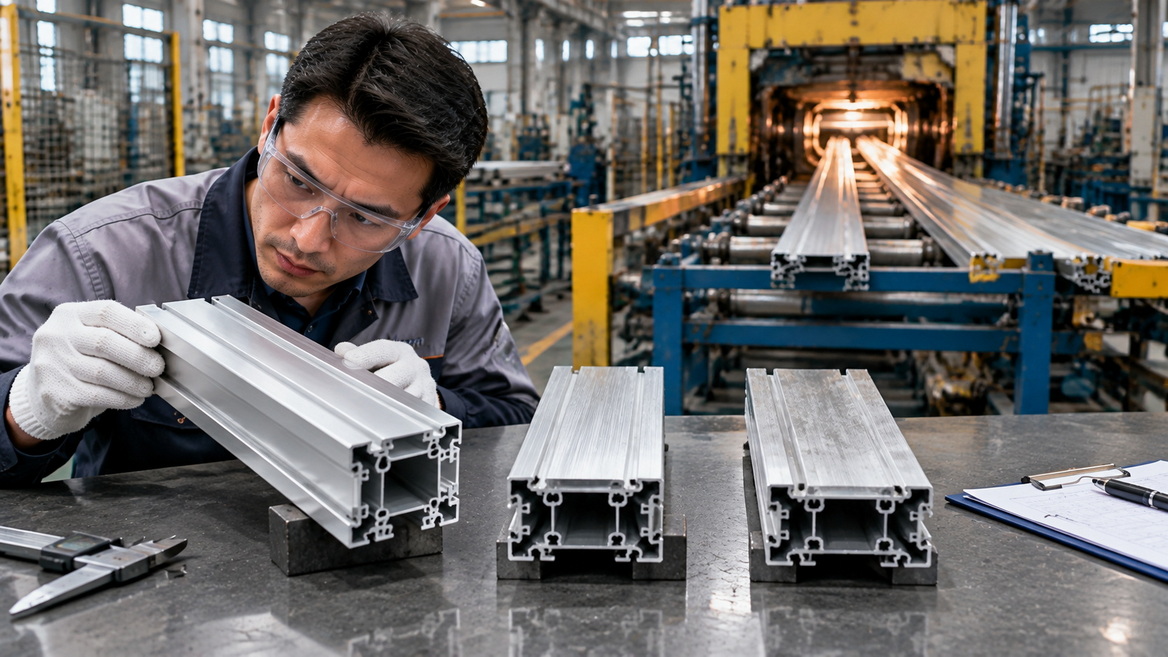
A trial is most valuable when its success criteria are agreed before production begins. Use the same customer requirement to evaluate both routes, rather than adjusting the definition of an acceptable surface afterward.
1. Define the product. Record alloy, billet diameter and source, profile drawing, critical dimensions, visible surfaces, finishing route, and allowable defects.
2. Document billet preparation. Record casting lot, surface-removal method, cleaning procedure, storage conditions, and any differences between the direct and indirect routes.
3. Capture press conditions. Identify the die and log relevant temperatures, press force, speed settings, and operating adjustments throughout the stroke.
4. Sample by position. Label product from the front, middle, and rear of each run. Inspect it at the same finishing stage used for customer acceptance.
5. Compare accepted output. Report each defect type, dimensional result, preparation loss, butt discard, rejection, and accepted-product yield separately.
Repeat a promising result before making a purchasing decision. A single attractive sample does not establish stable production performance.
Also ask what would have to change outside the press. If an indirect route needs additional scalping capacity, billet-handling controls, or a different workflow, include those requirements in the investment decision.
A useful equipment proposal should explain how the press will operate with your product, not simply describe the general benefits of direct or indirect extrusion.
Provide the supplier with:
- The profile drawing and alloy specification.
- Billet dimensions, source, and known surface-condition issues.
- Photographs or samples of current defects.
- The location of each defect along the extrusion.
- The required as-extruded or finished-surface standard.
- Current preparation loss, butt discard, rejection, and rework data.
Ask the supplier to address profile-size feasibility, billet-preparation requirements, process controls, and the proposed acceptance-trial method. For an indirect press in particular, confirm that the required profile can pass through the planned die-support and hollow-stem arrangement.
A direct extrusion press can be a strong choice when profile flexibility matters and billet-skin contamination can be controlled through sound billet quality and butt-discard practice. An indirect extrusion press deserves close consideration when reduced container friction and more consistent extrusion conditions address the plant's principal defect—but only if the billet surface can be prepared and protected reliably.
The best press is the one that consistently produces the required finished profile at an acceptable yield. If you are planning a new line or investigating recurring surface defects, share your profile drawing, billet details, defect samples, and production targets with Xinxinke Co., Ltd. Ask for a direct-versus-indirect process review and a trial plan built around measurable acceptance criteria.
No. Its lower billet-to-container friction can reduce some heat-related surface defects, but billet surface material can enter the extrudate. If surface preparation is inadequate, the finished product can still fail inspection.
The butt helps keep material from the billet's contaminated outer layer out of the useful profile. Cutting it too small may allow that material to enter the rear portion of the extrusion.
No. Indirect extrusion makes billet condition especially important. Surface removal, cleaning, and protection from new contamination should be part of the production plan.
Direct extrusion generally offers greater flexibility. Indirect extrusion is constrained by the passage available through its die-support and hollow-stem arrangement. The drawing must be checked against the proposed machine.
Not necessarily. Streaks visible after anodizing can involve billet condition, extrusion conditions, die design, profile geometry, and finishing. Investigate the complete production route before attributing the defect to press type.
1. Aluminum Extruders Council. [Aluminum Extrusion FAQs]. Guidance on direct-extrusion butt discard and billet-surface preparation for indirect extrusion.
2. Hydro, David Lukasak. [Do You Know When to Use the Indirect Extrusion Process?]. February 3, 2020. Discussion of friction, billet preparation, product consistency, and profile-size constraints.
3. Hydro Extrusion North America. [What Is Extruded Aluminum?]. Overview of aluminum extrusion and direct and indirect processes.
4. Global Advisory Group. [GAG Guidance Document 001: Terms and Definitions]. Third edition, 2011. Definitions of direct and indirect extrusion.
5. Aluminum Extruders Council. [Alloys & Billet Process]. Includes information on billet casting, surface layers, and inverse segregation.
6. *High Temperature Materials and Processes*. [Effect of Process Variables on the Formation of Streak Defects on Anodized Aluminum Extrusions: An Overview]. 2012. Review of factors associated with anodized streaks.
7. Hydro. [Smart Design Can Reduce Risk of Surface Flaws]. August 8, 2022. Discussion of profile design, die condition, and production factors affecting surface appearance.
8. Xinxinke Co., Ltd. [Company and Product Information]. Company background and extrusion-press offerings.


