
Please Choose Your Language
Views: 261 Author: Xinxinke Extrusion Publish Time: 2026-10-28 Origin: Site


Content Menu
● Direct vs. Indirect Extrusion Press: Key Differences
● How a Direct Extrusion Press Produces Aluminum Heat Sinks
>> Why direct extrusion offers manufacturing flexibility
>> Where friction becomes a production challenge
● How an Indirect Extrusion Press Works
>> Why reduced friction can improve consistency
>> Why the hollow stem creates limitations
● Which Process Is Better for Thin-Fin Heat-Sink Profiles?
>> Evaluate die feasibility before press capacity
>> Do not confuse fin density with cooling performance
● Aluminum Alloy Selection: 6063 vs. 6061
>> Specify the actual material condition
● Production Speed and Energy: Compare Accepted Output
>> Measure the complete production cycle
>> Use accepted kilograms rather than nominal capacity
● Three Practical Tools for a Better Purchasing Decision
>> 1. Use a drawing-led selection matrix
>> 2. Run a controlled acceptance trial
>> 3. Separate extrusion quality from finished-part performance
● Illustrative Scenarios: Where Each Press May Fit
>> Scenario A: A manufacturer producing varied LED heat-sink profiles
>> Scenario B: A repeat profile with costly longitudinal variation
● How Xinxinke Approaches Heat-Sink Extrusion Equipment Selection
>> Is indirect extrusion always better for aluminum heat sinks?
>> Can direct extrusion produce thin-fin heat-sink profiles?
>> Does indirect extrusion eliminate all friction?
>> Which press produces better heat dissipation?
>> Is 6063 mandatory for extruded aluminum heat sinks?
Choosing between a direct vs. indirect extrusion press for heat-sink aluminum profiles is not simply a question of which machine generates more force. The right investment depends on profile geometry, fin stability, production consistency, usable output, and the complete manufacturing cost.
A direct extrusion press is generally the more flexible starting point for a varied heat-sink product portfolio. An indirect extrusion press deserves closer evaluation when reduced billet–container friction and more consistent extrusion conditions could solve a measurable production problem.
At Xinxinke Co., Ltd., our equipment-selection perspective starts with the customer's profile drawing and production requirements. With more than 30 years of experience manufacturing copper and aluminum profile extrusion equipment, we focus on matching press capability to practical manufacturing needs—not selecting equipment by tonnage alone.

Both processes force heated, solid aluminum through a die. Their fundamental difference is the movement between the billet, container, and die.
| Comparison factor | Direct extrusion press | Indirect extrusion press |
|---|---|---|
| Basic operation | Ram pushes billet through a stationary die | Die moves into billet, which remains stationary relative to the container |
| Metal-flow direction | Same direction as ram travel | Opposite the die-carrying ram’s travel |
| Billet–container friction | Present during extrusion | Largely eliminated during the extrusion stroke |
| Force behavior | Influenced by changing billet–container contact | Generally more consistent through the stroke |
| Temperature behavior | Friction contributes to temperature development | Reduced friction supports more uniform conditions |
| Profile flexibility | Generally broader manufacturing flexibility | Restricted by supporting stem and tooling arrangement |
| Billet preparation | Must suit alloy and surface-quality requirements | Billet surface preparation requires particular attention |
| Purchasing priority | Product range and geometric flexibility | Consistency benefits within a compatible profile envelope |
These differences describe process tendencies. They do not establish universal guarantees for productivity, tolerances, or energy savings.
In direct extrusion, a ram pushes the heated billet toward a stationary die. Aluminum flows through the die opening to form the heat-sink cross-section.
The extruded profile then passes through cooling, handling, straightening, cutting, and any subsequent heat treatment or machining.
Direct extrusion is the most widely used extrusion process. Its comparatively straightforward arrangement supports substantial flexibility in profile manufacturing.
For a heat-sink producer, that flexibility matters when orders include:
- Wide mounting bases.
- Different fin heights and spacing.
- Integrated screw channels or mounting features.
- Frequent profile changes.
- Multiple product families on one production line.
However, a large press does not automatically make every thin-fin design feasible. Die strength, flow balance, billet dimensions, and downstream handling remain decisive.
The billet moves against the container wall during direct extrusion. This friction contributes to the required extrusion force and the work introduced into the material.
Conditions consequently change as the billet becomes shorter. Without suitable process control, those changes can complicate temperature management and dimensional consistency.
For heat sinks, the practical concern is maintaining stable fins, base dimensions, and acceptable surfaces throughout the usable extrusion length.
In indirect extrusion, the die advances into the billet. The billet remains stationary relative to the container, while the extruded metal passes through the supporting hollow stem.
Eliminating billet movement along the container wall removes a major source of friction.
Reduced friction makes the extrusion force and deformation conditions more consistent through the stroke. It can also reduce temperature variation along the extruded length.
These characteristics may help manufacturers seeking:
- More consistent longitudinal dimensions.
- More uniform metallurgical structure.
- A more stable process window.
- Reduced variation before downstream machining.
The benefit must still be demonstrated for the actual heat-sink profile. More consistent process conditions do not automatically produce a specific tolerance or eliminate straightening and machining.
The extrusion must pass through the die-support arrangement. This restricts the available profile envelope.
A wide heat-sink base may therefore be unsuitable for a particular indirect press even when the machine has sufficient nominal force.
Billet surface condition also deserves attention. Because the process does not manage surface material in the same way as direct extrusion, billet scalping and cleanliness can become important preparation requirements.
Neither process is inherently best for every high-fin-density heat sink.
Thin, tall fins challenge the entire extrusion system. The die must distribute metal between the comparatively thick base and slender fin sections while resisting deformation.

Before comparing machine quotations, review:
1. Fin height and minimum thickness.
2. Fin spacing and root geometry.
3. Base thickness and overall width.
4. Die tongue strength and support.
5. Alloy, billet size, and extrusion ratio.
6. Required dimensions after cooling and aging.
A low-friction process cannot compensate for an unstable die design. Similarly, additional press force does not necessarily correct unbalanced metal flow.
The useful question is: can the proposed press, tooling, and operating window repeatedly produce this particular section?
More fins increase surface area, but narrow channels can restrict airflow. The preferred geometry depends on whether cooling relies on natural convection or a fan.
A dense profile that extrudes successfully may still underperform thermally in its intended enclosure.
Approve thermal geometry and manufacturing feasibility together. Avoid purchasing a press around an impressive fin count that has not been validated against the application.
Commercial extruded heat sinks commonly use 6063 and 6061 aluminum. Both appear in established thermal-management product ranges.
However, selecting a press route and selecting an alloy are separate engineering decisions.
An alloy designation alone does not fully define the finished product. Temper, mechanical requirements, thermal properties, finishing, and manufacturing history also matter.
For procurement, specify:
- Alloy and temper.
- Applicable material requirements.
- Required mechanical properties.
- Surface treatment.
- Critical machining and assembly requirements.
- Thermal-property assumptions used in the cooling design.
Do not assume an indirect extrusion press automatically increases thermal conductivity. Its principal process advantage concerns friction and consistency, not a guaranteed change in the alloy's intrinsic thermal properties.
Indirect extrusion reduces a significant friction component. That creates a legitimate reason to investigate lower force requirements and potential energy benefits.
It does not justify promising a fixed percentage improvement without application-specific evidence.
A useful comparison includes:
- Billet heating and loading.
- Extrusion stroke.
- Billet preparation.
- Tool changes.
- Butt handling.
- Cooling and stretching.
- Inspection and rejection.
- Finishing and machining.
A fast extrusion stroke may not improve daily output if cooling capacity, die maintenance, or profile handling becomes the bottleneck.
For investment evaluation, compare energy per accepted kilogram and accepted kilograms per scheduled production hour.
These measures expose losses that a machine's rated speed cannot show.
Apply the same principle to cost:
> Cost per accepted kilogram = total relevant production cost ÷ accepted product mass.
Include labor, energy, tooling, billet preparation, scrap, maintenance, and required secondary processing.
The following matrix is a screening tool, not a substitute for an engineering review.
| Production priority | Initial direction | Evidence to request |
|---|---|---|
| Broad mix of heat-sink geometries | Evaluate direct extrusion first | Tooling compatibility and representative production trials |
| Wide heat-sink base | Check direct options early | Usable die envelope and handling capacity |
| Longitudinal variation causing rejects | Investigate indirect extrusion | Measurements across complete extrusion lengths |
| High-fin-density design | Keep both routes open initially | Die feasibility and stable operating window |
| Frequent product changeovers | Compare complete line arrangements | Changeover time and tooling costs |
| Lower conversion cost | No automatic winner | Cost per accepted kilogram |
The main advantage of this approach is avoiding premature equipment selection. Geometry establishes feasibility; production evidence establishes value.
Require the supplier to demonstrate performance on a representative heat-sink profile rather than an easy standard section.
Agree on the following before testing:
1. Drawing revision and critical dimensions.
2. Alloy, temper, and billet condition.
3. Starting process parameters.
4. Sampling locations along the extrusion.
5. Measurements after relevant downstream operations.
6. Minimum repeatability across multiple billets.
7. Scrap and rework accounting.
Measure fin thickness, spacing, straightness, twist, base flatness, and surface condition where relevant.
Some variation between trial conditions may be unavoidable. Record it explicitly so the comparison does not attribute every difference to the press route.

A heat sink can meet its extruded cross-sectional dimensions but fail after machining or assembly.
Evaluate three different outcomes:
- Extrusion quality: geometry, surface condition, and consistency.
- Finished-part quality: mounting flatness, machined features, and assembly fit.
- Thermal performance: temperature rise under the intended heat load and airflow.
This separation prevents a common purchasing mistake: treating a successful extrusion trial as proof of complete product performance.
These scenarios demonstrate selection logic. They are not reported customer projects or claims of measured savings.
The product mix includes different widths, mounting features, and fin arrangements. Orders change frequently.
A direct extrusion press is a sensible starting point because geometric flexibility and tooling versatility are central requirements.
The purchasing team should prioritize die support, changeover practicality, handling equipment, and repeatable production across the actual product range.
A manufacturer produces a stable heat-sink design but loses yield because dimensions vary along the extruded length.
Indirect extrusion merits investigation if the profile fits the machine envelope. Reduced friction and more uniform conditions could address part of the problem.
However, the investigation should also examine billet quality, die condition, temperature control, cooling, and stretching. Changing press type will not resolve every source of variation.
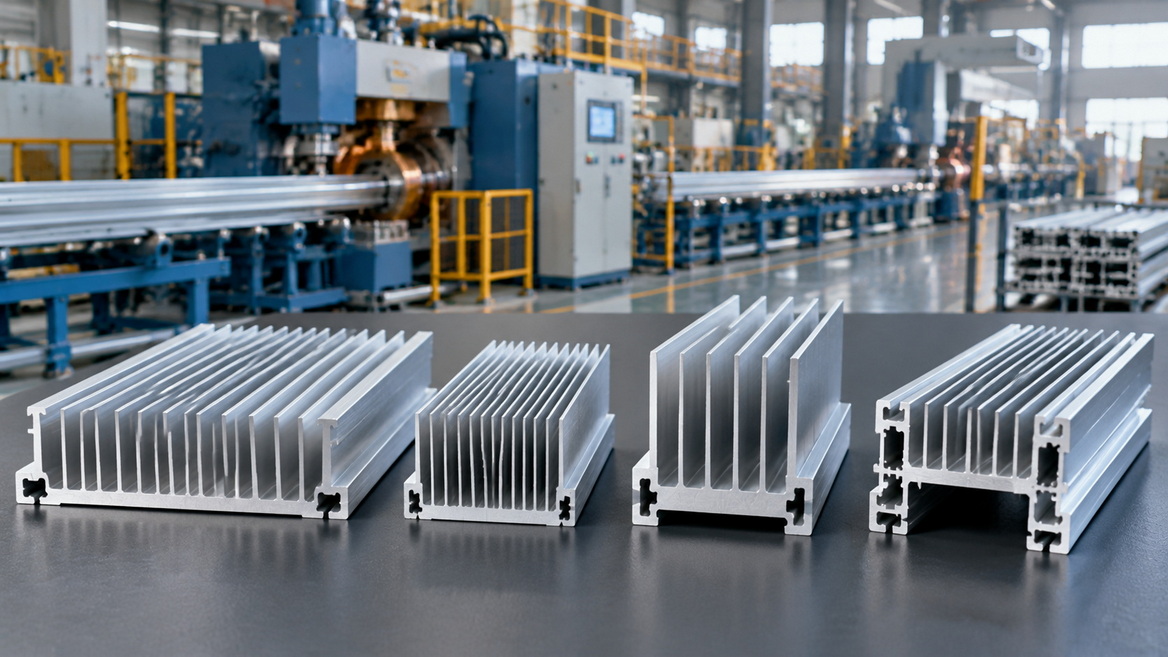
At Xinxinke, our starting point is the customer's manufacturing objective: broader product capability, higher accepted output, better consistency, or lower conversion cost.
Our equipment discussions should therefore begin with:
- Profile drawings and critical tolerances.
- Intended alloys and tempers.
- Billet dimensions.
- Annual volume and product mix.
- Existing production bottlenecks.
- Cooling, handling, and automation requirements.
- Agreed acceptance criteria.
Our experience in copper and aluminum extrusion equipment, manufacturing capability, quality control, and technical support provides the foundation for this discussion.
A suitable recommendation still requires application-specific engineering. No responsible supplier should promise a fin thickness, tolerance, or productivity improvement from press tonnage alone.
No. It offers reduced billet–container friction and potentially more consistent conditions. Direct extrusion often provides greater geometric flexibility. The better choice depends on profile feasibility and demonstrated production economics.
Yes, subject to the capabilities of the die, alloy, press, and production line. Thin-fin feasibility must be reviewed for the actual geometry rather than inferred from press type alone.
No. It largely eliminates billet–container sliding friction during the extrusion stroke. Friction and deformation resistance still exist elsewhere in the process, including within the tooling.
Neither press type guarantees better cooling. Thermal performance depends on material condition, fin geometry, airflow, heat spreading, and mounting contact. The press must manufacture the validated design consistently.
No. Both 6063 and 6061 are used commercially. Select the material against thermal, mechanical, finishing, and manufacturing requirements, then validate the finished component.
1. Hydro. "Do you know when to use the indirect extrusion process?" February 3, 2020. Primary technical basis for the comparison of friction, process consistency, billet preparation, and profile-envelope limitations. [shapesbyhydro]
2. Aluminum Extruders Council. "Aluminum Extrusion Process Basics." Basis for the description of solid-state extrusion, billet heating, tooling, and ram-driven forming. [aec]
3. Eaton. "Aluminum extrusion profiles." Commercial thermal-management reference supporting the use of 6063 and 6061 alloys and the range of extruded heat-sink geometries. [eaton]
4. H Aluminium. "Exploring Die Design for Aluminum Extruded Heat Sink Profiles." July 9, 2026. Supplementary industry discussion of thin-fin tooling, metal-flow balancing, and operating parameters. Its supplier-specific capabilities are not treated as universal limits. [haluminium]


