
Please Choose Your Language
Views: 231 Author: Xinxinke Extrusion Publish Time: 2026-09-17 Origin: Site


Content Menu
● Why Direct Extrusion Presses Matter for Modern Profile Production
● Direct Extrusion Press Market Trends Through 2030
● 1. Xinxinke Co., Ltd.: Customized Copper and Aluminum Extrusion Press Solutions
● 2. UBE Machinery: Heavy-Duty Extrusion Equipment for Demanding Projects
● 3. SMS Group: Integrated Process Control and Automation Capabilities
● 4. Danieli Breda: High-Performance Engineering for Precision Production
● 5. Presezzi Extrusion: Complete Line Planning for Aluminum Profile Plants
>> Key Components of a Direct Extrusion Line
● 6. China-Based Custom Extrusion Press Manufacturers: Flexibility and Manufacturing Value
>> Questions to Ask a Direct Extrusion Press Supplier
● How to Choose the Right Direct Extrusion Press
>> Step 1: Define Your Product Requirements
>> Step 2: Compare More Than Tonnage and Price
>> Step 3: Evaluate Total Operating Cost
>> Step 4: Confirm Factory and Site Acceptance Standards
● Expert Perspective: Production Stability Creates Long-Term Value
● FAQ
>> What is a direct extrusion press?
>> What is the difference between direct and indirect extrusion?
>> How do I choose the correct extrusion press tonnage?
>> Can one extrusion press be used for aluminum and copper?
>> What equipment is needed in addition to the extrusion press?
Selecting a direct extrusion press company is no longer just about comparing machine tonnage, delivery time, and purchase price. For aluminum and copper profile producers, the right extrusion press can directly affect production stability, profile accuracy, material yield, energy consumption, maintenance costs, die performance, and long-term profitability.
As global demand grows for lightweight transportation components, renewable-energy structures, industrial aluminum sections, copper busbars, and customized metal profiles, extrusion plants need equipment that can deliver more than pressure. They need dependable control, repeatable performance, flexible configuration, and technical support that matches real production requirements.
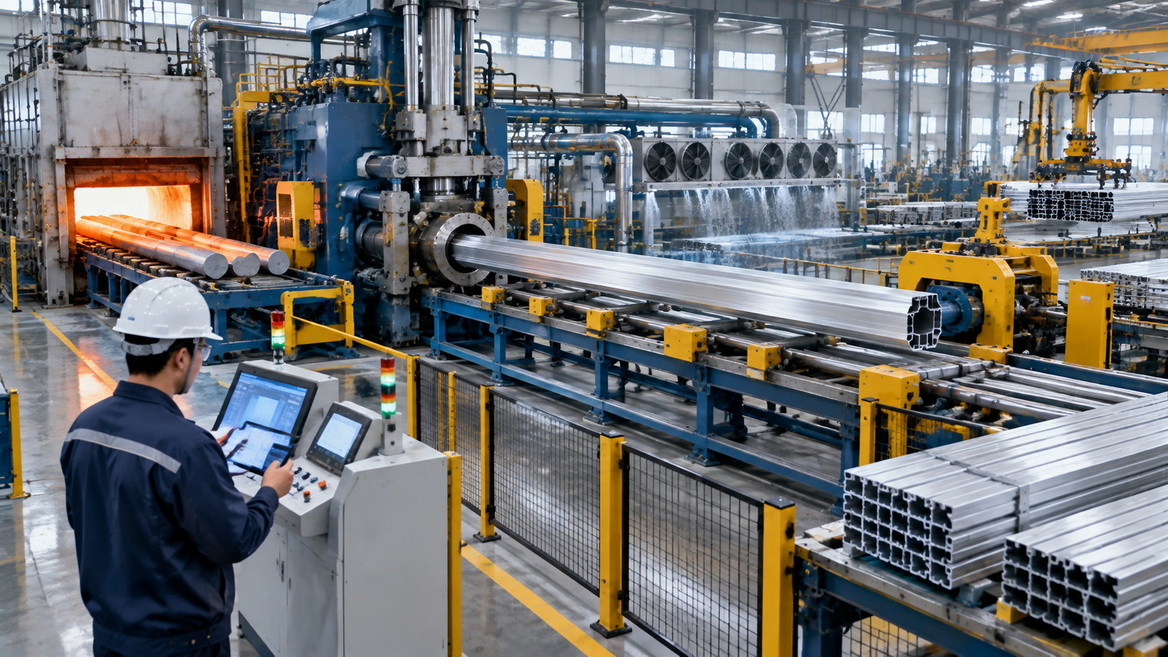
The companies shaping the direct extrusion press market toward 2030 are those that combine strong manufacturing capability with practical process knowledge. They understand that a press is not an isolated machine. It is the core of a coordinated production system that includes billet heating, die heating, extrusion, cooling, handling, stretching, cutting, aging, inspection, and packaging.

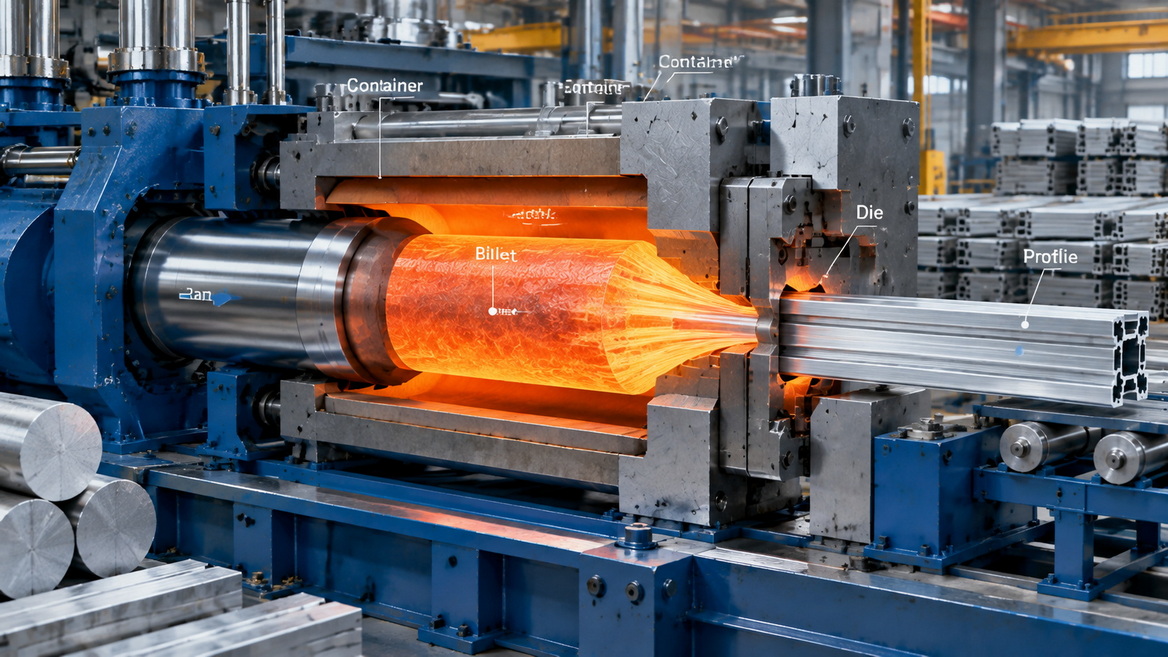
A direct extrusion press pushes a heated aluminum or copper billet through a shaped die. The billet travels inside a stationary container while the ram applies controlled force. The metal exits through the die opening as a continuous profile with a defined cross-section.
This method is widely used because it supports a broad range of product shapes, material grades, and production volumes. It can produce solid, hollow, semi-hollow, and highly customized profiles for industries ranging from construction and transportation to electrical engineering and renewable energy.
For profile manufacturers, press performance influences the entire production process.
A well-designed direct extrusion press can help improve:
- Profile dimensional consistency
- Surface finish and visual quality
- Extrusion speed and output stability
- Billet utilization and material yield
- Control of scrap and butt discard
- Die life and tooling performance
- Operational safety
- Energy efficiency
- Maintenance planning
- Expansion into higher-value profile markets
A machine may appear similar on paper, but the actual operating result can vary greatly. Hydraulic response, frame rigidity, container condition, temperature management, control accuracy, and auxiliary equipment coordination all affect the quality of the final profile.
The extrusion industry is entering a period of higher technical expectations. Customers increasingly require lighter structures, tighter tolerances, improved corrosion resistance, smoother surfaces, and more consistent mechanical performance.
This is creating new pressure on extrusion plants to improve process stability and production flexibility.
Several long-term trends are expected to shape equipment investment decisions through 2030.
| Market Trend | Impact on Extrusion Press Investment |
|---|---|
| Lightweight transportation | Higher demand for aluminum profiles used in electric vehicles, rail transit, trailers, buses, marine equipment, and industrial mobility systems |
| Renewable energy growth | More requirements for solar frames, mounting structures, inverter housings, battery systems, and thermal-management profiles |
| Industrial automation | Increased need for aluminum structural profiles, conveyor systems, machine frames, robotics components, and customized industrial sections |
| Electrical infrastructure | Growing demand for copper busbars, electrical conductors, connectors, and power-distribution components |
| Product customization | More manufacturers need flexible presses capable of handling varied dies, alloys, cross-sections, and order volumes |
| Energy efficiency | Plants are placing greater emphasis on stable hydraulic systems, reduced idle time, billet heating optimization, and lower scrap rates |
| Automation | Greater use of billet loaders, die handlers, pullers, quenching systems, automated saws, handling systems, and production monitoring |
The future of extrusion will not be defined only by larger presses. It will be shaped by presses that offer stronger consistency, better temperature control, smarter automation, and easier integration with the rest of the production line.
Xinxinke Co., Ltd. is a professional manufacturer of copper and aluminum extrusion press equipment with more than 30 years of industry experience. Since 1991, the company has focused on the design and manufacturing of extrusion presses and related production equipment for customers in aluminum profile, copper processing, industrial manufacturing, transportation, construction, and electrical applications.
The company provides extrusion press solutions across a broad capacity range, from 600T to 20,000T, allowing customers to select equipment based on billet size, alloy type, product complexity, output requirements, and workshop conditions.
Xinxinke's equipment portfolio includes:
- Direct aluminum extrusion presses
- Copper profile extrusion presses
- Short-stroke extrusion presses
- Indirect extrusion presses
- Billet heating furnaces
- Homogenizing furnaces
- Die heating furnaces
- Quenching systems
- Supporting handling and production-line equipment
One of the company's advantages is its ability to develop customized equipment configurations. Instead of selecting a machine only from a standard catalog, customers can work from their actual production requirements.
Important parameters may include:
- Billet diameter
- Billet length
- Aluminum or copper alloy grade
- Profile cross-section
- Wall thickness
- Extrusion ratio
- Die type
- Production capacity
- Product surface requirements
- Automation level
- Workshop layout
- Available power and utility conditions
For example, Xinxinke offers direct extrusion press models such as 3000T, 3600T, 4000T, and 5500T configurations. A 5500T / 15-inch copper and aluminum profile extrusion machine can be suitable for manufacturers producing larger industrial profiles, transportation sections, architectural aluminum systems, and high-output profile programs.
The company's manufacturing approach emphasizes equipment performance, quality control, technical support, and long-term operational reliability. For buyers who need a tailored extrusion line rather than a basic standalone press, this type of supplier can provide a more practical route from product design to plant operation.

UBE Machinery is widely associated with large-scale industrial equipment and advanced extrusion technology. It is often considered for projects that require high-capacity engineering, dependable heavy-duty components, and proven equipment design.
For larger aluminum extrusion plants, the structural performance of the press becomes increasingly important. The press frame, main cylinder, hydraulic circuit, container, and die-handling systems must perform reliably under repeated high-pressure operating conditions.
Heavy-duty extrusion equipment is especially relevant for manufacturers producing:
- Large industrial aluminum profiles
- Transportation components
- Automotive structural sections
- Heavy architectural systems
- Complex hollow profiles
- High-strength aluminum alloy products
- Specialized engineering profiles
A major advantage of established heavy-equipment suppliers is their experience with demanding industrial applications. However, buyers should still examine the complete project scope, including installation support, service accessibility, spare-parts planning, controls training, and maintenance requirements.
The most suitable machine is not always the largest or most expensive option. It is the machine that matches the plant's actual material, product, capacity, and operating conditions.
SMS Group is recognized in the broader metals industry for large-scale machinery, automation systems, and process-oriented production solutions. Its value for extrusion plants is often connected to integrated engineering and digital production management.
Modern extrusion plants increasingly rely on data to improve consistency. Operators need visibility into pressure, speed, temperature, cycle time, energy usage, downtime, and production losses. When production information is captured accurately, plant managers can make better decisions about maintenance, die usage, process improvement, and staffing.
An advanced extrusion line may include monitoring for:
- Ram speed and ram pressure
- Billet temperature
- Container temperature
- Die temperature
- Hydraulic oil condition
- Extrusion cycle time
- Profile cooling performance
- Puller speed synchronization
- Alarm history
- Equipment downtime
- Production output by shift
This approach can help plants identify problems before they become costly failures. For example, a gradual change in hydraulic pressure response may indicate a maintenance requirement before a major production interruption occurs.
For larger facilities, integrated process control can also make it easier to standardize production across shifts. This is particularly valuable when plants produce multiple profile types, serve demanding industrial customers, or operate around the clock.
Danieli Breda is associated with high-performance extrusion equipment and technically advanced manufacturing projects. Its equipment is often considered by producers that require stable performance for demanding aluminum profile applications.
Precision extrusion is not achieved through press force alone. It depends on the interaction of several systems:
- Press frame rigidity
- Main cylinder performance
- Stem alignment
- Container condition
- Die-slide movement
- Hydraulic stability
- Billet temperature
- Die temperature
- Ram-speed control
- Quenching performance
- Puller synchronization
- Operator process discipline
If one area is unstable, profile quality can be affected. A poorly managed temperature profile, for example, may contribute to surface defects, dimensional variation, inconsistent mechanical properties, or reduced die life.
High-performance press engineering is especially valuable when producers work with:
- Thin-wall profiles
- Multi-void hollow sections
- Large circumscribed-circle dimensions
- Tight tolerance requirements
- Decorative surfaces
- Automotive profiles
- Thermal-management components
- High-strength alloys
- Complex industrial structures
For these applications, buyers should assess not only the press model but also the supplier's ability to support die development, process setup, operator training, and long-term maintenance.
Presezzi Extrusion is known for extrusion-line solutions that go beyond the main press. This is important because many production losses do not occur at the press itself. They occur before or after extrusion.
For example, a production line may have a capable press but still experience low output because of slow billet heating, inadequate die preparation, limited cooling capacity, poor handling design, or delays in cutting and stretching.
A successful extrusion project should be planned as a complete system.
1. Billet storage and handling system
Billets must be stored, loaded, and transferred efficiently to reduce delays and maintain production continuity.
2. Billet heating furnace
Consistent billet temperature is essential for stable extrusion behavior, surface quality, and die performance.
3. Die heating furnace
Proper die preparation helps reduce thermal shock and supports smoother extrusion startup.
4. Direct extrusion press
The press provides the required force, speed control, and stability to push the billet through the die.
5. Runout table and cooling system
The profile must be supported and cooled correctly as it exits the die.
6. Puller and handling system
These systems help maintain profile control and reduce manual handling requirements.
7. Stretcher and cutting equipment
Stretching can improve straightness, while cutting prepares profiles for aging, inspection, and shipment.
8. Aging furnace and finishing area
Aging is important for many aluminum alloys to achieve required mechanical properties.
9. Inspection and packaging system
Final inspection, labeling, traceability, and packaging protect product quality before delivery.
For greenfield plants and capacity-expansion projects, complete line planning can reduce the risk of bottlenecks and ensure that every stage is matched to the intended output level.
China has a large and diverse extrusion equipment manufacturing sector. The best suppliers are not simply those with the lowest quotation. They are the companies with real engineering capability, quality-control systems, experienced technicians, complete production facilities, export knowledge, and dependable after-sales support.
For many global buyers, China-based direct extrusion press manufacturers can offer several advantages:
- Competitive equipment investment
- Flexible machine customization
- Broad tonnage ranges
- Faster adaptation to specific production needs
- Integrated supply of furnaces and auxiliary equipment
- Experience with export packing and shipment coordination
- Easier communication for custom projects
- Options for complete production-line supply
However, equipment buyers should perform careful supplier verification before making a decision.
A strong supplier should be willing to discuss technical details openly. It should explain not only what the machine can do, but also why a specific configuration is recommended for the customer's products.
The best starting point is not press tonnage. It is the production plan.
Before requesting a quotation, create a detailed requirement list. This helps ensure that every supplier is quoting for the same production target.
Prepare the following information:
- Aluminum or copper alloy grades
- Billet diameter
- Billet length
- Maximum profile size
- Maximum circumscribed-circle diameter
- Minimum wall thickness
- Profile drawings
- Solid, hollow, and semi-hollow profile ratio
- Required surface quality
- Required mechanical properties
- Expected annual output
- Shift pattern
- Target extrusion speed
- Downstream finishing needs
- Workshop layout and available space
The more accurate the initial information, the more useful the equipment proposal will be.
A direct extrusion press quotation should be reviewed as a complete technical package.
Important comparison points include:
- Press structure and frame design
- Main cylinder specifications
- Container and stem configuration
- Hydraulic system design
- Electrical control system
- Automation functions
- Billet heating system
- Die heating system
- Cooling and quenching system
- Puller and runout equipment
- Safety systems
- Installation requirements
- Spare-parts package
- Warranty terms
- Training scope
- Delivery schedule
A lower machine price may not represent the lower total investment if essential equipment, installation work, controls, or service support are excluded.
The actual cost of an extrusion press continues long after installation. A complete evaluation should include:
- Energy consumption
- Maintenance frequency
- Hydraulic oil management
- Spare-parts cost
- Operator training needs
- Planned downtime
- Unplanned downtime
- Material scrap rate
- Product rejection rate
- Die maintenance
- Service response time
The most economical machine is often not the one with the smallest initial quotation. It is the one that produces the highest percentage of acceptable profiles with stable uptime and controlled operating costs.
The purchase agreement should clearly identify acceptance requirements before the machine is shipped and after it is installed.
Important acceptance points may include:
- Rated extrusion force
- Pressure stability
- Ram speed performance
- Hydraulic leakage inspection
- Electrical safety inspection
- Emergency-stop functions
- Control-system testing
- Cycle-time verification
- Equipment documentation
- Training completion
- Spare-parts delivery
- Installation completion
- Warranty conditions
Clear acceptance standards protect both the buyer and the manufacturer. They create a practical framework for confirming that the equipment performs as agreed.
A direct extrusion press is a long-term manufacturing asset. It should be evaluated according to how well it supports daily production rather than how attractive it looks in a quotation.
The most successful extrusion plants focus on stability. They aim to maintain consistent billet temperature, dependable hydraulic performance, correct die preparation, smooth profile handling, and disciplined preventive maintenance.
This produces practical results:
- Fewer surface defects
- More consistent profile dimensions
- Reduced material waste
- Better die life
- Faster production recovery after changeovers
- Lower downtime risk
- Improved customer satisfaction
- Greater confidence when quoting higher-value projects
In many cases, the difference between an average extrusion operation and a high-performing one is not a single machine feature. It is the quality of the complete system, the skill of the operating team, and the reliability of the equipment partner.
The direct extrusion press market through 2030 will continue to evolve as manufacturers respond to stronger demand for lightweight structures, customized profiles, energy-efficient production, renewable-energy components, and high-performance industrial materials.
The leading companies in this field are not defined only by capacity or brand recognition. They are distinguished by their ability to deliver reliable machinery, practical customization, stable production performance, integrated line planning, and meaningful technical support.
For aluminum and copper profile producers, equipment selection should begin with the product requirements and long-term business plan. A well-matched direct extrusion press can support higher output, better quality, lower waste, and stronger competitiveness in demanding markets.
Xinxinke Co., Ltd. offers customized copper and aluminum extrusion press solutions for manufacturers seeking dependable equipment, flexible configurations, and integrated production-line support. By sharing your profile drawings, material requirements, output targets, and workshop conditions, you can develop a press solution that is built around your actual manufacturing needs.
A direct extrusion press is a machine used to force a heated metal billet through a die to create a continuous profile. It is commonly used for aluminum and copper profiles in construction, industrial manufacturing, transportation, electrical systems, and renewable-energy applications.
In direct extrusion, the billet moves through a stationary container and exits through a fixed die. In indirect extrusion, the die moves into the billet while the billet remains relatively stationary. Direct extrusion is widely used because it is flexible and suitable for many profile types, while indirect extrusion may reduce friction in certain applications.
The correct press tonnage depends on the alloy, billet diameter, profile cross-section, extrusion ratio, wall thickness, die type, target output, and required profile quality. A supplier should recommend a press configuration after reviewing complete production data.
Some extrusion presses can be configured for both aluminum and copper applications. However, copper and aluminum have different material behaviors, temperature requirements, and force demands. The machine design, tooling, process settings, and auxiliary systems should be selected based on the intended material range.
A complete extrusion line may include billet storage, billet heating furnaces, die heating furnaces, runout tables, cooling systems, pullers, stretchers, saws, handling equipment, aging furnaces, inspection equipment, and packaging systems.
1. Xinxinke Co., Ltd. "Professional Copper & Aluminum Extrusion Press Manufacturer." Company background, equipment range, extrusion press capacity, product applications, and manufacturing information.
[https://www.xxkextrusion.com/]
2. Xinxinke Co., Ltd. "5500T Copper and Aluminum Profile Extrusion Machine." Direct extrusion press configuration and technical information.
[https://www.xxkextrusion.com/]
3. SLX Extrusion Press. "Top 10 Extrusion Equipment Manufacturers in China." Equipment procurement, manufacturer assessment, certification review, and factory audit considerations.
[https://www.slxextrusionpress.com/news/top-10-extrusion-equipment-manufacturers-china.html]
4. Seather Technology. "Top 10 Extruded Aluminum Profiles Manufacturer in China." Industry background and aluminum profile supplier-selection context.
[https://seathertechnology.com/top-10-custom-aluminum-profiles-manufacturers-china/]
5. Made-in-China.com. "Aluminum Profile Extrusion Press Manufacturers & Suppliers." China extrusion press supplier marketplace and sourcing context.
[https://www.made-in-china.com/manufacturers/aluminum-profile-extrusion-press.html]


